Best Thermostat for heat Pump: what Homeowners Should Know
Picking a thermostat for a heat pump is more complicated than many homeowners expect. If you are trying to find the best thermostat for heat pump systems, the most important thing to understand is that the right choice depends on your actual equipment, not just the thermostat’s features or price.
A thermostat that works well with a standard furnace and air conditioner may not control a heat pump properly. Some thermostats handle heat pumps, auxiliary heat, and emergency heat with no trouble. Others are only a good fit for simpler systems. That is why homeowners should think about compatibility first, then decide how simple or how smart they want the controls to be.
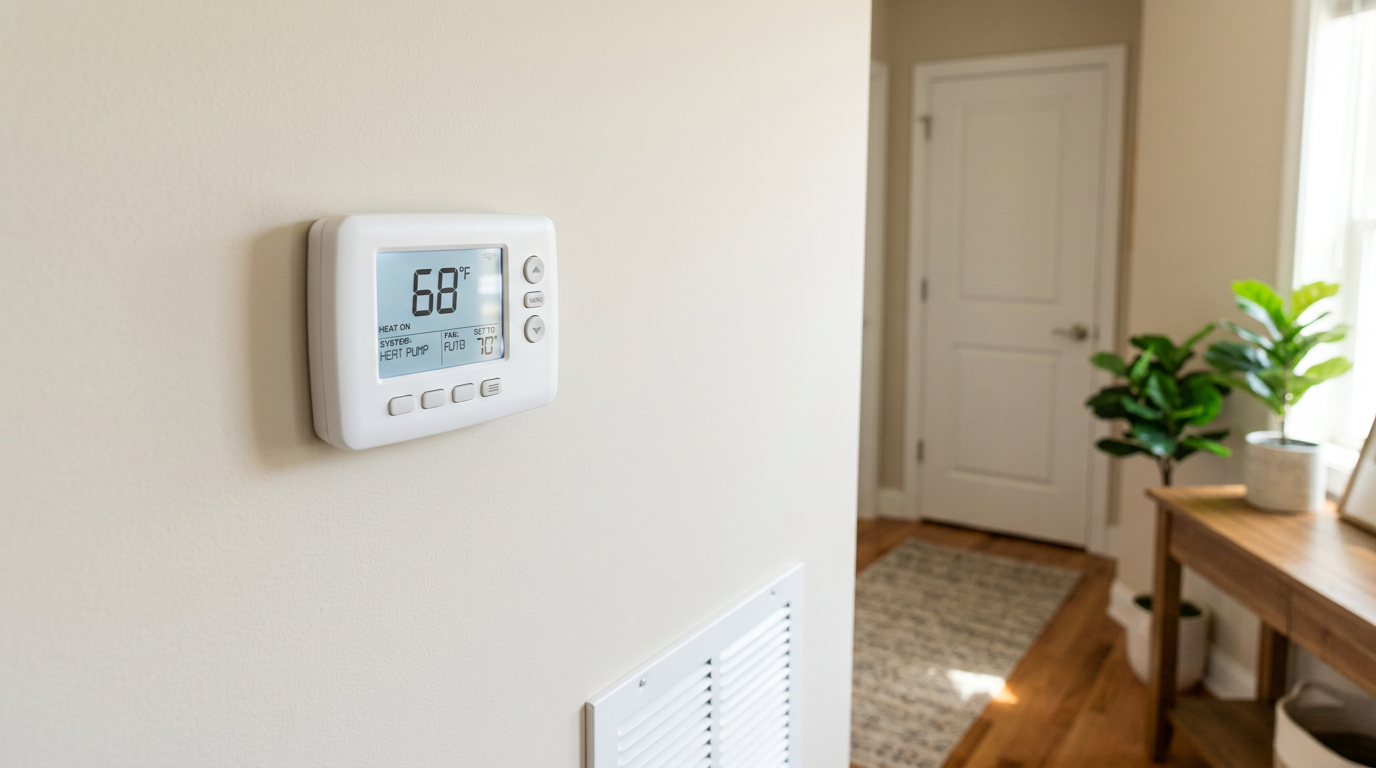
What makes a thermostat heat-pump compatible
A heat-pump compatible thermostat is designed to control the way a heat pump heats and cools your home. Unlike a standard furnace setup, a heat pump uses the same outdoor system for both heating and cooling. The thermostat has to tell the system when to switch modes and, in many homes, when to bring on backup heat.
That means a true heat-pump thermostat needs to do more than just raise or lower the temperature.
A thermostat is usually heat-pump compatible when it can handle:
- The correct heating and cooling mode changes
- The reversing valve connection, often labeled O or B
- Auxiliary heat if your system has backup heat
- Emergency heat if your system supports it
- The correct number of stages for your equipment
- The right wiring and setup for your exact HVAC system
In plain English, a heat-pump thermostat has to understand how your system is built. If it does not, the system may still turn on, but it may not heat, cool, or switch modes the way it should.
How a heat pump thermostat setup differs from a furnace and AC thermostat
A standard furnace and central AC setup is easier for many homeowners to understand. The furnace handles heating. The air conditioner handles cooling. The thermostat tells one piece of equipment or the other when to run.
A heat pump works differently. The outdoor unit is usually involved in both heating and cooling. The thermostat has to help manage that changeover. In many homes, it also has to work with backup heat for colder weather.
That is why heat-pump thermostat wiring often includes connections that homeowners may not see on a basic furnace system.
Common thermostat differences on a heat pump system include:
- An O or B wire for the reversing valve
- AUX or W2 for auxiliary heat on some systems
- E for emergency heat on some setups
- More staging options on certain systems
- More installer settings than a simple conventional thermostat
This is one reason the best-looking thermostat is not always the best fit. A thermostat can have great reviews and still be the wrong choice for a heat pump.
Why auxiliary heat and emergency heat matter
Auxiliary heat and emergency heat are two terms homeowners often hear when shopping for a heat-pump thermostat. They are related, but they are not the same thing.
Auxiliary heat is backup heat that the system can bring on automatically when the heat pump needs help. This often happens during colder weather or when the thermostat is trying to recover from a large temperature setback.
Emergency heat is usually a manual setting. It tells the system to use the backup heat source without running the heat pump in its normal way.
For homeowners, the important part is simple: the thermostat needs to know how to control both functions properly if your system has them.
Why these functions matter when choosing a thermostat
- Some thermostats support a basic heat pump but not a heat pump with backup heat
- Some thermostats can control auxiliary heat but offer limited control over emergency heat
- A poor match can cause comfort problems or confusing operation
- A thermostat that is set up wrong may bring on backup heat too often or not when needed
You do not need to become an HVAC expert to shop for a thermostat. But you do need to know whether your system includes backup heat, because that changes what kind of thermostat you should buy.
Why staging matters on heat pump systems
Staging means the system can operate at more than one output level. A single-stage system is mostly on or off. A multi-stage system can run at different levels depending on how much heating or cooling the house needs.
Some heat pumps are single-stage and fairly straightforward. Others are two-stage or more advanced. Some homes also have multiple stages of backup heat.
The thermostat has to match that capability. A thermostat that is too simple for the equipment may still run the system, but not as well as it should.
Staging affects things like:
- How steadily the system heats or cools the home
- How often the equipment cycles on and off
- How often auxiliary heat is used
- How comfortable the house feels during temperature swings
- How much control the installer has over system behavior
This does not mean every homeowner needs a high-end thermostat. It just means the thermostat should match the number of stages your heat pump actually has.
Not every thermostat works properly with every heat pump system
This is the most important buying point in the whole article.
Not every thermostat works properly with every heat pump system, even if the box says it works with heat pumps. Some thermostats are a good fit for simple residential heat pumps. Others are better for more advanced systems. Some are not a good choice at all if the home has proprietary controls, unusual wiring, zoning, or dual-fuel equipment.
The best thermostat for heat pump buyers is the one that matches the actual system in the home.
Compatibility becomes more important when you have:
- Auxiliary or emergency heat
- Two-stage or multi-stage equipment
- A dual-fuel setup
- A communicating or proprietary system
- Zone controls
- A smart thermostat that needs a C-wire
- More advanced variable-speed or inverter-based equipment
In some homes, the best thermostat may even be the manufacturer’s own control rather than a universal thermostat replacement.
Guidance for homeowners who want simple controls
Many homeowners do not want a complicated thermostat. They want something that is easy to read, easy to adjust, and dependable every day.
That is a completely reasonable goal. In fact, a simple thermostat is often the better choice when the homeowner does not care about phone control, automation, or extra settings.
A simple thermostat is often a good fit if you want:
- Basic up-and-down temperature control
- A clear screen and familiar buttons
- Scheduling without a complicated app
- Less setup confusion
- Fewer features to learn
- A lower chance of someone in the house getting frustrated with the controls
For many homes with a basic single-stage heat pump or a straightforward heat pump with backup heat, a simple programmable thermostat can be the smartest choice as long as it is confirmed to support that system.
Guidance for homeowners who want smart features and app control
Some homeowners want the convenience of changing the temperature from a phone, adjusting schedules remotely, or getting alerts while away from home. A smart thermostat can be a good match for a heat pump, but only if the compatibility is there first.
Smart features are useful when they solve a real problem. They are less useful when they add cost without adding convenience.
Smart thermostat features that many homeowners actually use
- App control from anywhere
- Flexible scheduling
- Vacation or away settings
- Maintenance reminders
- Alerts about unusual temperature changes
- Better visibility into how the thermostat is set up
Smart thermostats can be especially appealing for homeowners who travel, have changing schedules, or just like checking and adjusting settings from their phone.
Homeowners should also remember that many smart thermostats need a C-wire or a manufacturer-approved power accessory. That is a separate issue from heat-pump compatibility, but it matters before you buy.
If you want a broader homeowner-friendly look at feature differences, our guide on best smart thermostats can help you compare app control, convenience, and everyday use.
Guidance for dual-fuel and more advanced systems
Some homes have more complicated equipment. A common example is a dual-fuel system, where the home uses a heat pump along with a furnace as an alternate heating source. Other homes may have zoning, communicating controls, or more advanced variable-speed equipment.
These systems need more careful thermostat shopping.
A universal thermostat may work on one advanced system and be a poor fit for another. In some cases, the best option is a thermostat or control designed specifically for the equipment brand and setup.
If you have a dual-fuel or advanced system, look for:
- Confirmed compatibility with dual-fuel operation
- Support for the correct number of heating and cooling stages
- Proper control of auxiliary or alternate heat
- Support for installer settings needed by the equipment
- Clear compatibility guidance from the thermostat maker
- Confirmation that the thermostat works with any zoning or control modules in the home
If you are not sure whether your system is dual-fuel, look for a heat pump outside and a furnace inside. That combination often needs more careful thermostat selection than a standard all-electric heat pump.
Common homeowner mistakes when buying a thermostat for a heat pump
Most thermostat mistakes happen because homeowners shop by features first and system details second.
That is understandable. Product pages talk a lot about touchscreens, smart-home integrations, and energy reports. They usually do not explain enough about the system requirements that really matter.
Common mistakes include:
- Assuming every thermostat labeled for heat pumps will work with every heat pump
- Forgetting to check for auxiliary or emergency heat
- Ignoring whether the system is single-stage or multi-stage
- Confusing a standard furnace thermostat with a heat-pump thermostat
- Buying a smart thermostat without checking for a C-wire
- Looking only at wire colors instead of terminal labels
- Replacing a communicating thermostat with a universal model without verifying compatibility
- Expecting a new thermostat to solve comfort problems caused by ductwork or equipment issues
Another common mistake is assuming that the most expensive thermostat is automatically the best one. In many homes, the better choice is a simpler thermostat that fits the equipment correctly.
What to check before you buy
Before buying any thermostat, it helps to identify what kind of system you actually have. That one step can save a lot of frustration.
Before choosing a thermostat, check these basics
- Whether your home has a heat pump or a standard furnace and AC
- Whether you have auxiliary heat
- Whether emergency heat is available on the current setup
- Whether the system is single-stage or multi-stage
- Whether the home has dual-fuel equipment
- Whether the existing thermostat uses O, B, AUX, W2, or E terminals
- Whether the current thermostat is part of a communicating or proprietary system
- Whether a smart thermostat will need a C-wire or adapter
- Whether the new thermostat is specifically listed as compatible with your setup
Take a clear photo of the current thermostat wiring before changing anything. Look at the terminal labels, not just the wire colors. If the system has unusual labels, multiple thermostats, or advanced equipment, it is worth slowing down before buying.
If you are also trying to figure out your wiring before choosing a smart model, our guide on do you need a C-wire for a smart thermostat can help you sort out that part first.
Best thermostat for heat pump buyers: practical recommendation categories
Most homeowners do not need one perfect thermostat. They need the right category of thermostat for their home, comfort preferences, and budget.
Best overall for most heat pump homeowners
- A heat-pump compatible programmable or smart thermostat
- Support for auxiliary heat if your system has it
- Easy-to-understand controls
- Clear setup guidance
- Confirmed compatibility with standard residential heat pump systems
This is the safest choice for most households because it balances features, ease of use, and compatibility.
Best for simple everyday use
- A basic heat-pump thermostat with a clear display
- Straightforward scheduling or non-programmable controls
- Support for backup heat if needed
- Easy operation for everyone in the house
This category is often the best fit for homeowners who care more about reliability and simplicity than app control.
Best for smart-home users
- A smart thermostat with verified heat-pump support
- Phone app access
- Flexible scheduling
- Useful alerts and reminders
- Compatibility with required wiring or power accessories
This is a strong fit for homeowners who will actually use the connected features and want remote control.
Best for advanced or multi-stage systems
- Support for the exact number of stages your system uses
- Compatibility with dual-fuel setups if needed
- More installer settings for advanced equipment
- Careful matching to the HVAC system
For advanced systems, compatibility matters more than convenience or price.
Best budget-friendly option
- A lower-cost thermostat that is still clearly rated for heat pumps
- Support for your system’s backup heat setup
- A simpler design without extra smart features
- Proven fit for your wiring and equipment
Budget-friendly is a good goal, but only if the thermostat truly works with the system you have.
Conclusion
The best thermostat for a heat pump is not always the most advanced model or the most expensive one. It is the thermostat that matches your system’s wiring, backup heat setup, staging, and day-to-day comfort needs.
For many homeowners, the smartest approach is to confirm compatibility first, then choose between simple controls and smart features based on how the house is actually used. When the thermostat matches the heat pump correctly, everyday operation is easier, installation tends to go more smoothly, and the system has a better chance of working the way it was designed to work.