
Gutters Overflowing But Not Clogged
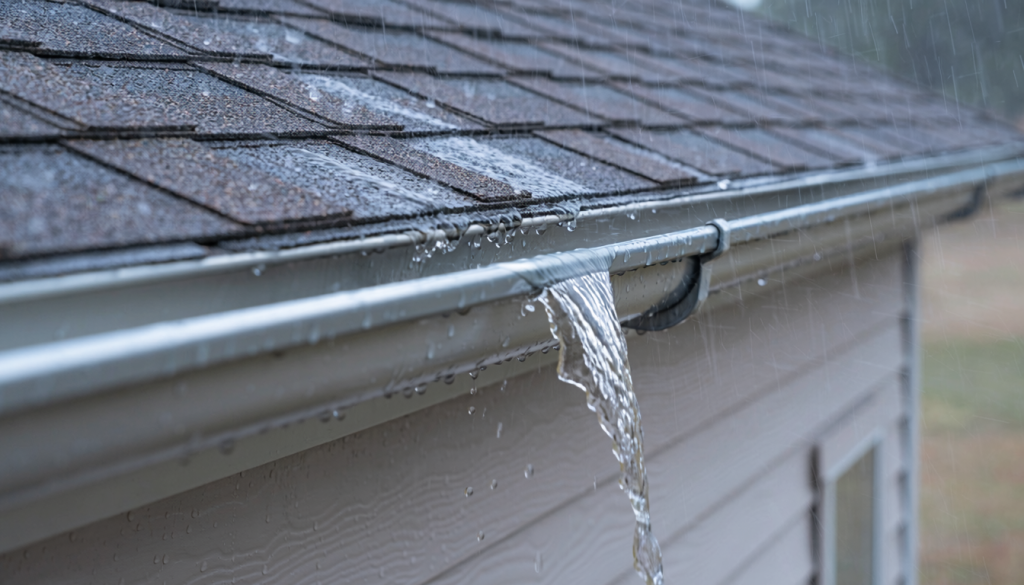
If your gutters overflowing but not clogged seem completely clear, the problem may be hidden at the outlet or downspout, caused by poor slope or sagging, or related to concentrated roof runoff and gutter capacity. Where the overflow occurs and whether it happens during ordinary rain or only during intense storms are the most useful clues.
Keep troubleshooting at ground level when possible. Wet roofs, electrical conductors, unstable gutters, and inaccessible components are reasons to stop and use professional help.
| What You Observe | Possible Cause | What It Suggests |
|---|---|---|
| Overflow near one downspout | Outlet or downspout restriction | Check discharge and accessible debris |
| Standing water in the middle of a run | Sagging or poor slope | Gutter may not be draining toward the outlet |
| Overflow directly below a roof valley | Concentrated roof runoff | Large water volume may reach one short section |
| Water crossing over a gutter guard | Guard restriction or fast runoff | Inspect guard surface and overflow pattern |
| Water overshooting the front edge | Roof runoff missing the gutter | Consider roof geometry and gutter position |
| Entire run fills despite appearing clear | Drainage or capacity problem | Rule out restrictions before blaming gutter size |
| Overflow only during intense rain | Concentrated runoff or limited capacity | Compare performance in ordinary rainfall |
Why a Clear Gutter Can Still Overflow
A gutter is only one part of a drainage path. Rainwater moves from the roof into the gutter, toward an outlet, through the downspout, and finally to the discharge point. A problem anywhere along that route can cause water to spill over the edge even when the visible gutter channel appears clean.
Small restrictions near an outlet may slow drainage enough that water accumulates faster than it can leave. A downspout may pass some water without handling the full flow. A sagging gutter can hold water away from the outlet, while an improperly sloped run can send water in the wrong direction or leave low spots.
Roof geometry also matters. Certain parts of a roof can direct much more water into one section of gutter than another. That becomes especially important when gutters overflowing in heavy rain perform normally during lighter storms.
If visible leaves and loose debris are the main problem, routine how to clean gutters from the ground methods may be enough. When the gutter already appears clear, the next step is to determine where drainage is breaking down.
Check for Hidden Restrictions
A gutter can look clean from the yard while still containing enough debris to restrict water near an outlet. Leaves, pine needles, seed pods, roof grit, and decomposed organic material tend to collect where water leaves the gutter.
Gutter guards can make the problem harder to see. Debris may accumulate on the surface of a guard, but material can also collect underneath some systems. The visible portion of the gutter may therefore appear open while the outlet area drains slowly.
Watch what happens during rain or during a cautious ground-level flow check where appropriate. If water begins backing up near a particular outlet while the rest of the gutter appears relatively open, a localized restriction is more likely than a whole-house capacity problem.
Do not assume that adding more water will clear a suspected obstruction. Once water is backing up, forcing additional flow can create more overflow without identifying the cause.
Look at Downspout Flow
The downspout is a common place for hidden restrictions. From the ground, observe whether water leaves the downspout steadily during rainfall.
A strong, continuous discharge generally suggests that water is moving through that part of the system. Weak, intermittent, or unexpectedly small flow while the gutter above is filling may indicate a restriction at the outlet or somewhere inside the downspout.
Partial blockage can be misleading because some water may still pass. Seeing water at the bottom does not prove that the downspout can handle the amount entering from the gutter.
If the symptoms point to a downspout not draining, treat that as a separate troubleshooting problem. Do not dismantle elevated downspout sections or continue forcing water through an obstruction that cannot be addressed safely from the ground.
Check for Sagging or Poor Slope
Gutters need to direct water toward their outlets. When a run develops a low spot, water can collect in the middle rather than moving efficiently toward the downspout.
Standing water after a storm is an important clue. Look from the ground for visible dips, uneven gutter lines, loose sections, or places where water remains long after neighboring sections have drained.
A gutter can also appear clear but overflow because its slope no longer carries water effectively toward the outlet. The problem may be related to loose hangers, distortion, installation, or movement in the supporting structure.
These are repair issues rather than cleaning issues. Do not attempt to change gutter pitch or reposition elevated gutter sections as part of ground-level troubleshooting.
Consider Roof Runoff Concentration
Not every foot of gutter receives the same amount of rainwater. Roof shape can direct large quantities of runoff into one relatively short section.
Roof valleys are a common example. Two roof planes can channel water toward the same point, creating a concentrated stream that reaches the gutter much faster than rainfall falling directly above that short section would suggest.
Large roof areas and steep roof planes can produce similar conditions. Water may accelerate down the roof and enter one portion of the gutter in a large volume. A short section beneath a valley can therefore overflow even while nearby sections remain well within their capacity.
This pattern becomes especially useful diagnostically when gutters overflowing in heavy rain behave normally in ordinary rainfall. Repeated overflow directly below a valley during intense storms may indicate that water is arriving faster than that section and its outlet can carry it away.
That does not automatically mean the gutter is undersized. Restrictions, slope, gutter position, guards, and downspout performance still need to be considered first.
When Gutter Size or Downspout Layout May Be Inadequate
Capacity becomes a more realistic possibility after obvious restrictions and drainage problems have been ruled out.
Consider it when the gutters appear clear, downspouts seem to discharge normally, the system performs adequately in ordinary rain, and overflow occurs mainly during intense storms. Large contributing roof areas, concentrated valley runoff, and long gutter runs can increase the likelihood that more water is entering than the existing drainage path can handle efficiently.
Downspout quantity and location also affect performance. A long gutter run with only one outlet may require water to travel a considerable distance before it can leave. An outlet positioned far from a major concentration of roof runoff may also leave part of the gutter carrying unusually high flow.
This does not mean homeowners should immediately add downspouts or install larger gutters. Those changes affect drainage layout and should follow a proper evaluation of the existing system.
Heavy rain is a diagnostic clue, not proof of inadequate capacity. If the same gutter overflows during moderate rainfall, hidden restrictions, poor slope, sagging, or another drainage problem becomes more likely.
How Gutter Guards Can Cause Overflow
Gutter guards can reduce the amount of larger debris entering a gutter, but they do not eliminate maintenance or guarantee unrestricted water entry.
Leaves, needles, dirt, and roof grit can accumulate on top of some guard systems. During rain, that material can slow water from entering the gutter or cause runoff to travel across the guard surface and over the front edge.
Debris may also collect beneath certain guards, especially near outlets. From below, the gutter may appear protected and clean even though water movement inside is restricted.
Watch where the water travels. If runoff moves across the guard instead of passing through it, the problem may be at the guard surface rather than inside the gutter channel.
Do not dismantle elevated gutter guards from the ground or during wet conditions. If the suspected restriction cannot be safely accessed, professional cleaning or inspection is the better approach.
When Water May Be Overshooting the Gutter
Overflow and overshooting can look similar from the ground, but they are different problems.
A gutter that fills to the top and spills over the front edge is experiencing overflow. Water that comes off the roof and travels beyond the front edge without first filling the gutter is overshooting it.
Overshooting may occur where runoff moves quickly down a steep roof section or concentrates at a valley. Gutter position relative to the roof edge can also influence whether incoming water enters the channel.
This distinction matters because cleaning a gutter will not correct water that is missing the gutter entirely.
Observe the pattern during rain from a safe ground-level location. If the gutter remains relatively empty while a stream of water passes over it, the issue is different from a gutter that visibly fills before spilling.
What Homeowners Can Safely Check
Ground-level observation can reveal a surprising amount about an overflow problem.
Note exactly where water spills. Is it concentrated at one downspout, beneath a valley, in the middle of a long run, or along most of the gutter? Compare the left and right ends and watch whether the entire run fills or just one section.
Observe downspout discharge and whether it appears steady relative to the amount of rain. Look for roof valleys that direct water toward the problem area and note whether gutter guards are present.
Watch for water overshooting the front edge rather than filling the gutter. After rainfall, check from the ground for visible standing water, dips, sagging, or loose gutter sections.
Most importantly, compare storm conditions. Overflow during ordinary rainfall points more strongly toward drainage restriction, poor slope, sagging, or another system problem. Overflow only during unusually intense rain makes concentrated runoff or limited system capacity more plausible.
Common Mistakes
Avoid these common troubleshooting errors:
- Assuming a gutter that looks clean has no hidden restriction.
- Blaming gutter size before checking outlets, downspouts, slope, and sagging.
- Assuming more downspouts are needed before evaluating the existing drainage path.
- Ignoring repeated overflow beneath a roof valley.
- Assuming heavy rain automatically proves the gutter is undersized.
- Inspecting from a ladder during wet or slippery conditions.
- Ignoring gutter guards as a possible source of restricted water entry.
- Treating overshooting water as though the gutter itself is filling and overflowing.
Following the pattern of the water is usually more useful than guessing at a repair based on one symptom.
When to Call a Gutter Professional
Professional evaluation is appropriate when:
- Gutters sag, move, or pull away from the fascia.
- Standing water repeatedly remains after rainfall.
- A suspected obstruction cannot be reached safely.
- Overflow repeatedly occurs beneath a roof valley.
- Water consistently overshoots the gutter.
- The entire gutter run fills despite appearing clear.
- Gutter guards prevent safe access to suspected debris.
- Gutter pitch or positioning may need correction.
- Capacity or downspout layout needs to be evaluated.
- Fascia or roof-edge damage is visible.
- Overhead electrical conductors make the work area unsafe.
Do not climb onto the roof, reposition elevated gutters, alter downspout layout, resize gutters, or perform fascia or roof-edge repairs as part of homeowner-level overflow diagnosis.
Final Thoughts
When gutters overflowing but not clogged continue to spill water, start with the drainage path rather than assuming the gutters are too small.
First rule out hidden debris, outlet and downspout restrictions, sagging, poor slope, and gutter-guard problems. Then look at where roof runoff is concentrated and whether the problem appears only during unusually intense storms.
Overflow location and timing are the strongest clues. They can help separate an ordinary drainage problem from concentrated runoff or a genuine capacity and downspout-layout issue.