downspout not draining: causes and fixes
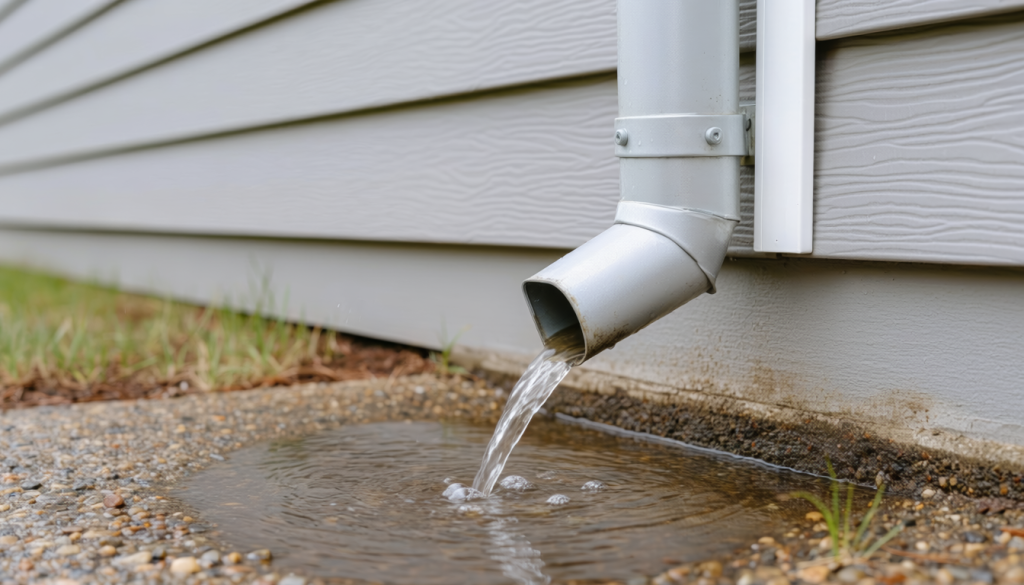
A downspout not draining usually means water is being stopped somewhere between the gutter outlet and the final discharge point. The most useful clue is where the backup first appears. Water backing up near the gutter outlet points toward an upper restriction, while water reaching the bottom and then backing up at a buried connection points more strongly toward an underground drainage problem.
Keep troubleshooting at stable ground level. Do not dismantle elevated sections or force tools into hidden clogs.
| What You Observe | Likely Cause | First Check |
|---|---|---|
| Water backs up near gutter outlet | Outlet or upper downspout restriction | Check visible debris near the outlet area |
| No water exits bottom | Significant blockage or damaged section | Inspect visible downspout and lower opening |
| Weak or intermittent flow | Partial clog | Compare flow with backup location |
| Water leaks from a joint | Restriction farther downstream | Inspect lower sections and discharge |
| Water reaches bottom but buried drain backs up | Underground drainage problem | Observe buried-drain entrance and discharge point |
| Crushed or disconnected section | Physical damage | Inspect visible alignment and joints |
| Ice-related blockage | Frozen water inside downspout | Wait for safe thawing and inspect from ground |
Why a Downspout Stops Draining
A downspout is a relatively narrow drainage path with several places where debris or damage can interrupt flow. Water moves from the gutter through the outlet, into the upper downspout, around one or more elbows, through the vertical sections, past the bottom opening or extension, and finally to its discharge point.
Leaves, roof grit, seed pods, pine needles, nesting material, and other debris can collect at any of those transitions. Elbows and joints are especially common restriction points because they change the direction of flow and can catch material that passed through the gutter outlet.
Physical damage can create similar symptoms. A crushed section, severe dent, separated joint, or misaligned extension can reduce flow even when the downspout itself is not packed with debris.
The key is to follow the water. Where the backup begins usually tells you more than simply knowing that the downspout is not draining.
Start With the Gutter Outlet
The gutter outlet is one of the first places to suspect because leaves and roof debris naturally collect near the opening where water enters the downspout.
If water is backing up at the top of the downspout or spilling from the gutter near the outlet, the restriction may be at the outlet itself or in the upper section immediately below it. A gutter can appear fairly clean along most of its length while debris remains concentrated at this one point.
From the ground, look for visible buildup around the outlet area when it can be seen safely. Do not climb onto the roof or use elevated access to reach the opening.
Clearing only the bottom of the downspout will not solve a clog near the top. If the gutter is overflowing even though the visible channel appears clear, the broader article on gutters overflowing but not clogged can help distinguish an outlet restriction from slope, sagging, runoff concentration, or other gutter-system issues.
Check the Visible Downspout
Inspect the visible downspout from top to bottom while remaining on the ground.
Look for crushed sections, severe dents, disconnected pieces, loose joints, leaking seams, unusual bulges, or sections that appear twisted or out of alignment. These conditions can restrict flow or allow water to escape before it reaches the bottom.
Leakage from a joint can be an important clue. If water escapes from a seam while very little reaches the lower opening, the restriction may be below that leaking joint. Water is then backing up inside the downspout and finding a path out through the connection.
A visibly separated section is different from a clog. Cleaning will not restore proper drainage if the water path is physically broken.
Do not attempt elevated disassembly to investigate a suspected upper blockage. If the problem is above safe ground-level reach, professional service is the safer next step.
Look at Elbows and Joints
Elbows are common clog locations because debris must change direction as it travels through them.
An upper elbow may collect leaves or compacted material shortly after water leaves the gutter. When that happens, backup often appears near the gutter outlet, and little or no water may reach the lower downspout.
A lower elbow can create a different pattern. Water may travel through most of the vertical section but then slow, leak from a nearby joint, or fail to discharge normally at the bottom.
If an elbow is safely visible and plainly accessible from the ground, look for obvious debris at the opening. Limit homeowner work to loose material that can be removed without forcing tools into the downspout.
Do not push long rigid rods, improvised poles, or similar objects deep into the system. They can compact debris farther inside, damage thin metal or plastic components, or become stuck.
Likewise, do not dismantle elevated elbows or joints from a ladder.
Check the Bottom Opening
The lower opening is another common place for drainage to fail.
Leaves, mulch, soil, stones, nesting material, and other debris can block the end of the downspout. Above-ground extensions can also become flattened, disconnected, or clogged where they lie close to the soil or landscaping.
Inspect the bottom opening and any accessible extension from stable ground. Remove only plainly visible, loose debris that can be reached safely.
Afterward, observe whether normal discharge returns. Water should leave the downspout without immediately backing up above the lower opening.
Some flow does not necessarily mean the system is fully clear. A partial clog may still allow a trickle or intermittent discharge while restricting the larger volume produced during rainfall.
If discharge remains weak, the blockage may be farther upstream or downstream than the section you can see.
Consider Underground Extensions or Buried Drains
A vertical downspout can be completely clear while the underground drain connected to it is blocked or damaged.
This distinction becomes especially important when water travels normally through the visible downspout but immediately backs up where it enters a buried pipe. In that situation, the problem is likely downstream of the visible downspout.
Buried drainage systems can develop several problems, including debris at the entrance, sediment farther inside, root intrusion, crushed or collapsed pipe, separated connections, blocked outlets, submerged outlets, or poor drainage slope and layout.
Do not assume the visible downspout is clogged simply because water rises at the underground connection.
Also consider where the drainage system is supposed to discharge. An above-ground outlet placed too close to the building can create a different water-management problem even when the downspout itself is flowing. If discharge placement is part of the concern, review how far downspouts should extend from the house.
Do not excavate buried lines, attempt underground pipe repair, or force rods, drain snakes, chemicals, or high-pressure equipment into an unknown buried system. Those methods can damage piping or turn a localized blockage into a larger repair.
Cold-Weather Ice Blockages
Cold weather can stop downspout flow even when there is little debris.
Water remaining in an elbow, low section, or buried connection can freeze and restrict the passage. Repeated freeze-thaw cycles may create a solid blockage that prevents later meltwater from draining normally.
Visible swelling, leaking at joints, or very weak discharge during a thaw can suggest that ice is limiting flow.
Do not use open flame, strike the downspout, pour harsh chemicals into it, or attempt unsafe elevated thawing.
When conditions allow, observe the system from the ground as temperatures rise. If normal flow returns after thawing, ice was likely part of the problem. If drainage remains poor, a debris or structural restriction may also be present.
What Homeowners Can Safely Do
Safe homeowner troubleshooting should remain focused on observation and plainly accessible ground-level checks.
- Observe where backup first appears.
- Inspect visible downspout sections for damage.
- Check accessible elbows from the ground.
- Inspect the bottom opening.
- Remove plainly visible loose debris.
- Check an above-ground extension.
- Observe the entrance to an underground drain.
- Confirm whether water reaches the intended discharge point.
The goal is not to force the clog out at any cost. It is to determine which part of the drainage path is failing.
If the suspected problem moves beyond visible, accessible areas, stop before turning a simple diagnosis into an unsafe repair attempt.
Common Mistakes
Avoid these common troubleshooting errors:
- Assuming every blockage is inside the vertical downspout.
- Forcing long rigid tools into a suspected clog.
- Using harsh drain chemicals.
- Blasting an unknown blockage with excessive water pressure.
- Clearing only the bottom while ignoring backup near the gutter outlet.
- Ignoring crushed, separated, or badly dented sections.
- Assuming some water flow means the system is completely clear.
- Confusing an underground drainage problem with a vertical downspout clog.
- Attempting elevated disassembly from a ladder.
- Continuing to add water when the system is already backing up.
Following the water path is more useful than choosing increasingly aggressive clearing methods.
When to Call a Professional
Professional service is appropriate when:
- The suspected clog is above safe ground-level reach.
- Elevated downspout sections require disassembly.
- Accessible debris removal does not restore drainage.
- Water backs up near the gutter outlet with little discharge below.
- An elevated elbow appears blocked.
- The downspout is badly crushed or damaged.
- Water repeatedly leaks through joints.
- A buried drain immediately backs up.
- Underground piping may be blocked, collapsed, or separated.
- Water repeatedly collects near the foundation.
- Ice blocks inaccessible sections.
- Diagnosis requires ladder work, excavation, or specialized drain-cleaning equipment.
Do not climb onto the roof, perform elevated ladder work, dismantle upper downspout sections, excavate buried drains, or use uncontrolled pressure to clear a blockage.
Final Thoughts
When a downspout not draining problem appears, follow the water from the gutter outlet to the final discharge point.
Backup at the top usually points toward the gutter outlet or upper downspout. Leakage from a joint can indicate a restriction farther downstream. Water reaching the bottom and then backing up at a buried connection points more strongly toward the underground drainage system.
Locating the failure first makes the next step much clearer and helps avoid unnecessary or unsafe work.