When to Replace Gutters: Signs Repair May Not Be Enough
Knowing when to replace gutters depends more on their overall condition and performance than on age alone. Replacement deserves consideration when failures are widespread, recurring, or connected to broader material, attachment, or drainage problems. A single leaking seam, loose hanger, or damaged section often does not justify replacing the entire system if the surrounding gutters remain sound and functional.
| Gutter Condition | Repair More Likely | Replacement More Likely |
|---|---|---|
| One leaking seam | Yes, if surrounding material is sound | Usually no |
| One loose attachment area | Yes, if damage is localized | If similar failures occur throughout the system |
| One damaged short section | Often | If damage extends into adjoining sections |
| Repeated leaks in several locations | Less likely | More likely |
| Multiple sagging runs | Less likely | More likely |
| Widespread corrosion or cracking | Rarely | More likely |
| Repeated repairs that keep failing | Less likely | More likely |
| Extensive fascia or attachment problems | Depends on extent | More likely if problems are widespread |
| Widespread drainage or configuration problems | Depends on the cause | More likely when reasonable corrections have failed |
The Basic Repair-Versus-Replacement Decision
The first distinction when deciding whether to repair or replace gutters is whether the problem is localized or system-wide.
Repair generally makes sense when the cause is clearly limited, the surrounding gutter remains structurally sound, the attachments are secure, and drainage works normally. If correcting one defect is reasonably likely to restore normal performance, replacing sound portions of the system may be unnecessary.
Replacement becomes more reasonable when problems occur across several sections or different types of failure appear together. Multiple leaks, sagging runs, deteriorating material, repeated attachment failures, and persistent drainage problems can indicate that individual repairs are addressing symptoms rather than restoring the overall system.
When Gutter Repair Usually Makes Sense
Localized problems often remain good candidates for repair. Examples include one leaking joint, a damaged corner or end cap, a localized downspout connection problem, one loose attachment area, a short sagging section, or isolated impact damage.
The key is the condition of the surrounding system. If the nearby gutter remains secure, holds its shape, and drains properly, correcting a limited defect may restore normal operation without replacing the entire run.
A repair also makes more sense when the problem has an identifiable cause and there is no pattern of similar failures elsewhere. The decision should be based on whether the repair is likely to last rather than simply whether the visible defect can be patched temporarily.
Signs It May Be Time to Replace Gutters
Replacement becomes a stronger consideration when deterioration is distributed across much of the gutter system.
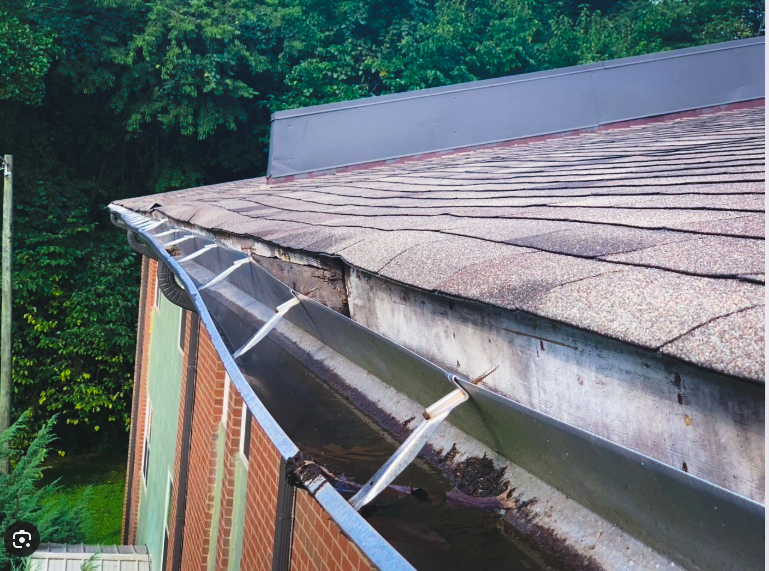
Multiple gutter runs that are sagging, numerous leaking seams, widespread corrosion, perforations, severe cracks or splits, and several deformed sections all suggest a broader condition problem. The same is true when attachment failures occur in multiple locations or several sections are pulling away from the house.
Recurring failures after previous repairs are especially important. One repaired seam followed by an unrelated isolated problem years later does not necessarily indicate system failure. However, new weak points appearing throughout the gutters within a relatively short period can suggest that deterioration is widespread.
Broad drainage problems also deserve attention when they involve several runs or remain after reasonable corrections. The pattern and extent of failure matter more than one isolated defect.
Repeated Repairs That Keep Failing
A history of repeated repairs can reveal more about gutter condition than any single problem.
Recurring leaks in different locations, repeated hanger or attachment failures, or new weak areas appearing soon after earlier repairs may indicate that the underlying system is deteriorating. Repair costs can also begin accumulating as one section after another requires attention.
There is no universal number of repairs or dollar threshold that means replacement is automatically necessary. The practical question is whether each repair is correcting an isolated defect or whether repairs are repeatedly treating symptoms of the same broader deterioration.
When multiple repairs no longer restore dependable performance, replacement may become the more sensible long-term option.
Sagging and Gutters Pulling Away
A single sagging area or attachment failure does not automatically justify replacing an entire gutter system. Localized support problems may still be repairable when the gutter itself remains sound and the mounting surface can provide secure support.
Multiple sagging or separating sections deserve broader evaluation. They can indicate widespread attachment problems, weakened supporting material, distorted gutter runs, installation deficiencies, or drainage problems that have placed continuing stress on the system.
If you are specifically diagnosing a gutter pulling away from the house, the cause of that separation should be identified before deciding whether repair or replacement is appropriate.
For replacement decisions, the important distinction is whether the separation is isolated or part of a repeated pattern affecting several areas.
Corrosion, Cracks, and Material Failure
Small blemishes or surface discoloration do not automatically mean gutters need replacement. Localized impact damage may also be repairable when the surrounding material remains structurally sound.
More serious concerns include rust-through, widespread corrosion, cracking, splitting, multiple holes, severe deformation, or gutter material that no longer holds its intended shape.
Extent matters. One damaged area may be addressed separately, while the same type of deterioration occurring throughout several runs can make continued repairs less practical.
Material condition should therefore be judged across the affected system rather than by appearance at one isolated location.
Fascia and Attachment Condition
New or repaired gutters need a sound mounting surface. If fascia or other supporting material has deteriorated, that condition must be addressed as part of any lasting gutter work.
Repeated moisture exposure can weaken fascia and contribute to fasteners or attachments losing their hold. Evidence of water dripping between gutter and fascia may help identify a moisture problem that should be evaluated before new gutters are attached.
Deteriorated fascia does not automatically mean the entire gutter system must be replaced. However, widespread support problems can change the scope of the project, particularly when multiple gutter sections are already sagging or separating.
Drainage Performance Matters
Poor drainage does not automatically mean gutters need replacement. Overflow and standing water can result from obstructions, downspout restrictions, poor slope, concentrated runoff, gutter positioning, or configuration problems.
Those causes should be distinguished from actual gutter deterioration. Replacing otherwise sound gutters without correcting the underlying drainage problem may leave the homeowner with the same performance issue.
Replacement becomes more relevant when broad drainage problems remain after reasonable corrections or when the existing system has fundamental layout, condition, or configuration problems that prevent dependable performance.
The decision should therefore consider both physical condition and whether the system can still move runoff effectively.
Partial Replacement Versus Whole-System Replacement
Gutter replacement is not always an all-or-nothing decision.
Partial replacement may make sense when one run is badly damaged, impact damage is localized, or deterioration is limited to one section while the remaining gutters are structurally sound and performing normally.
Compatibility matters when new sections are connected to retained gutters. The replacement portion must work properly with the existing system rather than creating new alignment, drainage, or connection problems.
Whole-system replacement becomes more reasonable when several runs are failing, deterioration is widespread, attachment problems occur throughout the house, or drainage and layout deficiencies affect the larger system. It may also make sense when the remaining sections show similar deterioration and are likely to require substantial work soon.
The goal is to replace only as much of the system as necessary to restore reliable performance.
Does Gutter Age Mean It Is Time to Replace Them?
Age can provide useful context, but it should not be the deciding factor.
An older gutter system that remains securely attached, structurally intact, and capable of draining properly may still be serviceable. Conversely, a newer system can require replacement earlier if installation problems, storm damage, severe corrosion, or other failures have affected its performance.
There is no single lifespan that determines when every gutter system must be replaced. Materials, climate, maintenance, installation quality, and exposure all influence condition.
Actual condition and performance are more useful than age alone.
Cost and Long-Term Value
The repair-versus-replacement decision should consider more than the immediate cost of fixing one visible problem.
Homeowners can compare the likely cost of a limited repair with the frequency of previous repairs and the likelihood that additional sections will fail. Fascia or support work, partial replacement options, and unresolved drainage problems may also affect the decision.
A relatively small repair can make sense when it is expected to restore a sound system. Repeated spending on different areas of a broadly deteriorated system may provide less value if additional failures are likely.
There is no universal payback calculation. The practical goal is to choose the option most likely to restore dependable gutter performance without replacing sound material unnecessarily.
What Homeowners Can Safely Check From the Ground
A useful preliminary assessment can be made without climbing onto a ladder or roof.
From a safe ground-level location, look for:
- The number of visibly damaged areas
- Localized versus widespread sagging
- Several separated joints
- Staining below leak areas
- Visible corrosion, cracking, or deformation
- Gutter sections pulling away
- Standing water visible in low sections
- Evidence of repeated overflow
- Storm or impact damage
The pattern is important. One damaged spot points toward localized repair more strongly than similar defects appearing around several sides of the house.
Photos taken safely from the ground can help document the condition for a contractor. Do not climb a ladder or roof simply to determine whether replacement might be needed.
Common Decision Mistakes
One common mistake is replacing an entire gutter system because of one repairable leak. The opposite mistake is continuing to patch widespread deterioration when failures are appearing throughout the system.
Other errors include replacing gutters without correcting damaged fascia, replacing them before diagnosing drainage restrictions, or using age alone to make the decision. A single sag also does not automatically mean full replacement is necessary.
Homeowners should also consider repair history. Repeated failures can be an important sign that individual fixes are no longer restoring dependable performance.
Finally, replacement does not automatically correct roof-runoff or drainage-layout problems. Those issues still need to be identified separately.
When to Call a Gutter Professional
Professional evaluation is appropriate when several sections are failing, widespread corrosion or cracking is visible, or multiple areas are sagging or separating.
Help is also appropriate when fascia deterioration is suspected, repeated repairs have failed, drainage remains poor after obvious restrictions are addressed, or it is unclear whether partial or full replacement makes more sense.
Any inspection requiring ladder or roof access should be left to someone equipped to work safely at height. Professional evaluation is especially important where overhead electrical conductors are nearby.
Final Thoughts
Knowing when to replace gutters depends on the extent, recurrence, and seriousness of the problems—not just system age or one isolated defect.
Localized damage may still justify repair. Widespread deterioration, repeated failures, multiple sagging sections, severe material damage, or broad performance problems make replacement more reasonable.
A professional evaluation can help distinguish between focused repair, partial replacement, and full replacement when the condition is not obvious from the ground.