
Water Pooling Near Foundation: Causes and What to Check
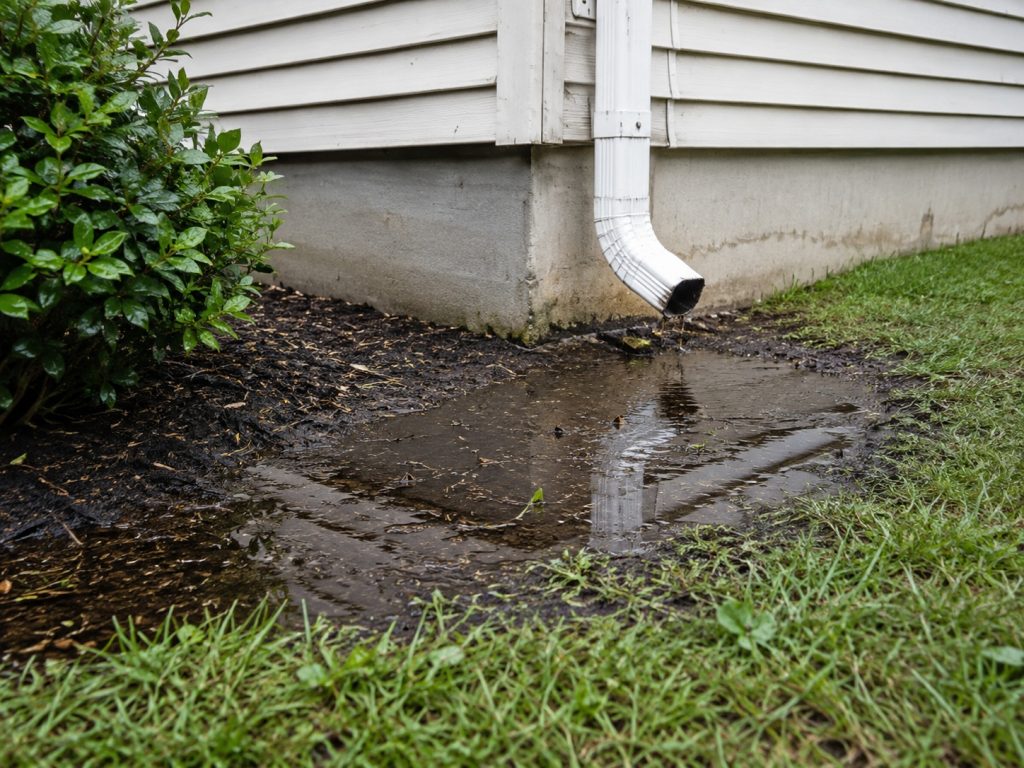
Water pooling near foundation areas usually means runoff is arriving faster than it can drain away. Common causes include downspouts discharging too close to the house, poor grading, settled low spots, landscaping that traps water, gutter overflow, slow-draining or saturated soil, and buried drainage problems.
One puddle after an unusually severe storm is different from standing water that returns after ordinary rainfall. The pattern helps identify whether the problem is temporary or needs correction.
| What You Observe | Likely Cause | What It Suggests |
|---|---|---|
| Puddle directly below a downspout | Discharge too close or poorly directed | Roof runoff may be concentrated beside the house |
| Water along one foundation wall | Grading, low spot, or drainage problem | Surface water may lack a path away |
| Pooling after every moderate rain | Recurring drainage deficiency | More than temporary soil saturation may be involved |
| Pooling only after prolonged heavy rain | Saturated soil | Drainage may be adequate during normal storms |
| Mulch or landscape bed holding water | Low bed or edging barrier | Landscaping may be trapping runoff |
| Water at end of downspout extension | Poor discharge location | The extension may simply move the puddle |
| Water surfacing near buried downspout connection | Underground restriction or failure | Buried drainage may need evaluation |
| Water near basement or crawl-space entry | Surface drainage nearby | Moisture should be monitored closely |
Keep observations at ground level. Avoid slippery or eroded areas, flooded crawl spaces, standing water near electrical equipment, and probing unknown buried drains. Do not dig or trench until buried utilities have been properly located.
Why Water Pools Near a Foundation
Pooling develops when more water enters an area than can soak into the soil, continue downhill, enter a drainage path, or otherwise be carried away.
Roof runoff can create especially concentrated flows. A large roof surface may collect rainwater and direct it through only a few downspouts. If one of those downspouts empties onto flat ground or into a depression, a substantial amount of water can collect in a small area even when the rest of the yard drains normally.
Soil settlement can also create shallow depressions beside the house. Landscaping borders, mulch beds, compacted soil, or underground drainage problems may further interfere with runoff.
The goal is not simply to move water a few feet away from the wall. Water needs a continuing path that carries it away from the house instead of allowing it to collect at a new location.
Start With the Downspouts
A puddle directly below or near a downspout is one of the simplest clues to investigate.
The downspout may end too close to the house, or an extension may be too short to reach an area where water can continue draining away. An extension can also shift, separate, become crushed, or turn toward the foundation.
Sometimes the extension itself appears adequate, but its end sits in a depression. In that case, runoff has been moved farther from the wall but still has nowhere to go. The puddle simply forms at the end of the extension instead.
A splash block can create the same problem if it releases water onto nearly flat ground.
When evaluating the discharge area, consider how far downspouts should extend from the house along with what happens to the runoff after it leaves the extension. Distance matters, but the water also needs a reliable drainage path beyond that point.
Check Gutter Performance
Downspouts cannot effectively manage roof runoff if water spills from the gutters before reaching them.
During rainfall, observe the gutter system from a safe ground-level location. Look for water overflowing the outer edge, dripping heavily at joints or ends, escaping behind the gutter, or concentrating at one roof corner.
Another clue is relatively little water coming from a downspout while the nearby gutter is overflowing. That can suggest a drainage problem within the gutter or downspout system.
If you see gutters overflowing but not clogged, the cause may involve slope, downspout flow, runoff concentration, or another gutter-performance issue rather than a simple visible blockage.
Do not climb a ladder to inspect or clean gutters as part of this diagnosis. Ground-level observation during safe weather can provide useful information without creating fall risk.
How Grading Affects Drainage
Surface water should continue away from the foundation rather than stop or flow back toward the house.
Pooling can develop where the yard is nearly flat, the ground slopes toward the foundation, soil has settled, or a shallow trough has formed beside the wall. In these situations, runoff may collect over a wider area rather than directly beneath one downspout.
A grading problem often looks different from a simple discharge problem. Instead of one concentrated puddle, you may see a broader strip of wet soil or water extending along part of the foundation.
During rainfall, observe which direction surface water naturally travels. That can reveal whether the ground is helping runoff leave the area or guiding it back toward the house.
Major grading changes require planning because moving water from one location can create a new problem elsewhere. Homeowners should avoid treating grading as simply adding soil without considering the overall drainage path.
Soil Type and Saturation
Some soils absorb water more slowly than others.
Clay-heavy or heavily compacted soil may keep water near the surface longer after rainfall. Even soil that normally drains adequately can become saturated during extended wet weather.
This makes the timing of the pooling important.
A puddle that appears only after an unusually long or intense storm may result from temporary saturation. The soil has simply received water faster than it can absorb or release it.
Standing water that returns after ordinary rainfall is more concerning because it suggests an ongoing drainage problem rather than an exceptional weather event.
Soil type should not automatically be blamed, however. Downspout discharge, grading, landscaping, and buried drainage can all contribute to the same wet area.
Landscaping and Low Spots
Landscaping can unintentionally create shallow basins beside a foundation.
Mulch beds may settle lower than the surrounding lawn. Landscape edging or borders can act like small dams, preventing water from continuing downhill. Compacted planting beds may also absorb water slowly.
A common pattern occurs when a downspout empties into a landscape bed with no clear outlet. The extension moves roof runoff away from the wall, but edging or surrounding higher ground traps it inside the bed.
Look for water collecting behind edging, low mulch areas, or depressions where soil has settled.
Simply adding more soil or mulch is not always the right response. Raising one area without considering the next drainage path can redirect water toward another section of the house or yard.
The objective is to identify where runoff should continue after leaving the problem area.
Buried Drainage Problems
Some homes have downspouts connected to underground pipes or other buried drainage systems.
When these systems work properly, runoff enters the buried pipe and is carried to another discharge location. Problems can develop if the pipe becomes restricted or damaged, the outlet no longer works properly, or the system backs up during heavier rainfall.
Ground-level clues may include water pooling around the point where the downspout enters the ground, unusually slow drainage, or water surfacing from nearby soil.
A buried system that works during light rain but backs up during heavier storms may also have a capacity, restriction, or outlet problem.
Do not dig around suspected drainage pipes or attempt to expose buried components without proper utility-location procedures. If diagnosis requires excavation, professional evaluation is the safer approach and helps avoid damage to underground utilities.
Why Repeated Pooling Matters
Recurring water beside the house means moisture is repeatedly remaining in an area where runoff should normally be moving away.
Over time, persistent pooling can contribute to muddy soil, erosion, and consistently wet ground adjacent to the foundation. It may also increase moisture around basement or crawl-space areas.
A puddle by itself does not prove that structural foundation damage has occurred. The concern is the repeated moisture exposure and the possibility that the underlying drainage problem will continue.
Give higher priority to pooling that returns after ordinary rain, remains for extended periods, repeatedly affects the same location, contributes to visible erosion, or occurs along with basement or crawl-space moisture.
Those patterns suggest a recurring drainage issue rather than a one-time weather event.
What Homeowners Can Safely Observe
Ground-level observations can provide much of the information needed to narrow the cause.
Watch where pooling begins and identify which downspout serves that area. Note exactly where the downspout releases water and whether the runoff continues moving after discharge or stops nearby.
Also observe whether gutters overflow during rain and whether the surrounding ground appears to slope toward or away from the house. Look for landscaping borders, mulch beds, or depressions that may block runoff.
Compare different storms. Pooling after an exceptional downpour may have a different cause or urgency than water appearing after ordinary rainfall.
If buried drainage is present, watch for water surfacing from the soil or backing up around the connection. Note how long puddles remain after the rain stops.
Photos taken safely from the same locations during different rain events can help establish a pattern.
Do not enter standing water near electrical equipment, enter flooded crawl spaces, probe buried pipes, trench, or excavate while investigating the problem.
Common Mistakes
One common mistake is focusing only on the puddle instead of identifying where the water originates.
Adding a short downspout extension may appear to solve the problem but simply move the standing water into another low spot. Similarly, a splash block does not guarantee that runoff will travel far enough away if the surrounding ground remains flat.
Ignoring gutter overflow is another mistake. Water spilling before it reaches the downspout can create foundation-area pooling even when the downspout extension itself is properly positioned.
Filling a depression without considering where water will flow next can also redirect the problem instead of solving it.
Avoid assuming soil type is the only cause, especially when roof runoff, grading, or landscaping could also be involved. Do not dig for buried drainage without following utility-location procedures.
Most importantly, distinguish an exceptional storm from a recurring pattern. A one-time puddle after extreme rainfall does not carry the same significance as standing water that returns after ordinary rain.
When to Call a Drainage Professional
Professional evaluation is appropriate when pooling repeatedly returns after moderate rainfall, extends along a large section of the foundation, or continues despite obvious downspout corrections.
Help may also be needed when the ground clearly slopes toward the house, substantial grading changes appear necessary, buried drainage seems blocked, or erosion is occurring.
Basement or crawl-space moisture occurring with exterior pooling is another reason to investigate the drainage system more closely.
If correcting the problem requires trenching, excavation, work around buried utilities, or changes that could affect neighboring drainage, professional planning can help avoid creating additional problems.
Final Thoughts
Water pooling near foundation areas usually means runoff lacks a reliable path away from the house.
Start by looking at downspout discharge, gutter performance, grading, low spots, landscaping, soil saturation, and any buried drainage system serving the area.
A one-time puddle after exceptional rainfall may reflect temporary saturation. Recurring pooling after ordinary rain deserves closer attention and, when the cause is not obvious, professional drainage evaluation.