
fruit fly traps: types, uses, and how to choose
A fruit fly trap can help reduce adult flies and monitor whether activity is declining, but it will not eliminate the breeding source by itself. The best choice depends on where the flies are active, whether you prefer a liquid lure, sticky surface, enclosed trap, or plug-in light design, and how much you care about spill risk, cleanup, appearance, and replacement costs.
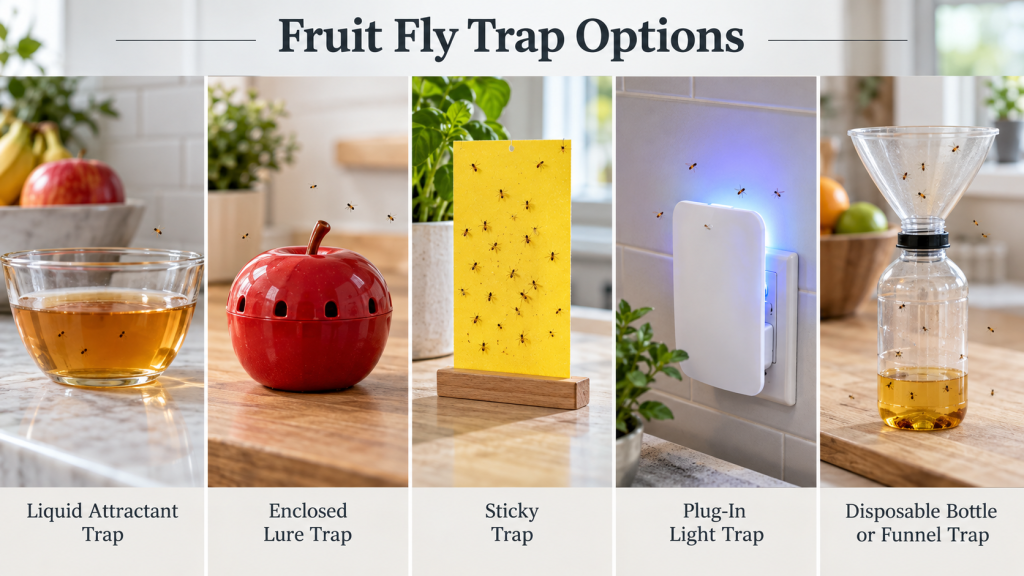
| Trap Type | Best Fit | Main Advantage | Main Limitation |
|---|---|---|---|
| Liquid attractant | Kitchens and active countertop areas | Easy to monitor captures | Can spill or create odor |
| Enclosed lure trap | Visible indoor areas | Cleaner, contained design | Requires replacement or refill |
| Sticky trap | Monitoring in low-contact areas | Simple and low-maintenance | Exposed adhesive can collect dust |
| Plug-in light trap | Indoor areas with a nearby outlet | Convenient continuous monitoring | Placement affects results |
| Disposable bottle or funnel trap | Concentrated activity areas | Enclosed capture and easy disposal | Ongoing replacement cost |
What a Fruit Fly Trap Does
A fruit fly trap attracts and captures adult flies. Depending on the design, it may use a liquid lure, sticky surface, enclosed attractant, or light combined with an adhesive card.
Traps can reduce the number of adults you see and help you judge whether activity is decreasing after the source has been removed.
They do not remove spoiled produce, sticky residue, food waste, or other organic material supporting reproduction. If that source remains, the trap may keep catching adults without ending the problem.
If you are still dealing with active fruit flies, see our guide on how to get rid of fruit flies by finding and removing the breeding source.
Main Types of Fruit Fly Traps
Liquid attractant traps
Liquid attractant traps use a lure that draws adult fruit flies into or onto the trap.
They are common around kitchens, produce areas, trash zones, and other places where flies are active. Captured flies are often easy to see, which helps with monitoring.
The tradeoffs are spill risk, possible odor, and cleanup. Some require refills or replacement after the lure dries out.
Enclosed commercial lure traps
Enclosed lure traps keep the attractant inside a small housing or container.
They often look cleaner than open liquid traps and can reduce direct contact with the lure or captured flies. Some are prefilled and simple to set up.
Their limitations include recurring replacement cost and the need to place them near actual activity. Enclosed does not mean child-proof or pet-proof, so follow product directions.
Sticky traps
Sticky traps capture flies on an adhesive surface.
They are simple and useful for monitoring, but open adhesive can collect dust, hair, and debris. Place them where children and pets cannot touch them.
Plug-in light traps
Plug-in traps typically use light to draw small flying insects toward a replaceable sticky card.
They can be convenient where a suitable outlet is available, and the capture card makes monitoring easy.
Results depend on placement and on whether the insects respond to the light. They may also catch other small flying insects, so a catch does not automatically confirm fruit flies.
Disposable bottle or funnel-style traps
These traps use an enclosed lure chamber that allows flies to enter while making escape difficult.
They can reduce direct contact with captured flies and are easy to discard. The main drawback is ongoing replacement cost.
How to Choose the Right Fruit Fly Trap
Start with the location and your main goal.
If monitoring matters most, choose a design that makes captured flies easy to see. If appearance matters more, an enclosed lure trap or plug-in design may be less intrusive.
Compare the features that matter
Consider:
- Where the flies are most active
- Proximity to food-preparation areas
- Children and pets
- Spill risk
- Odor
- Appearance
- Cleanup effort
- Trap capacity
- Refill or replacement cost
- Whether catches are easy to monitor
- Outlet availability
- Open versus enclosed design
A well-placed trap near actual activity is usually more useful than a more elaborate trap placed far away.
Best Fruit Fly Trap Type for a Kitchen Counter
A kitchen-counter trap needs to balance proximity to the flies with spill and food-contact concerns.
Liquid or enclosed lure traps may be convenient near produce or recycling areas, but they should sit where they will not spill, be knocked over, or contaminate exposed food.
An enclosed design may offer cleaner handling, while a liquid trap may make catches easier to see.
Avoid putting any trap directly on a food-preparation surface unless the product is specifically designed and labeled for that use.
Best Trap Type Around Trash, Recycling, or Compost
Place traps near the activity zone rather than inside dirty or wet material.
Choose a stable location where the trap will not be tipped during normal use. A disposable enclosed trap or stable liquid-lure design can be convenient in these areas.
Keep the surrounding source area clean. If fermenting waste or sticky residue remains, the trap will continue competing with the source.
Best Fruit Fly Trap Type for Monitoring
For monitoring, the most useful trap is one that lets you see whether catches are decreasing.
Sticky traps, enclosed traps with visible capture areas, and some plug-in designs can all serve this purpose.
Look for a trend rather than a precise count. If catches steadily decline after cleanup, that suggests the source has been addressed. If catches stay high, inspect again for another source.
Do Plug-In Fruit Fly Traps Work?
Plug-in light traps can capture adult small flying insects when the insects are attracted to the light and encounter the sticky card.
They can be convenient for ongoing indoor monitoring and adult reduction, especially when an outlet is close to the activity.
They are not a universal solution. Placement matters, other insects may also be captured, and the trap does not remove breeding material.
Are Homemade Fruit Fly Traps Worth Using?
Homemade traps can catch adult fruit flies, but results, mess, and maintenance vary.
If your priority is convenience and predictable cleanup, a purpose-built trap may be easier to use. This article focuses on trap selection rather than homemade lure recipes.
Where to Place a Fruit Fly Trap
Place traps close to where adult flies are active.
Useful locations may include:
- Near produce storage
- Near trash or recycling
- Near compost containers
- Near beverage or bottle-storage areas
- Near another confirmed activity zone
Keep traps away from exposed food and where they may be knocked over. Keep sticky surfaces and liquid lures away from children and pets as appropriate for the product.
Follow the manufacturer’s placement instructions.
How Many Traps Do You Need?
There is no universal number.
A small kitchen with one concentrated activity area may need only one well-placed trap, while separate activity zones may justify more than one.
Adding more traps does not compensate for an untreated breeding source.
How Long Should You Use a Fruit Fly Trap?
Follow the product instructions for replacement intervals.
Replace or service a trap when it is full, dried out, contaminated, expired, or otherwise no longer functioning as intended.
Continue monitoring while adult activity declines. If catches stay high, inspect again for hidden produce, food residue, trash, recycling, compost, or another source.
Why a Fruit Fly Trap May Not Be Working
Common reasons include:
- The breeding source is still present
- The trap is too far from the activity
- Competing food is more attractive
- The lure has dried out
- The trap is full or contaminated
- Multiple source areas remain
- The insect is not actually a fruit fly
Poor results should trigger reassessment before you buy more traps.
If the flies seem to be coming directly from a drain rather than from produce or food residue, see how to get rid of drain flies safely before adding more fruit fly traps.
Fruit Fly Trap Safety Around Children and Pets
Read and follow the product instructions before use.
Place liquid traps where they cannot be spilled, and keep open sticky traps out of reach of children and pets. Keep lures and replacement components away from food and food-contact surfaces.
Store unused refills or lures securely in their original packaging. Do not modify commercial trap contents or combine them with other pest-control products.
Wash your hands after handling when the directions call for it.
Fruit Fly Traps vs. Source Removal
Traps can:
- Reduce visible adult flies
- Monitor whether activity is declining
- Support the control process
Source removal can:
- Eliminate the organic material supporting reproduction
- Reduce competition with the trap
- Provide the foundation for lasting control
If traps keep filling, the breeding source may still be present.
A Practical Fruit Fly Trap Buying Checklist
Before buying, ask:
- Where are the flies most active?
- Do you want monitoring, adult reduction, or both?
- Would an open or enclosed design fit better?
- Is spill risk important?
- Can children or pets reach it?
- Does it require refills or replacement cards?
- What will replacements cost?
- Is the trap acceptable visually?
- Does a plug-in design have a suitable outlet?
- Can you place it according to the instructions?
- Have you addressed the likely breeding source?
Final Thoughts
A fruit fly trap is most useful for catching adult flies and monitoring whether activity is declining. Liquid lures, enclosed traps, sticky designs, plug-in light traps, and disposable funnel-style traps can all be practical depending on location, cleanup, safety, and convenience.
Choose the design that fits the activity area and household conditions. If flies remain numerous, do not assume you simply need more traps. Reinspect for the food or organic material that is still supporting them.