Best Concrete Driveway Sealer
The best concrete driveway sealer depends on the condition of the driveway, local climate, previous treatments, appearance goals, and maintenance expectations. There is no single best choice for every driveway. A penetrating sealer is often a practical starting point for natural-looking water repellency and lower visual maintenance, while acrylic or other compatible film-forming sealers may fit homeowners who want visible enhancement and additional surface protection.
| Driveway Need | Best Sealer Type | Main Tradeoff |
|---|---|---|
| Natural appearance | Penetrating sealer | Less visible surface enhancement |
| Freeze-thaw exposure | Compatible penetrating sealer | Must be rated for the conditions |
| Deicing-salt exposure | Compatible penetrating sealer with appropriate chloride resistance | Product claims vary |
| Decorative wet look | Compatible film-forming sealer | More visible wear and maintenance |
| UV exposure | Exterior-rated, UV-suitable product | Performance varies by formulation |
| Oil or stain concerns | Product specifically rated for expected stains | Water repellency alone may not provide sufficient stain resistance |
| Previously sealed driveway | Compatible recoat system | Existing treatment must be identified when possible |
Broad categories are useful for narrowing the choices, but specific product formulations and manufacturer requirements matter more than category names alone.
What Makes a Concrete Driveway Sealer a Good Fit?
Start with what you want the sealer to accomplish. Some homeowners want the driveway to retain a natural concrete appearance while gaining additional water repellency. Others want a darker, glossier, or wet-look finish.
Climate matters as well. Repeated freeze-thaw exposure, deicing salts, rainfall, and sunlight can influence the type of protection that makes sense. Garages and driveways exposed to oil, grease, and automotive fluids may also need different performance characteristics than surfaces where water exposure is the main concern.
Determine whether the driveway has been sealed previously and whether a visible coating remains. Compatibility can be critical when applying a new product over an older treatment.
Finally, assess the concrete itself. A sealer works best on sound, properly prepared concrete. It cannot compensate for major deterioration, movement, or unresolved moisture and drainage problems.
Penetrating Concrete Sealers
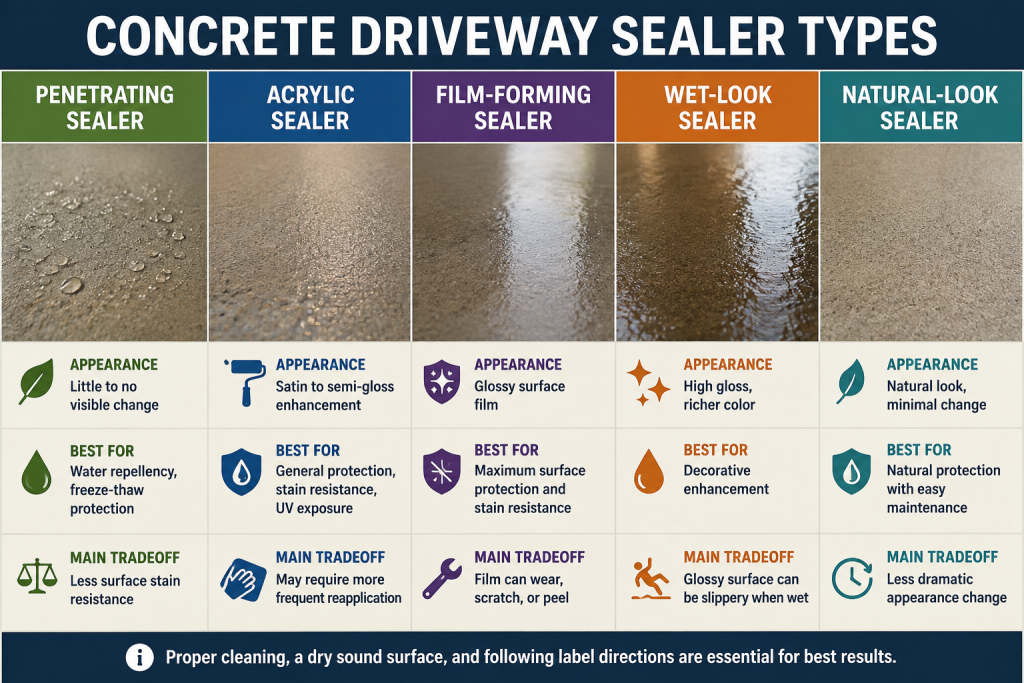
Penetrating sealers soak into the concrete rather than forming a thick visible film on top. They are often a strong choice when homeowners want water repellency while keeping the driveway close to its natural appearance.
Common category terms include silane, siloxane, and silane/siloxane blends. The chemistry and concentration vary among products, so these labels alone do not determine performance.
A compatible penetrating sealer can be especially attractive where freeze-thaw exposure and deicing salts are concerns. Reducing water and chloride penetration can help protect suitable concrete, although sealing does not eliminate all weather-related deterioration.
Penetrating products also tend to have less visible wear than film-forming coatings because there is no thick surface film to scratch, peel, or lose gloss.
One limitation is stain protection. A product designed primarily for water repellency may not provide strong resistance to motor oil, grease, or other automotive contaminants. Check the manufacturer’s specific performance claims rather than assuming all penetrating products protect against every type of stain.
Acrylic and Film-Forming Sealers
Acrylic and other film-forming sealers create a more visible layer at the concrete surface. They may be a better fit when appearance enhancement matters as much as protection.
Depending on the product, these sealers can deepen color, add sheen, or create a wet-look appearance. They may also provide greater surface stain resistance than some basic penetrating products.
The tradeoff is that the coating itself becomes part of the driveway’s visible appearance. Wear, scratches, whitening, peeling, gloss loss, and uneven recoating can become noticeable over time.
Film-forming sealers can also affect traction, especially when a smooth or glossy finish becomes wet. Homeowners should verify that a product is intended for exterior horizontal concrete and consider any manufacturer guidance related to slip resistance.
Not all film-forming sealers perform alike. Formulation, surface preparation, application thickness, weather exposure, and maintenance all influence the result.
Natural Look vs Wet Look
Natural-look sealers make sense when you want the driveway to continue looking much like untreated concrete. Penetrating products are commonly considered for this purpose because they generally do not build a heavy visible surface film.
Wet-look products intentionally deepen or enhance the appearance of the concrete. They may be desirable on decorative concrete or when the homeowner wants a more noticeable finished surface.
The appearance decision also affects maintenance. A visible film can show scratching, dulling, peeling, or uneven wear more readily than a penetrating treatment. Future recoating also requires attention to compatibility with the existing sealer.
Traction should be considered as well, particularly on sloped driveways or surfaces frequently exposed to rain, snow, or ice.
Best Sealer for Freeze-Thaw Conditions
Where concrete experiences repeated freezing and thawing, limiting water entry can be valuable. Water that enters concrete can contribute to deterioration when freezing conditions repeatedly occur.
A compatible penetrating sealer designed for exterior horizontal concrete may be a practical option. Verify that the specific product is intended for freeze-thaw exposure and provides the level of water repellency needed for the application.
If deicing salts are regularly used, also check whether the manufacturer specifically rates the product for chloride or deicing-salt exposure.
Sealing does not eliminate freeze-thaw risk, and it does not correct drainage. Ponding water, runoff, or persistently saturated areas should still be addressed when they contribute to driveway deterioration.
Best Sealer for Oil and Stain Concerns
Driveways can be exposed to motor oil, transmission fluid, brake fluid, grease, rust, and other contaminants.
Basic water repellency does not automatically provide strong resistance to these materials. A sealer that performs well against rain may not necessarily prevent automotive fluids from staining the surface.
If stain resistance is a major priority, look for specific manufacturer claims covering the types of exposure the driveway actually receives. Consider whether the product is designed for exterior horizontal use and whether its maintenance requirements fit your expectations.
Avoid choosing a sealer solely because it is described broadly as protective.
Previously Sealed Concrete
Previously sealed concrete requires an additional compatibility check.
When possible, determine whether the old treatment was penetrating or film-forming and whether a visible coating remains. Look for peeling, whitening, flaking, uneven gloss, or other evidence of an existing surface film.
The new sealer’s instructions should indicate whether it can be applied over the existing treatment. Applying an incompatible product can lead to poor bonding, uneven appearance, or premature failure.
Do not improvise with solvents, aggressive grinding, or chemical stripping to remove an unknown coating. Extensive coating removal may require professional preparation, appropriate ventilation, PPE, and dust or chemical controls.
New Concrete and Moisture Conditions
New concrete may need to cure for a product-specific period before sealing. There is no single waiting period that applies to every sealer and every concrete mixture.
Older concrete can also have moisture problems. Recent rain, washing, groundwater movement, or persistent moisture through the slab may affect whether a particular product can be applied.
Some sealers require dry concrete, while others have different moisture limitations. Manufacturer instructions should determine when the surface is ready.
What to Check Before Sealing a Driveway
Before applying any sealer, inspect the driveway for active cracks, scaling, spalling, deep pitting, loose concrete, settlement, vertical displacement, persistent moisture, oil or grease contamination, and existing coatings.
Minor cosmetic defects do not necessarily make sealing inappropriate, but substantial damage should be corrected first.
If the driveway has broader deterioration, movement, or significant cracking, review the appropriate concrete driveway repair approach before sealing.
Grinding or cutting concrete during preparation can generate respirable silica dust. Aggressive mechanical work requires suitable equipment, PPE, and dust controls and may be better handled professionally.
When Sealing Is Not the Right First Step
Delay sealing when the driveway has active slab movement, major settlement, heaving, widespread spalling, severe scaling, deep deterioration, loose or failing concrete, significant cracking, unresolved drainage, or a failing old coating.
Sealer protects suitable concrete. It does not repair structural or material failure.
Applying a new product over unstable concrete can hide the surface temporarily without correcting the underlying condition. The same applies to persistent moisture or an incompatible existing coating.
Repair, evaluation, or removal of failing material should come before sealing when those conditions are present.
Which Concrete Driveway Sealer Is Best for Different Homeowners?
For a natural appearance, a compatible penetrating sealer is usually the most logical starting point.
For freeze-thaw exposure, consider a penetrating sealer specifically rated for exterior concrete and those conditions.
For visible sheen or a decorative wet look, an acrylic or other compatible film-forming sealer may be a better fit, provided the added maintenance is acceptable.
For lower visual maintenance, penetrating products generally have an advantage because there is less visible surface film to wear.
For stronger stain protection, choose a product specifically rated for the oils, fluids, or contaminants you expect rather than assuming a general-purpose water repellent will provide the same protection.
For a previously sealed driveway, compatibility with the existing treatment becomes the priority.
Once you have selected an appropriate product, follow the correct preparation and application process in how to apply concrete sealer.
Final Thoughts
For many homeowners seeking natural-looking weather protection, a compatible penetrating sealer is a practical starting point.
Acrylic or other film-forming products may fit better when appearance enhancement and surface protection matter more and additional visible maintenance is acceptable.
The best results come from matching the sealer to the driveway’s condition, climate, previous treatments, exposure, appearance goals, and maintenance expectations. Sealing works best on sound concrete, compatible existing surfaces, properly prepared concrete, and suitable moisture and weather conditions.
No single sealer category is universally superior. The best choice is the one whose specific formulation and manufacturer requirements match the conditions your driveway actually faces.