Best Garage Floor Coating for Homeowners
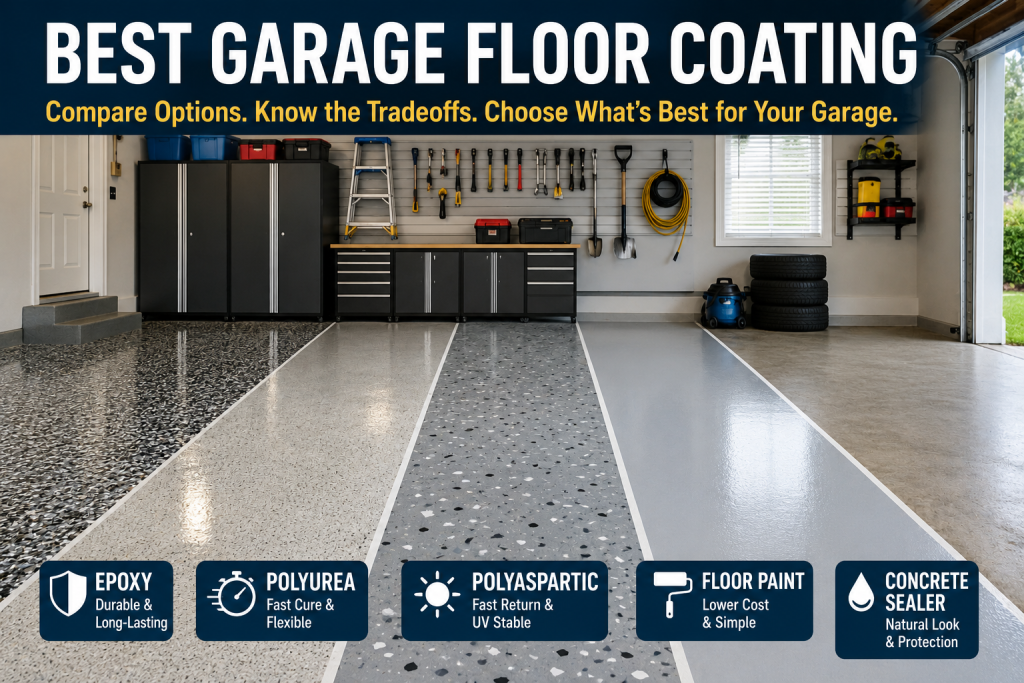
The best garage floor coating depends on how you use the garage, the condition of the concrete, and how much installation difficulty and downtime you are willing to accept. Epoxy offers a strong durability-to-DIY balance, while polyurea and polyaspartic systems cure faster but can be less forgiving. Paint costs less but is less durable, while concrete sealer preserves a more natural appearance.
Just as important, even a premium coating can fail when applied over poorly prepared, contaminated, damaged, or moisture-problem concrete.
| Coating Type | Best For | Durability | DIY Friendliness | Main Tradeoff |
|---|---|---|---|---|
| Epoxy | General residential garages, workshops, decorative finishes | High when properly installed | Moderate | Longer cure and careful preparation |
| Polyurea | Fast-cure, durable systems | High | Low to moderate | Short working time |
| Polyaspartic | Fast return to service and UV-exposed areas | High | Low to moderate | Higher cost and fast application window |
| Garage floor paint | Budget-conscious cosmetic improvement | Low to moderate | High | Shorter service life |
| Concrete sealer | Natural concrete appearance and basic protection | Varies by type | Moderate to high | Does not provide a thick decorative coating |
These categories have different strengths rather than a single universal winner. The right choice starts with the slab and the homeowner's priorities.
What Makes a Garage Floor Coating a Good Fit?
Start by thinking about how the garage is actually used. A garage that mainly holds two passenger vehicles has different demands than one used for automotive work, woodworking, equipment storage, or frequent rolling tool traffic.
Vehicle traffic, abrasion, chemical exposure, and dropped tools can favor more durable coating systems. Sunlight also matters. A garage with the door open for long periods may expose part of the floor to ultraviolet light, which can affect some coating materials more than others.
The slab itself is equally important. Moisture, cracking, weak concrete, contamination, or previous coatings can make a particular system unsuitable until those conditions are addressed. A coating should not be chosen solely because its finished appearance looks attractive.
Other practical considerations include how long the garage can remain out of service, how comfortable you are with surface preparation and timed application, your budget, and the amount of future maintenance you are willing to accept.
Epoxy Garage Floor Coatings
Epoxy remains one of the most established choices for residential garage floors because it combines durability, decorative appearance, and relatively broad availability.
A properly selected and applied epoxy system forms a durable film over the concrete and can provide good resistance to abrasion, stains, and normal garage traffic. Decorative flakes can also be incorporated into many systems to create a more finished appearance and help disguise minor surface imperfections.
Epoxy may be manageable for capable DIY homeowners, particularly when the system provides enough working time to apply it carefully. That does not make installation simple. Surface preparation, mixing, application timing, temperature, and curing conditions all matter.
Some epoxy formulations can yellow or chalk when exposed to substantial ultraviolet light. This may be more noticeable near a garage door that remains open frequently. Epoxy systems also require adequate curing time before vehicles and other heavy loads return to the floor.
Slab moisture can create another problem. Applying an epoxy coating over concrete with excessive moisture transmission can contribute to poor adhesion, bubbling, or coating failure.
For many homeowners with a sound slab and enough time for preparation and curing, epoxy provides one of the strongest overall balances between durability, appearance, cost, and DIY accessibility.
Polyurea Garage Floor Coatings
Polyurea systems appeal to homeowners who want a durable coating with faster curing than traditional epoxy systems. The material can also provide useful flexibility, depending on the formulation and system design.
One of the major benefits is reduced downtime. Some polyurea systems can move through application and curing stages more quickly, which can matter when a garage cannot remain empty for several days.
The disadvantage is that rapid curing also reduces working time. A product that sets quickly gives the installer less time to correct application problems, maintain a wet edge, distribute decorative flakes, or respond to changing conditions.
Formulations also vary significantly, so "polyurea" alone does not guarantee a particular level of performance. Homeowners considering a polyurea garage floor coating should evaluate the entire system and its installation requirements rather than relying on the material name alone.
Because preparation and application timing can be demanding, polyurea is often better suited to experienced installers or professional workflows, particularly when extensive mechanical surface preparation is required.
Polyaspartic Garage Floor Coatings
Polyaspartic coatings share some of the fast-cure advantages associated with polyurea systems while also offering strong resistance to ultraviolet exposure.
That UV stability can be valuable in garages where sunlight regularly reaches the floor through open doors or windows. Polyaspartic systems are also commonly used as part of decorative flake-floor installations and can allow a faster return to service than many traditional epoxy systems.
Those benefits come with tradeoffs. Polyaspartic materials can cost more, and the fast application window may be difficult for an inexperienced DIY installer. Once material begins curing, there may be little time to correct mistakes.
For homeowners who prioritize rapid turnaround, UV stability, and a professionally installed decorative finish, polyaspartic can be a strong option. It should not automatically be considered superior to epoxy or polyurea in every garage.
Garage Floor Paint
Garage floor paint is the simplest choice when the main goal is improving appearance at relatively low cost.
It is generally easier for homeowners to apply than heavy-duty coating systems and may work well when the floor sees modest use and the owner accepts the possibility of more frequent touch-ups or recoating.
The important distinction is durability. Garage floor paint is not equivalent to a high-build epoxy, polyurea, or polyaspartic system. Vehicle traffic, hot tires, abrasion, chemical spills, and workshop use can challenge painted surfaces more quickly.
Paint may therefore be appropriate when budget and ease of application matter more than maximum service life.
Homeowners deciding between these two common approaches can review garage floor paint vs epoxy for a more focused comparison.
Concrete Sealers
A concrete sealer can be the better choice when you want to protect the floor without covering the natural appearance of the concrete with an opaque or heavily decorative coating.
This approach can work particularly well when the slab is already in reasonably good condition and the homeowner prefers a simpler finished appearance.
Penetrating sealers and film-forming sealers work differently. Some penetrate the concrete with little visual change, while others create a visible surface film and may alter sheen or color.
Because sealer categories vary, homeowners should select a garage floor sealer based on the desired appearance, protection level, and condition of the slab rather than treating all sealers as interchangeable.
A sealer is not a substitute for repairing significant deterioration, correcting movement, or solving an active moisture problem.
Epoxy vs Polyurea vs Polyaspartic
Epoxy generally offers the strongest balance for capable DIY homeowners who want a durable decorative coating and can accommodate longer preparation and curing time.
Polyurea can provide excellent durability and faster curing, but short working times can make installation less forgiving.
Polyaspartic is particularly attractive when UV exposure and rapid return to service are priorities. It is also commonly associated with professionally installed decorative systems.
Cost generally increases as installation becomes more specialized, but material price should not be considered in isolation. Preparation requirements, slab repairs, coating removal, labor, and downtime can influence the total project cost more than the coating container itself.
No chemistry should be chosen simply because it is marketed as the newest or toughest option. Installation quality and concrete condition remain critical.
Surface Preparation Matters More Than Most Homeowners Expect
Garage floor coatings commonly fail because of surface conditions rather than because the coating itself was inherently poor.
Oil contamination, old coatings, incompatible sealers, weak surface concrete, dust, insufficient cleaning, poor surface profiling, and excessive slab moisture can all interfere with adhesion.
A floor that looks clean may still contain oil or other contaminants in the pores. Previously applied sealers can also prevent a new coating from bonding correctly.
Mechanical preparation may be required for some coating systems, especially when old material must be removed or a specific concrete surface profile is needed. Grinding and other mechanical preparation can generate respirable silica dust.
Homeowners should not aggressively grind or mechanically prepare concrete without appropriate equipment and dust controls. Professional preparation may be more appropriate when extensive grinding or coating removal is required.
Chemical coatings can also involve fumes and skin or eye exposure. Manufacturer requirements for ventilation, personal protective equipment, mixing, application temperature, cure time, recoat windows, and return to service should be followed.
Premium coating chemistry cannot compensate for poor preparation.
Check the Slab Before Choosing a Coating
A garage floor should be evaluated before investing in any decorative coating.
Vertical displacement at cracks, active slab movement, sinking, heaving, widespread spalling, weak concrete, substantial moisture problems, severe contamination, or extensive peeling from a previous coating can all indicate that coating should not be the first step.
Cracks that remain level and stable may be repairable as part of coating preparation, depending on the system. A crack with one side higher than the other indicates movement that a surface coating cannot correct.
Widespread weak or deteriorated concrete can create the same problem. A coating depends on the surface beneath it. If that surface is failing, the coating may fail with it.
DIY vs Professional Installation
DIY installation may be reasonable when the slab is sound, preparation is manageable, moisture concerns are limited, and the selected coating provides enough working time for an inexperienced installer to apply it correctly.
Homeowners should also be comfortable following detailed manufacturer instructions and using the required ventilation and protective equipment.
Professional installation becomes more attractive when the job requires extensive mechanical preparation, removal of an old coating, significant slab repair, or evaluation of uncertain moisture conditions.
Fast-cure systems can also favor professional installation. A short working window leaves little time to correct errors, and decorative flake systems can require consistent application across the entire garage.
The choice between DIY and professional installation is therefore partly about coating chemistry and partly about the condition of the existing floor.
Best Garage Floor Coating by Homeowner Priority
Different priorities point toward different coating categories:
- Best balance for a capable DIY homeowner: epoxy
- Best for fast return to service: polyaspartic or an appropriate fast-cure polyurea
- Best for strong UV exposure: polyaspartic
- Best lower-cost cosmetic option: garage floor paint
- Best for preserving a natural concrete appearance: concrete sealer
- Best for a professionally installed premium system: polyurea or polyaspartic
- Best for vehicle or workshop use: a properly selected and installed epoxy, polyurea, or polyaspartic system
These are practical starting points rather than guarantees. Slab condition, preparation quality, system formulation, and installation can change the outcome significantly.
When Coating Is Not the Right First Step
Sometimes the best flooring decision is to postpone coating.
A damaged floor may need crack or surface repair first. Widespread deterioration can require more substantial preparation, and a severely worn surface may need evaluation for garage floor resurfacing before a decorative coating is considered.
Moisture problems should also be investigated rather than covered. A coating can hide the concrete surface, but it cannot stop active movement or correct a moisture condition simply by being applied over it.
Severe contamination, weak concrete, extensive peeling from a previous coating, or substantial surface deterioration may likewise require corrective work before a new system can bond reliably.
Choosing the coating only after determining whether the floor is ready for one can prevent an expensive installation from failing prematurely.
Final Thoughts
The best garage floor coating depends on the condition of the slab and what the homeowner values most.
Epoxy offers a strong combination of durability, appearance, and DIY accessibility when preparation and curing requirements are manageable. Polyurea provides fast curing and durable system potential but can be less forgiving during installation. Polyaspartic combines rapid return to service with strong UV stability, making it attractive for sun-exposed or professionally installed decorative floors.
Garage floor paint is a lower-cost option when cosmetic improvement matters more than maximum durability. Concrete sealer fits homeowners who prefer to preserve the natural appearance of sound concrete.
Whichever category you choose, do not let the coating name overshadow the fundamentals. Surface preparation and slab condition are just as important as coating chemistry.