deck paint vs stain: which is better for an older deck?
The deck paint vs stain decision for an older deck should begin with the condition of the wood and the coating already on it. Paint provides stronger color coverage, while stain can preserve more wood character and may simplify future maintenance in some situations.
Neither finish can correct rot, loose railings, unstable stairs, failed framing, or persistent drainage problems. Inspect the deck first, identify the existing coating, and choose a compatible product designed for horizontal walking surfaces.
| Deck condition or priority | Paint or stain may fit better | Main caution |
|---|---|---|
| Sound older boards with visible grain | Transparent or semi-transparent stain | Weathered boards may absorb color unevenly |
| Uneven color or widespread cosmetic wear | Paint or solid-color stain | Opaque coverage does not repair damaged wood |
| Previously painted deck | Compatible deck paint | Existing paint must be firmly bonded |
| Peeling or flaking surface coating | Neither until properly prepared | Loose coating will undermine the new finish |
| Cracked, soft, or rotten boards | Neither | Repair or replacement comes before refinishing |
| Homeowner wants easier future maintenance | Penetrating stain may fit better | Maintenance still depends on exposure and product type |
Deck Paint vs Stain at a Glance
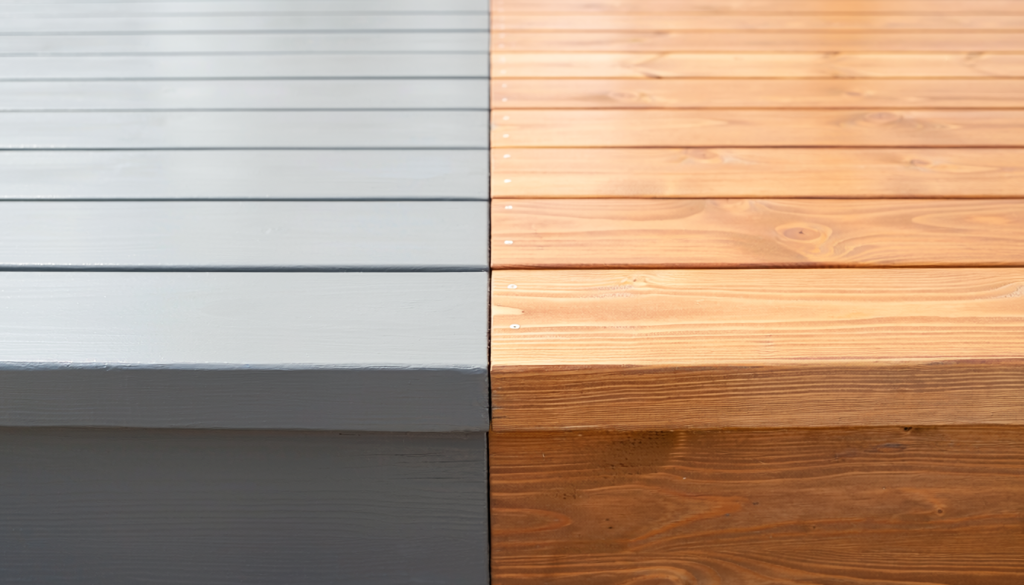
Deck paint creates an opaque film over the wood. It hides most of the grain and color variation, producing a more uniform appearance.
Stain covers a broad range of products. Some stains penetrate the wood, while others create a thinner colored coating on the surface. Transparent and semi-transparent stains reveal more grain. Solid-color stain can resemble paint visually, but its formulation and behavior may be different.
No option is universally better. Product formulas vary considerably, so the manufacturer’s preparation, application, compatibility, moisture, and weather instructions take priority over general advice.
Inspect the Older Deck Before Choosing a Finish
Walk around the deck and look at the boards, stairs, railings, fasteners, and areas where water collects. Press suspicious boards carefully with a blunt tool rather than assuming faded or cracked wood is still solid.
Watch for soft or rotten areas, deep splits, loose or moving boards, raised fasteners, unstable stairs, loose railings, sagging, and visible structural movement. Also check for standing water, blocked gaps between boards, and water that drains toward the house.
Paint or stain cannot repair structural deterioration, rot, unstable stairs, loose railings, failed framing, or significant movement. Those conditions should be evaluated and corrected before the deck is coated.
Identify the Existing Finish
Try to determine whether the deck has paint, solid-color stain, semi-transparent stain, penetrating stain, a clear sealer, or an unknown coating. Look in protected areas beneath railings or furniture, where the original finish may be easier to recognize.
New coatings must be compatible with what remains on the wood. A penetrating stain cannot soak through paint or another intact film-forming coating. Switching from paint to a penetrating stain may therefore require complete removal of the old coating.
Peeling or layered finishes often require extensive preparation. When the age or composition of an older painted coating is unknown, arrange appropriate testing before sanding or scraping it. Do not create hazardous dust from paint that may contain lead.
What Is Deck Paint?
Deck paint forms an opaque surface coating. It hides most wood grain, repairs in appearance, and differences in board color.
Its performance depends heavily on proper preparation and adhesion. When moisture enters beneath the film or boards expand and move, the coating can crack, chip, or peel. This does not mean every deck paint will fail, but horizontal surfaces place demanding conditions on any film-forming product.
Paint made only for siding, fences, or other vertical exterior wood may not withstand foot traffic or standing water. Choose a product specifically approved for decks, porches, or horizontal exterior walking surfaces.
Advantages of Painting an Older Deck
Paint offers strong color coverage and a broad selection of colors. It can make mismatched boards, old stains, cosmetic discoloration, and widespread weathering appear more consistent.
An opaque finish may be useful when the homeowner prefers a uniform architectural look instead of visible wood grain. Repainting may also be a practical choice when the deck is already painted, the remaining coating is sound, and the new product is compatible.
Paint does not eliminate cleaning, removal of loose coating, drying, or other preparation. It also should not be used to conceal rot, loose boards, or structural damage.
Disadvantages of Deck Paint
Paint can peel, flake, crack, or chip when adhesion fails. Moisture beneath a damaged film can worsen coating failure and may remain trapped against the wood.
Scratches and worn traffic paths are often noticeable because they expose a different color beneath the surface. Removing multiple layers later can also become difficult and labor-intensive.
Deck boards receive more sun, water, abrasion, and movement than vertical surfaces. Some painted finishes may also become slippery when wet, especially when they are glossy, dirty, shaded, or covered with organic growth.
What Is Deck Stain?
“Stain” describes several different types of exterior wood finish. Penetrating stains soak into the wood with little surface buildup. Film-forming stains leave more material on the surface.
Transparent and semi-transparent products allow more grain and natural variation to remain visible. Solid-color stains hide most color differences while usually leaving some wood texture visible.
Protection, appearance, peeling potential, and maintenance requirements vary by formulation. Read the product label rather than assuming all stains behave the same way.
Advantages of Staining an Older Deck
Stain can preserve the appearance of sound wood, especially when the grain is still attractive. Several opacity levels allow homeowners to choose between a natural appearance and stronger color coverage.
Some penetrating products are less likely to peel in sheets like a thick surface film. Cleaning and recoating may also be simpler with certain compatible penetrating stains because there is less coating buildup to remove.
Stain can be a strong option for sound older boards that are bare, absorbent, and properly prepared. It will still fade, wear, and require maintenance over time.
Disadvantages of Deck Stain
Transparent and semi-transparent stains do not hide repairs, discoloration, filler, or mismatched replacement boards well. Heavily weathered areas may absorb more stain than protected areas, producing uneven color.
Traffic paths can wear faster than low-use areas. Solid stains and other film-forming formulations may peel or flake when adhesion fails.
Compatibility remains important. Boards of different ages, species, or exposure levels may absorb stain differently even when the surface appears uniformly prepared.
Solid Stain vs Semi-Transparent Stain on an Older Deck
Semi-transparent stain keeps more grain visible and creates a more natural-looking finish. It works best when the boards are sound and reasonably consistent in appearance. Repairs, patches, dark staining, and replacement boards will remain noticeable.
Solid-color stain hides much more discoloration and creates a more consistent color. It may suit a deck with sound but mismatched boards. Because some solid stains create more surface buildup, they can peel or flake under unfavorable conditions.
Solid stain can serve as a middle option between paint and a more transparent stain, but it is not identical to paint. Preparation, compatibility, and future maintenance still depend on the specific formulation.
Which Finish Hides an Older Deck Better?
Paint generally provides the most opaque coverage. It is usually the strongest choice when the main goal is hiding uneven color, old cosmetic stains, and broad variation among otherwise sound boards.
Solid-color stain also hides much of the grain and discoloration while often leaving more visible wood texture. Semi-transparent stain reveals weathering, repairs, patches, and board-to-board variation.
Cosmetic coverage should never be confused with repair. Deep cracks, softness, decay, unstable boards, and structural movement remain problems regardless of how completely a finish hides them.
Which Is Easier to Maintain?
Some penetrating stains can be cleaned and recoated without the extensive scraping associated with a failing paint film. That can make future maintenance more manageable, provided the existing stain remains compatible with the new coat.
Paint may require scraping, sanding, or more extensive coating removal when it cracks and peels. Solid stains vary: some behave more like penetrating finishes, while others build a film and require additional removal when they fail.
Maintenance depends on sunlight, moisture, drainage, foot traffic, preparation, wood condition, and product quality. No single maintenance interval applies to every deck or finish.
Which Is Better for Peeling or Previously Painted Decks?
A previously painted deck may be simplest to repaint when the remaining paint is compatible, clean, dry, and firmly bonded. Loose or peeling material must be addressed before another coat is applied.
Stain applied over remaining paint cannot penetrate the wood properly. Switching from paint to a penetrating stain may require extensive coating removal, particularly when paint remains in cracks, around fasteners, or between boards.
Thick layers, widespread failure, or an unknown coating can make preparation difficult. Professional help may be appropriate when safe removal and compatibility are uncertain.
Which Is Better for Cracked or Weathered Boards?
A finish can improve color and surface appearance, but it cannot restore damaged wood. Deep cracks, severe checking, cupping, warping, softness, and decay require evaluation before coating.
Do not use a thick paint or coating to bridge cracks that move as the boards expand and contract. The coating may split, trap moisture, or hide worsening damage.
Some heavily weathered but still solid boards may accept a compatible stain after proper preparation. Badly deteriorated boards may need replacement before the deck is refinished.
Surface Preparation for Paint and Stain
Preparation requirements differ among paints, penetrating stains, and film-forming stains. Follow the instructions for the exact product and the condition of the existing surface.
Basic preparation commonly includes
- Clean the deck and remove dirt, growth, grease, and other contaminants.
- Remove loose debris and failed coating.
- Allow the wood to dry fully.
- Sand only when appropriate for the coating and wood condition.
- Correct accessible protruding surface fasteners without attempting structural repairs.
- Remove sanding dust before applying the finish.
- Follow the product’s moisture, temperature, and weather requirements.
- Test the finish in a hidden area and allow it to dry before judging the result.
Moisture and Drainage Matter More Than Finish Choice
Standing water and trapped moisture can shorten the useful life of paint or stain. Blocked gaps and poor spacing can slow drying, while water draining toward the house may indicate a problem that needs attention.
Wet leaves, outdoor rugs, planters, and storage containers can hold moisture against the boards. Move them periodically and keep drainage paths clear where this can be done safely.
Neither paint nor stain fixes drainage problems. Do not coat a persistently damp deck in an attempt to seal the moisture in.
Appearance Differences
Paint produces opaque, consistent color and may be available in different sheens. It hides most grain and usually makes repairs or mismatched boards less noticeable.
Transparent and semi-transparent stains create a more natural look but show more variation. Solid stain offers greater color consistency while preserving some surface texture.
Wear also appears differently. Paint may show chips or exposed patches, while stain often fades or wears through gradually, depending on the formulation. Sample colors can look different on weathered wood, so test the product and judge it only after it has dried.
Slip Resistance and Walking Surfaces
Glossy and film-forming coatings may become slippery when wet. Stairs, sloped sections, shaded areas, and decks beside pools require particular caution.
Use only products approved for horizontal walking surfaces. When the manufacturer permits a slip-resistant additive, use only the approved type and amount.
Allow the test area to cure fully, then evaluate its texture under expected conditions. No finish or additive can guarantee slip prevention.
Paint or Stain for Railings and Vertical Surfaces
Railings, posts, and other vertical components receive less standing water and foot abrasion than deck boards. A homeowner may use one compatible finish on the walking surface and another on the railings when both products are approved for their locations.
Check compatibility where finishes meet, and confirm that each product is suitable for the material beneath it. Loose railings must be repaired before coating; paint or stain cannot make them secure.
Deck Paint vs Stain Comparison
| Factor | Deck paint | Deck stain |
|---|---|---|
| Wood-grain visibility | Hides most grain | Varies from high visibility to nearly opaque |
| Color coverage | Strong, uniform coverage | Depends on opacity |
| Peeling potential | Possible when the film loses adhesion | Lower with some penetrating stains; possible with film-forming stains |
| Surface preparation | Often extensive over failing coatings | Varies; bare absorbent wood may be required |
| Future maintenance | Failed films may need scraping or removal | Some penetrating stains are simpler to recoat |
| Ability to hide discoloration | High | Low to high, depending on opacity |
| Suitability over existing paint | Possible with a compatible, sound coating | Penetrating stain is generally unsuitable over paint |
| Suitability for sound bare wood | Possible with proper preparation | Often a good fit when absorption is suitable |
Choose Paint When
Paint may be the better fit when
- The deck already has a firmly bonded, compatible painted coating.
- The homeowner wants opaque, consistent color.
- Sound boards have widespread cosmetic variation.
- The selected product is approved for horizontal deck surfaces.
- The deck is stable, dry, clean, and properly prepared.
Choose Stain When
Stain may be the better fit when
- The homeowner wants the wood grain to remain visible.
- The boards are sound and suitable for staining.
- A penetrating finish is preferred.
- Simpler future recoating is an important priority.
- The existing surface can be prepared for proper stain penetration.
When stain is the better fit, review what homeowners should look for when choosing the best stain for an old deck.
When Neither Paint nor Stain Is the Right First Step
Address these conditions before choosing a finish
- Widespread rot or soft wood
- Loose or moving boards
- Unstable stairs or loose railings
- Sagging or structural movement
- Severe cupping or warping
- Recurring standing water
- Thick, layered, or unknown failed coatings
- Possible lead-containing paint
- Damp wood that cannot dry properly
Severe cupping, twisting, or repeated board movement should be evaluated using this guide to warped deck boards before any finish is selected.
Common Finish-Selection Mistakes
Avoid these common problems
- Choosing a product by color alone
- Painting over loose coating
- Applying penetrating stain over paint
- Coating damp wood
- Using vertical-surface paint on deck boards
- Ignoring drainage and blocked board gaps
- Skipping a hidden test area
- Using thick coating to conceal damaged boards
- Assuming solid stain cannot peel
- Applying a new product without checking compatibility
When to Call a Professional
Professional evaluation may be appropriate for
- Possible lead-containing paint
- Thick or layered coating removal
- Widespread peeling or coating failure
- Large areas of rotten wood
- Structural movement or sagging
- Loose railings or unstable stairs
- Major or recurring drainage problems
- Extensive board replacement
- Uncertain coating compatibility
- Large or complex refinishing projects
Final Thoughts
Paint provides the strongest color coverage and may be practical for a stable deck that is already painted. Stain generally preserves more wood character, while solid-color stain can offer a middle option when additional coverage is needed.
The existing finish and the condition of the boards often determine the best choice more than appearance alone. Proper cleaning, drying, compatibility, and surface preparation matter as much as the selected product. Neither paint nor stain can correct rot, movement, unstable components, or structural damage.