Concrete Driveway Resurfacing: When It Makes Sense
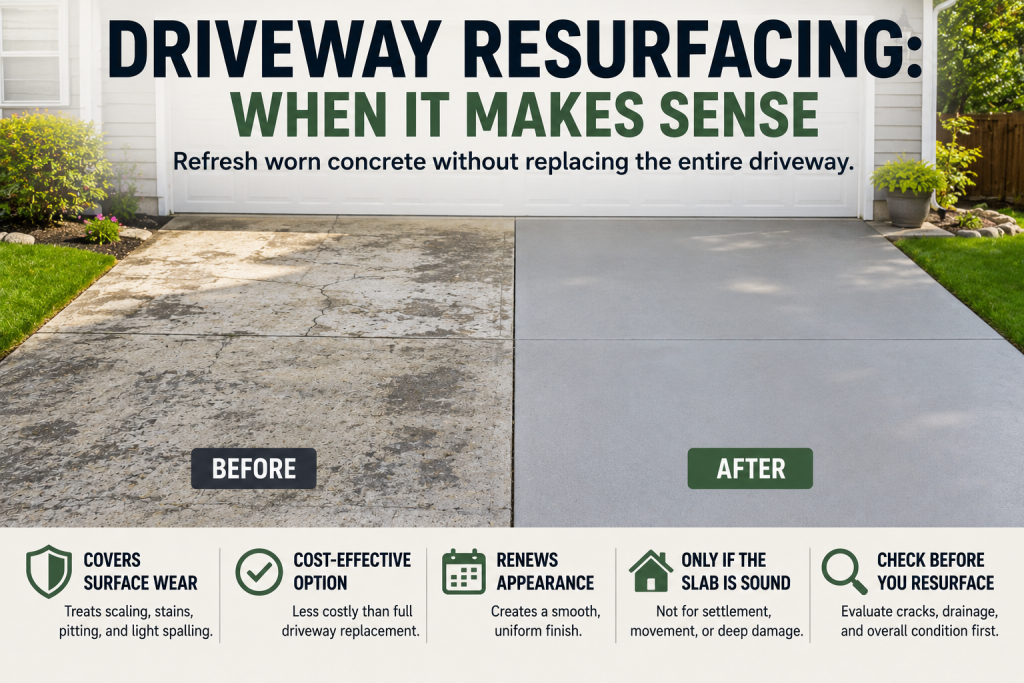
Concrete driveway resurfacing is usually a good option when the existing slab is stable and sound but has widespread shallow surface deterioration. Fading, light scaling, shallow pitting, limited spalling, and general surface wear may be suitable for resurfacing. Sunken, heaved, displaced, crumbling, or actively moving slabs are poor candidates because resurfacing renews the surface; it does not stabilize a failing driveway.
| Driveway Condition | Resurfacing Fit | Why |
|---|---|---|
| Faded but solid concrete | Good candidate | Surface appearance can often be renewed without replacing the slab |
| Light scaling | Often suitable | Shallow deterioration may be covered after proper preparation |
| Shallow pitting | Often suitable | A resurfacing layer may restore a more uniform surface |
| Limited shallow spalling | Possible | Damaged areas must be properly prepared first |
| Minor stable cracks | Possible | Appropriate cracks may be repaired during preparation |
| Widespread surface wear | Good candidate | Surface renewal may be more practical than many isolated patches |
| Crack with vertical displacement | Poor candidate | Movement is occurring below the surface |
| Sunken section | Poor candidate | A surface layer cannot restore slab elevation |
| Heaved slab | Poor candidate | Underlying movement must be addressed |
| Widespread deep deterioration | Poor candidate | The existing slab may not provide a sound base |
What Is Concrete Driveway Resurfacing?
Concrete driveway resurfacing places a new bonded surface layer over an existing concrete driveway. The original slab remains in place and serves as the base for the new material.
That makes resurfacing different from replacement. Replacement removes and rebuilds failed concrete, while resurfacing is intended to renew a surface that is still supported by a reasonably sound slab.
The process can improve worn appearance, shallow scaling, pitting, fading, and similar surface problems without removing the entire driveway. The key limitation is that the existing concrete must be capable of supporting the new bonded layer.
When Concrete Driveway Resurfacing Makes Sense
Resurfacing is most appropriate when the damage is mostly at the surface and the driveway beneath it remains stable.
Good candidates often have widespread shallow wear, light scaling, pitting, discoloration, or limited shallow spalling. Stable cracks may also be compatible with resurfacing when they can be repaired appropriately during preparation.
A driveway can look tired, stained, or rough and still be structurally suitable for resurfacing. Appearance alone does not determine whether the slab is sound.
Conditions that favor resurfacing include no major settlement, no significant vertical displacement, no deep structural deterioration, and enough sound concrete for the resurfacing material to bond properly.
What Resurfacing Can and Cannot Fix
Concrete resurfacing can improve widespread shallow deterioration, worn texture, fading, light scaling, shallow pits, and limited surface spalling.
It cannot stop active slab movement, raise a sunken slab, lower a heaved slab, rebuild a failed base, restore badly deteriorated concrete, or permanently conceal cracks that continue to move.
Resurfacing also does not correct ongoing drainage or erosion problems. If runoff, saturated soil, or washout continues to undermine the driveway, a new surface layer may fail even when it was applied correctly.
Cracks and Resurfacing
Small stable cracks may sometimes be repaired during preparation, but cracks need to be evaluated before they are covered.
Be cautious when one side of a crack is higher than the other, the opening is widening, the repair has failed before, or nearby slabs are sinking or heaving. Those signs point toward movement rather than a simple surface defect.
If crack repair is appropriate before resurfacing, see how to repair cracks in a concrete driveway. Detailed crack preparation and repair methods belong in that process rather than in this resurfacing guide.
Resurfacing vs Patching vs Replacement
Patching is generally the better fit when damage is limited to a few isolated areas and most of the driveway remains in good condition.
Resurfacing becomes more useful when shallow deterioration is spread across a large portion of otherwise stable concrete. It creates a more consistent surface than numerous individual patches.
Replacement is more appropriate when deterioration is deep, slabs are moving, the base is failing, or large sections no longer provide sound concrete for bonding. For the broader decision between localized repair, resurfacing, and replacement, see concrete driveway repair.
Check Drainage and Slab Movement First
Ponding water, downspout discharge, edge erosion, saturated soil, washout, settlement, and repeated freeze-thaw exposure can all contribute to driveway deterioration.
Before resurfacing, look for areas where water repeatedly collects or flows toward damaged concrete. A driveway that continues to settle or erode should not simply be covered.
Resurfacing should follow correction of active drainage or movement problems, not hide them.
Preparing a Concrete Driveway for Resurfacing
Preparation affects bonding and durability as much as the resurfacing material itself.
The surface should be free of dirt, loose material, oil, grease, incompatible coatings, sealers, and other contaminants that can interfere with adhesion. Unsound concrete may need to be removed, and appropriate stable cracks and shallow defects should be repaired before the resurfacer is applied.
Preparation requirements vary by product and slab condition, so follow the resurfacing material manufacturer's instructions rather than assuming one method works for every driveway.
Mechanical grinding, cutting, scarifying, or similar preparation can generate respirable crystalline silica dust. Do not perform extensive dust-producing preparation without appropriate equipment, dust controls, and protective equipment. Professional preparation may be the safer option when substantial grinding, coating removal, or concrete removal is required.
Basic Concrete Driveway Resurfacing Process
- Evaluate whether the slab is sound enough to resurface.
- Correct active drainage or movement problems first.
- Clean and prepare the concrete as required by the resurfacing product.
- Repair compatible stable cracks and shallow defects.
- Prepare the resurfacing material according to manufacturer instructions.
- Apply the material within the product's working-time requirements.
- Finish the surface as directed for the selected system.
- Protect the resurfaced driveway while it cures.
- Keep vehicles off until the manufacturer permits return to service.
Mixing ratios, application thickness, cure time, and return-to-service requirements vary by product. Follow the specific instructions for the resurfacer being used.
Weather and Application Conditions Matter
Resurfacing performance depends on suitable weather and substrate conditions.
Temperature, surface moisture, direct sun, wind, and curing conditions can all affect application and bonding. Some materials have relatively narrow application windows.
Do not assume that one temperature range or curing period applies to every resurfacing product. Manufacturer instructions should control application timing, cure time, and traffic restrictions.
DIY vs Professional Resurfacing
DIY resurfacing may be reasonable when the driveway is structurally sound, deterioration is shallow, preparation is manageable, no major grinding is required, and the homeowner can work within the material's application window.
Professional resurfacing becomes more attractive when the driveway is large, extensive mechanical preparation is necessary, old coatings or heavy contamination must be removed, deep spalling is present, cracks or movement are difficult to interpret, or a highly consistent finished appearance is important.
Fast-working materials and large surface areas can be difficult to manage alone. The practical question is not only whether a homeowner can spread resurfacer, but whether the entire preparation and application process can be completed correctly and safely.
When Resurfacing Is the Wrong Choice
Resurfacing is a poor choice when slabs are sinking or heaving, cracks show vertical displacement, concrete is deeply deteriorated, large sections are crumbling, the base is failing, or damage continues because of soil movement.
It is also a poor choice when active drainage problems remain or the slab cannot provide a sound bonded surface for the new material.
Applying resurfacing material over unstable concrete may create a newer-looking driveway temporarily without solving the actual failure.
When to Call a Concrete Professional
Professional assessment is appropriate when the driveway has substantial slab movement, vertical displacement, recurring settlement, severe deterioration, widespread deep spalling, uncertain slab condition, or significant contamination.
Professional help may also be appropriate when a project requires extensive grinding, mechanical surface removal, treatment of significant contamination, or difficult removal of an existing coating.
Mechanical preparation can generate respirable crystalline silica dust, and appropriate equipment, dust controls, PPE, and professional handling may be necessary for substantial work.
Final Thoughts
Concrete driveway resurfacing is best suited to stable concrete with widespread shallow surface deterioration. It can renew worn, faded, lightly scaled, or pitted concrete without removing and rebuilding the entire driveway.
It cannot correct settlement, heaving, vertical displacement, active slab movement, a failed base, or major structural deterioration.
A successful resurfacing project depends on choosing the right driveway in the first place, preparing the concrete correctly, repairing compatible stable cracks, working in suitable weather, and following the resurfacing manufacturer's instructions for preparation, mixing, application, curing, and traffic restrictions.
When the existing slab is sound, those steps can make resurfacing a practical alternative to replacing an otherwise serviceable driveway.