
efflorescence vs mold on basement walls: how to tell the difference
When comparing efflorescence vs mold on a basement wall, start with the surface, texture, moisture pattern, and location rather than color alone. Efflorescence is a mineral salt deposit left as moisture moves through concrete or masonry and evaporates. Mold is biological growth associated with moisture and a suitable food source.
White powder on bare concrete or block may be efflorescence, but not every white deposit is. If the material is extensive, uncertain, or associated with persistent dampness or occupant health concerns, professional evaluation is the safer next step.
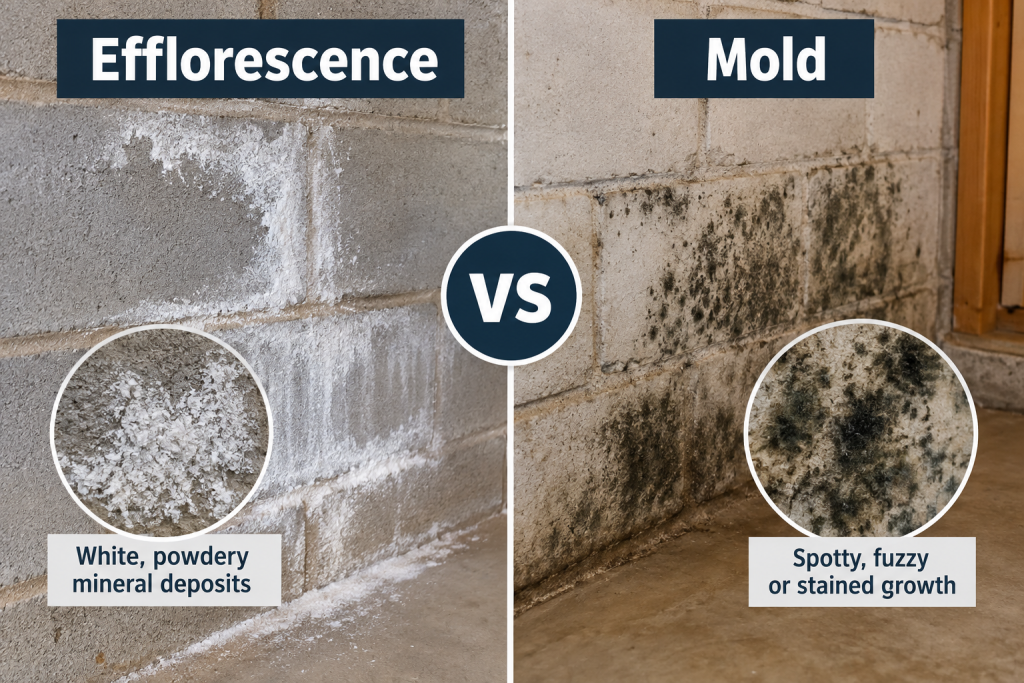
| Clue | Efflorescence | Possible mold |
|---|---|---|
| Typical appearance | White or light-colored powder, crystals, or crust | Spots, staining, fuzzy or irregular growth |
| Common surface | Concrete, block, brick, mortar | Drywall, wood, paper, paint, dust, other materials |
| Color | Usually white or pale | Can be many colors, including white |
| Cause | Moisture carries soluble salts through masonry | Moisture supports fungal growth |
| Pattern | Often follows masonry moisture paths | May follow damp or water-damaged materials |
| Texture | Often dry, powdery, or crystalline | Variable; may look fuzzy, spotty, slimy, or stained |
| Main next step | Find the moisture source | Address moisture and assess extent safely |
What Efflorescence Is
Efflorescence is a deposit of soluble mineral salts that can form on concrete, concrete block, brick, mortar, and other masonry materials.
Moisture moves through the masonry, dissolves or carries soluble compounds, and reaches the surface. As the water evaporates, some of those salts remain behind as a visible deposit.
In basements, that makes efflorescence a useful moisture clue. The deposit itself is not mold, but its presence tells you that moisture has been moving through or within the masonry.
Efflorescence often appears white, off-white, or grayish. It may look powdery, crystalline, chalky, or crusty depending on the material and how much has accumulated.
Repeated deposits in the same area deserve attention because they can indicate recurring moisture movement rather than a one-time event.
What Mold Is
Mold is fungal growth. Indoors, it develops when moisture is available along with material that can provide a suitable food source.
Basements provide plenty of potential growth surfaces. Mold can grow on wood, drywall paper, cardboard, insulation facing, wallpaper, fabrics, dust, paint films, and other organic or soiled materials.
That distinction is important when evaluating a masonry wall. Bare concrete itself is not the same food source as drywall paper or wood, but mold can still appear on dirt, dust, paint, or other material coating a concrete or block surface.
Mold can appear in many colors and patterns. It may look spotty, fuzzy, irregular, stained, or discolored.
Color does not reliably identify whether something is mold, and it cannot tell you the mold species or how hazardous a particular growth may be.
Efflorescence vs Mold: The Most Useful Visual Clues
No single appearance test provides certainty, but several clues together can make one explanation more likely.
Look at the underlying surface
A white crystalline deposit directly on bare concrete block, mortar joints, brick, or poured concrete is consistent with efflorescence.
Possible growth on drywall, wood framing, paper-faced materials, stored cardboard, or other organic surfaces deserves more suspicion for mold.
Painted masonry can be less straightforward. The deposit may be associated with moisture moving through the masonry, while mold can potentially grow on dust or other material present on the painted surface.
Do not rely on the wall material alone.
Look for a powdery or crystalline pattern
Efflorescence commonly forms a dry mineral deposit. It may appear as a dusty white coating, a collection of fine crystals, or heavier crust along a moisture path.
You may also notice loose powder that has already fallen below the affected area.
Possible mold often has a less mineral-looking pattern. It may form scattered dots, patches, fuzzy areas, irregular staining, or growth extending across materials rather than following the texture of masonry deposits.
There is enough overlap, however, that texture should be treated as a clue rather than a definitive identification.
Do not use color as the deciding factor
White material creates one of the hardest comparisons because homeowners often assume white powder is automatically efflorescence.
White mold or other biological growth can also appear light-colored. Conversely, efflorescence can look dirty, gray, or discolored after mixing with dust and other material.
Descriptions such as “white mold,” “green mold,” or “black mold” describe appearance only. They do not identify a species.
If identification matters to the repair decision, color is not enough evidence.
Why Both Problems Point Back to Moisture
Efflorescence and mold are fundamentally different, but moisture connects them.
Efflorescence indicates that moisture has been available to move soluble salts through masonry and leave them behind as evaporation occurs.
Mold also requires moisture. Indoor growth becomes more likely when building materials remain damp because of leaks, condensation, flooding, seepage, or persistently high humidity.
That means finding either condition should prompt a second question: Why is this area getting wet or staying damp?
On a basement wall, useful moisture clues include:
- Deposits returning after heavy rain
- Dampness concentrated near the wall-floor joint
- Moisture around a crack or penetration
- Condensation on a cool wall during humid weather
- Plumbing located above or near the affected area
- Water staining on adjacent drywall or wood
- Peeling paint or recurring surface deterioration
Correcting only the visible deposit without understanding recurring moisture can leave the original problem unchanged.
If the basement has recurring dampness beyond the visible wall deposit, our damp basement guide can help you compare humidity, rain-related seepage, groundwater, and indoor moisture sources.
Can You Tell by Whether It Brushes Away?
Efflorescence often powders or flakes away relatively easily because it is a surface mineral deposit.
That observation can be useful when material is already loose, but do not use aggressive dry brushing, scraping, sanding, or grinding as a diagnostic test.
If the material might be mold, unnecessary disturbance can spread particles and increase exposure. A homeowner does not need to create airborne dust merely to determine whether a patch looks powdery.
Instead, observe whether loose crystalline material is already collecting below the deposit or whether the surface naturally has the dry, mineral appearance associated with salts.
If the distinction remains unclear, leave the material undisturbed until you know how it should be handled.
Location Can Help Narrow the Difference
Efflorescence often follows moisture pathways through masonry.
For example, deposits may appear:
- Along mortar joints
- Across sections of concrete block
- Near the bottom of a foundation wall
- Around cracks or penetrations
- In recurring areas affected after wet weather
Possible mold may follow a different pattern. Growth may be concentrated on drywall beside the foundation, wood framing, baseboards, stored materials, painted surfaces, or areas where condensation remains for long periods.
Look beyond the visible patch. If white deposits are confined to bare block while adjacent cardboard shows fuzzy spotting and a musty odor, you could be looking at separate moisture-related conditions rather than one material spreading from surface to surface.
Appearance Alone May Not Give You Certainty
Homeowners can often recognize a classic mineral deposit on masonry, but ambiguous cases should remain ambiguous.
Do not identify a substance as harmless efflorescence simply because it is white. Likewise, do not assume every dark or fuzzy-looking mark is a specific type of mold.
Before deciding what to do, consider:
- The surface material
- Whether the area is consistently damp
- The shape and texture of the deposit
- Whether similar material appears on nearby masonry
- Whether organic building materials are affected
- Whether the condition is expanding or returning
- Whether there has been a leak, flood, seepage, or condensation problem
Photographs taken over time can help show whether the pattern changes with rainfall, humidity, or another moisture event.
Safe Homeowner Next Steps
If the material appears consistent with efflorescence, focus first on why moisture is moving through the masonry. Recurrent deposits may indicate seepage, condensation, or another moisture condition that needs attention.
If mold is possible, avoid aggressive scraping, sanding, dry brushing, or other unnecessary disturbance. Do not treat bleach or any other cleaner as a universal answer for an unidentified basement-wall problem.
Instead:
- Document the affected area
- Check for obvious leaks or water entry
- Look for damp drywall, wood, cardboard, or other nearby materials
- Note whether the condition follows rain or high humidity
- Keep stored belongings away from persistently damp walls
- Correct safely accessible moisture sources when their cause is clear
This first assessment is about determining what kind of problem you may have, not performing mold remediation or waterproofing work.
If the material appears to be mold rather than a mineral deposit, see our guide to mold on basement walls for moisture causes, limited homeowner-safe actions, and signs that professional evaluation may be appropriate.
When Professional Evaluation Makes Sense
Professional help becomes more appropriate when the affected area is extensive, moisture keeps returning, building materials are significantly damaged, or the water source cannot be identified.
A mold or indoor-environment professional may be appropriate when suspected growth is widespread, hidden damage is possible, identification is uncertain and would change the repair plan, or occupants have health concerns related to the damp or moldy environment.
People with asthma, chronic respiratory disease, immune suppression, significant mold allergies, or other health concerns should be particularly cautious about participating in mold cleanup or disturbing suspected growth.
A basement waterproofing or moisture professional may be the better starting point when mineral deposits repeatedly return with seepage, wet-weather water entry, or persistent foundation dampness.
Structural cracking, displacement, bowing, or foundation movement also requires appropriate professional evaluation rather than being treated as a surface moisture problem.
Final Thoughts
The most useful way to compare efflorescence vs mold is to consider several clues together. Efflorescence is typically a powdery or crystalline mineral deposit associated with moisture moving through masonry. Possible mold is biological growth associated with moisture and a suitable food source and may appear in many colors and textures.
Neither color nor appearance alone provides absolute certainty. Examine the underlying surface, moisture pattern, location, and changes over time without aggressively disturbing uncertain material. Whether you find mineral deposits or possible mold, addressing the moisture source is the essential next step.