
garbage disposal leaking from bottom: causes and what to do
Garbage disposal leaking from bottom problems should be treated cautiously because water and electricity share the same under-sink area. Stop using the disposal, disconnect power safely, and confirm whether water is truly coming from the bottom housing. A leak from the sink flange, dishwasher hose, discharge pipe, or mounting area can run down the disposal and make the bottom appear to be the source.
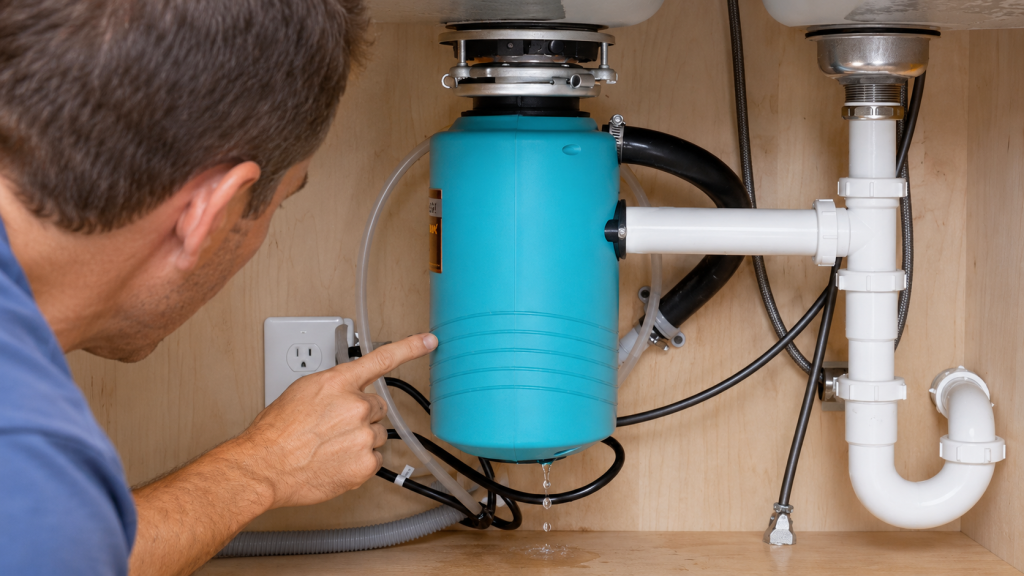
Garbage Disposal Leaking From Bottom? Start Here
| Where Water Appears | Likely Source | Safe First Step |
|---|---|---|
| Around sink flange | Sink-flange seal or mounting issue | Look for water beginning at the top |
| Near dishwasher hose | Hose, clamp, or inlet connection | Inspect accessible hose and clamp |
| At discharge pipe | Gasket, pipe, or connection | Check for fresh moisture at the joint |
| Around mounting ring | Flange or mounting problem | Trace water from above |
| From bottom housing | Possible internal seal or housing failure | Stop before internal disassembly |
| Near reset button or electrical area | Internal leak or electrical exposure | Keep power off and arrange qualified help |
| Only when dishwasher drains | Dishwasher hose or drain connection | Inspect accessible connection with disposal off |
The important first distinction is whether water originates at an external plumbing connection or actually emerges from the disposal body.
Turn Off Power Before Checking the Leak
Do not inspect a leaking disposal while it remains energized.
First:
- Stop using the disposal.
- Keep the wall switch off.
- Do not reach into the grinding chamber.
- Unplug the disposal only if the plug, receptacle, and surrounding area are dry and safely accessible.
- If it is hardwired or the plug cannot be safely reached, shut off the appropriate breaker or use qualified help.
Do not touch a wet cord, plug, receptacle, electrical cover, reset button, or exposed wiring.
If water is contacting the power cord, receptacle, electrical connection, reset-button area, or wiring, stop the inspection and arrange qualified service.
Do not perform live electrical testing or remove electrical covers to investigate the leak.
Dry the Disposal and Check Where the Water Starts
Water often travels along the outside of a disposal before dripping from its lowest point. That can make an upper connection leak look like a bottom-housing failure.
After power is safely disconnected:
- Dry the outside of the disposal.
- Dry accessible plumbing connections.
- Remove water from the cabinet floor only if you can do so without touching wet electrical equipment.
- Place a dry towel or paper around suspected connections.
- Add water to the sink without operating the disposal.
- Watch for the first place fresh moisture appears.
Check from the top downward. A leak that begins at the sink flange or discharge connection may form a drip at the bottom several seconds later.
Do not run the disposal to reproduce the leak.
If the leak appears only when the dishwasher drains, a separate dishwasher drain observation may help when plumbing and electrical conditions are safe, and the disposal remains off.
Check the Sink Flange Above the Disposal
The sink flange forms the connection between the disposal mounting assembly and the sink opening.
If that seal loosens or deteriorates, water can leak near the top of the disposal and run down the exterior.
Clues include:
- Moisture starting around the sink opening
- Water appearing near the upper mounting area
- Leaking when water is held in or drains through the sink
- A visible wet trail down the outside of the disposal
Confirm that the water starts above the disposal body before assuming the unit itself has failed.
Repairing a flange leak may require removing and remounting the disposal so the sink connection can be resealed. That is more involved than a simple visual inspection and may be better handled by a plumber or experienced installer.
Check the Dishwasher Drain Hose Connection
Many dishwashers discharge through a hose connected to the garbage disposal.
A leak here can run down the side or underside of the disposal, especially when the dishwasher pumps out water.
Look for:
- Moisture around the hose connection
- A loose-looking clamp
- Cracking or deterioration near the hose end
- A hose that appears poorly seated
- Water that appears primarily when the dishwasher drains
With disposal power disconnected, visually inspect the accessible hose and clamp.
A simple external connection problem may be repairable, but do not turn this into a dishwasher drainage diagnosis or begin dismantling under-sink plumbing if access is difficult.
If the hose is damaged or the connection cannot be secured normally, replacement or plumbing service may be appropriate.
If the dishwasher is also holding standing water or failing to drain normally, diagnose the separate dishwasher not draining problem rather than assuming the disposal leak explains both symptoms.
Check the Disposal Discharge Pipe
The disposal’s side discharge connection carries wastewater into the household drain piping.
A leak at this connection can travel downward and look like a leak from the disposal bottom.
Possible causes include:
- A loose connection
- A worn or damaged gasket
- Misaligned drain piping
- A cracked pipe
- Excessive strain on the connection
Inspect the visible joint for fresh moisture while the disposal remains off.
If the connection design allows normal homeowner tightening and it is safely accessible, a slightly loose fastener may sometimes be corrected. Tighten only enough to secure the connection.
Do not overtighten plastic fittings or force plumbing that is misaligned. Cracked parts, failed gaskets, or badly aligned piping should be repaired rather than pulled into position with excessive force.
Check the Mounting Assembly
Water around the upper mounting assembly can also migrate down the outside of the disposal.
The actual problem may involve the sink flange, a loose mounting connection, or installation-related movement rather than the sealed disposal body.
Look for where moisture first forms.
Do not remove the disposal simply to investigate an uncertain leak. If the mounting assembly is loose, damaged, or difficult to access, professional help can prevent damage to the sink, plumbing, or electrical connection.
What a True Bottom Leak Usually Means
A true bottom leak is different from water that travels down from an external connection.
If the exterior has been dried and water clearly emerges from the lower housing, a body seam, or another point within the disposal itself, an internal seal or housing failure may be involved.
Possible signs include:
- Water forming directly on the bottom housing
- Moisture emerging from a seam in the disposal body
- Water appearing from inside the lower shell
- No wet trail from the sink flange, dishwasher hose, or discharge connection above
The exact failed component depends on the disposal design, so a bottom leak does not prove that one particular seal has failed.
Many residential garbage disposals are sealed assemblies that are not intended for homeowner internal repair. Opening the motor housing or disposal body is not an appropriate next diagnostic step.
Can You Repair a Garbage Disposal Leaking From the Bottom?
It depends on where the water actually originates.
An external problem may be practical to repair when the leak comes from:
- A dishwasher hose connection
- A discharge-pipe connection
- A replaceable external gasket
- Another accessible plumbing joint
If water is clearly originating inside the disposal body or lower housing, replacement is often more practical than attempting internal seal or housing repair.
Model design, condition, parts availability, installation, and repair access all affect the decision. Age alone should not determine whether the disposal is replaced.
Do not attempt to open a sealed motor body or replace internal seals as a beginner repair.
What If Water Is Near the Reset Button?
Water near the reset button or another electrical area changes the situation from ordinary plumbing diagnosis to an electrical safety concern.
If moisture is near the reset button, power cord, receptacle, wiring, or electrical cover:
- Stop using the disposal.
- Keep power disconnected.
- Do not press the reset button.
- Do not touch wet electrical components.
- Arrange for qualified evaluation.
Do not dry the area and immediately restore power to test the disposal. The source of the water and the condition of any affected electrical components should be addressed first.
What If the Leak Happens Only When the Dishwasher Runs?
A dishwasher-specific leak pattern can help narrow the source.
Possible areas include:
- The dishwasher drain hose
- The connection between the hose and disposal
- The disposal’s dishwasher inlet
- Nearby drain plumbing
With disposal power disconnected, inspect accessible hose and clamp areas for fresh moisture.
If the hose and connection appear dry but the leak continues only during dishwasher drainage, professional plumbing or appliance evaluation may be needed.
What If the Disposal Is Also Humming?
Treat the leak first.
A humming disposal and a leaking disposal may have separate causes, and running or resetting the unit while water is present could create additional risk.
Do not press the reset button, attempt jam-clearing procedures, or restore power until the leak and any electrical exposure have been addressed.
After the leak and any electrical exposure are safely addressed, use our garbage disposal humming guide to diagnose a disposal that receives power but does not grind normally.
When Replacement Makes More Sense
Replacement deserves stronger consideration when the leak is not coming from an external plumbing connection.
It may be the more practical option when:
- Water clearly emerges from the sealed bottom housing.
- The disposal body is cracked or significantly corroded.
- An internal seal or housing failure is suspected.
- Water has entered electrical areas.
- The disposal has several unrelated problems.
- Repair would require opening the sealed motor body.
- Parts or specialized repair are impractical.
A leaking hose, gasket, or discharge connection does not automatically justify replacing the disposal.
Confirm the source first.
When to Call a Plumber or Electrician
A plumber is generally the better choice when the problem involves:
- Sink-flange leakage
- Drain piping
- Dishwasher drain connections
- Disposal mounting
- Disposal replacement
- Poor under-sink plumbing alignment
An electrician may be appropriate when the problem involves:
- A wet or damaged receptacle
- Damaged wiring
- A burned or deteriorated electrical connection
- Hardwired installation concerns
- Breaker or circuit problems
Depending on the installation, a qualified disposal installer or appliance professional may also handle certain replacement or connection work.
If water is reaching electrical components, keep power off until the situation has been evaluated.
Common Garbage Disposal Leak Mistakes
Avoid these common mistakes:
- Assuming every drip at the bottom means an internal disposal leak
- Running the disposal to reproduce the problem
- Pressing the reset button while water is present
- Touching wet cords, plugs, receptacles, or wiring
- Reaching into the grinding chamber
- Overtightening plastic drain fittings
- Overlooking the dishwasher hose connection
- Opening the sealed motor housing
- Replacing the disposal before checking external connections
- Continuing to use a disposal that is leaking into electrical areas
Garbage Disposal Leaking From Bottom FAQ
Why is my garbage disposal leaking from the bottom?
A garbage disposal leaking from bottom areas may actually have water running down from the sink flange, dishwasher hose, discharge pipe, or mounting assembly. If those areas are dry and water clearly emerges from the lower housing, an internal seal or housing failure may be involved.
Can a garbage disposal leaking from the bottom be repaired?
External hose, pipe, or gasket leaks may be repairable. If the water is coming from inside the sealed disposal body, replacement is often more practical than internal repair. The correct decision depends on the disposal design and condition.
How can I tell whether the leak is from the sink flange or the disposal?
Disconnect power, dry the exterior and accessible connections, then add water to the sink without operating the disposal. Watch where fresh moisture first appears. Water beginning near the top mounting area suggests a sink-flange or mounting leak rather than a true bottom-housing leak.
Why does my garbage disposal leak only when the dishwasher drains?
The dishwasher drain hose, clamp, disposal inlet, or nearby drain piping may be leaking. Inspect only accessible connections with disposal power disconnected and avoid turning the issue into an internal dishwasher repair.
Should I replace a garbage disposal that leaks from the bottom?
Replacement often makes sense when water clearly originates from inside the sealed lower housing rather than an external plumbing connection. Do not replace the unit solely because water drips from its lowest point; first confirm that the leak is not traveling down from above.
Final Thoughts
For a garbage disposal leaking from bottom areas, stop using the unit, disconnect power safely, dry the exterior, and identify where water first appears. Check the sink flange, dishwasher hose, discharge pipe, and mounting area before deciding that the disposal itself has failed.
If water truly emerges from the sealed bottom housing, replacement is often more practical than internal repair. Stop before electrical diagnosis, motor-body disassembly, or any work involving wet electrical components, and use a plumber, electrician, or qualified installer when the leak extends beyond safe external checks.