Gutter Cleaning Tools From the Ground
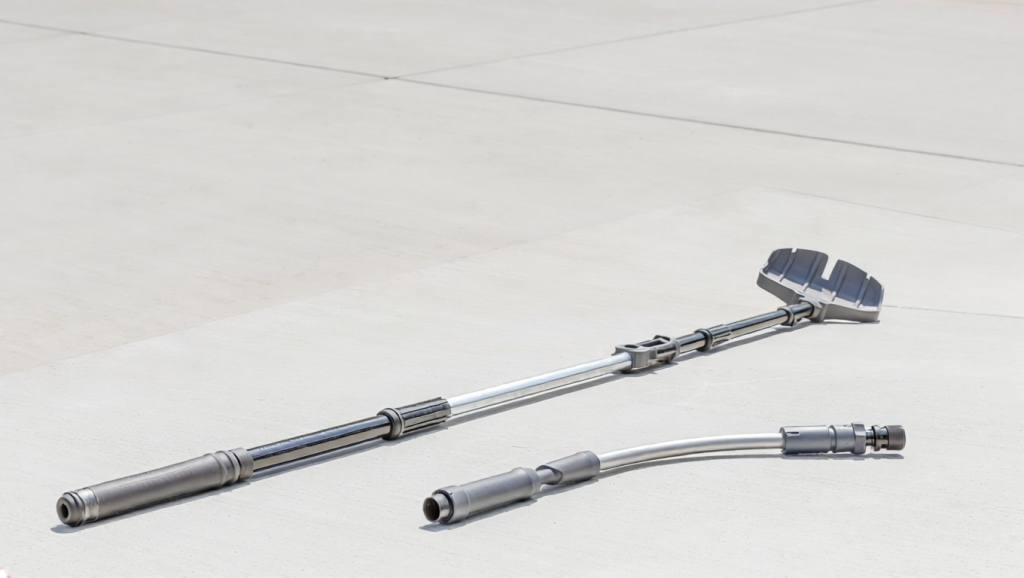
The most useful gutter cleaning tools from the ground are telescoping scoops or claws, curved hose wands, leaf-blower attachments, gutter vacuums, and inspection aids. The best choice depends on gutter height, debris type, whether the material is wet or dry, and how well you can control the tool. Maximum advertised reach is less important than stable, predictable control from the ground.
Keep all long tools well away from overhead electrical conductors, and stop if the equipment becomes difficult to control.
| Tool Type | Best For | Main Limitation |
|---|---|---|
| Telescoping scoop or claw | Leaves, pine debris, seed pods, moderate clumps | Becomes harder to control as reach increases |
| Curved hose wand | Light debris, sediment, final rinsing | Can turn packed debris into sludge |
| Leaf-blower attachment | Dry leaves and lightweight debris | Poor performance on wet material |
| Gutter vacuum | Loose debris with better containment | Tube weight and suction limits |
| Inspection mirror or camera | Checking debris and results | Helps inspect but does not clean |
What Makes a Good Ground-Based Gutter-Cleaning Tool?
A good ground-based gutter-cleaning tool gives you enough reach to access the gutter while still allowing you to control the working end accurately. Advertised maximum extension can be useful for comparing products, but it does not tell you how manageable the tool will feel when fully assembled and raised overhead.
Rigidity and weight matter because long poles create leverage. A lightweight tool can still become tiring or difficult to steer when extended, while a very rigid system may be heavier than expected. The shape of the cleaning head is also important. Scoops, claws, nozzles, blower elbows, and vacuum tubes interact with debris differently.
Debris condition should influence the choice. Dry leaves may respond well to airflow, while wet organic material is more likely to require mechanical removal or suction. Visibility matters too. If you cannot see the gutter well enough to position the tool accurately, an inspection mirror or camera may help confirm where debris is concentrated.
Consider the entire work area, not just the roofline. Landscaping, fences, vehicles, trees, narrow side yards, uneven ground, and overhead electrical service can all limit where a long tool can be used safely.
This page focuses on selecting equipment. For the full cleaning sequence, see how to clean gutters from the ground.
How Gutter Height Changes Your Tool Choice
One-story gutters are generally the best candidates for ground-based cleaning because the working head remains closer to the user and easier to control. Shorter extension also reduces pole flex and leverage.
Some two-story gutters may technically fall within the advertised reach of certain tools, but that does not automatically make them practical. As a telescoping pole extends, small hand movements can create large movements at the cleaning head. The assembly may also flex, sway, or become tiring to support.
There is no universal safe reach number because tool design, user strength, ground conditions, gutter position, landscaping, and nearby hazards all vary. A tool that feels easy to manage at one height may become difficult well before its stated maximum extension.
Do not add homemade extensions, stand on furniture or boxes, or use another elevated surface to gain a few more feet. If the required reach exceeds what you can comfortably control from stable ground, another approach is needed.
Tool-by-Tool Comparison
Telescoping Gutter Scoops and Claws
Telescoping scoops and claws are useful for physically moving leaves, pine needles, seed pods, small twigs, and moderate clumps of organic debris. Because they remove material mechanically, they can work where airflow or water would simply move debris around.
A scoop-style head can drag material toward an accessible section, while a claw or grabber may lift individual clumps. These tools can also reduce the amount of water needed during cleanup.
Their main limitation is control at longer reach. The working head may be difficult to position precisely when the pole is extended, especially if the gutter cannot be seen clearly. Heavy wet debris also increases the force required to manipulate the tool.
Choose a design with enough stiffness for the intended height and a head shape that can enter the gutter without catching unnecessarily on the edge.
Curved Gutter-Cleaning Wands
Curved hose wands direct water over the gutter edge while the user remains on the ground. They are best suited to light debris, loose sediment, and rinsing after larger material has already been removed.
They can be useful where you want to observe whether water travels toward the downspout, but water is not a substitute for mechanical removal of a heavily packed gutter.
Wet leaves and decomposed debris may turn into sludge when flushed too early. That material can move toward the downspout and create a more difficult restriction.
Also consider where the runoff will land. Dirty water can splash siding, landscaping, windows, walkways, and people standing nearby. A wand should provide controllable flow rather than maximum pressure.
Leaf-Blower Gutter Attachments
Leaf-blower gutter attachments use connected tubes and curved sections to direct airflow into the gutter from below. They can clear dry leaves quickly and may work well when the debris is light and loose.
Compatibility is a key buying issue. Attachment diameter, connection style, blower configuration, and overall tube weight can vary. An attachment marketed for one blower type may not fit another without an approved adapter.
The main drawback is debris scattering. Leaves, dirt, and dust can be blown onto siding, landscaping, roofs, walkways, or neighboring areas. Wet leaves and packed organic buildup also respond poorly to airflow.
A blower attachment is therefore best matched to dry conditions rather than treated as an all-purpose gutter cleaner.
Gutter Vacuum Systems
Gutter vacuums offer better debris containment because material is drawn into the vacuum instead of blown across the property. They can work well for leaves, pine needles, and other loose debris when the equipment provides sufficient suction.
Some systems are designed for wet and dry material, while others perform best with relatively dry debris. Check compatibility before assuming an ordinary shop vacuum will work effectively with a long overhead tube system.
Tube weight becomes important as sections are added. The longer the assembly, the more effort it takes to position the nozzle accurately. Long hoses and narrow tubes can also reduce effective suction or clog when debris is bulky.
For homeowners who value containment and have manageable gutter height, a compatible vacuum system can be practical, but it is not automatically the easiest option.
Inspection Mirrors and Camera-Based Aids
Inspection mirrors, pole-mounted cameras, and similar aids do not remove debris, but they can make ground-level gutter work more effective.
Their main value is visibility. They can help show whether a section contains leaves, whether the gutter is holding standing water, and whether cleaning has actually removed the visible buildup.
A camera can be especially useful where the gutter edge blocks a direct view from the ground. However, these tools add another piece of equipment to manage and should not encourage reaching into areas that would otherwise be inaccessible.
Think of them as inspection aids that support tool selection and verification rather than as cleaning equipment.
Powered Versus Manual Tools
Manual tools such as scoops and claws give the user direct control over the cleaning head. They are relatively simple and can work well on moderate clumps that need to be physically moved.
Powered options such as blowers and vacuums can work faster under the right conditions. A blower is effective on dry lightweight debris, while a vacuum provides better containment. A hose wand uses water rather than mechanical power, but it also depends heavily on debris condition.
More power does not automatically mean better cleaning. A strong blower is still a poor match for wet compacted leaves, and high water flow can make a blockage worse if debris is driven toward a restricted outlet.
| Debris Condition | Tool Type That Often Fits Best | Main Consideration |
|---|---|---|
| Dry loose leaves | Blower attachment or vacuum | Scattering versus containment |
| Pine needles and seed pods | Scoop, claw, or vacuum | Head shape and suction |
| Damp loose debris | Scoop, claw, or suitable wet/dry vacuum | Added weight |
| Wet compacted debris | Manual removal where controllable | Powered airflow may be ineffective |
| Light sediment after debris removal | Curved hose wand | Use controlled water flow |
| Uncertain gutter condition | Mirror or camera aid | Inspect before choosing a method |
Features That Matter When Comparing Products
Usable reach should come before maximum advertised reach. A tool that reaches the gutter but cannot be controlled accurately is not a good fit.
Rigidity affects how much a pole bends or sways when extended. A very flexible assembly can make it difficult to guide a scoop, nozzle, or vacuum head into the gutter.
Head shape should match the intended debris. A broad scoop may handle leaves well, while a narrow vacuum tube may fit tighter areas. Curved hose and blower attachments need an outlet angle that works with the gutter position.
Compatibility is equally important. Check hose diameter, blower connections, vacuum fittings, threading, adapters, and any manufacturer-specific mounting system before buying an attachment.
Total operating weight can be more useful than the weight of the pole alone. Include the head, hose, adapters, blower tube, or vacuum sections when judging how manageable the complete assembly will be.
Assembly and storage also affect usability. A system that requires many long sections may take more time to set up and store than a compact telescoping design.
Visibility matters as well. If the design makes it difficult to tell where the working head is positioned, consider whether an inspection aid would improve control.
Common Buying Mistakes
Common mistakes include:
- Buying primarily for maximum advertised height.
- Choosing a tool that does not match the debris condition.
- Assuming blower, hose, or vacuum attachments are universal.
- Ignoring the weight of the complete assembled system.
- Overlooking where leaves, dirt, or dirty water will land.
- Buying a tool that becomes difficult to steer when fully extended.
- Choosing a powered method simply because it appears faster.
- Failing to consider landscaping, fences, or narrow working areas.
A useful tool is one you can actually position, operate, and verify from stable ground.
When Ground-Based Cleaning Is No Longer the Right Approach
Ground-level equipment has practical limits. Stop if a pole, wand, blower tube, or vacuum assembly could approach overhead electrical conductors.
The job has also exceeded normal ground-based cleaning when the working head cannot be controlled reliably or the gutter cannot be seen or checked well enough to know what is happening.
Roof geometry can block a ground-use tool even when the gutter is technically within reach. Heavily compacted debris, plant growth, damaged gutters, or an obstruction that cannot be located safely may also require a different level of service.
Do not keep adding extension simply because debris remains. If completing the job would require a ladder, roof access, an improvised platform, or a tool you cannot control, stop.
If the gutter itself appears clear but flow remains restricted, the problem may instead be a downspout not draining. That calls for separate troubleshooting rather than buying a more powerful gutter-cleaning attachment.
Final Thoughts
The best gutter cleaning tools from the ground depend on the height of the gutter, the condition of the debris, and how easily the complete tool can be controlled.
Telescoping scoops and claws work well for physical debris removal, hose wands are useful for light rinsing, blower attachments favor dry leaves, and vacuums provide better containment. Mirrors and cameras can make inspection easier.
One-story gutters are generally the easiest candidates for these tools. Whatever the height, prioritize usable control over maximum advertised reach and stop when the equipment becomes difficult to manage safely from stable ground.