heat pump vs furnace: which is better for your home?
Heat pump vs furnace decisions come down to more than climate alone. A heat pump transfers heat and usually provides both heating and cooling, while a furnace generates heat through combustion or electric resistance and normally provides heating only. Heat pumps can be strong year-round choices, including in many cold climates, while furnaces remain attractive where severe cold, fuel costs, existing gas infrastructure, or high heating loads favor them.
Quick Answer
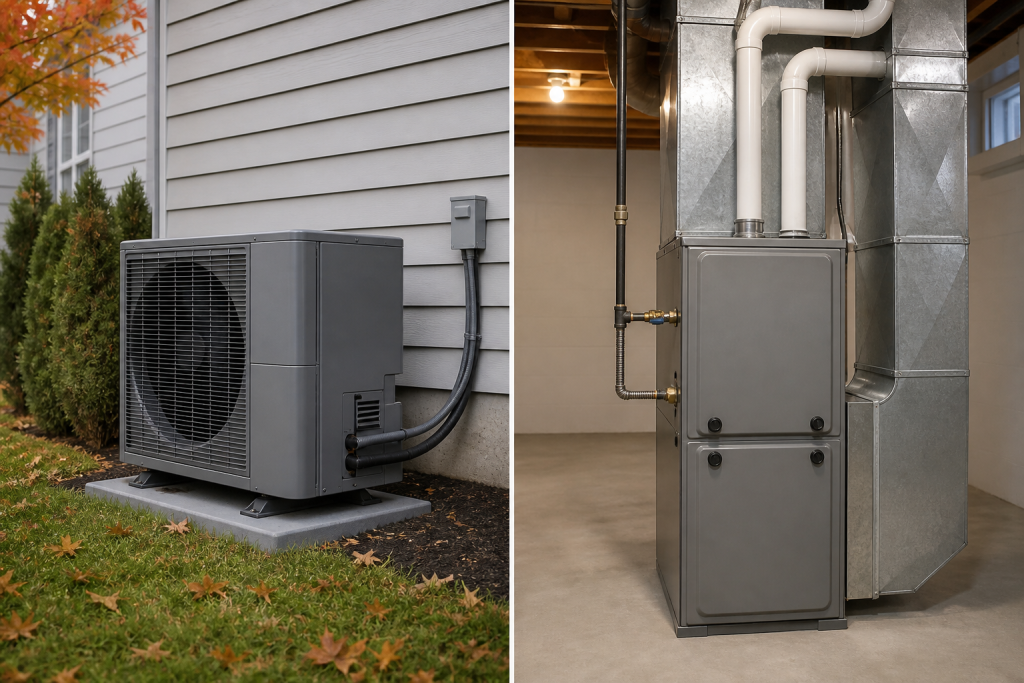
A central air-source heat pump uses refrigeration technology to move heat into the home in winter and reverse direction for cooling in summer. A gas furnace burns fuel to create heat and typically needs a separate central air conditioner for summer cooling.
Modern cold-climate heat pumps have improved low-temperature capacity, so saying heat pumps simply “do not work in cold weather” is outdated. Their performance still changes as temperatures fall, making proper sizing and low-temperature capacity especially important.
A dual-fuel system offers another option by combining a heat pump with a gas or propane furnace.
Heat Pump vs Furnace: Quick Comparison
| Comparison factor | Heat pump | Furnace | What it means for homeowners |
|---|---|---|---|
| Heating method | Transfers outdoor heat indoors | Generates heat | Different technologies and energy use |
| Heating and cooling | Usually provides both | Heating only | Furnace homes normally need separate AC |
| Energy source | Electricity | Usually gas; also propane, oil, or electricity | Utility availability and rates matter |
| Cold-weather performance | Capacity and efficiency vary with temperature | Strong heating output in cold weather | Compare design conditions, not general climate labels |
| Efficiency measurement | HSPF2, COP; SEER2/EER2 for cooling | AFUE for fuel furnaces | Ratings are not directly interchangeable |
| Upfront installation | May require electrical or duct changes | May require gas, venting, or condensate work | Existing infrastructure affects price |
| Operating costs | Electricity rate, temperature, backup heat | Fuel price and AFUE | Neither is always cheaper |
| Indoor/outdoor equipment | Indoor unit plus outdoor unit | Indoor furnace; AC adds outdoor unit | Space and equipment layout differ |
| Existing ductwork | Can often reuse suitable ducts | Can often reuse suitable ducts | Airflow must match new equipment |
| Supply-air temperature | Often milder | Often warmer | Comfort sensation can differ |
| Cycle behavior | Often longer, steadier cycles | May provide shorter, hotter cycles | Proper sizing changes both |
| Maintenance | Refrigeration, airflow, outdoor unit | Combustion, venting, airflow | Both need routine service |
| Combustion/CO concerns | No onsite combustion at heat-pump equipment | Present with fuel-burning furnaces | CO protection matters with combustion appliances |
| Electrical requirements | Can be substantial | Usually lower heating electrical demand for gas models | Panel capacity may affect installation |
| Expected equipment usage | Heating and cooling | Primarily heating | Heat-pump outdoor equipment operates more of the year |
| Best-fit situations | Year-round electric heating/cooling | Homes favoring combustion heat | Home-specific analysis should decide |
How a Heat Pump Works
An air-source heat pump uses a refrigeration cycle to transfer heat rather than creating all of its heat through electric resistance.
During winter, refrigerant absorbs heat available outdoors, and the system moves that heat into the home. During summer, the process reverses, and the heat pump removes heat from the home like a central air conditioner.
A ducted system normally includes an outdoor heat-pump unit and an indoor air handler or compatible indoor coil and blower.
This is not “free heat.” The compressor, fans, controls, and other components use electricity to move thermal energy.
How a Furnace Works
A natural-gas, propane, or oil furnace produces heat through controlled combustion. A blower then moves heated air through the home’s ductwork.
An electric furnace works differently. It uses electric-resistance elements instead of burning fuel.
A furnace does not normally provide air conditioning. In homes with central cooling, the furnace blower and duct system may work with a separate indoor cooling coil and outdoor air-conditioning unit.
Heating and Cooling Differences
The biggest functional advantage of an air-source heat pump is that one refrigeration system provides both heating and cooling.
A furnace provides only heat, so a homeowner comparing replacement proposals should look carefully at what each bid includes. Comparing the price of a heat pump with a furnace alone can be misleading if the furnace proposal does not include the separate air conditioner the home also needs.
Ductless heat pumps provide the same basic heating-and-cooling functions without conventional central ductwork. Ground-source or geothermal heat pumps transfer heat with the ground rather than outdoor air, making them a different installation and cost category.
Heat Pump vs Furnace Efficiency
Heating efficiency is described differently for the two technologies.
A fuel-burning furnace commonly uses AFUE, or Annual Fuel Utilization Efficiency. It describes how much of the fuel’s energy is converted into useful seasonal heat at the equipment.
Heat-pump heating efficiency is commonly expressed as HSPF2. Performance at a specific operating condition may also be described using COP, or coefficient of performance.
For cooling, heat pumps commonly use SEER2 and EER2 ratings.
AFUE and HSPF2 measure different things. An AFUE percentage should not be compared directly with an HSPF2 number as though they were two versions of the same efficiency scale.
An electric-resistance furnace can convert nearly all the electricity consumed at the equipment into heat. A heat pump can deliver more heat per unit of electricity because it moves heat rather than relying entirely on resistance heating.
Rated efficiency still does not guarantee low utility bills.
Which System Costs Less to Operate?
There is no universal winner.
Heat-pump operating costs depend on factors such as:
- Outdoor temperatures
- Electricity rates
- Equipment efficiency
- Low-temperature heating capacity
- Use of auxiliary or backup heat
- Home insulation and air sealing
- Thermostat settings
- Duct losses
Furnace costs depend on fuel prices, AFUE, heating demand, duct condition, thermostat use, and other factors.
A high-efficiency heat pump in one utility territory may have very different operating economics from the same system in another. The same applies to natural gas, propane, and oil furnaces.
Ask contractors to estimate energy use using your local rates and the proposed equipment rather than relying on broad savings claims.
Upfront Installation Considerations
The lowest equipment price is not necessarily the lowest installed-system price.
A complete proposal may involve:
- Equipment purchase
- Installation labor
- Electrical upgrades
- Gas-line or fuel-system modifications
- Furnace venting and condensate requirements
- Duct repairs or resizing
- Backup-heating equipment
- Old-equipment removal
- Thermostat and control changes
- Future maintenance and repair needs
- A separate central air conditioner with a furnace
A heat-pump conversion can become more expensive if the electrical panel or service needs upgrading. A furnace installation can become more involved if fuel piping, venting, combustion air, or condensate disposal needs modification.
Federal, state, local, and utility incentives can also affect the comparison. Programs and eligibility change, so verify current requirements before purchasing.
Heat Pumps in Cold Climates
Air-source heat pumps can operate below freezing.
Cold-climate models are designed and tested to provide improved heating capacity and efficiency at low outdoor temperatures. That does not mean their output remains identical at every temperature.
As outdoor temperature falls, available capacity and efficiency can change. The proposed system therefore needs to be evaluated against the home’s heating requirement at local winter design conditions.
Ask for the model’s actual low-temperature capacity data rather than relying only on its nominal size.
Backup heat may come from:
- Electric resistance
- A gas or propane furnace
- Another properly designed heat source
Auxiliary heat turning on does not automatically mean the heat pump has failed.
Air-source heat pumps also periodically use a defrost cycle to remove frost from the outdoor coil during heating operation. A temporary change in operation during defrost can be normal.
Older standard heat pumps are not a reliable benchmark for every modern cold-climate system.
Comfort and Cycle Differences
Heat pumps commonly deliver longer, steadier heating cycles than traditional single-stage furnaces.
Their supply air may feel less intensely hot against your hand even while the system is correctly heating the home. It should not be described as “cold air” simply because it feels cooler than furnace discharge air.
If a furnace is actually blowing cold air instead of heating the home, troubleshoot that condition separately before comparing its comfort with a heat pump.
Combustion furnaces often deliver warmer supply air and may recover from a temperature setback more quickly.
Those differences become less clear with modern equipment. Variable-capacity heat pumps and multi-stage or modulating furnaces can adjust output and run for longer periods at reduced capacity.
Comfort also depends heavily on:
- Correct equipment sizing
- Duct design
- Airflow setup
- Insulation and air sealing
- Thermostat configuration
- Register placement
Noise likewise varies by model, fan speed, equipment placement, capacity, and installation quality.
Maintenance and Expected Usage
Both systems need routine maintenance.
Homeowners can generally:
- Replace approved filters as needed
- Keep supply and return registers unobstructed
- Keep accessible outdoor equipment clear of loose leaves and debris
- Watch for unusual sounds or changes in performance
Because a heat pump normally provides cooling and heating, its refrigeration equipment may operate through more of the year.
A combustion furnace has different service needs involving burners, combustion, heat-exchanger condition, fuel supply, and venting.
Refrigerant, gas, combustion, electrical, control, and internal equipment work should be handled by qualified professionals.
Safety Considerations
Gas, propane, and oil furnaces require correct fuel supply, combustion air, venting, and operation of their safety controls.
Carbon-monoxide alarms remain important in any home containing combustion appliances, regardless of whether the primary HVAC system is a furnace or heat pump.
A heat pump avoids combustion at the heat-pump equipment, but it is not risk-free. It contains high-voltage electrical components and refrigerant under pressure.
Correct installation and maintenance matter with either system.
Heat Pump vs Gas Furnace
A gas furnace can be appealing when natural gas is already available, the existing venting and fuel infrastructure can be reused, and local gas costs are favorable.
It also provides strong heating capacity during severe cold.
A heat pump may be attractive when the homeowner wants one system for both heating and cooling, electricity economics are favorable, or eliminating furnace combustion is a priority.
The comparison becomes especially important when an aging furnace and air conditioner both need replacement. If you are unsure whether the furnace is nearing replacement age, start by reviewing how long a furnace lasts and which warning signs matter. At that point, comparing a complete heat-pump system with a complete furnace-plus-AC system usually gives a more useful picture.
Heat Pump vs Electric Furnace
A heat pump generally has an efficiency advantage over electric-resistance heating because it transfers heat.
An electric furnace creates heat through resistance elements. Although resistance heating converts electricity into heat effectively at the equipment, it does not multiply delivered heat through heat transfer the way a heat pump can.
Electric furnaces may still serve as backup heating or fit particular homes, but local electricity rates and heating loads matter.
What Is a Dual-Fuel System?
A dual-fuel system combines an electric heat pump with a compatible gas or propane furnace.
The heat pump can provide heating during conditions when it is advantageous to do so, while the furnace serves as the alternate heat source. System controls determine which source operates based on the designed changeover strategy.
That strategy can consider outdoor conditions, system configuration, energy costs, or other programmed criteria.
Dual fuel can be worth considering when a homeowner already has a usable furnace but needs new cooling equipment.
It requires properly matched equipment, correct thermostat and control compatibility, and properly configured changeover settings. It is not automatically the lowest-cost solution for every home.
When a Heat Pump May Be the Better Choice
A heat pump may be especially attractive when:
- You need both new heating and cooling equipment.
- Electricity rates make heat-pump operation competitive.
- The proposed model has suitable capacity at local winter conditions.
- The home is well insulated and air sealed.
- Existing ducts can support the required airflow.
- Electrical capacity is adequate or practical to upgrade.
- Reducing onsite combustion is a priority.
- You prefer longer, steadier heating operation.
Ductless heat pumps can also be useful where adding or repairing central ducts would be impractical.
When a Furnace May Be the Better Choice
A furnace may remain attractive when:
- The home already has useful gas infrastructure.
- Local fuel economics favor the furnace.
- The house has a high heating load.
- Severe cold dominates the HVAC decision.
- Electrical upgrades for a heat pump would be substantial.
- Existing equipment and ducts favor a furnace replacement.
- Warmer supply-air characteristics are important to the homeowner.
Propane and oil furnaces require the same broader cost comparison, but their fuel pricing, storage, delivery, and equipment requirements differ from natural gas.
Do not select a furnace—or reject a heat pump—based solely on being in a northern climate.
Questions to Ask Before Choosing
Before signing an HVAC proposal, ask:
- What is the home’s calculated heating and cooling load?
- What is the local winter design temperature?
- What heating capacity does the proposed heat pump provide at low temperatures?
- Will backup heat be required?
- What will provide the backup heat?
- Does the electrical panel need an upgrade?
- Can the existing ducts handle the required airflow?
- Are the indoor and outdoor components properly matched?
- What efficiency ratings apply to the complete matched system?
- How will local electricity and fuel rates affect estimated costs?
- Is a separate air conditioner included in the furnace proposal?
- What routine maintenance is required?
- What equipment and labor warranties apply?
- Which current incentives may apply, and who verifies eligibility?
- Will the contractor perform and document a heating-and-cooling load calculation?
HVAC equipment should be selected from a professional load calculation, not square footage alone.
Final Recommendation
The best heat pump vs furnace choice depends on the house and the complete installation, not a universal rule.
A properly selected heat pump can provide efficient heating and cooling across a wide range of climates, including cold regions when low-temperature capacity is matched to the home’s heating load. A furnace can remain a strong option where fuel economics, existing infrastructure, severe heating demand, or installation constraints favor combustion heat.
Compare complete installed systems, including cooling, backup heat, electrical or fuel upgrades, ducts, local energy rates, and current incentives. Most importantly, require a documented load calculation and equipment performance data for your actual climate before deciding.
Frequently Asked Questions
Is a heat pump better than a furnace?
Not universally. In a heat pump vs furnace comparison, climate, utility prices, existing infrastructure, cooling needs, home efficiency, comfort preferences, and equipment design all affect the better choice.
What is the main difference between a heat pump and a furnace?
A heat pump transfers heat using a refrigeration system and normally provides cooling as well. A furnace creates heat through combustion or electric resistance and normally provides heating only.
Can a heat pump replace a furnace?
Yes, when a properly designed heat-pump system can meet the home’s heating and cooling requirements. Some homes also use backup heat or a dual-fuel arrangement.
Can a heat pump heat a house below freezing?
Yes. Air-source heat pumps can operate below freezing, and cold-climate models are designed for improved low-temperature performance. Their capacity still needs to be checked against the home’s heating load.
Does a heat pump need backup heat?
Not every installation uses backup heat in the same way. The need and type depend on climate, equipment capacity, home heating load, and system design.
Is a heat pump cheaper to run than a gas furnace?
It can be, but not everywhere. Electricity and gas prices, climate, equipment efficiencies, backup-heat use, and the home’s heating demand determine operating costs.
Is a heat pump better than an electric furnace?
A heat pump can generally deliver more heat per unit of electricity because it transfers heat rather than relying entirely on electric resistance. Actual costs still depend on climate and system design.
Does a heat pump also provide air conditioning?
Yes. An air-source heat pump normally reverses its refrigeration cycle to provide cooling during warm weather.
Does a furnace provide cooling?
No. A furnace provides heating. Central cooling requires separate air-conditioning equipment, although it may share the furnace blower and ductwork.
Why does heat-pump air feel cooler than furnace air?
Heat pumps often deliver air at a lower temperature than combustion furnaces while still adding enough heat to warm the home. Longer, steadier operation is common.
Do heat pumps run longer than furnaces?
They often do, particularly variable-capacity systems designed to maintain temperature with longer cycles. Runtime alone does not indicate inefficiency or a problem.
What is a cold-climate heat pump?
It is a heat pump designed and tested for stronger heating performance under low outdoor-temperature conditions.
What is a dual-fuel heat-pump system?
It combines an electric heat pump with a compatible gas or propane furnace, with controls determining which heat source operates under specified conditions.
Does a heat pump produce carbon monoxide?
The heat-pump equipment does not burn fuel and therefore does not create carbon monoxide through onsite combustion. CO alarms are still important when any combustion appliance is present in the home.
How should an HVAC system be sized?
A contractor should calculate the home’s heating and cooling loads using recognized load-calculation methods and then select equipment whose performance matches those loads. Square footage alone is not sufficient.
Which system is better for an existing home?
It depends on the home’s heating and cooling loads, ducts, electrical capacity, fuel infrastructure, insulation, utility rates, equipment condition, and installation costs. Compare complete proposals rather than equipment type alone.