
How to keep mice out of your house: prevention and exclusion
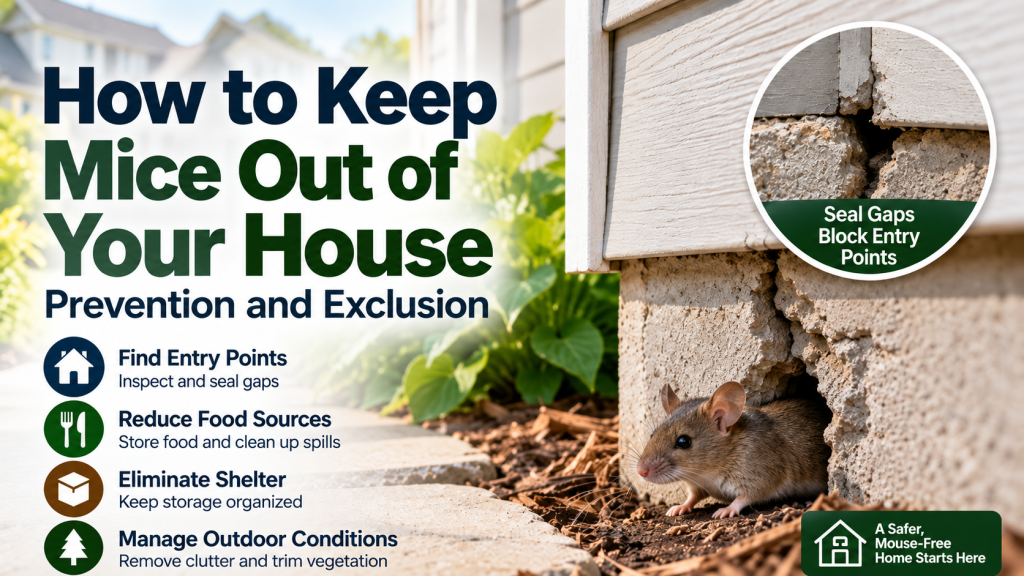
How to keep mice out of house entry points comes down to two priorities: block the openings they can use and reduce the food and shelter that encourage them to stay. Start with a ground-level exterior inspection, correct accessible gaps with materials suited to the opening, improve food and storage practices, and monitor for new signs of activity. Even a well-maintained home can develop mouse-sized entry points over time.
Why Mice Try to Get Into Houses
Mice enter homes because buildings can offer food, warmth, shelter, and water. Seasonal weather changes can increase the appeal of protected indoor spaces, but mouse problems are not limited to any one season or type of home.
Garages, basements, crawlspaces, utility areas, and other lower-level spaces deserve particular attention because they often contain doors, pipes, vents, foundation joints, or stored materials. These areas can provide both access and shelter.
A mouse problem does not automatically mean a home is dirty. Small gaps can develop around otherwise well-maintained structures, and ordinary food or storage habits can give mice a reason to remain after they get inside.
How Small an Opening Can a Mouse Use?
Mice can squeeze through surprisingly small openings. As a practical rule, treat narrow gaps around the lower exterior of the house as worth inspecting rather than assuming an opening is too small to matter.
Pay attention to gaps around:
- Foundations and siding transitions
- Exterior and garage doors
- Pipes, wires, and utility lines
- Lower vents
- Crawlspace openings
- Places where different building materials meet
A gap only about the width of a pencil can be large enough for a mouse to use. That makes careful inspection more useful than looking only for obvious holes.
Start With a Ground-Level Exterior Inspection
Inspect the house from ground level during daylight when possible. Good lighting makes it easier to notice gaps beneath doors, around utility penetrations, and where trim or siding has deteriorated.
Check the lower exterior systematically
Walk the perimeter and look at:
- The foundation edge
- Exterior door frames and thresholds
- Garage-door edges
- Pipes, wires, cable lines, and other penetrations
- Damaged or separated trim
- Siding transitions
- Crawlspace openings
- Lower vents
- Joints where masonry, siding, trim, or other materials meet
Keep the inspection accessible and noninvasive. There is no need to climb onto the roof, open walls, enter an unsafe crawlspace, or dismantle building components for routine mouse prevention.
If you find an opening connected with electrical, gas, combustion equipment, or another utility and are unsure how it should be sealed, leave the assembly intact and have the appropriate professional evaluate it.
Check Doors and Garage Doors Carefully
Doors are practical mouse-entry points because their seals wear, shift, and get damaged through normal use.
Close an exterior door during daylight and look for visible light beneath it or at the lower corners. Inspect the door sweep and weatherstripping for wear, tearing, missing sections, or poor contact.
Garage doors deserve the same attention. Check the bottom seal, side edges, and corners for gaps, especially where an uneven floor or worn seal prevents the door from closing tightly.
A worn sweep, weatherstrip, or simple seal may be a straightforward maintenance repair. A garage door that closes unevenly because of damaged tracks, springs, cables, or powered components is different. Do not treat those mechanisms as a pest-control DIY project.
If the gap is beneath an exterior door, our guide to choosing a door sweep for bugs can help you match the sweep style to the door and threshold.
Seal Appropriate Mouse Entry Points
Exclusion works best when the repair matches both the opening and the building assembly. There is no single material that is right for every gap.
Small deteriorated joints may need fresh exterior-grade sealant where caulk is appropriate. Worn weatherstripping and door sweeps can be replaced. Damaged screens or vent covers may need repair, and accessible utility gaps may require a durable seal compatible with the materials and service passing through them.
For openings vulnerable to chewing, a durable metal-backed or other pest-resistant repair can be more suitable than a soft filler by itself.
Match the repair to the opening
Consider:
- The size and shape of the gap
- The surrounding building materials
- Exposure to rain or moisture
- Whether pipes, wires, or utilities pass through it
- Whether the opening serves ventilation, drainage, or another function
Do not seal required ventilation, drainage openings, combustion-air openings, functional weep paths, or equipment clearances. If you cannot identify why an opening exists, determine its purpose before closing it.
Avoid invasive wall opening or structural disassembly to chase a suspected mouse route. If access requires that level of work, professional evaluation is more appropriate.
What About Expanding Foam, Steel Wool, and Similar Materials?
Common exclusion materials have different strengths and limitations.
Ordinary soft expanding foam alone may not provide a durable mouse barrier because rodents can damage or chew some foam products. Foam can still have a role in certain building repairs, but it should not automatically be treated as a stand-alone rodent-proof material.
Steel wool is often used for small gaps, but location matters. It can rust or deteriorate when exposed to moisture, so it is not ideal for every exterior repair.
More durable metal mesh, flashing, or other pest-resistant materials may be appropriate for some openings. The repair still needs to be compatible with the surrounding construction and must not create an electrical, fire, corrosion, drainage, or ventilation problem.
Reduce Indoor Food and Shelter
Sealing gaps addresses access. Reducing attractants makes the interior less rewarding if a mouse still finds a way inside.
Make food harder to reach
Focus on recurring food sources rather than trying to maintain a perfectly spotless house.
- Store pantry foods in secure packaging or containers.
- Keep pet food in durable containers with tight-fitting lids.
- Clean accessible crumbs and spills.
- Store birdseed, grain, and bulk foods securely.
- Keep trash reasonably contained.
- Periodically clean food debris from accessible spaces behind or beneath appliances.
Pet food, birdseed, and bulk dry goods are especially easy to overlook when stored in garages, basements, or utility areas.
Reduce protected nesting spaces
Cardboard, paper, fabric, and undisturbed storage can provide quiet shelter. You do not need to discard useful belongings, but organize storage so you can inspect wall edges, corners, and the floor.
Avoid letting large amounts of cardboard, loose paper, fabric piles, or rarely moved belongings accumulate indefinitely. Where practical, keep stored items from being packed tightly against every wall.
Pay Attention to Garages, Basements, and Utility Areas
These spaces often combine several mouse-friendly conditions: exterior access, stored food, quiet corners, moisture, and utility penetrations.
In garages, inspect the main door seal as well as the door connecting an attached garage to the house. Check around visible pipes, cables, and wall penetrations without opening electrical or mechanical equipment.
In basements and utility rooms, look for foundation gaps, openings around accessible services, damp areas, and storage that hides wall edges.
Keep pet food and other edible supplies secured rather than leaving bags exposed. Reducing cardboard and reorganizing quiet corners can also make new activity easier to notice.
Manage Conditions Outside the House
Mouse prevention extends beyond the wall itself. Shelter and food immediately around the building can increase mouse activity near potential entry points.
Where practical:
- Move firewood and stored materials away from the house.
- Avoid debris piles directly against the foundation.
- Trim dense vegetation that stays in contact with the structure.
- Keep outdoor trash contained.
- Clean up spilled birdseed.
- Store animal feed in durable closed containers.
- Reduce clutter around sheds, garages, and foundations.
- Address recurring drainage or moisture problems near the building.
The goal is not to strip the landscape bare. It is to avoid creating concentrated food, cover, and moisture directly beside the structure.
Check Whether Exclusion Is Working
After correcting obvious entry points and attractants, continue watching the areas where you previously noticed activity.
Signs that mice may still be getting inside include:
- Recurring mouse sightings
- Fresh gnaw marks
- New shredded nesting material
- Repeated scratching sounds
- Newly damaged food packaging
- New droppings
Treat droppings and other rodent-contaminated material cautiously and follow appropriate rodent-cleanup guidance rather than handling contaminated areas casually.
Continued signs can mean another entry point remains, mice are moving through an inaccessible area, or prevention alone is no longer enough.
If you find new droppings while monitoring for continued activity, see our guide to identifying and cleaning up mouse droppings safely.
When Prevention May Not Be Enough
Consider professional pest evaluation when mice continue appearing after obvious gaps have been addressed, activity seems widespread, entry routes cannot be located safely, or mice appear to be moving through inaccessible structural spaces.
A professional may also be appropriate when necessary exclusion would require unsafe crawlspace access, invasive wall work, utility disassembly, or another repair outside normal homeowner maintenance.
The purpose of escalation is not simply to add more control products. It is to determine where mice are still getting in and what repair will close that route safely.
Final Thoughts
The most effective way to keep mice out is to combine exclusion with basic food, storage, and exterior maintenance. Inspect likely entry zones, seal appropriate openings with durable materials, protect food, reduce undisturbed shelter, and keep conditions immediately around the house less inviting.
Then monitor. If fresh signs continue after practical entry points have been addressed, the next step is to find the remaining access route safely rather than relying on repeated trapping or pesticide use.