how to prevent ice dams
The most effective long-term answer to how to prevent ice dams is to reduce unwanted heat reaching the roof through the attic. Ice dams form when snow melts on a warmer upper section of roof, flows toward colder eaves, and refreezes near the roof edge.
Prevention focuses primarily on controlling attic air leakage, maintaining insulation continuity, using appropriate attic ventilation, routing exhaust outdoors, and keeping drainage paths functional. Clearing gutters alone does not prevent the roof-temperature conditions that create a true ice dam.
| Prevention Area | Why It Matters | Homeowner Role |
|---|---|---|
| Attic air sealing | Limits warm indoor air entering the attic | Watch for recurring uneven snowmelt and seek evaluation when needed |
| Insulation continuity | Reduces heat transfer toward the roof | Note suspected thin or uneven areas without disturbing unsafe attic spaces |
| Attic ventilation | Helps manage attic temperature and moisture | Look for obvious exterior venting issues from safe locations |
| Bathroom/kitchen exhaust routing | Prevents warm, moist air from being discharged into the attic | Confirm visible exterior outlets where possible |
| Gutter and downspout drainage | Helps meltwater move away when temperatures permit | Observe drainage from the ground |
| Recurring roof-edge ice | May indicate persistent roof warming | Document repeated locations |
| Uneven snow melting | Can indicate uneven heat reaching the roof | Compare roof areas from the ground |
| Attic moisture or frost | May signal winter moisture problems | Observe only from safe established access |
Do not walk on snowy or icy roofs, climb ladders for snow or ice removal, chop or pull ice from gutters, stand beneath heavy icicles, or work near wet electrical components. Avoid entering attic areas without safe footing or disturbing electrical, combustion, or heat-producing equipment.
How Ice Dams Form
A true ice dam begins with uneven roof temperature.
Heat escaping from the house can warm portions of the roof above the heated building envelope. Snow on those warmer areas melts, and the resulting water flows downward toward the eaves.
The eaves are often colder because they extend beyond the heated portion of the building. When meltwater reaches that colder roof edge, it can freeze.
Repeated melting and refreezing may gradually build a ridge of ice. Additional meltwater can then collect behind the ridge and reach vulnerable areas of the roofing system.
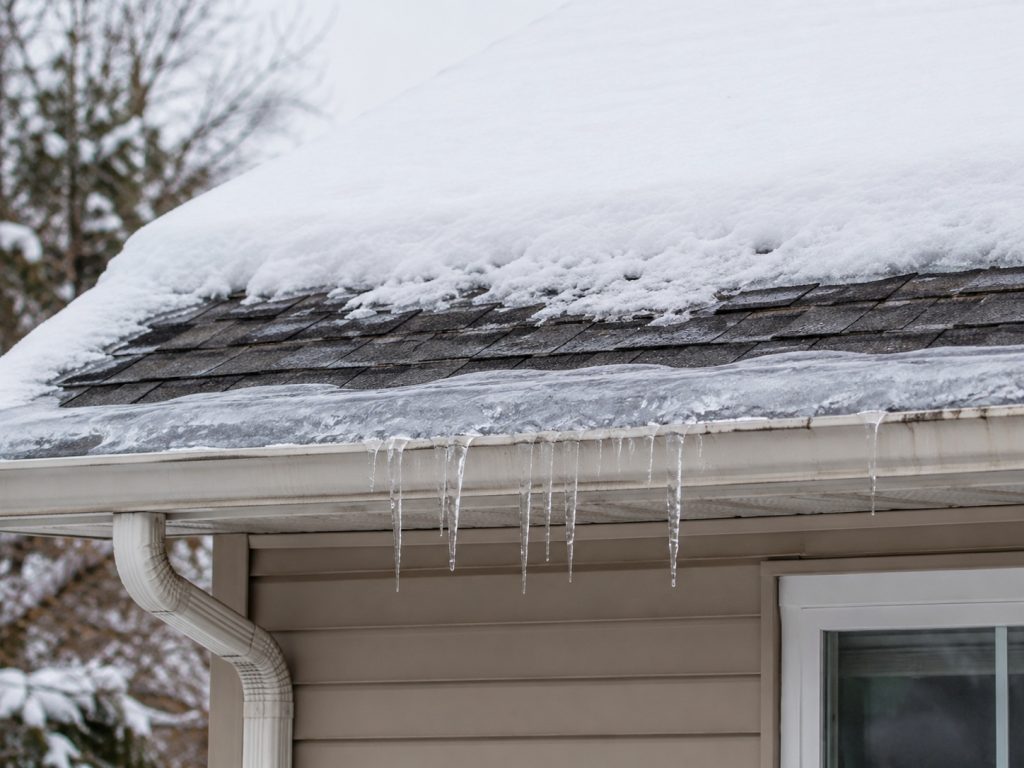
Icicles alone do not prove that a serious ice dam is present. Icicles can develop under several winter conditions. Recurring roof-edge ice combined with uneven snowmelt across the roof is a stronger clue that heat is reaching the roof unevenly.
The Most Important Prevention Principle
The main prevention goal is to keep the roof surface as consistently cold as practical during freezing weather.
That does not mean cooling the house or trying to make the attic identical to outdoor conditions in every situation. It means reducing unnecessary heat transfer from the living space into the attic and roof assembly.
Air sealing, insulation, and ventilation each have different roles.
Air sealing limits uncontrolled movement of warm indoor air into the attic. Insulation slows heat transfer through building materials. Ventilation can help manage attic temperature and moisture when the attic is designed to be vented.
These measures work together, but ventilation should not be treated as a substitute for excessive heat loss from the house.
Reduce Attic Air Leakage
Warm indoor air can move into the attic through openings in the ceiling plane.
Potential leakage areas may include attic access openings, plumbing and wiring penetrations, duct penetrations, light fixtures, and other ceiling openings. Even relatively small openings can allow warm air to enter the attic repeatedly during cold weather.
That added heat may warm the roof enough to contribute to uneven snowmelt.
Homeowners should avoid treating air sealing as a simple matter of filling every visible opening. Some areas involve electrical requirements, combustion clearances, heat-producing equipment, or ventilation paths that should not be blocked or altered casually.
Recurring ice dams or obvious uneven snowmelt can justify a professional energy or attic evaluation. The objective is to identify where heat is escaping and determine which improvements are appropriate without creating new safety or moisture problems.
Check Insulation Continuity
Insulation helps slow heat transfer from the living space toward the attic and roof.
Its effectiveness depends not only on having insulation present but also on whether it is reasonably continuous and properly installed. Gaps, thin areas, compressed insulation, and poorly insulated transitions can allow more heat to move upward in certain locations.
That can help explain why one section of roof melts snow faster than another.
Insulation and air sealing should not be treated as the same thing. Insulation limits heat transfer through materials, while air sealing limits uncontrolled air movement through openings and gaps.
Both can matter when trying to reduce roof warming.
Avoid assuming that simply adding more insulation will solve recurring ice dams if significant air leakage remains. Also avoid relying on one universal insulation value without considering the home’s construction, climate, existing materials, and local requirements.
Understand the Role of Attic Ventilation
Attic ventilation can help manage temperature and moisture, but it is not the primary cure for major heat leakage from the living space.
In a properly designed vented attic, airflow can help keep attic and roof conditions closer to outdoor temperatures. That can reduce the temperature differences that contribute to uneven snowmelt.
However, more ventilation is not automatically better.
Blocked intake vents, obstructed airflow, poorly coordinated vent locations, or insulation blocking soffit ventilation paths can reduce the effectiveness of the system. Adding vents without understanding the existing design can also fail to address the actual cause.
Ventilation should therefore be considered as one part of the overall attic system rather than a stand-alone fix for ice dams.
Do not attempt roof-vent installation or modification as a winter DIY response to recurring ice.
Make Sure Exhaust Ducts Vent Outdoors
Bathroom and kitchen exhaust systems should not terminate inside the attic.
These ducts carry warm, moisture-laden air from the living space. If that air is discharged into the attic, it adds both heat and moisture.
The additional heat can contribute to roof warming, while the moisture may create frost, condensation, or other winter attic problems.
From the ground, homeowners may be able to identify exterior exhaust outlets serving bathrooms or kitchens. Concealed duct routing, however, may be difficult to confirm without access to the attic or building cavities.
Do not crawl through unsafe attic areas simply to trace ductwork. If routing is uncertain, professional inspection is safer.
Keep Roof Drainage Paths Functional
Gutters and downspouts do not prevent the uneven roof temperature that creates an ice dam. They still matter because meltwater needs a path away from the roof when temperatures permit.
Before winter, obvious visible problems such as damaged gutters, disconnected downspouts, or known drainage restrictions should be addressed.
During winter, observe drainage only from the ground. Do not climb a ladder to clear frozen gutters or pull ice from the roof edge.
If a downspout not draining appears to be restricting meltwater flow during thawing conditions, the drainage problem should be evaluated separately from the underlying ice-dam cause.
Functional drainage helps manage water, but it does not replace the need to control attic heat loss.
What Gutter Guards Do and Do Not Change
Gutter guards can affect how leaves, snow, and ice behave around the gutter edge.
They do not usually create the underlying attic heat-loss condition responsible for a true ice dam. Likewise, installing guards does not automatically prevent ice dams if the roof is being warmed from below.
Winter performance can vary depending on the guard design, roof configuration, snow conditions, and other factors.
Homeowners wondering whether gutter guards cause ice dams should consider them as one part of the roof-edge environment rather than the primary cause of attic-driven ice damming.
Avoid broad conclusions that gutter guards always cause or always prevent winter icing.
Uneven Snowmelt Is an Important Clue
Snow patterns on the roof can provide useful information when observed from a safe ground-level location.
Bare patches surrounded by snow, snow melting faster over certain rooms, recurring melt channels, or ice repeatedly forming along the same eaves may indicate that heat is reaching the roof unevenly.
These observations do not identify the exact air leak or insulation defect. They simply show that one part of the roof may be receiving more heat than another.
Comparing roof sections over several cold-weather events can be more useful than judging conditions during a single storm.
Photos taken safely from the same location can help document whether the same patterns return.
Why Recurring Ice Dams Deserve Investigation
One unusual winter event does not automatically prove there is a major building problem.
A combination of heavy snow, rapid temperature swings, sun exposure, and unusual weather may create temporary icing even on a generally well-performing roof.
Recurring ice dams are different. When the same roof areas repeatedly develop ice during normal winter conditions, the conditions causing roof warming may still be present.
Repeated problems may justify evaluation of air leakage, insulation, ventilation, exhaust routing, roof drainage, and attic moisture.
Recurring ice dams do not automatically prove structural failure. They do indicate that repeated melting and refreezing deserves more than temporary ice removal.
What Homeowners Can Safely Observe
Homeowners can gather useful information without climbing onto the roof.
Watch whether ice repeatedly forms in the same areas and whether snow melts unevenly across different roof sections. Notice whether one portion of the roof clears much faster than another or whether icicles appear in the same locations each winter.
During safe thawing conditions, observe whether gutters and downspouts appear to drain or whether water remains trapped.
If the home has a safe, established attic access location with proper footing, visible frost or moisture near that access can be noted without venturing into unsafe areas. Do not crawl across joists, disturb wiring, or enter areas where secure footing is not available.
Exterior exhaust outlets may also be visible from the ground.
Keep notes or photographs showing whether the condition occurs every winter or only during unusually severe weather.
Common Ice-Dam Prevention Mistakes
A common mistake is assuming that gutters themselves cause ice dams. Gutters can become part of the visible ice buildup, but a true ice dam usually begins with uneven roof temperatures.
Another mistake is adding ventilation without addressing major attic air leakage. Ventilation may help manage attic conditions, but it cannot compensate for large amounts of warm indoor air escaping through the ceiling.
Similarly, adding insulation while leaving significant air leaks untreated may not solve the underlying problem.
Insulation should not be allowed to block intended soffit ventilation paths, and bathroom or kitchen exhaust should not terminate in the attic.
Winter safety mistakes are especially serious. Do not climb onto an icy roof, chop ice from the roof edge, perform ladder-based frozen-gutter work, or stand beneath heavy icicles.
Finally, do not assume that icicles alone prove severe ice damming. The more important pattern is recurring roof-edge ice combined with uneven snowmelt or repeated winter moisture problems.
When to Call a Professional
Professional evaluation is appropriate when ice dams recur, roof snow melts unevenly each winter, or attic access is unsafe.
Help may also be appropriate when insulation or air-sealing problems are suspected, ventilation appears blocked or poorly designed, exhaust ducts terminate in the attic, or attic frost and moisture return repeatedly.
Roof leaks that appear during freeze-thaw cycles also deserve professional evaluation.
Electrical or combustion equipment can complicate attic work and should not be disturbed by inexperienced homeowners. Roof-level work should likewise be left to qualified professionals.
Depending on the suspected cause, the appropriate professional may be an insulation or weatherization contractor, building-performance specialist, or qualified roofer.
Final Thoughts
The best answer to how to prevent ice dams is to address the heat that reaches the roof through the attic.
Air sealing, continuous insulation, appropriate attic ventilation, proper exhaust routing, and functional drainage work together.
Do not rely on gutter cleaning or visible ice removal as the primary long-term solution.
Keep homeowner observations at ground level and have recurring problems professionally evaluated.