Pipe Insulation to prevent freezing: what homeowners should know
Pipe insulation to prevent freezing can reduce the risk of exposed water pipes freezing by slowing heat loss, but insulation does not create heat or guarantee that a pipe will stay above freezing. It works best as one part of a broader freeze-prevention strategy that also addresses cold-air exposure, outdoor faucet preparation, and vulnerable plumbing locations.
| Insulation Type | Best Fit | What to Compare | Main Caution |
|---|---|---|---|
| Foam pipe sleeves | Accessible indoor water pipes | Diameter, thickness, slit style | Gaps reduce protection |
| Rubber pipe insulation | Locations needing flexibility or moisture resistance | Diameter, thickness, ratings | Not all products are outdoor-rated |
| Fiberglass pipe insulation | Some exposed pipe applications | Size, thickness, protective covering | Requires careful handling |
| Self-sealing sleeves | Straight, accessible pipe runs | Fit, adhesive closure, thickness | Surfaces and seams need proper fit |
| Outdoor-rated insulation | Approved exterior applications | Weather, moisture, temperature ratings | Indoor insulation may not be suitable outside |
Where Pipe Insulation to Prevent Freezing Helps Most
Pipe insulation is most useful where accessible water lines are exposed to colder conditions than the main living space.
Common locations include:
- Garages
- Crawl spaces
- Basements
- Utility rooms
- Exterior-wall areas
- Under sinks on cold exterior walls
- Areas near drafts
- Other unconditioned or semi-conditioned spaces
A water pipe running through a consistently heated interior room generally faces a different level of freezing risk from one passing through a cold garage or drafty crawl space.
Start by identifying where plumbing is exposed to the lowest temperatures. Pay particular attention to pipes near exterior openings or places where cold air can reach the plumbing directly.
Insulating the most vulnerable accessible runs is usually more useful than assuming every water pipe in the home needs insulation for freeze protection.
What Pipe Insulation Actually Does
Pipe insulation slows the transfer of heat from warmer water and piping to colder surrounding air.
That can delay how quickly a pipe cools during freezing weather and provide additional protection during cold periods.
However, passive insulation does not:
- Generate heat
- Repair a plumbing leak
- Thaw an already frozen pipe
- Guarantee protection during prolonged extreme cold
- Overcome severe cold-air infiltration by itself
This distinction matters when planning frozen pipe prevention.
A heavily insulated pipe can still eventually reach dangerously low temperatures if the surrounding area remains cold enough for long enough. Likewise, insulation may provide limited protection if freezing outdoor air is continuously blowing across the pipe.
Think of insulation as a way to slow heat loss, not as a heat source.
Choosing the Right Type of Pipe Insulation
For most homeowners, product selection starts with pipe size, location, insulation material, and the conditions the product is designed to handle.
There is no single insulation type that is automatically right for every pipe.
Foam Pipe Sleeves
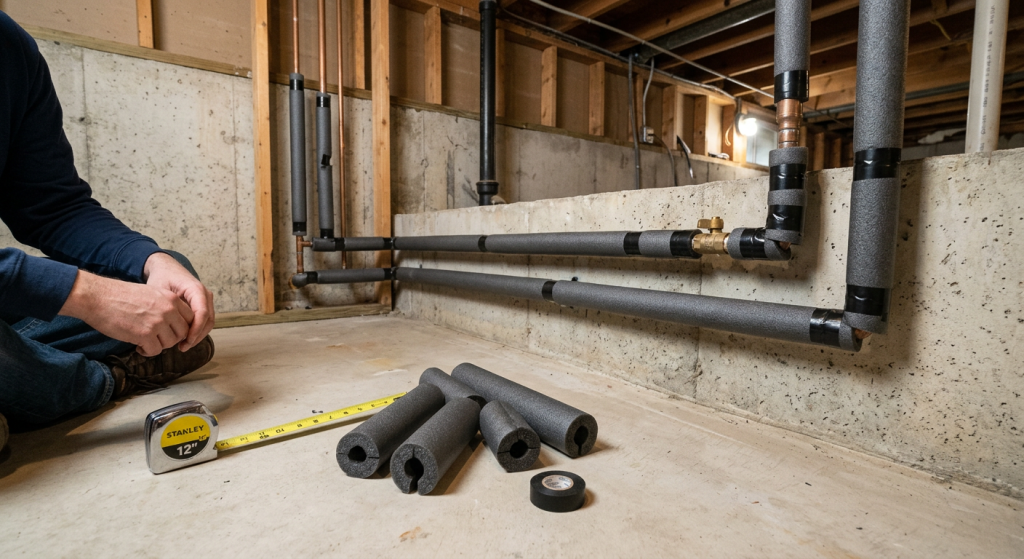
Foam sleeves are a common beginner-friendly choice for accessible indoor water lines.
They are typically formed into tubes with a slit that allows the sleeve to fit around an existing pipe. Some versions have self-sealing edges, while others require the seams or joints to be secured according to the product instructions.
When comparing foam sleeves, look at:
- Correct pipe diameter
- Insulation thickness
- Slit or self-sealing construction
- Intended location
- Product temperature ratings
- Ease of fitting around the pipe
The sleeve should fit around the pipe without being stretched excessively or leaving large gaps.
At elbows, tees, and other fittings, the goal is reasonable insulation continuity rather than a complicated custom installation.
Rubber Pipe Insulation
Flexible rubber insulation can be useful where flexibility, moisture resistance, or easier fitting around certain pipe arrangements is valuable.
As with foam products, compare the intended pipe diameter and insulation thickness.
Also check:
- Indoor or outdoor rating
- Moisture resistance
- Temperature rating
- Intended plumbing application
- Closure or sealing method
Do not assume that all rubber insulation is suitable for outdoor exposure. A material that works well in a basement or utility space may not be designed for sunlight, weather, or exterior temperature conditions.
Use the product’s stated application rather than relying on material type alone.
Fiberglass Pipe Insulation
Fiberglass pipe wrap or formed fiberglass insulation is another option used in some pipe applications.
Its suitability depends on the product, pipe location, and required protection. Some fiberglass insulation systems also require an appropriate outer covering or other protection.
Wear suitable protective clothing and gloves when handling fiberglass products, avoid unnecessary skin contact, and follow the manufacturer’s handling instructions.
For a straightforward exposed indoor water line, a preformed foam or rubber sleeve may be simpler for many beginner homeowners. Fiberglass remains an option where its characteristics fit the application.
Measure Before Buying Pipe Insulation
Correct sizing matters.
Pipe insulation is generally selected to fit the outside diameter of the pipe it will cover. Do not rely on appearance alone when choosing a sleeve.
Measure the pipe and compare that measurement with the insulation manufacturer’s sizing information.
A sleeve that is too small may not close correctly. Stretching or forcing it can leave an open seam.
A sleeve that is too large can leave excessive space around the pipe or create gaps that reduce the usefulness of the insulation.
If you plan to insulate several pipe runs, check their sizes individually. Do not assume every visible water line in the area has the same diameter.
Knowing the correct size before shopping also makes it easier to compare materials and insulation thickness without guessing at fit.
How Much Insulation Thickness Do You Need?
Thicker insulation generally provides greater resistance to heat loss than a thinner layer of the same type, but that does not mean the thickest available product is automatically the correct choice.
Consider:
- Available clearance around the pipe
- Pipe location
- Severity of cold exposure
- Product rating
- Indoor or outdoor use
- Manufacturer instructions
A pipe tightly positioned beside a wall may have less room for a thick sleeve than a pipe running through an open basement.
Avoid relying on a universal insulation thickness or R-value as a guarantee against freezing. Actual freeze risk depends on more than the insulation itself, including temperature, duration of cold exposure, drafts, and the surrounding space.
Pay Attention to Elbows, Tees, and Valves
A long insulated pipe run can still have vulnerable areas where the insulation stops at fittings.
Elbows, tees, transitions, and valves can interrupt an otherwise continuous sleeve. When selecting insulation, consider whether the material can be fitted reasonably around those areas without interfering with plumbing controls.
Do not cover shutoff handles or controls that need to remain accessible.
You should still be able to identify and operate a shutoff valve after nearby piping is insulated.
If a valve is already difficult to operate, do not use tools or extra leverage to force it simply because you are preparing the pipe for winter. Water Shut-Off Valve Won’t Turn: What Homeowners Should Know explains the safer approach to a stuck or corroded shutoff.
Insulation should protect accessible plumbing without hiding controls you may need during an emergency.
Never Insulate Over an Active Leak or Damaged Pipe
Inspect the pipe before covering it.
Do not install insulation over a pipe, valve, or fitting that is actively leaking. Insulation can hide moisture and make it harder to notice whether the leak is getting worse.
Stop if you find:
- Active dripping
- A cracked pipe
- Bulging or distorted pipe
- A damaged fitting
- Significant corrosion associated with leakage
- A pipe that is already frozen
Address the underlying plumbing condition first.
Insulation cannot repair damaged plumbing, and covering a questionable section can make later inspection more difficult.
A pipe suspected of being frozen also requires a different response. Do not simply wrap additional insulation around it and assume the problem is solved.
Cold Air Leaks Can Undermine Pipe Insulation
The temperature around the pipe matters as much as the fact that the pipe is insulated.
A water line near a strong exterior draft can cool rapidly during freezing weather. Insulation can slow that process, but persistent cold-air infiltration may still leave the pipe vulnerable.
Look for obvious cold-air exposure around accessible plumbing areas, such as openings where freezing air enters a garage, crawl space, basement, or utility area.
Appropriate air sealing may be part of the broader solution, but keep the plumbing itself accessible and avoid covering moisture problems or unsafe conditions.
Insulation works best when it is not being asked to compensate for severe cold air continuously reaching the pipe.
Pipes Under Sinks on Exterior Walls Need Extra Attention
Sink plumbing against an exterior wall can become significantly colder than the room itself, particularly when pipes sit inside an enclosed cabinet.
Insulating accessible supply piping may help slow heat loss.
During severe cold, however, insulation may not be enough by itself. The temperature around the plumbing, cold-air leakage, wall construction, and duration of the freeze all affect the risk.
Avoid treating any single temporary measure as guaranteed protection.
If you are insulating pipes inside a cabinet, keep shutoff valves accessible and continue watching for leaks or unusual moisture.
Outdoor Faucets Need More Than Nearby Pipe Insulation
Insulating an interior pipe that supplies an outdoor faucet is not the same as winterizing the faucet itself.
Garden hoses and accessories can trap water, and some outdoor faucet systems have dedicated winterization requirements.
If an exterior hose bibb is part of the vulnerable plumbing, follow the appropriate seasonal preparation rather than relying only on insulation around nearby piping. How to Winterize an Outdoor Faucet Before Freezing Weather covers hose removal, drainage, indoor shutoffs, frost-free faucets, and faucet covers.
Insulation can complement those measures, but it does not replace them.
What About Heat Cable or Heat Tape?
Electric heat cable is different from passive pipe insulation because it actively supplies heat.
That also introduces additional requirements and risks.
Products can have specific limits for pipe materials, insulation, overlap, placement, electrical supply, temperature control, and indoor or outdoor use. Improvised installation can create overheating, electrical, or fire hazards.
Do not treat generic heat tape as something that can simply be wrapped around any vulnerable pipe.
If active heating is needed, use only equipment specifically approved for the application and follow its installation requirements. Electrical work or conditions beyond normal plug-in product use should be handled by an appropriately qualified professional.
If the Pipe Is Already Frozen
Pipe insulation is a preventive measure, not the immediate solution to an already frozen pipe.
Do not use a torch, open flame, or propane heater directed at plumbing. Avoid improvised electrical heating and unattended high-heat devices.
A frozen pipe may also be cracked without producing an obvious leak while the water remains frozen. Leakage can begin when the pipe thaws.
If the pipe is bulging, cracked, inaccessible, near unsafe electrical conditions, or begins leaking as it thaws, stop and get qualified help.
What to Compare Before Buying
When shopping for pipe insulation, focus on whether the product actually fits the pipe and environment rather than choosing solely by price or material name.
Compare:
- Pipe diameter
- Insulation thickness
- Foam, rubber, fiberglass, or other approved material
- Self-sealing versus non-self-sealing design
- Moisture resistance
- Indoor or outdoor rating
- Temperature rating
- Space available around the pipe
- Ease of fitting around the actual pipe run
A well-fitted product designed for the location is more useful than an insulation sleeve that is too large, cannot close properly, or is not rated for the environment.
Final Thoughts
Pipe insulation to prevent freezing is most useful on accessible water lines in colder garages, crawl spaces, basements, exterior-wall areas, and other vulnerable locations. Choose insulation that fits the pipe’s outside diameter, compare thickness and material, and make sure the product is rated for the environment where you plan to use it.
Remember that insulation only slows heat loss. It cannot repair leaks, thaw frozen plumbing, eliminate severe drafts, or guarantee freeze protection during prolonged cold. Combine appropriate pipe insulation with attention to cold-air exposure, accessible shutoffs, outdoor faucet winterization, and the overall temperature around vulnerable plumbing.