Rubber vs vinyl garden hose for everyday use
Rubber vs vinyl garden hose for everyday yard use is a practical question because the right choice depends less on marketing and more on how often you use the hose, how much weight you want to handle, and how rough your yard work tends to be. For many homeowners, the better hose is the one that feels easy enough to use regularly without wearing out too quickly.
At a basic level, rubber hoses are usually heavier, more durable, and better at handling tougher conditions. Vinyl hoses are usually lighter, cheaper, and easier to carry, but they often do not hold up as well over time.
That does not mean one is always right and the other is always wrong. A small yard with light watering needs may do just fine with vinyl. A homeowner who drags a hose across concrete, around corners, and through frequent yard work may be much happier with rubber.
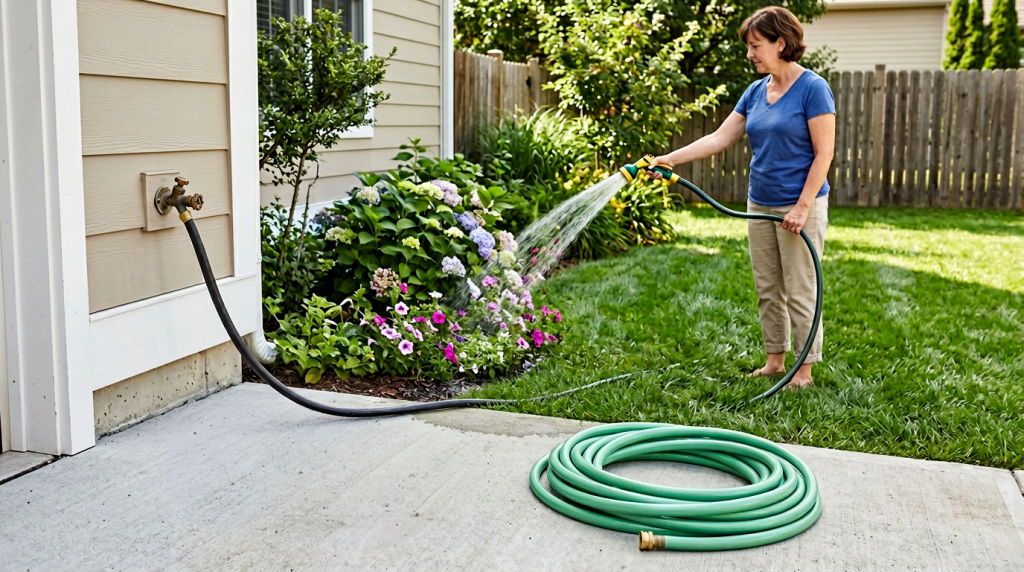
What is the difference between rubber and vinyl hoses?
The main difference is the material used to make the hose body.
A rubber hose is usually built for heavier-duty use. It tends to stay more flexible across a wider range of conditions and often handles wear better.
A vinyl hose is usually made to be more budget-friendly and lightweight. It can be easier to lift and store, especially for quick watering jobs, but it may kink more easily or wear out faster depending on the build quality.
Some hoses are also made as hybrid hoses, which means they combine materials to balance flexibility, weight, and durability. Those can be good middle-ground options, but when comparing basic rubber vs vinyl, the choice is usually between toughness and light handling.
Rubber vs Vinyl Garden Hose for Everyday Yard Use
When comparing rubber vs vinyl garden hose for everyday yard use, the biggest trade-off is durability versus convenience.
Rubber hoses are usually stronger and longer-lasting, especially if the hose sees regular use. They often handle hot weather, rough surfaces, and frequent dragging better than vinyl.
Vinyl hoses are usually lighter and less expensive. That makes them appealing for homeowners who want something simple for occasional watering, patio plants, or small-yard use.
Here is the simplest way to think about it
- Choose rubber if you want durability and heavier use performance
- Choose vinyl if you want a lighter hose for basic tasks
- Choose based on how often the hose will be used, not just on price
- Expect rubber to feel sturdier and vinyl to feel easier to carry
- Remember that a better-built hose of either type can outperform a cheap one
For many homeowners, rubber vs vinyl garden hose for everyday yard use comes down to whether the hose is a light convenience tool or a regular work tool.
Why some homeowners prefer rubber hoses
Rubber hoses are often the better fit for homeowners who use a hose often and want something that can take more abuse.
They are commonly chosen for larger yards, more frequent watering, washing driveways, rinsing equipment, and other jobs where the hose gets dragged, twisted, and left outside more often.
Rubber hoses usually offer these advantages
- Better durability for regular yard work
- Better resistance to rough handling
- More reliable flexibility in demanding conditions
- Less chance of feeling flimsy during use
- A longer service life in many homes
The trade-off is weight. A rubber hose can feel noticeably heavier than vinyl, especially in longer lengths. That can matter if you want something easy to carry around a small yard.
Why some homeowners prefer vinyl hoses
Vinyl hoses are usually chosen for one simple reason: they are easier to handle.
If your yard is small, your watering jobs are light, and you do not want to wrestle with a heavy hose, vinyl can be a practical choice. It often works well for beginner homeowners who mainly water flower beds, small lawns, or patio containers.
Vinyl hoses usually offer these advantages
- Lower cost
- Lighter weight
- Easier carrying for quick jobs
- Simpler storage in small garages or sheds
- Good fit for occasional or light-duty use
The main drawback is that many vinyl hoses are less durable than rubber. They may be more likely to kink, split, or wear down if they are used heavily or stored poorly.
Which hose is better for a small yard?
In many small yards, vinyl is often enough.
If you are watering a few beds, some containers, or a compact lawn area, a lightweight vinyl hose can be easier to live with from day to day. It is less tiring to pull around, easier to coil up, and usually cheaper to replace.
But small yard does not automatically mean vinyl is best. If you are rough on equipment, leave your hose outdoors often, or want to buy one hose and keep it longer, rubber may still be the better value.
A vinyl hose often makes sense when
- You have a small yard
- You mainly do light watering
- You want a lower upfront cost
- You care more about easy carrying than maximum durability
- The hose will not be used hard every week
A rubber hose often makes sense when
- You use the hose frequently
- You drag it across concrete or rough edges
- You want something sturdier
- You do heavier cleanup or washing jobs
- You would rather buy once and keep it longer
If your main goal is finding a hose that feels easier to handle in a compact space, read our guide on best garden hose for homeowners with small yards.
Which hose is better for frequent use?
For frequent use, rubber is usually the stronger choice.
If you water several times a week, wash tools, rinse off hard surfaces, or use the hose for many different tasks, rubber often holds up better. It generally feels more dependable when the hose is under regular strain.
This is especially true if you use a longer hose or keep it outside during the season. Frequent use tends to expose weak spots faster, and heavier-duty materials usually perform better in that kind of routine.
Which hose is easier to store?
Vinyl is usually easier to store because it is lighter.
That matters more than many homeowners expect. A hose that is easier to lift, coil, and hang up often becomes less frustrating to use. In smaller homes with limited garage or shed space, that can be a real benefit.
Rubber hoses can take up more space and feel heavier when coiling them onto a reel or hanging them on a wall hook. They are manageable, but they are not as effortless.
Vinyl is usually easier for storage if you want
- Less weight to carry
- Faster cleanup after watering
- Easier lifting onto a hook or reel
- A simpler option for older homeowners or beginners
- Less hassle in a tight storage area
If you also want a cleaner way to manage that hose once you are done watering, our guide on best wall-mounted hose reel for homeowners will help you choose the right storage setup.
What about kinks and flexibility?
This is where quality matters a lot.
In general, cheap vinyl hoses are more likely to kink than good rubber hoses. Rubber usually feels more supple and less stiff in use, especially when the hose is being pulled around corners or across a yard.
Still, not every vinyl hose kinks badly, and not every rubber hose is perfect. Hose construction, reinforcement, and fittings also affect how the hose behaves.
For everyday homeowner use, the safest assumption is that rubber usually gives a more durable, less flimsy feel, while vinyl usually wins on lighter handling.
Safe DIY checks before you buy
Before choosing a hose, it helps to look at how the hose will actually be used around your home.
That can prevent buying something too heavy, too weak, or longer than you need.
Check these things first
- Measure how far the hose needs to reach from the spigot
- Think about whether you mostly water plants or also do cleanup work
- Decide how often the hose will be used each week
- Look at where the hose will be stored
- Notice whether you often drag hoses over rough surfaces
- Think about whether hose weight bothers you
- Check whether you need a shorter hose for a smaller yard
These are safe DIY checks for any homeowner and can make the choice much easier.
When a professional issue is the real problem
Sometimes homeowners blame the hose when the real problem is the faucet, water pressure, or connection point.
If the hose always leaks badly, loses pressure, or performs poorly no matter what you attach, the issue may not be the hose material at all.
A professional may be the better choice when
- The outdoor spigot leaks from behind the handle
- The faucet connection is damaged or corroded
- Water pressure is low throughout the home
- The hose bib moves or feels loose against the wall
- You see signs of plumbing leaks around the exterior faucet
That kind of problem is usually better handled by a plumber than solved with a different hose.
Common mistakes homeowners make when choosing a hose
A lot of bad hose purchases happen because homeowners focus only on price or only on weight.
The better choice usually comes from matching the hose to the job.
Avoid these common mistakes
- Buying the cheapest hose without thinking about how often it will be used
- Choosing a heavy rubber hose for a tiny yard with very light watering needs
- Choosing a light vinyl hose for frequent rough-use jobs
- Buying more hose length than you actually need
- Ignoring storage space
- Assuming all hoses made from the same material perform the same way
The best hose for your home is the one that fits your yard size, workload, and comfort level.
So which one should most homeowners choose?
For light everyday watering in a small or average yard, a vinyl hose is often the easier and more budget-friendly pick.
For heavier use, longer-term durability, and more demanding yard work, a rubber hose is often the better investment.
If you want the simplest recommendation, it usually looks like this: choose vinyl for lighter, occasional homeowner use and choose rubber for tougher, more frequent use.
Final thoughts
Rubber vs vinyl garden hose for everyday yard use is really a choice between tougher performance and easier handling. Rubber is usually stronger, heavier, and better for frequent work. Vinyl is usually lighter, cheaper, and better for lighter-duty watering around the house.
For many beginner homeowners, the right answer is not about finding the strongest hose on the shelf. It is about finding a hose that fits your yard, your routine, and the kind of jobs you actually do. A lighter hose you enjoy using is often better than a heavy one that feels like a chore every time you pull it out.