Smart Thermostat with an Older HVAC System: compatibility guide
Smart thermostat with older HVAC system compatibility depends more on the controls and wiring than on the age of the furnace, air conditioner, heat pump, or boiler. Many older systems use conventional low-voltage thermostat controls and can work with a compatible modern thermostat. The key is verifying voltage, terminals, equipment stages, power requirements, and whether the existing control is proprietary or communicating.
Quick Answer
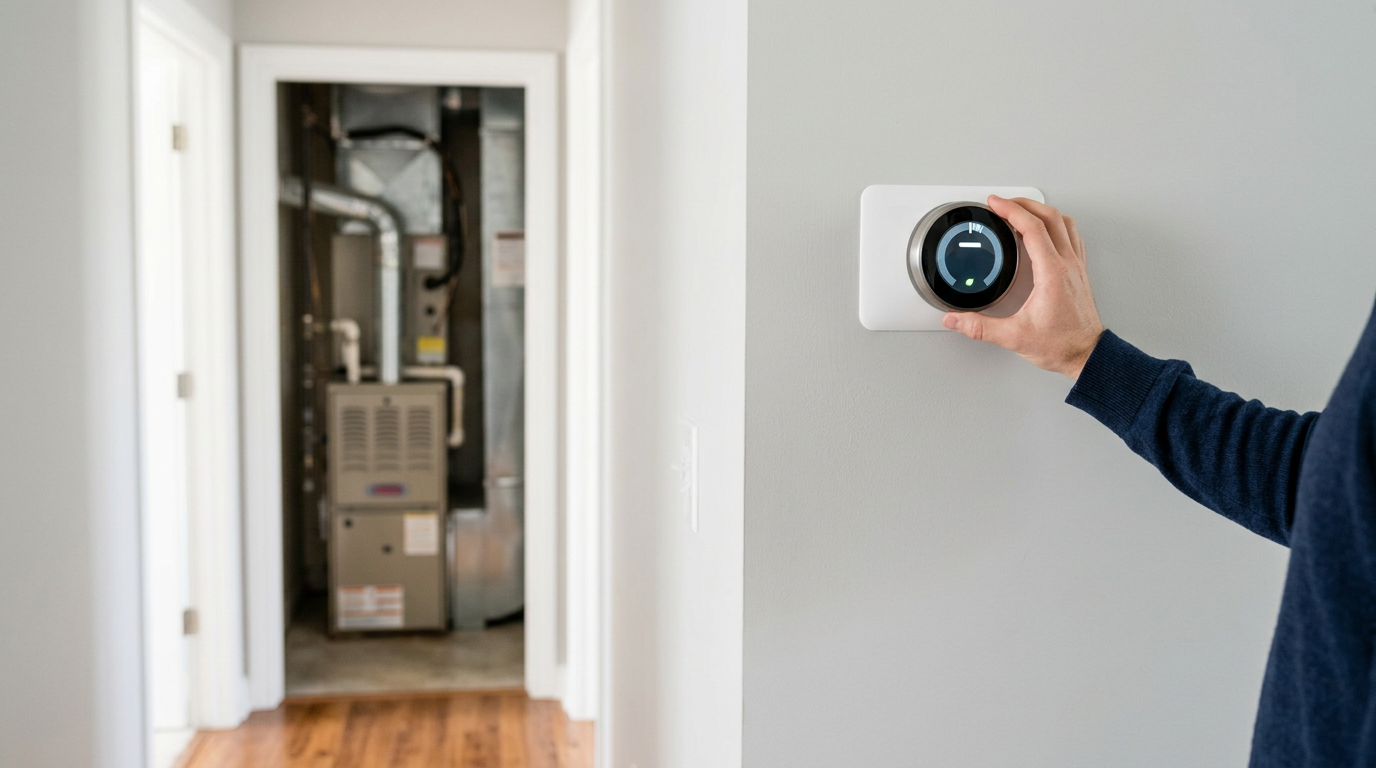
An older HVAC system is not automatically too old for a smart thermostat. A conventional furnace and central-air system using standard low-voltage thermostat wiring may be a straightforward match, while heat pumps, boilers, zoned systems, line-voltage heat, and communicating equipment need closer verification.
Before buying, identify the system and compare the existing thermostat terminals with the compatibility requirements for the exact thermostat model.
If you see thick wires, wire nuts, 120V or 240V markings, damaged wiring, brittle insulation, or unfamiliar proprietary terminals, replace the thermostat cover and contact a qualified professional.
Smart Thermostat With Older HVAC System: Compatibility at a Glance
| Existing system | Compatibility outlook | Main issue to verify | Recommended next step |
|---|---|---|---|
| Conventional single-stage furnace and central air | Often compatible | Low-voltage terminals and power | Use the exact model’s compatibility checker |
| Multi-stage furnace or air conditioner | May be compatible | Number of heating and cooling stages | Confirm thermostat stage support |
| Standard heat pump | Often possible | O/B control and compressor stages | Verify the complete heat-pump configuration |
| Heat pump with auxiliary or emergency heat | More complex | AUX/E terminals and staging | Consider professional verification |
| Dual-fuel heat pump and furnace | Specialized | Heat-pump and furnace coordination | Use professional installation |
| Heat-only boiler | Model-dependent | Voltage, switching method, and power | Verify exact boiler-control compatibility |
| Millivolt wall or floor heater | Limited | Millivolt controls | Use only a specifically compatible control |
| Zoned HVAC system | Model-dependent | Zone panel and thermostat power | Verify compatibility with the zoning system |
| Proprietary or communicating system | Often restricted | Manufacturer-specific communication | Check with the equipment manufacturer or dealer |
| Electric baseboard or other line-voltage heat | Usually incompatible with standard models | 120V or 240V controls | Do not connect an ordinary 24V thermostat |
No table can confirm a specific installation by itself. Smart thermostat compatibility ultimately depends on the exact thermostat and HVAC control configuration.
Why an Old HVAC System May Still Be Compatible
Many older furnaces and central-air systems use conventional low-voltage thermostat wiring. Standard residential controls commonly operate around 24 volts AC, allowing a thermostat to call for functions such as heating, cooling, or fan operation through familiar terminals.
That basic control method has been used for decades. A 20-year-old furnace could therefore be easier to pair with a modern thermostat than a newer high-efficiency system that relies on proprietary digital communication.
Equipment age, efficiency, and thermostat compatibility are separate questions. Never assume voltage or compatibility from the equipment’s appearance or age alone.
The Five Things That Determine Smart Thermostat Compatibility
Control voltage
Ordinary smart thermostats are commonly designed for low-voltage HVAC controls. Line-voltage thermostat systems and millivolt systems are different and require products specifically designed for those controls.
Terminal and conductor configuration
Terminal letters matter more than wire colors. What is connected to R, W, Y, G, C, O/B, AUX, or other terminals helps identify which functions the thermostat controls.
Heating and cooling stages
A multi-stage HVAC thermostat must support the number and type of stages the equipment actually uses. For example, equipment with W1 and W2 or Y1 and Y2 may have multiple controlled stages.
C-wire or approved power accessory
Wi-Fi, displays, sensors, and electronics need dependable power. Some thermostats require a thermostat C-wire, while others can operate on certain systems without one or support an approved power connector.
Conventional versus proprietary controls
A communicating HVAC system can exchange more information with its matched thermostat than conventional on/off control wiring does. Replacing that control with an ordinary smart thermostat may be unsupported or may remove important system functions.
Safe Checks Before Buying a Thermostat
Limit your inspection to the wall thermostat and information already safely visible on the equipment.
- Turn HVAC power off at the breaker or equipment disconnect according to the manufacturer’s instructions.
- Confirm the system does not respond when you make a temperature adjustment.
- Remove only a thermostat faceplate designed to detach without disturbing the wiring.
- Photograph the complete old HVAC thermostat wiring and all readable terminal labels.
- Record the existing thermostat model number.
- Identify the furnace, air conditioner, heat pump, boiler, or other equipment type from information visible without removing an equipment panel.
Do not disconnect or move wires, open HVAC or electrical panels, access a control board, test voltage, splice conductors, or install an adapter as part of this compatibility check.
Enter the terminal labels—not assumed wire functions based on color—into the smart thermostat compatibility checker for the exact model you are considering. Passing one manufacturer’s checker does not establish compatibility with another manufacturer’s thermostat.
Understanding Common Thermostat Terminals
These descriptions help identify functions; they are not a wiring diagram.
- R or Rc/Rh: Usually supplies low-voltage power to the thermostat.
- C: Common connection used to provide continuous thermostat power.
- W or W1/W2: Commonly associated with one or more heating stages.
- Y or Y1/Y2: Commonly associated with compressor or cooling stages.
- G: Commonly controls the indoor fan.
- O/B: Commonly operates a heat pump’s reversing valve.
- AUX or E: May control auxiliary or emergency heat on a heat-pump system.
Terminals marked A, B, C, D; 1, 2, 3; data; bus; or other unfamiliar designations can indicate specialized or proprietary controls. Those labels do not automatically prove the system is communicating, so verify them before replacing the thermostat.
Does an Older System Need a C-Wire?
A C-wire provides a continuous electrical path that some smart thermostats use for operating power. Some models require a connected C-wire, while others may operate without one on specific HVAC configurations.
Some thermostats also support a manufacturer-approved power connector or extender when the normal wiring cannot provide the required power.
A spare conductor behind the thermostat is not automatically a working C-wire. Its complete connection must be verified before it can be treated as one. If that verification requires equipment access, leave it to a qualified professional.
Follow the exact thermostat manufacturer’s requirements rather than assuming every smart thermostat with no C-wire works the same way.
Older Furnaces and Central-Air Systems
A conventional single-stage furnace and central air conditioner is often one of the simpler older systems to evaluate. Common low-voltage terminals may separately control heat, cooling, and the blower.
Multi-stage equipment needs more attention. A furnace with two thermostat-controlled heating stages or an air conditioner with multiple cooling stages needs a thermostat capable of controlling those stages correctly.
Accessories can matter too. Humidification, dehumidification, ventilation, and multi-speed blower functions may require additional compatibility.
A thermostat that powers on is not necessarily configured correctly. Incorrect equipment-type or staging settings can contribute to poor comfort, short cycling, lost functions, or inefficient equipment operation.
Heat Pumps and Dual-Fuel Systems
A smart thermostat with heat pump equipment must support more than basic heating and cooling calls. It may need to operate compressor stages, the reversing valve, and auxiliary or emergency heat.
The thermostat also has to be configured for how that particular system uses the O/B reversing-valve control. Guessing at heat-pump settings can cause improper operation.
Dual-fuel thermostat compatibility is more specialized because the system combines a heat pump with another heat source, commonly a furnace. Proper control determines when each source should operate.
Use professional verification when the heat-pump wiring is unclear, when auxiliary or emergency heat is involved, or when the system is dual fuel. Configuration errors can cause excessive auxiliary-heat use, comfort problems, or incorrect equipment operation.
Boilers, Radiators, and Two-Wire Heating Systems
A smart thermostat with boiler equipment is possible in some homes, but “two wires” does not describe one universal control system.
Boilers and other heat-only systems may use conventional low-voltage switching, millivolt controls, dry contacts, relays, or zone valves. Some combinations work directly with specific thermostats, while others require approved accessories or professional modifications.
Do not assume a smart thermostat for old furnace wiring will also work with a boiler simply because both thermostats have two conductors. Verify the exact control requirements.
Zoned HVAC Systems
A smart thermostat with zoned HVAC must work with the existing zone-control equipment, not merely with the furnace or air conditioner.
A zoned home may have several thermostats connected to a zone panel that manages dampers and equipment calls. Power requirements can also differ by zone or control-panel design.
Record how many thermostats serve the home and use the proposed thermostat’s compatibility information for zoned systems. Do not reconfigure zone-panel wiring as part of a beginner smart thermostat installation.
Proprietary and Communicating HVAC Systems
Some variable-capacity and high-efficiency equipment uses a proprietary thermostat or communicating wall control matched to the HVAC system.
Those controls may manage functions that a conventional thermostat cannot reproduce, including:
- Variable-capacity or modulating operation
- Equipment staging
- Blower-speed control
- Humidity management
- Equipment diagnostics
- Accessory control
Replacing a matched communicating control with a standard smart thermostat can remove some of those functions even if an installer can make the equipment heat or cool.
Before replacing a branded communicating thermostat, check with the HVAC equipment manufacturer or a qualified dealer. An approved interface may exist in some cases, while other systems are designed to keep their manufacturer-specific control.
Line-Voltage and Millivolt Warning Signs
Electric baseboard heaters and some wall-heating systems commonly use a line-voltage thermostat instead of ordinary low-voltage thermostat wiring.
Thick wires, wire nuts, or markings such as 120V or 240V are warning signs. Do not connect an ordinary 24-volt smart thermostat directly to that wiring, and do not attempt a voltage conversion yourself.
Millivolt systems are also different from standard 24-volt systems. Some older wall or floor heaters use millivolt controls that require model-specific compatibility.
If you encounter either type, replace the cover and have the system identified before purchasing a thermostat.
Compatibility Checklist Before Purchasing
- Identify the heating and cooling system types.
- Record the existing thermostat model.
- Photograph every connected terminal and its label.
- Determine whether the home has one thermostat or zoning.
- Note heat-pump, auxiliary-heat, multi-stage, dual-fuel, humidity, or ventilation functions.
- Use the exact thermostat model’s compatibility checker.
- Confirm C-wire or approved power-accessory requirements.
- Verify whether the existing control is proprietary or communicating.
- Arrange professional installation when the system is specialized or uncertain.
Is a Smart Thermostat Worthwhile on Older Equipment?
A smart thermostat for older home HVAC equipment can still provide useful control features even when the furnace or air conditioner itself is not new.
Depending on the thermostat, benefits may include scheduling, remote temperature adjustments, automatic setbacks, equipment-use information, and maintenance reminders.
ENERGY STAR-certified smart thermostats have independently verified energy-saving performance based on field data. Actual household savings still vary with the HVAC equipment, climate, temperature settings, schedules, building condition, and occupant behavior.
A thermostat cannot correct inefficient equipment, leaky ductwork, excessive air leakage, poor insulation, or deferred maintenance. Treat it as a control improvement rather than an HVAC repair.
DIY Replacement Versus Professional Installation
A straightforward DIY replacement may be reasonable only when:
- The exact thermostat manufacturer confirms compatibility.
- The existing system is conventional low voltage.
- Terminal labels are clear and wiring is in good condition.
- No equipment-panel work or power-accessory installation is required.
- You can follow the exact manufacturer instructions without improvising.
Use a qualified HVAC professional for line-voltage or millivolt controls, unfamiliar boiler systems, uncertain heat-pump wiring, dual-fuel equipment, zoning, multi-stage or variable-capacity equipment, communicating controls, or any missing C-wire solution that requires equipment access.
Professional installation is also appropriate when wiring is brittle, damaged, spliced, undocumented, or otherwise unclear.
Frequently Asked Questions
Can a smart thermostat work with an old furnace?
Yes, many older furnaces use conventional low-voltage controls that can support a compatible smart thermostat. Verify the terminals, stages, and power requirements first.
Does HVAC equipment age determine thermostat compatibility?
No. Control voltage, wiring, system type, stages, power requirements, and control architecture matter more than age alone.
How do I check smart thermostat compatibility?
Identify the HVAC type, photograph the thermostat terminals with power off, record the current thermostat model, and enter the terminal labels into the exact proposed thermostat’s compatibility checker.
Can a smart thermostat work without a C-wire?
Some can on certain HVAC configurations. Others require a C-wire or an approved power connector, so follow the requirements for the specific thermostat.
Can I use a smart thermostat with a boiler?
Possibly. Boiler controls vary widely, and two-wire, millivolt, dry-contact, relay, and zone-valve systems require exact compatibility verification.
Can I use a smart thermostat with electric baseboard heat?
Most ordinary 24-volt smart thermostats cannot connect directly to line-voltage baseboard wiring. Use only a thermostat or professionally designed control solution intended for that system.
Can a smart thermostat work with a heat pump?
Yes, if the thermostat supports the heat pump’s compressor stages, reversing valve, and any auxiliary or emergency heat.
What is a communicating HVAC system?
It is a system in which matched components exchange more detailed control information than conventional thermostat wiring normally carries.
Will replacing a communicating thermostat remove HVAC features?
It can. Modulation, staging, blower control, humidity functions, diagnostics, or accessory control may be reduced or lost.
Can the wrong thermostat damage an HVAC system?
An incompatible or incorrectly configured thermostat can cause improper operation and equipment problems. Incorrect staging or equipment settings can also increase auxiliary-heat use or cause short cycling.
Does a smart thermostat save energy with older equipment?
It can help through scheduling, setbacks, and better control, but results depend on the equipment, home, climate, settings, and household habits.
When should a professional install the thermostat?
Use a professional when the controls are line voltage, millivolt, zoned, communicating, multi-stage, variable capacity, dual fuel, unusually wired, damaged, or otherwise uncertain.
Final Thoughts
A smart thermostat with older HVAC system equipment can be a practical upgrade when the controls are genuinely compatible. Identify the system type, photograph the existing terminal labels, use the compatibility checker for the exact thermostat model, and confirm its C-wire or approved power-accessory requirements before purchasing.
For conventional low-voltage systems, replacement may be straightforward. For heat pumps, boilers, zoning, dual-fuel equipment, line-voltage or millivolt controls, and proprietary or communicating systems, professional verification can prevent lost features, incorrect operation, and an incompatible thermostat purchase.