
solar vs electric attic fan: which makes more sense?
For a solar attic fan vs electric attic fan comparison, solar usually makes more sense when strong sunlight is available and low routine electrical use matters, while electric makes more sense when consistent operation and broader controls are priorities. Both still need adequate attic intake, and neither should compensate for blocked soffits, major air leakage, poor insulation, or unresolved moisture problems.
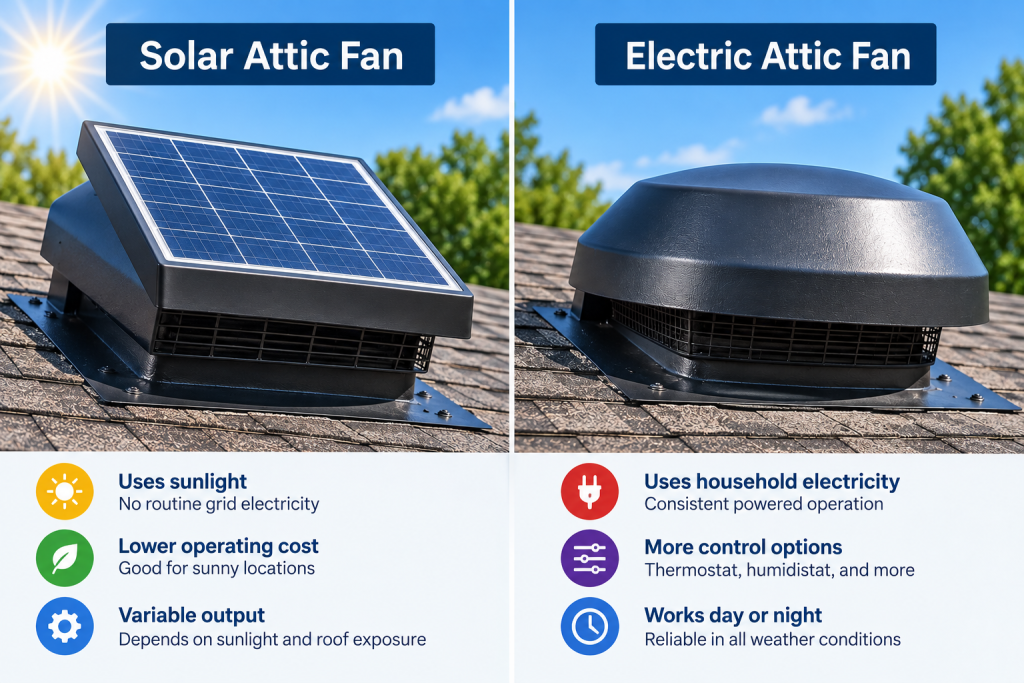
| Feature | Solar Attic Fan | Electric Attic Fan |
|---|---|---|
| Power source | Solar panel | Household electricity |
| Airflow consistency | Varies with sunlight | More predictable |
| Operating cost | No routine grid use during solar operation | Uses grid electricity |
| Controls | Varies by model | Often broader options |
| Installation | Roof or gable; solar exposure matters | Roof or gable plus electrical connection |
| Cloudy/night operation | Reduced or none on basic models | Available when controls call for it |
| Wiring needs | Often lower | Usually hardwired |
| Noise | Motor and vibration possible | Motor and vibration possible |
| Maintenance | Fan, panel, wiring, possible battery | Fan, controls, wiring, shutters |
| Best fit | Sunny locations where variable output is acceptable | Homes needing consistent powered airflow |
What Solar and Electric Attic Fans Do
Both are powered attic ventilators. They use a motor-driven fan to exhaust air from a conventional vented attic.
They differ from passive ridge, box, and gable vents, which rely on natural airflow, and from whole-house fans, which move air through living spaces.
A powered attic fan can increase attic air exchange when enough replacement air is available. It does not create intake ventilation, seal ceiling leaks, add insulation, or remove the source of attic moisture.
Some attics do not need powered ventilation. If passive ventilation, insulation, and air sealing already work well, adding a fan may provide little value.
Solar Attic Fan vs Electric: Main Tradeoffs
Solar attic fans
Solar attic fans use a solar panel to power the motor. Many are roof-mounted, although some gable-mounted models are available.
Their main advantage is that normal operation does not require routine grid electricity. Depending on the product, they may also reduce electrical wiring needs.
Solar output usually rises with available sunlight, which can coincide with strong roof heating. However, performance varies with shade, roof exposure, clouds, time of day, and product design.
Basic models may slow substantially or stop after sunset. Some products add batteries, thermostats, switches, or other controls, so compare actual features rather than assuming all solar fans behave alike.
A solar fan still needs adequate intake. Solar power does not prevent pressure problems if the fan removes more air than the attic can replace.
Electric attic fans
Electric attic fans use household electrical service and are often hardwired. They are available in roof-mounted and gable-mounted configurations.
Their main advantage is predictable powered operation. They can run during cloudy weather, at night, or whenever their controls call for operation.
Electric models also commonly offer thermostats, humidistats, combination controls, manual override, or programmable features.
The tradeoffs are electrical installation, ongoing electricity use, and potentially stronger or longer operation. A powerful electric fan can create significant negative pressure if attic intake is inadequate.
Compare Airflow and CFM Carefully
Both solar and electric attic fans are commonly rated in cubic feet per minute, or CFM.
Do not choose the highest CFM model automatically. Manufacturer sizing guidance, attic layout, intake capacity, and mounting location all matter.
A fan that is too large for the available intake may be noisier or more likely to draw air through unintended leakage paths.
Solar models may advertise maximum airflow under strong solar input, while actual output can fall as sunlight decreases. Electric models generally provide more predictable output when powered, but oversized airflow is still undesirable.
The better comparison is whether the fan provides the amount of powered exhaust the attic actually needs under realistic conditions.
Before comparing fan output, it helps to understand how passive attic intake and exhaust are sized, which our attic ventilation calculator explains.
Intake Requirements Matter for Both Types
Powered exhaust removes air from the attic, so replacement air must enter somewhere.
Before choosing either type, check:
- Soffit or eave intake
- Vents blocked by insulation
- Missing, crushed, or displaced baffles
- Divided attic sections that restrict airflow
- Whether intended intake openings actually communicate with the attic
If intake is inadequate, either fan can pull air through attic hatches, recessed-light openings, plumbing or wiring penetrations, and other leakage paths from the living space.
A solar fan does not avoid this risk because it uses solar power, and a powerful electric fan does not solve inadequate intake.
Solar Exposure and Controls
Solar fans depend on actual panel exposure, not simply whether the roof gets some sun.
Trees, nearby buildings, dormers, chimneys, roof orientation, and roof geometry can reduce solar input. There is no universal orientation that is best for every home, so evaluate the proposed mounting location based on its real exposure.
Basic solar fans may run whenever enough sunlight reaches the panel. Other models may add thermostats, switches, batteries, or more advanced controls.
Electric fans commonly offer thermostats, humidistats, combination controls, or programmable operation.
More controls provide flexibility, but they do not correct a poor ventilation system. If nighttime or cloudy-weather operation matters, electric models generally provide more consistent availability, while basic solar models may provide little or no output when solar input drops.
Installation Differences
Solar does not make installation risk-free.
A roof-mounted solar fan still requires a roof penetration unless it uses another configuration. Flashing and weatherproofing remain critical, and the solar panel adds another exterior component.
A roof-mounted electric fan requires the same roofing considerations plus an electrical connection.
Gable-mounted solar or electric models may avoid creating a new roof opening when a suitable gable location exists.
Do not climb steep roofs, cut roof openings, alter flashing, or work near roof edges without appropriate professional training and protection. Hardwired electrical work should follow manufacturer instructions and applicable electrical requirements, with a qualified electrician or other appropriate professional when needed.
Operating Cost, Noise, and Maintenance
Solar fans avoid routine grid electricity use during normal solar operation, but they are not “free ventilation.” Product cost, installation, maintenance, and future repair still matter.
Electric fans use household electricity whenever they operate. Their consistent output may be useful, but operating cost is part of long-term value.
Both types use motors and can create noise or vibration. Roof-mounted units may transmit sound through the roof structure, while gable-mounted fans may be noticeable near rooms close to the gable.
For solar fans, maintenance may involve the motor, panel, exterior wiring, debris or shading, and battery components if included. For electric fans, consider the motor, controls, wiring, shutters or louvers, and service access.
Neither type universally lasts longer. Durability depends on product quality, weather exposure, mounting, maintenance, and operating hours.
When Solar Makes More Sense
A solar attic fan may be the better fit when:
- Strong, reliable sunlight is available.
- Minimizing routine grid electricity use matters.
- Full nighttime operation is not important.
- The attic genuinely benefits from powered exhaust.
- Adequate intake already exists.
- The mounting location is practical.
- The fan’s realistic output suits the attic.
When Electric Makes More Sense
An electric attic fan may be the better fit when:
- Predictable operation is important.
- Cloudy or nighttime operation may be needed.
- Thermostat, humidistat, or programmable controls matter.
- Solar exposure is weak or inconsistent.
- Existing electrical access is convenient.
- The attic needs more consistent powered airflow.
The tradeoff is electrical installation and ongoing energy use in exchange for greater operating consistency.
When Neither Fan Makes Sense
Neither option should be the first solution when:
- Soffit intake is blocked or inadequate.
- Major attic-floor air leakage is present.
- Insulation is severely deficient or displaced.
- Bathroom or dryer exhaust enters the attic.
- Roof leaks or other moisture sources are unresolved.
- Existing passive ventilation is already adequate.
- The attic is conditioned or intentionally unvented.
- Combustion-safety concerns remain unresolved.
Correcting the underlying problem may provide more value than adding powered exhaust.
If you are still unsure whether powered ventilation is worthwhile, our guide to whether attic fans are worth it explains when a fan may help and when it may add little value.
Combustion safety applies to both
Solar and electric fans can both create negative pressure because both actively remove attic air.
In homes with atmospherically vented fuel-burning appliances or uncertain pressure relationships, have a qualified professional evaluate combustion safety before installing a powerful attic fan. Do not attempt pressure or combustion testing yourself.
Common Solar vs. Electric Attic Fan Buying Mistakes
Avoid these common mistakes:
- Assuming solar is automatically better because sunlight is free. Output, installation, and attic fit still matter.
- Assuming electric is automatically better because it is consistent. Consistent airflow only helps when powered exhaust is needed.
- Choosing by CFM alone. Match the fan to the attic and intake capacity.
- Ignoring intake requirements. Both types need replacement air.
- Choosing solar without checking shade.
- Ignoring nighttime or cloudy-weather needs.
- Overlooking noise or controls.
- Using a fan to compensate for blocked soffits.
- Overlooking ceiling air leakage.
- Assuming utility savings are guaranteed.
- Installing in a conditioned attic without understanding the assembly.
Frequently Asked Questions
Are solar attic fans better than electric attic fans?
Not universally. Solar can be a better fit where sunlight is reliable and low grid use matters, while electric is often better when consistent operation and broader controls are priorities.
Do solar attic fans work on cloudy days?
Usually at reduced output, depending on the panel, fan, and available sunlight. Battery-equipped systems may behave differently.
Do solar attic fans work at night?
Basic direct-solar models generally provide little or no nighttime operation. Battery-equipped models may continue running.
Do electric attic fans use a lot of electricity?
Energy use depends on the motor, airflow, controls, and operating time. Compare the product’s electrical specifications.
Which attic fan moves more air?
Either type can have different CFM ratings. Electric fans generally provide more predictable rated operation, while solar output can vary with sunlight.
Can solar attic fans cause negative pressure?
Yes. The power source does not change the airflow effect. A solar fan with inadequate intake can draw air through unintended openings.
Is a solar attic fan worth the extra cost?
It can be when solar exposure is strong, the attic genuinely needs powered exhaust, and reduced grid use matters. Higher upfront cost alone does not determine value.
Final Thoughts
Choose between a solar and electric attic fan based on solar exposure, airflow consistency, controls, intake capacity, installation requirements, operating cost, noise, and attic design.
Solar reduces routine grid electricity use but depends on sunlight; electric provides more predictable operation but uses household power. In some attics, neither powered option is necessary.