Splash Blocks for Downspouts: When They Work
Splash blocks for downspouts work best when the surrounding ground already slopes away from the house. They reduce erosion where concentrated water leaves the downspout and help direct the initial flow outward, but they move runoff only a short distance. A splash block cannot compensate for flat ground, inward slope, poor drainage, or persistent pooling beside the foundation.
| Site Condition | Splash Block Likely Enough? | Why |
|---|---|---|
| Ground slopes away well | Often | Runoff can continue moving after leaving the block |
| Flat yard | Often not | Water may stop and pool near the house |
| Ground slopes toward house | No | Runoff can return toward the foundation |
| Clay-heavy or slow-draining soil | Sometimes not | Water may remain near the discharge area |
| Modest roof runoff | Often | The block may handle the initial discharge adequately |
| Large roof drainage area | Less likely | Higher runoff volume may overwhelm the immediate area |
| Pooling already present | Usually not | The existing drainage path is already inadequate |
What Splash Blocks Actually Do
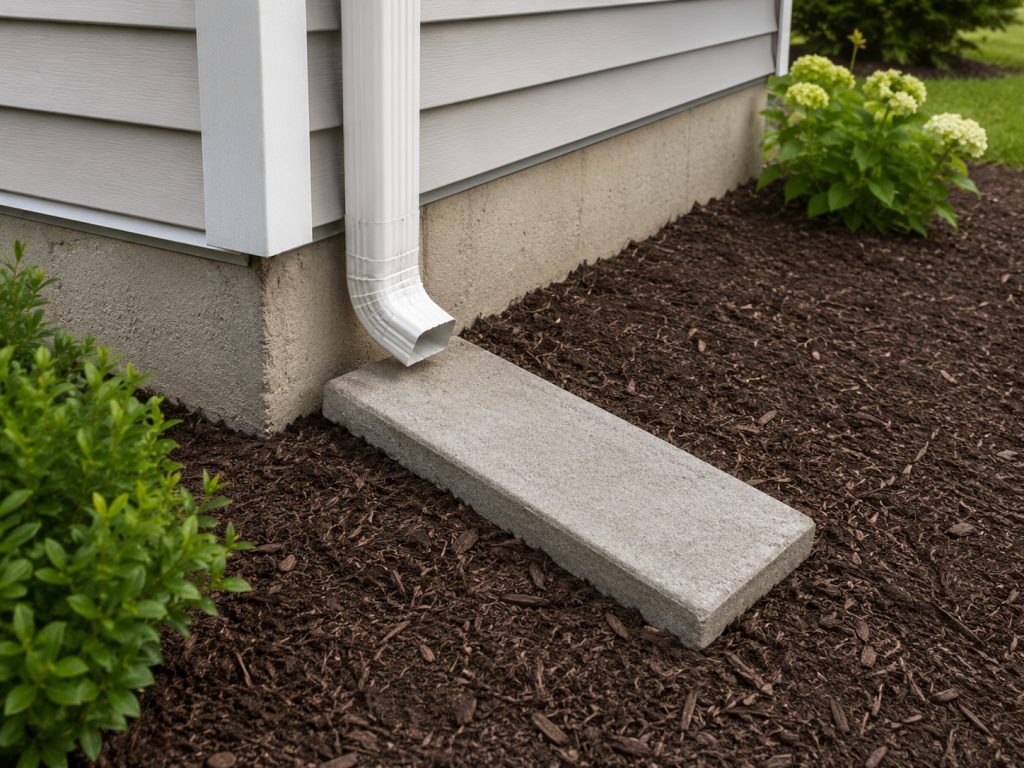
A splash block provides a controlled surface directly below a downspout outlet. Instead of concentrated water striking bare soil, mulch, or landscaping, it lands on the block and is directed away from the wall.
That helps reduce erosion, soil displacement, and small washouts immediately beneath the downspout. The channel or slope built into the block also gives the initial runoff a predictable direction.
What the splash block does not provide is a complete drainage path. Once water reaches the end of the block, the surrounding grade must continue carrying it away. If the ground is flat or slopes back toward the house, the water may simply stop a few feet farther out.
For that reason, a splash block should be viewed as an erosion-control and short-distance directing tool rather than a solution to every drainage problem.
When a Splash Block Works Well
A splash block is most effective when the site already has favorable surface drainage. The ground beyond the block should visibly slope away so runoff can keep moving after it leaves the channel.
Moderate runoff from the roof is also easier for a simple splash block setup to handle. If water reaches the block, travels to its end, and then disperses across reasonably well-draining soil without forming a recurring puddle, the arrangement may be doing exactly what is needed.
Open ground around the discharge point also helps. Water needs somewhere to spread without immediately encountering a raised landscape edge, dense planting bed, walkway, or other obstruction.
You can learn a great deal by safely observing the area during ordinary rainfall. Watch from a protected ground-level location and note whether water continues away from the house after leaving the block. Do not inspect drainage outdoors during lightning, flooding, unusually heavy runoff, or slippery conditions.
When a Splash Block Is Not Enough
A splash block becomes much less effective when the surrounding site cannot carry the discharged water away.
Flat ground is a common problem because water reaches the end of the block and has nowhere to go. Inward-sloping ground is worse because runoff may move back toward the wall. Clay-heavy or compacted soil can produce a similar result by absorbing water slowly and remaining saturated after repeated rain.
A large roof drainage area can also send substantial amounts of water through one downspout. Even if the splash block controls erosion directly beneath the outlet, the surrounding soil may not be able to handle the volume.
One of the clearest warning signs is a puddle that repeatedly forms at the end of the block. That means the drainage problem has not really been solved; it has only been moved slightly farther from the house.
When water needs to be carried farther before reaching a suitable discharge area, a downspout extension may be more appropriate. Our guide to how far downspouts should extend from the house covers that distance decision in more detail.
How Placement and Slope Affect Performance
Even a suitable splash block will perform poorly if it is positioned incorrectly.
The block should sit directly beneath the downspout outlet so discharged water lands inside it rather than beside it. Its open end should point away from the house, following the direction in which runoff needs to travel.
The block itself should not tilt back toward the foundation. Settlement, foot traffic, landscaping work, and storms can gradually move or tilt a block that was originally positioned correctly.
Also check the outlet end. Mulch, soil, leaves, or landscape edging should not create a dam that traps water inside the block or forces it to spill over the sides.
Advertised block length is less important than what happens to the water after it leaves the block. A short block on well-sloped ground can outperform a longer one placed on flat soil where the runoff immediately stops.
Material and Shape Considerations
Material affects durability and stability, but drainage performance still depends primarily on proper placement and site conditions.
Concrete Splash Blocks
Concrete splash blocks are heavy and generally resist shifting better than lightweight alternatives. That stability can be useful where downspout flow is strong or landscaping is frequently disturbed.
Their weight also makes repositioning less convenient. Concrete blocks can settle into soft soil over time and may eventually tilt, so they should still be checked occasionally to confirm that the discharge end remains pointed downhill.
Plastic Splash Blocks
Plastic blocks are lightweight and easy to reposition. That can make them convenient where landscaping changes or where the block needs occasional adjustment.
The tradeoff is lower stability. Lightweight blocks can shift, move during storms, or warp over time. If they move away from the downspout outlet, water may begin discharging beside them rather than through them.
Decorative or Stone-Style Splash Blocks
Decorative designs can work if they still provide a clear and unobstructed path for runoff.
Appearance should remain secondary to drainage function. Narrow channels, irregular shapes, or designs that trap leaves, mulch, or debris may reduce performance even if the block looks attractive.
Splash Block Versus Downspout Extension
A splash block and a downspout extension solve related but different problems.
A splash block primarily manages water impact and short-distance direction close to the downspout. It works best when the grade beyond it already provides a good route away from the house.
A downspout extension physically carries the water farther. That makes it more useful when the area immediately around the downspout is a poor place for discharge.
A longer extension deserves consideration when water repeatedly stops at the end of the splash block, the nearby ground is flat, the soil remains wet, runoff travels back toward the house, roof runoff is substantial, or there is a better drainage area farther away.
The key distinction is simple: a splash block helps water start moving in the right direction, while an extension carries it farther before releasing it.
Signs the Setup Is Failing
A splash-block setup should be reconsidered when you repeatedly notice:
- standing water near the foundation
- a puddle at the end of the block
- runoff flowing back toward the house
- erosion channels forming beyond the block
- mulch or soil washing away
- persistently saturated soil
- water spilling over both sides during ordinary rainfall
- recurring dampness near the same foundation area
- the splash block shifting or tilting
One unusually severe storm does not necessarily prove that a setup is inadequate. Extreme rainfall can temporarily overwhelm drainage arrangements that work well during typical conditions.
Repeated failure during ordinary rainfall is more meaningful. It suggests that the discharge location, grading, soil conditions, or runoff volume needs further attention.
Also make sure water is actually reaching the splash block. If the downspout is backing up or little water is coming from the outlet during rainfall, the issue may be a downspout not draining rather than a problem with the splash block itself.
Common Mistakes
One of the simplest mistakes is installing the splash block backward. The lower discharge end should point away from the house, not toward it.
Another is placing the block near the outlet rather than directly beneath it. Water that lands beside the block can still erode soil and may never follow the intended path.
A block can also become ineffective if it settles and tilts toward the foundation. Likewise, mulch or soil piled around the end can trap water and cause it to spill sideways.
It is also a mistake to assume that a splash block can fix poor grading. Flat or inward-sloping ground may require water to be carried farther before it reaches a suitable discharge area.
Choose a block wide enough to receive the normal downspout flow, and do not ignore recurring pooling simply because the block itself appears to be positioned correctly.
Recheck the setup after major landscaping work or storms. Soil, mulch, edging, and the block itself can move enough to change how runoff behaves.
When to Call a Drainage Professional
Professional drainage evaluation is appropriate when:
- a longer surface discharge route still does not prevent pooling
- water consistently collects beside the foundation
- several downspouts empty into the same wet area
- the yard has little usable slope
- runoff repeatedly travels back toward the house
- significant grading may be necessary
- buried drainage appears necessary
- there is no obvious safe and legal discharge point
- runoff could affect neighboring property
Keep homeowner work at the ground level and limited to safe observation, splash-block placement, and basic surface-drainage decisions. Major grading, excavation, and underground drainage systems involve broader site conditions and should be evaluated appropriately.
Final Thoughts
Splash blocks for downspouts are simple tools for reducing erosion and directing runoff a short distance from the wall. They work best when the surrounding ground already slopes away and continues carrying the water after it leaves the block.
If water repeatedly pools at the end, moves back toward the house, or keeps the surrounding soil saturated, the splash block is not providing a complete drainage path. In that situation, a longer downspout extension or broader drainage solution may be needed.