
toilet tank not filling with water: beginner checks
Toilet tank not filling with water after a flush usually points to a water-supply or tank-component problem. Common causes include a closed or partly closed shutoff valve, a kinked supply line, a stuck float, a fill valve problem, mineral buildup or debris, or a broader household water-supply issue.
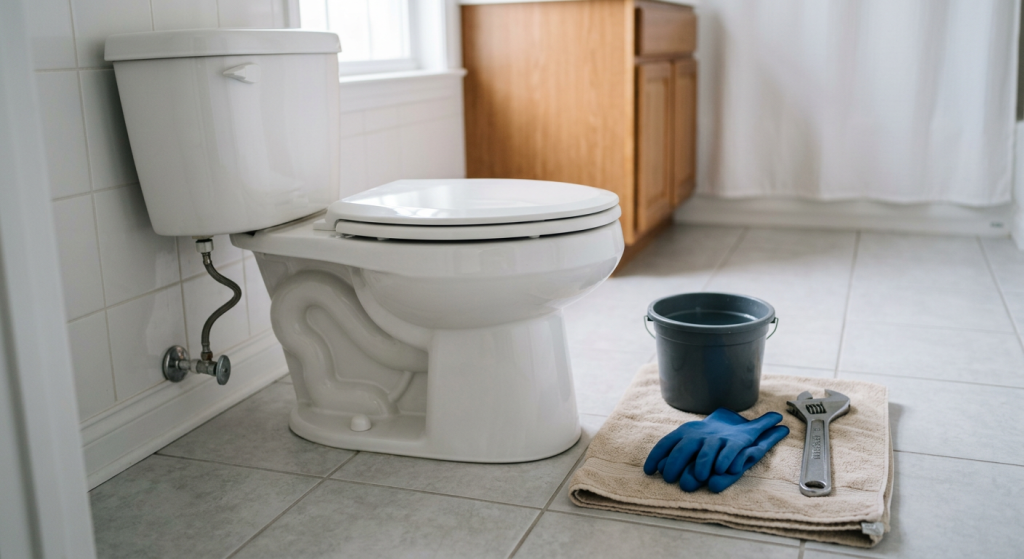
If your toilet isn’t filling with water is the problem after a flush, start with the water supply before assuming a tank part has failed. Common causes include a closed or partly closed shutoff valve, a kinked supply line, a stuck float, a fill valve problem, mineral buildup or debris, or a broader household water-supply issue.
| What you notice | Likely area to check | First action |
|---|---|---|
| Tank is empty and silent | Water supply or shutoff valve | Check other fixtures, then the toilet valve |
| Tank fills very slowly | Restricted flow or fill valve | Check valve position and supply line |
| Tank stops filling too early | Float or fill valve | Watch the float during refill |
| Problem started after water work | Debris in the water supply | Check for restricted fill-valve operation |
| Water is leaking | Supply line, valve, or connection | Stop and control the water if safely possible |
Start by Checking Whether Other Fixtures Have Water
Before inspecting the toilet itself, turn on a nearby sink faucet. Check another fixture as well if necessary.
If other fixtures have normal water pressure but the toilet does not refill, the problem is probably limited to the toilet, its shutoff valve, supply line, or tank components.
If several fixtures have little or no water, the toilet may not be the source of the problem. There could be a household water-supply interruption, a closed main valve, utility work, or another issue affecting more than one fixture.
This distinction can save time. A toilet-specific repair will not restore water if the supply problem affects the entire home.
Also pay attention to what happens immediately after flushing.
A completely empty, silent tank suggests little or no water is reaching the tank. A tank that fills very slowly has some flow but may have a restriction. A tank that begins filling and stops too early points more strongly toward the float or fill valve.
Check the Toilet Shutoff Valve
The toilet’s shutoff valve is usually on the wall or floor near the fixture, with a supply line running from the valve to the toilet tank.
If the valve is closed or only partly open, it can stop or restrict the water entering the tank.
Check its position and condition before doing anything inside the tank. If you know the valve operates normally, confirm that it is open enough to supply the toilet.
Do not force a shutoff valve that is stiff, corroded, or difficult to turn. Older valves can begin leaking when disturbed, and forcing one can turn a refill problem into an uncontrolled water leak.
If the valve will not move with reasonable hand pressure, leaks when touched, or appears badly corroded, stop. The guide Water Shut-Off Valve Won’t Turn: What Homeowners Should Know explains the appropriate next steps.
If the valve appears open and other fixtures have normal water, continue to the toilet’s supply line.
Check the Supply Line for Kinks or Damage
The flexible supply line carries water from the shutoff valve to the toilet’s fill valve.
Inspect the visible length of the line without disconnecting it. Look for:
- Sharp kinks that could restrict water flow
- Twisting or crushing
- Visible cracks or other damage
- Corrosion around connections
- Drips or active leaks
A line that has been pushed against the wall or moved during cleaning or other work can sometimes become kinked.
Do not loosen plumbing connections merely to see whether water is reaching them. If the line is damaged, corroded, or leaking, replacement requires reliable control of the water supply.
If you cannot confidently shut off the water, do not disconnect the line.
Inspect the Water Level Inside the Tank
Remove the toilet tank lid carefully and place it on a stable surface where it cannot fall or crack.
Look at the tank before flushing again. The amount of water inside can help narrow down the problem.
If the tank is nearly or completely empty and no water enters after a flush, concentrate on the shutoff valve, supply line, and fill valve.
If water enters but does so very slowly, there may be restricted flow through a partly closed valve, supply line, or fill valve.
If the tank contains some water but consistently stops below its normal level, watch the float and fill valve during the next refill cycle.
The refill tube may also be visible inside the tank. It normally directs some water into the overflow tube during refilling. Make sure it has not obviously fallen out of position, but remember that refill-tube problems more often affect bowl refill behavior than completely prevent the tank from filling.
Check Whether the Float Moves Freely
The float works with the fill valve to control tank refilling. As the water level drops after a flush, the float should move into a position that allows the fill valve to supply water. As the tank fills, the float rises and eventually signals the valve to stop.
Float designs vary. Many newer toilets use a float cup that moves along the fill-valve body, while older toilets may have a float attached to an arm.
Flush the toilet and watch the float.
It should move freely rather than catching against the tank wall or another component. If it remains stuck in a raised position, the fill valve may not open normally even though the tank needs water.
Check for obvious interference or mineral deposits around accessible moving parts. Do not force the float or bend brittle plastic components.
If the float moves normally but little or no water enters the tank, the fill valve or water supply becomes a more likely suspect.
Check the Fill Valve for Buildup or Wear
The fill valve controls the water entering the tank. If it cannot open properly, the toilet may fill slowly or not refill at all.
Inspect the accessible portions of the valve for obvious mineral deposits, damage, or parts that do not move normally. Listen during a flush as well. A change in sound without normal water flow may indicate that water is reaching the valve but not passing through as expected.
Mineral buildup can interfere with moving components, particularly in areas with hard water. Internal wear can also cause a fill valve to stop operating correctly.
Keep this check diagnostic. Do not take the valve apart unless its manufacturer specifically provides an ordinary homeowner cleaning procedure for that model and you can safely control the water supply.
If the valve appears damaged or remains nonfunctional after the basic supply and float checks, replacement may be appropriate. That is a different decision from a valve that allows water in but fails to stop it.
If your problem is continuous filling rather than a toilet that will not refill, see Toilet Fill Valve Not Shutting Off: What to Check First instead.
Consider Debris After Plumbing or Water-Main Work
Timing can provide an important clue when a toilet tank not filling with water develops suddenly.
Sediment or debris can sometimes move through water lines after the water supply has been shut off and restored. Recent plumbing repairs, a household water shutoff, or water-main work may therefore coincide with restricted flow at the toilet’s fill valve.
If other fixtures work normally but the toilet began filling poorly immediately after such an event, a restriction at the toilet becomes more plausible.
Do not compensate by forcing valve components, disassembling the fill valve without appropriate instructions, or repeatedly disconnecting supply parts.
If the restriction cannot be addressed with an ordinary manufacturer-supported maintenance procedure, replacement of the affected component or professional service may be the safer approach.
What a Slow-Filling or Partly Filling Tank Can Tell You
A toilet tank not filling does not always mean that no water enters at all. The way it fails to refill can help identify where to look.
An empty and silent tank: Start with the household water supply, toilet shutoff valve, and supply line. The toilet may not be receiving water.
A very slow refill: Check whether the shutoff valve is fully open and whether the supply line is kinked. A restriction or fill-valve problem may also limit flow.
A tank that stops too early: Watch the float. A float that sticks or reaches its shutoff position prematurely can interfere with normal filling.
A toilet not filling after flush despite normal supply: If the valve is open, the supply line looks normal, and the float moves freely, the fill valve becomes a stronger suspect.
Avoid replacing parts based on the symptom alone. Working through the water path in order—from the household supply to the shutoff valve, supply line, float, and fill valve—makes it easier to identify the actual failure.
Watch for Leaks While Troubleshooting
Stop your checks if you discover active leaking around the shutoff valve, supply line, tank connection, or nearby plumbing.
If the toilet’s shutoff valve works normally and can be operated safely, close it to stop water to the fixture. Use towels or a container for basic containment if appropriate, but do not continue manipulating leaking or corroded components.
Do not force a valve that will not turn, and do not disconnect supply components when you cannot reliably control the water.
Water spreading beyond the immediate fixture area or a leak that cannot be stopped warrants prompt plumbing help.
When to Call a Plumber
Call a qualified plumber if the toilet still will not refill after you have confirmed that other fixtures have water, the shutoff valve is open, the supply line is not visibly kinked, and the float can move normally.
Professional help is also appropriate when the shutoff valve leaks or will not operate safely, the supply line is damaged or corroded, the fill valve or other tank components are visibly damaged, or the water supply cannot be reliably controlled.
If several fixtures have lost water at the same time, investigate the broader water-supply issue rather than treating the toilet as an isolated failure.
Final Thoughts
When a toilet not filling with water is the problem, trace the water path in a logical order. Confirm that the home has water, check the toilet shutoff valve and supply line, then inspect the tank, float, and fill valve.
The pattern matters: no refill, slow refill, and a tank that stops filling too early can point to different causes. Stop if you encounter an unreliable shutoff valve, damaged supply components, or an active leak, and get qualified plumbing help when the basic checks do not identify a safe solution.