Furnace Smells Like Burning? causes and what to do
Furnace smells like burning for several possible reasons, including dust heating during the first seasonal startup, a dirty filter or restricted airflow, an overheating blower motor, an electrical problem, heated plastic or rubber, an oil-furnace problem, or another mechanical malfunction. A brief dusty burning smell from furnace operation after months of nonuse can sometimes be normal, but electrical, plastic, rubber, smoky, strong, worsening, or recurring odors call for shutdown and professional help.
Visible smoke or flames, a sounding carbon-monoxide alarm, or a suspected gas leak requires immediate safety action rather than routine troubleshooting.
Furnace Smells Like Burning: What to Do First
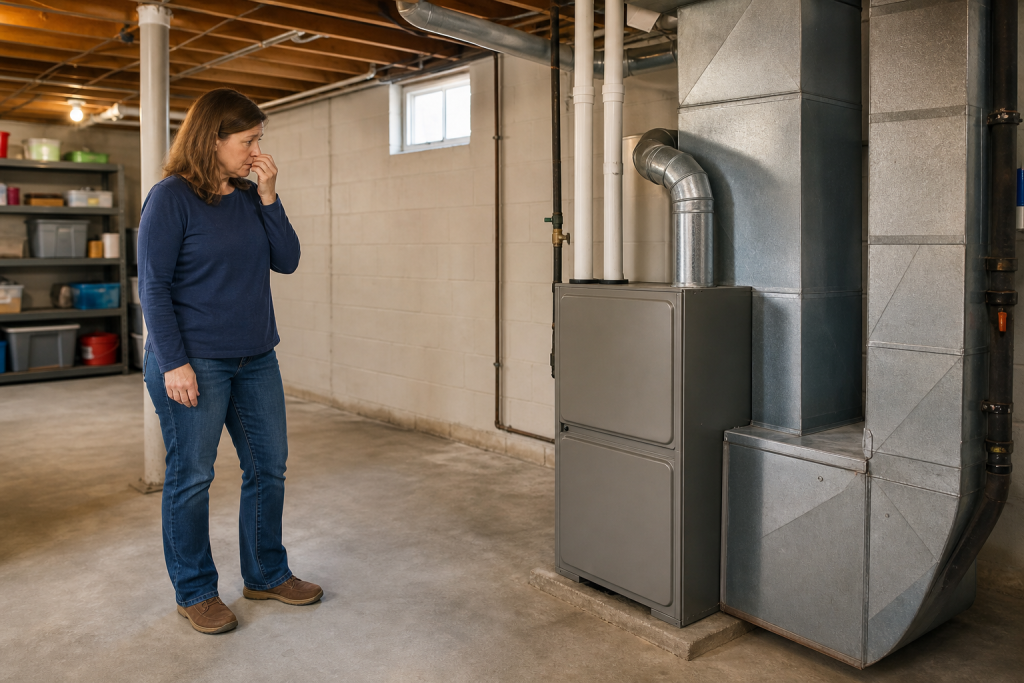
Use the odor and other visible signs to decide how quickly you need to act. Do not move close to the furnace or open its cabinet to identify the smell.
- Identify the general odor from a safe distance. Notice whether it smells dusty, electrical, plastic-like, rubber-like, smoky, oily, or gas-like.
- Look for visible smoke or flames. Do this only from a safe location.
- Consider when the furnace last ran. A light dusty odor during the first heating cycle after months of nonuse is different from an odor that appears during every cycle.
- Turn the furnace off at the thermostat when appropriate. If the odor is strong, worsening, electrical, plastic-like, smoky, or recurring, shut the system down if the thermostat can be reached safely and you do not suspect a gas leak.
- Leave for fire, substantial smoke, or a carbon-monoxide alarm. Call emergency services from outside.
- Leave immediately for a rotten-egg or sulfur-like gas odor. Do not operate switches, thermostats, breakers, lights, garage-door openers, appliances, or phones inside.
- Call an HVAC professional when the cause remains uncertain. Persistent or unusual odors deserve diagnosis before the furnace is used again.
Gas-leak instructions override ordinary furnace-shutdown steps. If gas is suspected, leave rather than stopping to operate the furnace controls.
Quick Furnace-Odor Decision Table
| Type of Smell | Possible Explanation | Immediate Action | Professional Help? |
|---|---|---|---|
| Brief dry or dusty odor at first seasonal startup | Dust heating after months of nonuse | Monitor only if it clearly diminishes | Yes if it persists or worsens |
| Dusty odor that does not diminish | Heavy dust, dirty filter, restricted airflow, other problem | Check accessible filter; shut down if persistent | Usually |
| Burning plastic | Overheated wiring, motor, material, or foreign object | Turn furnace off safely | Yes |
| Hot rubber | Belt, insulation, motor, or another overheating material | Turn furnace off safely | Yes |
| Electrical, metallic, or ozone-like odor | Possible electrical overheating | Turn furnace off safely | Yes |
| Visible smoke | Overheating, burning material, or fire | Leave if smoke is substantial or fire is visible | Emergency response as needed |
| Rotten eggs or sulfur | Possible odorized gas leak | Leave without operating switches | Gas utility or 911 from outside |
| Oily or smoky odor from oil furnace | Burner, fuel, combustion, soot, or venting problem | Shut furnace down safely | Yes |
| Chemical odor from newly installed furnace | Possible temporary coating or manufacturing odor | Follow installer instructions and monitor | Yes if persistent or concerning |
| Musty odor | Moisture, dust, or contamination in HVAC system | Note when and where it occurs | If persistent |
| Carbon-monoxide alarm sounding | Possible CO hazard | Leave immediately | Call emergency services |
An odor can suggest a category of problem, but smell alone does not confirm which component has failed.
When a Burning Smell From Furnace Operation May Be Normal
Dust can settle on furnace and heating-system surfaces while the equipment sits unused. When heat is turned on again, that dust may create a temporary dry, dusty odor.
Ordinary seasonal dust burnoff should clearly diminish rather than become stronger. There should not be visible smoke, a melting-plastic or electrical odor, repeated breaker trips, unusual noises, or visible scorching. Furnace manufacturers similarly distinguish temporary first-use dust odor from persistent plastic or electrical smells that require attention.
Avoid using a rigid number of minutes as proof that an odor is safe. If the smell persists, intensifies, changes character, or returns repeatedly, have the system evaluated.
Furnace Smells Like Burning Dust
When a furnace smells like burning dust during the first startup after months of nonuse, accumulated dust is a reasonable explanation. A recurring dusty smell later in the season deserves a closer look.
Possible contributors include:
- Dust or debris in the system
- A visibly dirty air filter
- Excess household dust or pet hair
- Restricted airflow
- An object or debris near an accessible room register
You can inspect a normally accessible filter and make sure supply vents and return grilles are open and unobstructed. You can also look at accessible registers for objects without reaching into the duct.
Do not reach inside furnace compartments or ductwork to search for debris.
For routine upkeep before and during heating season, our preventive HVAC maintenance guide covers filter checks, seasonal inspections, and professional servicing that can help identify developing problems.
Dirty Filter and Restricted Airflow
A severely dirty filter can reduce airflow through the heating system. Restricted airflow can contribute to excessive internal temperature and furnace cycling, which may accompany a hot or burning odor.
For a safely accessible filter:
- Turn the furnace off normally before handling it.
- Verify that the filter is the proper type for the system and installed in the correct orientation.
- Replace it if it is visibly dirty or due for replacement under the equipment and filter instructions.
- Make sure ordinary supply vents and return grilles are open and not covered by furniture, rugs, boxes, or curtains.
A new filter does not prove that an overheating problem has been corrected. If the burning odor continues after basic airflow checks, leave the furnace off and call an HVAC technician.
If your furnace also starts and stops repeatedly, our furnace short cycling guide explains possible causes, safe homeowner checks, and when professional diagnosis is necessary.
Furnace Smells Like Burning Plastic or Rubber
If a furnace smells like burning plastic, rubber, or wire insulation, treat the odor more cautiously than ordinary dust.
Possible explanations include:
- Overheated wire insulation
- An overheating motor or electrical component
- A foreign object heating near a hot component
- A damaged belt on equipment that uses one
- Melting plastic or rubber
- Another internal mechanical malfunction
A heater that smells like burning plastic should be turned off from a safe location, provided there is no suspected gas leak. Arrange professional inspection before restarting it. Persistent plastic and electrical odors are recognized warning signs that warrant shutting down the heating equipment and having it checked.
Do not open furnace panels, remove suspected objects from inside the equipment, touch wiring, test the motor, or repeatedly restart the system.
Electrical Burning Smell From Furnace
An electrical burning smell from furnace equipment may be described as sharp, hot-metallic, ozone-like, or similar to overheated wiring.
Other observations that increase concern include:
- Buzzing or humming with a hot odor
- Flickering
- Visible scorch marks
- A breaker that trips
- An odor that gets stronger as the blower runs
Electrical problems and overheating motors require professional diagnosis. Buzzing combined with a burning odor, flickering, or a tripped breaker is a reason to shut the furnace down rather than continue testing it.
Do not repeatedly reset a furnace breaker that trips. Never open an electrical compartment, test voltage, touch wiring, replace a capacitor, or attempt motor repairs.
If you see sparks, arcing, flames, or substantial smoke, leave the house and call emergency services.
Furnace Smells Like Smoke
A dusty first-start odor and a true smoke smell are not the same thing.
Smoke-related possibilities include:
- Light dust heating during seasonal startup
- An actual overheating or burning problem near the furnace
- Smoke being drawn into return ductwork from elsewhere
- Fireplace smoke entering the HVAC airflow
- Cooking smoke being distributed through the home
A furnace that smells like smoke repeatedly should not be dismissed as routine dust burnoff. Look only from a safe distance for visible smoke or signs of scorching.
If there is visible fire or substantial smoke, get everyone outside and call emergency services.
Oily or Smoky Odor From an Oil Furnace
With an oil-fired furnace, an unusual oily or smoky odor can be associated with burner or ignition trouble, an oil leak, incomplete combustion, soot, venting problems, or delayed ignition.
Oil-burner faults can produce soot, smoke, delayed ignition, and oil-fume odors, and correcting those conditions requires equipment-specific burner service rather than homeowner adjustment.
Shut the furnace down and contact a qualified oil-heating professional if the odor is strong or persistent, you see soot, or the system behaves abnormally.
Do not adjust the burner, change a nozzle, perform combustion testing, or work on fuel lines yourself.
New Furnace Burning Smell
A new furnace can sometimes produce a mild temporary chemical-like odor during initial operation as manufacturing residues or protective finishes are heated. The installer and equipment instructions should determine what is expected for your particular system.
The smell should diminish rather than intensify. Do not assume a new furnace burning smell is harmless if you notice:
- Visible smoke
- An electrical odor
- Melting-plastic or rubber odor
- Repeated system shutdowns
- A smell that becomes stronger
- An odor that continues beyond what the installer describes as normal
Contact the installer when the odor remains unexplained.
Rotten-Egg or Gas Odor Is Different
A rotten-egg or sulfur-like smell can indicate odorized natural gas. Treat suspected gas differently from an ordinary furnace burning smell.
If you suspect gas:
- Leave the building immediately with people and pets.
- Do not light a match, smoke, or create any flame.
- Do not operate light switches, thermostats, appliances, breakers, garage-door openers, flashlights, or other electrical devices.
- Do not use a phone inside.
- Move away from the building.
- Call the gas utility or 911 from a safe location.
- Do not return until emergency personnel or the gas utility says it is safe.
Do not search for the leak, operate an internal gas valve, restart the furnace, or turn on fans to ventilate the building. Federal pipeline-safety guidance specifically warns against electrical switches, phones, flames, engines, and other potential ignition sources when gas is suspected.
Burning Odors and Carbon Monoxide
Carbon monoxide, or CO, has no smell, color, or taste. A furnace burning smell does not prove that CO is present, and the absence of an odor does not prove a fuel-burning furnace is safe.
Combustion or venting problems in fuel-burning equipment can create a carbon-monoxide hazard. Working CO alarms provide an important warning but do not replace proper furnace maintenance.
If a carbon-monoxide alarm sounds:
- Leave the home immediately.
- Call emergency services from outside.
- Do not re-enter until responders say it is safe.
If anyone feels ill or may be experiencing carbon-monoxide exposure, call emergency services rather than attempting to diagnose the symptoms yourself.
Safe Checks a Homeowner Can Make
Keep homeowner checks limited to observation and basic, accessible maintenance:
- Note the odor type and when it occurs.
- Look for smoke or scorching from a safe distance.
- Check a normally accessible filter after safely shutting the furnace down.
- Replace the filter according to its instructions when needed.
- Confirm normal supply vents and return grilles are open.
- Move furniture, rugs, boxes, or curtains away from room vents.
- Note unusual noises, weak airflow, cycling changes, or breaker trips.
- Make sure smoke and CO alarms are maintained and tested according to their instructions.
These observations can help an HVAC technician, but they do not replace an internal furnace diagnosis.
What Homeowners Should Not Do
- Do not remove furnace access panels.
- Do not touch wiring or electrical components.
- Do not reset a repeatedly tripping breaker.
- Do not bypass a safety switch.
- Do not adjust burners, pilot assemblies, gas valves, or fuel controls.
- Do not test for gas with a flame.
- Do not repeatedly restart a furnace producing a concerning odor.
- Do not attempt combustion or carbon-monoxide testing without professional equipment and training.
- Do not enter a smoke-filled or gas-filled area.
- Do not assume replacing a filter makes an electrical or mechanical problem safe.
When to Turn the Furnace Off
Use a normal thermostat shutdown when you can do so safely and there is no suspected gas leak.
Turn the furnace off for:
- Electrical, plastic, rubber, or strong chemical odors
- A persistent or intensifying burning smell
- An odor that returns during every cycle
- Buzzing, grinding, or another abnormal noise with the odor
- Visible scorch marks
- Repeated breaker trips
- Weak airflow accompanied by an overheating odor
- Symptoms that you cannot confidently identify
If gas is suspected, do not stop to operate the thermostat or other switches. Leave immediately.
When to Call an HVAC Professional
Arrange professional evaluation when:
- The smell persists or becomes stronger.
- The odor returns during multiple cycles.
- The furnace smells electrical, plastic-like, or smoky.
- An internal component may be overheating.
- The furnace shuts down repeatedly.
- A breaker trips.
- Airflow remains weak after basic accessible checks.
- An oil furnace produces soot or abnormal oily odors.
- You cannot confidently distinguish dust from a more concerning condition.
- You see visible damage or scorch marks.
- The odor appears with unusual noises or heating problems.
Internal electrical, fuel, combustion, motor, burner, and control problems are not appropriate homeowner troubleshooting tasks.
Preventing Future Furnace Odors
- Inspect or replace filters according to the equipment and filter instructions.
- Keep normal supply vents and return grilles unobstructed.
- Keep combustible storage away from furnace equipment and its required service area.
- Schedule periodic professional furnace maintenance.
- Have fuel-burning equipment, combustion, and venting inspected appropriately.
- Maintain smoke and carbon-monoxide alarms according to their instructions.
- Address recurring odors rather than repeatedly running the furnace to see whether they disappear.
- Follow the installer’s instructions for newly installed equipment.
Frequently Asked Questions
Why does my furnace smell like burning when I first turn it on?
Dust that collected while the heating system was unused may create a dry burning-dust odor during the first seasonal startup. It should clearly diminish rather than intensify or keep returning.
How long should a seasonal burning-dust smell last?
Do not use a specific time limit as proof that the system is safe. Normal dust odor should diminish relatively quickly. If it remains strong, grows worse, becomes smoky, electrical, or plastic-like, or keeps returning, shut the furnace down and have it checked.
Should I turn off my furnace if it smells like burning?
Turn it off for strong, persistent, electrical, plastic, rubber, smoky, worsening, or unexplained odors. If you suspect a gas leak, leave without operating the thermostat or other switches.
Can a dirty furnace filter cause a burning smell?
A severely dirty filter can restrict airflow and contribute to overheating conditions. Replacing an accessible dirty filter is reasonable maintenance, but continued odor requires professional evaluation.
Why does my furnace smell like burning plastic?
Possible causes include overheated wiring, a motor or electrical component, melting material, or another internal fault. Turn the furnace off safely and call an HVAC professional.
What does an electrical furnace smell mean?
A sharp electrical, hot-metal, or ozone-like odor can indicate overheated electrical equipment. Do not open the furnace or touch wiring; shut the system down safely and arrange service.
Why does the burning smell return every time the furnace starts?
A recurring odor is less consistent with one-time seasonal dust burnoff. Restricted airflow, overheating, debris, electrical trouble, or another malfunction may be involved.
Can a furnace burning smell mean carbon monoxide?
A smell cannot identify carbon monoxide because CO is odorless. A burning odor and a CO problem can occur independently. Leave immediately if a CO alarm sounds.
What should I do if the furnace smells like rotten eggs?
Leave the building without operating switches or phones inside. Once you are safely away, contact the gas utility or 911.
Is a burning smell from furnace operation an emergency?
Not always. Brief seasonal dust odor may be temporary. A burning smell from furnace equipment becomes urgent when it involves gas odor, visible fire, substantial smoke, a CO alarm, sparks, or another immediate safety hazard.
Can a new furnace smell like it is burning?
A mild temporary manufacturing or coating-related odor may occur during initial operation on some equipment. Follow the installer’s instructions and report any persistent, intensifying, smoky, electrical, or melting-plastic odor.
Can blocked vents cause a furnace to overheat?
Severely restricted airflow can contribute to excessive furnace temperature and safety shutdowns. Keep normal supply and return openings unobstructed, but have persistent overheating symptoms professionally diagnosed.
Final Thoughts
When a furnace smells like burning, a brief dusty odor during the first seasonal startup may simply be dust heating after months of nonuse. A persistent, worsening, electrical, plastic-like, smoky, or recurring burning smell from furnace operation is different and warrants shutting the system down safely and calling a qualified HVAC professional.
A suspected gas odor requires immediate evacuation without operating switches. Visible fire, substantial smoke, or a carbon-monoxide alarm means leave the home and contact emergency services. Internal furnace diagnosis and repair should remain with qualified professionals.