preventative HVAC maintenance: the complete homeowner guide
Preventive HVAC maintenance combines simple homeowner tasks—such as checking filters, clearing debris, and inspecting the condensate drain—with professional spring and fall tune-ups. The goal is to maintain airflow, reduce breakdown risks, and identify developing problems before they damage the system.
A good maintenance routine does not require homeowners to open HVAC cabinets or work with refrigerant, gas, combustion components, or high-voltage electrical parts. Most DIY maintenance is inspection, cleaning around accessible equipment, filter care, and watching for changes in system performance.
Preventive HVAC Maintenance Checklist
Use this HVAC maintenance checklist as a quick guide. Your equipment manufacturer’s instructions should take priority when they specify different intervals or procedures.
| Maintenance task | Recommended frequency | Homeowner or professional | Why it matters |
|---|---|---|---|
| Inspect the air filter | Monthly during heavy use | Homeowner | Helps identify restricted airflow |
| Replace or clean the filter | When dirty or as specified | Homeowner | Maintains proper airflow |
| Check thermostat operation | Seasonally | Homeowner | Confirms basic system response |
| Keep supply and return vents clear | Monthly | Homeowner | Prevents avoidable airflow restrictions |
| Clear debris around the outdoor unit | Seasonally and as needed | Homeowner | Keeps the unit unobstructed |
| Visually inspect the condensate drain | During cooling season | Homeowner | Helps catch drainage problems early |
| Inspect for water, unusual noises, and odors | Ongoing | Homeowner | Can reveal developing problems |
| Schedule cooling-system service | Before cooling season | Professional | Checks components beyond safe DIY scope |
| Schedule heating-system service | Before heating season | Professional | Checks combustion, electrical, and safety components |
| Inspect accessible ductwork | Seasonally | Homeowner visual check | May reveal obvious damage or disconnected sections |
| Test smoke and carbon-monoxide alarms | Per manufacturer instructions | Homeowner | Confirms alarms are operating as intended |
What Preventive HVAC Maintenance Includes
Preventive maintenance is work performed before a known equipment failure. It includes several levels of care.
Routine homeowner maintenance covers low-risk tasks such as checking filters, keeping vents open, removing debris around outdoor equipment, checking thermostat operation, and looking for visible leaks or other changes.
Seasonal inspections prepare the system for periods of heavier use. Spring is a logical time to check cooling equipment, while fall is the time to confirm that the heating system is ready.
Professional HVAC tune-ups go deeper. A technician can evaluate electrical components, airflow, refrigerant performance, burners, combustion, heat exchangers, safety controls, and other components that homeowners should not service themselves.
Repairs are different. Once the system has a confirmed malfunction—such as a failed motor, refrigerant problem, damaged electrical component, or faulty ignition system—the work has moved from preventive maintenance into diagnosis and repair.
Maintenance can reduce avoidable problems and help catch developing faults. It cannot guarantee that an HVAC system will never fail.
Monthly HVAC Maintenance Tasks
Inspect the HVAC filter
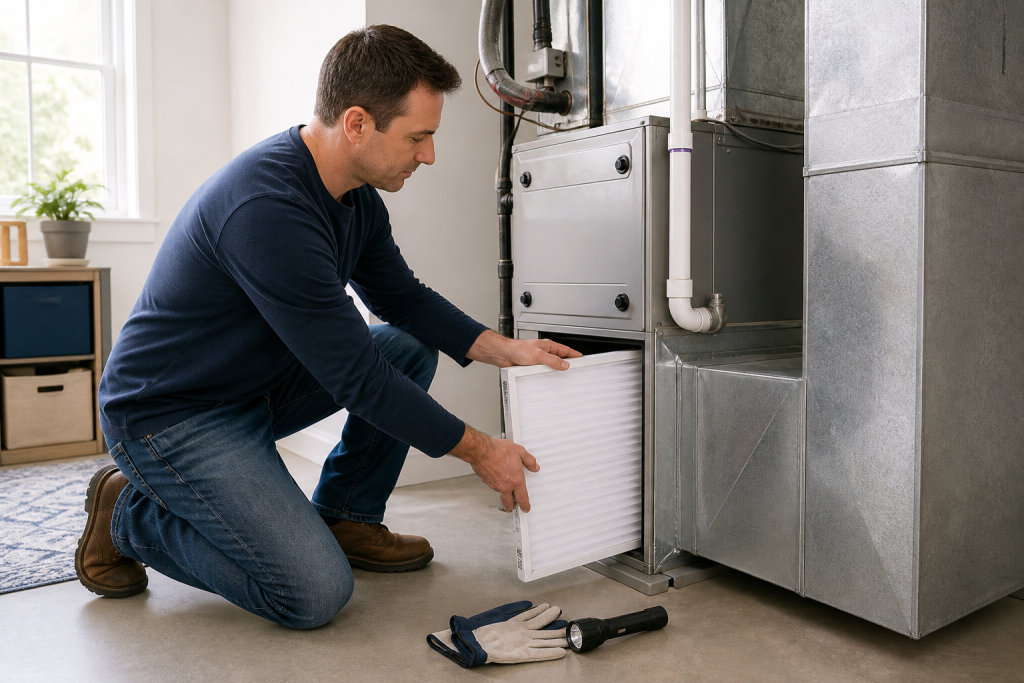
Check the filter monthly during periods of heavy heating or cooling use. A filter that has become loaded with dust can restrict airflow and make it harder for the system to move conditioned air through the home.
Checking monthly does not mean every filter must be replaced monthly. Replacement frequency depends on the filter, equipment, household conditions, pets, dust levels, remodeling activity, system runtime, and manufacturer instructions.
Replace disposable filters when needed. Clean reusable filters only according to their instructions and allow them to dry as required before reinstalling them.
Filter thickness and efficiency also matter. Homeowners choosing between MERV 8 vs MERV 11 vs MERV 13 filters should consider both filtration and equipment compatibility. Likewise, 1-inch vs 4-inch furnace filters can have very different replacement intervals and airflow characteristics.
If you’re choosing a replacement filter, our MERV 8 vs MERV 11 vs MERV 13 comparison explains filtration differences, airflow considerations, and how to select a filter compatible with your HVAC system.
Keep supply and return vents clear
Walk through the house and make sure furniture, curtains, rugs, boxes, and other items are not blocking supply or return vents.
Avoid closing multiple supply vents in an attempt to redirect air. Residential systems are designed around expected airflow, and excessive restriction can make existing comfort problems worse rather than solve them.
Remove accessible dust from vent covers as needed. If several rooms consistently have weak airflow even with open, unobstructed vents, the problem may require professional diagnosis.
Check the thermostat
Make sure the thermostat display looks normal and that the reported room temperature seems reasonable.
At the start of each season:
- Confirm heating mode starts the heating system.
- Confirm cooling mode starts the cooling system.
- Test fan operation if your thermostat provides manual fan control.
- Replace thermostat batteries when applicable.
If the thermostat is blank, unresponsive, or behaving unexpectedly, basic checks may help determine why the thermostat is not working. More involved issues can depend on thermostat wiring, including whether the system needs a C-wire for a thermostat.
Homeowners considering a smart thermostat with an older HVAC system should confirm compatibility before changing wiring.
Do not open energized HVAC equipment as part of thermostat troubleshooting.
If your thermostat has a blank screen, fails to respond, or doesn’t operate your heating and cooling equipment as expected, our thermostat not working guide explains common causes and safe troubleshooting steps.
Watch for developing problems
Pay attention to changes from normal operation, including:
- Water around indoor HVAC equipment
- Persistent burning odors
- Grinding, banging, or other new mechanical noises
- Furnace short cycling or unusually frequent system starts
- Weak airflow
- Unexpected increases in energy use
- Rooms that no longer reach the thermostat setting
These symptoms do not all indicate the same failure. For example, an AC running but not cooling requires a different diagnosis from an AC making a grinding noise. Treat new symptoms as reasons to investigate rather than assuming routine maintenance will correct them.
Spring Air Conditioner Maintenance Checklist
Clear the outdoor condenser area
Turn the system off before working close to the outdoor unit.
Remove loose leaves, grass clippings, weeds, and other surface debris around the condenser. Maintain the clearance specified by the equipment manufacturer so airflow is not obstructed.
Limit DIY work to accessible cleaning around the unit. Do not bend coil fins, remove electrical covers, reach into the equipment, or spray electrical components with water.
Visually inspect the AC coils
Look through the outdoor coil surfaces for obvious accumulations of leaves, lint, or other debris.
A visual inspection is different from a full coil cleaning. Light accessible debris may be removable without disassembly, but heavily contaminated or damaged coils should be evaluated professionally.
If coil cleaning is appropriate for your particular equipment, use only a method and product compatible with the manufacturer’s instructions. Different AC coil cleaner foam vs spray products are not interchangeable for every coil or application.
Inspect the condensate drain
During cooling operation, moisture removed from indoor air normally drains away through the condensate system.
Inspect accessible areas for:
- Visible algae or debris
- Standing water
- Water around the air handler or furnace
- An overflowing drain pan
- Evidence that water has repeatedly escaped the drain system
A homeowner may be able to clean an AC drain line when the drain is safely accessible, and the procedure does not require opening electrical or sealed equipment.
Stop if water is entering the HVAC cabinet, reaching electrical components, repeatedly overflowing, or returning after the drain has been cleared. An air conditioner leaking water inside the house may have a blockage, drainage defect, frozen coil, installation problem, or another cause that needs diagnosis.
Test the air conditioner before hot weather
Do not make the first major heat wave your first cooling test of the year.
Run a normal cooling cycle during mild spring weather. Verify that the thermostat calls for cooling, the outdoor unit starts, and cool air reaches the supply vents.
Listen for abnormal sounds and note whether the system shuts down normally.
If the AC unit is not turning on, is running but not cooling, or begins making a grinding noise, stop treating the issue as routine maintenance and troubleshoot the specific symptom.
Do not connect gauges, open refrigerant lines, add refrigerant, or attempt to diagnose refrigerant charge yourself.
Fall Furnace Maintenance Checklist
Test the heating system before cold weather
Start the furnace before regular heating becomes necessary. Let it complete a normal heating cycle and confirm that warm air reaches the occupied rooms.
During the test:
- Listen for new banging, scraping, or grinding noises.
- Pay attention to persistent burning or electrical odors.
- Make sure combustible materials are not stored against or immediately around the furnace.
- Confirm the system starts and shuts down normally.
A furnace blowing cold air, a persistent burning smell from the furnace, or a furnace banging during operation deserves symptom-specific attention rather than repeated test cycles.
Inspect accessible vents and flue components
Limit homeowner inspection to what is visible without disassembly.
Look for obviously disconnected, damaged, or displaced accessible vent components. Do not remove furnace panels or attempt to adjust the burner, gas pressure, ignition system, or venting.
Combustion testing, gas-pressure checks, burner adjustment, vent repairs, and heat-exchanger inspection belong to a qualified HVAC professional.
Check carbon-monoxide alarms
Homes with fuel-burning equipment need working carbon-monoxide alarms. Test and maintain each alarm according to its manufacturer’s instructions, including battery and end-of-life replacement requirements.
A carbon-monoxide alarm does not replace professional furnace inspection.
If a CO alarm activates, do not continue operating or inspecting the furnace in an attempt to find the cause. Follow the alarm’s emergency instructions and obtain qualified help.
What an Annual Professional HVAC Tune-Up Should Include
A professional tune-up reaches components that are inaccessible, hazardous, or difficult for homeowners to evaluate accurately. The precise checklist depends on the system type, equipment design, fuel source, and manufacturer.
For cooling equipment, service may include:
- Electrical connections, components, and controls
- Refrigerant-system evaluation
- Evaporator and condenser coil condition
- Blower operation
- Condensate drainage
- Temperature difference and airflow
- System start, operation, and shutdown cycles
Refrigerant work is not a homeowner maintenance task. Low refrigerant can indicate a problem that requires professional diagnosis rather than routine topping off.
For heating equipment, professional service may include:
- Burner and ignition operation
- Heat-exchanger condition
- Combustion and venting
- Gas or oil connections
- Blower operation
- Electrical controls
- Safety controls
- Start and shutdown cycles
Heat pumps and other equipment that provide both heating and cooling may have different service requirements. Follow the equipment manufacturer’s maintenance instructions and discuss the appropriate schedule with the contractor servicing the system.
How Often Should HVAC Be Serviced?
There is no single maintenance interval that applies identically to every HVAC system.
A practical home HVAC maintenance schedule is:
- Inspect filters monthly during periods of heavy use.
- Perform simple visual maintenance throughout the year.
- Prepare and inspect cooling equipment before summer.
- Prepare and inspect heating equipment before winter.
- Arrange professional pre-season service based on the equipment and manufacturer requirements.
Many homeowners use annual professional service, with cooling maintenance performed in spring and heating maintenance performed in fall when separate seasonal service is appropriate.
Manufacturer instructions and warranty requirements take priority over a generic schedule. Newer equipment, heat pumps, specialized systems, and equipment under warranty may have specific maintenance requirements.
HVAC Maintenance Schedule by Season
This printable-style seasonal HVAC maintenance checklist keeps the recurring tasks in one place.
Winter
- Check the filter regularly during heavy heating use.
- Keep supply and return vents open and unobstructed.
- Watch for unusual heating cycles, odors, or noises.
- Keep outdoor heat-pump equipment clear of obstructing snow and debris without damaging the unit.
Spring
- Schedule cooling-system service as appropriate.
- Inspect accessible condensate drainage.
- Clear leaves and debris around the outdoor unit.
- Test air-conditioning operation before hot weather.
Summer
- Check the filter frequently during heavy cooling use.
- Watch for standing water or drainage problems.
- Keep vegetation and debris away from the condenser.
- Investigate a sudden loss of cooling promptly.
Fall
- Schedule heating-system service as appropriate.
- Test the furnace or heating system before cold weather.
- Test smoke and carbon-monoxide alarms according to their instructions.
- Investigate persistent unusual odors or noises.
Keep a simple maintenance log with filter changes, service dates, unusual symptoms, and completed repairs. A record can make recurring problems easier to identify.
HVAC Maintenance Homeowners Should Not Attempt
HVAC safety boundary: Routine maintenance should not require refrigerant handling, combustion adjustments, gas work, high-voltage electrical work, or internal component repair. If a task requires removing a service panel to diagnose energized equipment, stop and call a qualified HVAC professional.
Leave the following work to qualified professionals:
- Handling refrigerant
- Opening or repairing sealed refrigerant components
- Gas-line work
- Burner adjustment
- Heat-exchanger inspection or repair
- High-voltage electrical diagnosis or repair
- Internal motor or capacitor work
- Bypassing safety switches
- Major duct alterations
Shut the system down when it is safe to do so and seek qualified help for smoke, sparking, repeated breaker tripping, significant water leakage near electrical components, or equipment that develops an electrical burning odor.
If you smell gas, do not attempt to locate or repair the leak. Leave the area and follow your gas utility or emergency service instructions from a safe location.
A suspected carbon-monoxide problem also requires immediate action rather than DIY troubleshooting.
Does Preventive HVAC Maintenance Save Money?
Maintenance can help an HVAC system operate as intended, but there is no universal dollar amount a homeowner will save.
A clean filter and unrestricted vents support proper airflow. Keeping the outdoor unit unobstructed helps it operate without avoidable external airflow restrictions. Finding a drain problem, worn component, or abnormal operating condition early may also prevent additional damage.
That does not mean maintenance eliminates repairs or guarantees lower utility bills.
Energy costs are influenced by climate, thermostat settings, equipment efficiency and condition, insulation, air leakage, duct leakage, energy prices, household occupancy, and how often the system runs.
Maintenance is best viewed as equipment care and early problem detection rather than a guaranteed financial return.
Preventive Maintenance Versus HVAC Repair
Preventive maintenance happens before a confirmed failure. Checking filters, clearing debris, testing seasonal operation, and scheduling tune-ups are examples.
Troubleshooting begins when a symptom appears. Its purpose is to determine why the system is not operating normally.
Repair corrects the diagnosed problem. That might involve replacing a failed component, correcting an electrical fault, repairing drainage, or addressing another specific defect.
Replacement becomes relevant when equipment is unsafe, increasingly unreliable, inefficient for the homeowner’s needs, or uneconomical to keep repairing. Equipment age is one factor, but condition, repair history, safety, efficiency, and replacement cost also matter. Understanding how long a furnace lasts can provide useful context without making age alone the deciding factor.
Preventive HVAC Maintenance Tools for Homeowners
A basic maintenance kit can stay simple:
- Correct replacement filters
- Flashlight
- Shop vacuum for accessible dry debris
- Soft brush
- Work gloves
- Manufacturer-approved drain-cleaning supplies
- Basic thermometer
- Maintenance log
Most homeowners do not need specialized HVAC diagnostic equipment for preventive care. A more detailed guide to the best HVAC tools for homeowners can help if you want to build a practical maintenance kit without buying professional equipment you cannot safely use.
Frequently Asked Questions
How often should HVAC maintenance be performed?
Check filters and basic system conditions throughout the year, with more frequent attention during periods of heavy heating and cooling. Cooling and heating equipment should also receive pre-season attention based on the equipment type and manufacturer requirements.
What HVAC maintenance can homeowners do themselves?
Homeowners can generally inspect and replace appropriate filters, keep vents clear, check thermostat operation, clear accessible debris around outdoor equipment, visually inspect drainage, and watch for leaks, odors, noises, or other operating changes.
Does an HVAC system need professional service every year?
Annual pre-season professional maintenance is a common approach, but the appropriate schedule depends on the equipment and its manufacturer. Some systems benefit from separate heating and cooling visits. Warranty conditions may also specify maintenance requirements.
How often should an HVAC filter be checked?
Monthly checks are reasonable during periods of heavy system use. Replace or clean the filter when its condition and manufacturer instructions indicate it is necessary rather than assuming every filter has the same monthly replacement schedule.
What happens when HVAC maintenance is neglected?
Filters can become restricted, debris can accumulate, drainage problems can go unnoticed, and developing mechanical or electrical problems may not be identified until they affect comfort or cause a failure. The exact consequences depend on the system and the maintenance being missed.
Is an HVAC tune-up the same as preventive maintenance?
A tune-up is one part of preventive maintenance. Preventive care also includes homeowner filter checks, airflow checks, seasonal inspections, debris removal, monitoring, and maintenance records.
Should a furnace and air conditioner be serviced separately?
Often, yes. Furnaces and air conditioners have different components and seasonal demands, so heating and cooling service may be performed at different times. Heat pumps and integrated systems may follow a different schedule.
Can HVAC maintenance improve indoor comfort?
It can help when comfort problems are related to issues such as restricted filters, blocked vents, incorrect thermostat operation, or equipment that needs service. Maintenance will not correct every comfort problem, especially when duct design, insulation, equipment sizing, or building air leakage is the underlying cause.
Final Thoughts
Preventive HVAC maintenance works best as a combination of small, consistent homeowner checks and appropriately timed professional service. Keep filters and airflow paths in good condition, inspect accessible equipment for changes, test heating and cooling before peak seasons, and address new symptoms instead of waiting for a complete failure.
Most importantly, know where maintenance ends. Refrigerant systems, combustion equipment, gas components, high-voltage electrical parts, heat exchangers, and internal HVAC repairs belong in qualified professional hands.