
MERV 8 vs MERV 11 vs MERV 13: Which Filter is best?
MERV 8 vs MERV 11 vs MERV 13 comes down to filtration performance and HVAC compatibility. MERV 8 provides basic residential filtration and captures many larger particles, MERV 11 improves capture of medium and smaller particles, and MERV 13 provides substantially better small-particle filtration. Of the three, MERV 13 is generally the strongest filtration choice when your system’s fan and filter slot can accommodate it.
Filter design matters too. Thickness, pleat design, media surface area, condition, airflow rate, and pressure drop all affect how a filter performs. The MERV number alone does not tell you how restrictive a particular filter will be. Check your equipment requirements or ask an HVAC professional if compatibility is uncertain.
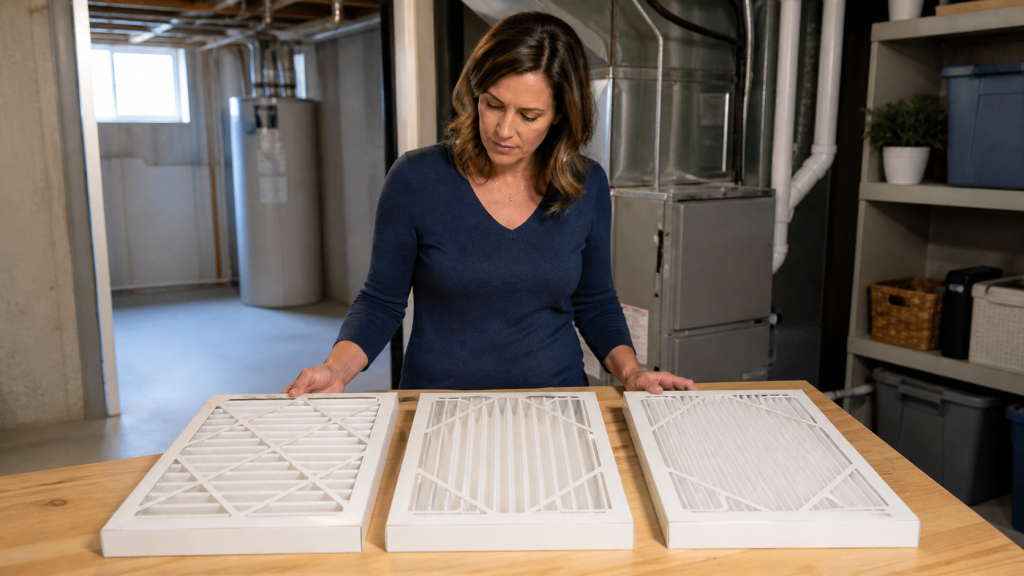
MERV 8 vs MERV 11 vs MERV 13: Quick Answer
For most homeowners, the choice can be narrowed down this way:
- Choose MERV 8 for basic equipment protection and larger-particle capture when your HVAC system calls for a lower-efficiency filter.
- Choose MERV 11 for improved residential filtration when your system supports it, especially if you want better capture of dust and airborne pet debris.
- Choose MERV 13 for the best smaller-particle filtration of these three when your HVAC system can accommodate it.
The equipment manufacturer’s filter requirements take priority over a general recommendation. If your system can properly handle MERV 13, there is no need to avoid it simply because its rating is higher.
MERV 8 vs MERV 11 vs MERV 13 Comparison Table
The three ratings differ most noticeably as particle size gets smaller.
| Filter Rating | Particle-Capture Performance | Common Household Uses | Main Advantage | Main Consideration |
|---|---|---|---|---|
| MERV 8 | No required minimum at 0.3–1.0 microns; at least 20% at 1.0–3.0; at least 70% at 3.0–10.0 | Basic residential filtration | Good larger-particle capture | Limited small-particle efficiency |
| MERV 11 | At least 20% at 0.3–1.0 microns; at least 65% at 1.0–3.0; at least 85% at 3.0–10.0 | Pets, dust, improved everyday filtration | Meaningful step up from MERV 8 | Check product resistance and system fit |
| MERV 13 | At least 50% at 0.3–1.0 microns; at least 85% at 1.0–3.0; at least 90% at 3.0–10.0 | Stronger small-particle filtration | Best particle capture of the three | System must accommodate filter and pressure drop |
These percentages are minimum performance thresholds under the MERV testing standard. They do not mean every filter with the same MERV rating has the same construction, pressure drop, lifespan, or effect on furnace filter airflow.
What a MERV Rating Measures
MERV stands for Minimum Efficiency Reporting Value. It is a standardized way to compare how effectively an air filter captures particles between 0.3 and 10 microns.
A higher MERV rating means better capture of specified particle sizes. It does not tell you everything about a filter.
MERV does not directly rate:
- Filter lifespan
- Fit in your equipment
- Construction quality
- Total media surface area
- HVAC filter pressure drop
- How quickly a filter becomes loaded with debris
You may also see proprietary ratings such as MPR or FPR on residential filters. Those systems are not identical to MERV, so their numbers should not be treated as direct MERV equivalents without reliable conversion information.
How MERV 8, MERV 11, and MERV 13 Differ
MERV 8: Basic Residential Filtration
A MERV 8 furnace filter provides useful capture of larger airborne particles and some particles in the 1-to-3-micron range. It has no required minimum efficiency for the smallest 0.3-to-1.0-micron range used in the MERV table.
MERV 8 may be appropriate when:
- Your equipment documentation calls for it.
- You mainly want basic filtration and equipment protection.
- Your existing system has limited filter capacity.
- A higher-efficiency filter has not been approved for the system.
That does not make MERV 8 automatically the safest filter for an older furnace or every 1-inch slot. Compatibility depends on the actual filter and HVAC system, not a rule that lower MERV always equals safer airflow.
Correct sizing also matters. A poorly fitting MERV 8 furnace filter that allows air to bypass its edges may perform worse in practice than a properly fitted filter.
MERV 11: Improved Everyday Filtration
The difference between MERV 8 and MERV 11 becomes especially clear with smaller particles.
A MERV 11 furnace filter must capture at least 20% of particles in the 0.3-to-1.0-micron range, where MERV 8 has no required minimum. MERV 11 also increases minimum capture to 65% for 1.0-to-3.0-micron particles and 85% for 3.0-to-10.0-micron particles.
That makes MERV 11 a useful intermediate choice for homeowners who want stronger filtration without automatically moving to MERV 13.
A MERV 11 filter may make sense for:
- Homes with pets
- Dustier households
- Homeowners seeking an upgrade from MERV 8
- Systems confirmed to accommodate the filter’s airflow resistance
The MERV 8 vs MERV 11 decision should still consider the particular product’s pressure drop and your equipment requirements.
MERV 13: Better Small-Particle Filtration
In a MERV 11 vs MERV 13 comparison, MERV 13 provides the strongest small-particle capture.
MERV 13 must achieve at least 50% efficiency for particles from 0.3 to 1.0 microns. MERV 11 requires at least 20% in that range. MERV 13 also raises minimum efficiency for 1.0-to-3.0-micron particles from 65% to 85%.
For homeowners seeking stronger central filtration, MERV 13 or the highest filter efficiency the system can accommodate is a practical target.
Many residential HVAC systems can use MERV 13, but compatibility cannot be guaranteed for every furnace, air handler, filter slot, or duct system. An HVAC professional may need to evaluate airflow or recommend a different filter setup when the existing system cannot support the desired filter.
A MERV 13 furnace filter is also not the same as a HEPA filter. HEPA filtration uses a different performance standard and provides substantially higher particle-capture efficiency.
Does MERV 13 Restrict Airflow?
Any HVAC filter creates some resistance as air moves through it. The important question is whether that resistance, or pressure drop, remains within what the HVAC system can handle.
So, does MERV 13 restrict airflow more than MERV 8 or MERV 11? Sometimes, but the rating alone does not give a complete answer.
HVAC filter pressure drop is affected by:
- Media construction
- Number and shape of pleats
- Filter thickness
- Total media surface area
- Air velocity through the filter
- Filter loading as dust accumulates
- Overall product design
A well-designed MERV 13 filter may not be more restrictive than every MERV 8 or MERV 11 filter on the market. Comparing published pressure-drop information for the actual products is more useful than comparing MERV numbers alone.
A dirty filter usually creates more airflow resistance as debris accumulates. Timely inspection and replacement therefore matter regardless of MERV rating.
Changes such as weak airflow, unusually long run times, repeated furnace limit trips, coil icing during cooling, overheating symptoms, or abnormal cycling need professional diagnosis. Do not assume the filter is the only possible cause.
An HVAC technician can measure total external static pressure and evaluate whether the system is moving the required amount of air. Homeowners do not need to perform this testing themselves.
Why Filter Thickness Matters
Deeper pleated filters can provide substantially more media surface area than shallow filters of the same face dimensions. More surface area can allow air to pass through more filter media at a lower velocity, helping control pressure drop while maintaining higher filtration efficiency.
That is one reason a deeper media cabinet can be useful when stronger filtration is desired.
However, a 4- or 5-inch filter cannot simply replace a 1-inch filter unless the filter cabinet is designed for that depth.
Also remember:
- Nominal and actual filter dimensions may differ.
- Do not bend or crush a filter to make it fit.
- Do not stack filters.
- Do not force a deeper filter into a shallow slot.
- Do not assume every deep filter has lower resistance than every 1-inch filter.
A 1-inch MERV 13 filter can be appropriate in some systems. The concern is not the words “1-inch MERV 13 filter” by themselves. The actual filter pressure drop and the HVAC system’s capabilities determine whether it is a suitable match.
For a closer look at how filter depth affects airflow, dust capacity, replacement intervals, and compatibility, see our 1-inch vs 4-inch air filter comparison before considering a different filter setup.
Which MERV Rating Is Best for Your Home?
The best MERV rating for home use is the highest-efficiency filter that meets your filtration goals while remaining compatible with the system.
Which MERV Rating Is Best for Pets?
For a MERV rating for pets, MERV 11 or MERV 13 can provide better airborne particle capture than MERV 8 when the HVAC system supports the upgrade.
Filters can capture airborne pet dander and debris that reaches the return-air system. Large pet hair often settles onto floors, furniture, and other surfaces before it ever reaches the HVAC filter.
Homes with pets may also load filters faster, particularly during periods of heavy shedding. Check the filter condition more frequently rather than relying on one replacement schedule for every household.
A furnace filter is only one part of controlling airborne and settled particles in a home.
Which MERV Rating Is Best for Allergies or Smaller Particles?
For homeowners comparing a MERV rating for allergies or other small-particle concerns, MERV 13 provides better small-particle capture than either MERV 8 or MERV 11.
That does not guarantee symptom relief or a particular health outcome. Filtration performance and personal health effects are different questions.
Central filtration also works only while air moves through the HVAC system. For a specific bedroom or living area, a properly selected portable air cleaner can supplement central filtration without changing the furnace filter setup.
What About an Older HVAC System?
An older furnace does not automatically require MERV 8, and age alone does not tell you what filter it can handle.
Older equipment may have:
- A shallow or restrictive filter slot
- Limited available fan capacity
- Existing duct restrictions
- Airflow problems unrelated to the filter
Start with the equipment documentation and the current filter arrangement. If you want to increase filtration but are unsure whether the system can support it, have an HVAC technician evaluate airflow before making a large change.
How to Tell What MERV Rating Your HVAC System Can Handle
Use these checks before moving to a higher-efficiency filter:
- Check the furnace or air-handler manual. Look for approved filter types, sizes, efficiency limits, or airflow requirements.
- Inspect the normal filter location. Look for filter information on the cabinet or the existing filter without opening electrical, blower, or combustion compartments.
- Confirm the exact dimensions and allowable thickness. Do not assume a filter will fit from nominal dimensions alone.
- Compare pressure-drop information when available. Product-specific resistance data is more informative than MERV rating alone.
- Inspect and replace filters based on actual conditions and instructions. Dusty conditions, remodeling, wildfire smoke, and heavy pet shedding may load filters faster.
- Pay attention after changing filter types. Unexpected airflow or equipment changes deserve investigation.
- Get professional airflow testing if compatibility remains uncertain. An HVAC technician can check static pressure and determine whether a filter change is appropriate.
Once you’ve selected a compatible filter, our preventive HVAC maintenance guide provides a practical schedule for filter inspections, replacements, and other routine heating and cooling maintenance.
Common MERV Filter Mistakes
Avoid these common problems:
- Assuming the highest MERV number fits every HVAC system
- Assuming higher MERV always means greater pressure drop
- Buying the wrong filter dimensions
- Forcing a deep filter into a 1-inch slot
- Installing a directional filter backward
- Leaving gaps that allow air to bypass the filter
- Stacking two filters together
- Waiting until the media is heavily packed with debris
- Following one universal replacement interval regardless of conditions
- Expecting the HVAC filter to remove dust that has already settled on household surfaces
Correct fit and maintenance matter at every MERV level.
Final Recommendation
For MERV 8 vs MERV 11, choose MERV 11 when you want better medium- and small-particle capture and your equipment supports the filter. MERV 8 remains appropriate for basic filtration when it meets your system requirements and household needs.
For MERV 11 vs MERV 13, MERV 13 delivers the stronger particle filtration, particularly in the smallest particle range measured by the MERV system. If your HVAC system can accommodate it, MERV 13 is the strongest filtration choice of these three.
Filter fit, thickness, surface area, pressure drop, equipment design, and replacement frequency all matter. When compatibility is uncertain, use the equipment documentation or have an HVAC technician evaluate the system rather than choosing based on MERV alone.
Frequently Asked Questions
Is MERV 11 better than MERV 8?
For particle capture, yes. MERV 11 has higher minimum efficiencies than MERV 8 and adds required performance in the 0.3-to-1.0-micron range. It still needs to be compatible with your HVAC system.
Is MERV 13 better than MERV 11?
MERV 13 provides better particle filtration, especially for smaller particles. In a MERV 11 vs 13 comparison, choose MERV 13 when your system can accommodate it.
Does MERV 13 restrict furnace airflow?
Every filter creates resistance, but MERV rating alone does not determine pressure drop. Construction, pleating, thickness, surface area, airflow rate, and filter loading all affect resistance.
Is MERV 13 too high for a residential furnace?
Not necessarily. Many residential systems can accommodate MERV 13. Check your equipment requirements or have an HVAC professional confirm compatibility if you are unsure.
What MERV rating is best for pets?
MERV 11 or MERV 13 can improve capture of airborne pet-related particles compared with MERV 8 when the system supports the filter.
What MERV rating is best for an older furnace?
There is no universal rating based on furnace age. Use the highest appropriate efficiency supported by the equipment, filter setup, and available airflow.
Can I use a MERV 13 filter in a 1-inch filter slot?
Possibly. Some 1-inch MERV 13 filters may work properly in compatible systems. Check the filter’s pressure-drop information and your equipment requirements rather than assuming all 1-inch MERV 13 filters are suitable or unsuitable.
How often should I change a MERV 13 filter?
Follow the filter and HVAC equipment instructions and inspect the filter based on actual household conditions. There is no single replacement interval that works for every filter and home.
Is MERV 13 the same as HEPA?
No. MERV 13 and HEPA are different filtration classifications. HEPA filters meet substantially higher particle-capture requirements.
What is the difference between MERV 8 and MERV 11?
MERV 11 captures more particles in the 1-to-10-micron ranges and adds a minimum 20% efficiency requirement for 0.3-to-1.0-micron particles. MERV 8 has no required minimum efficiency in that smallest tested range.
Final Thoughts
The right answer to MERV 8 vs MERV 11 vs MERV 13 is not simply to choose the lowest rating for airflow or the highest number for filtration. MERV 8 provides basic filtration, MERV 11 offers a meaningful improvement, and MERV 13 provides the strongest small-particle capture of the three.
Choose the highest-efficiency filter your HVAC fan and filter slot can accommodate. When filter pressure drop, system airflow, or compatibility is uncertain, verify the equipment requirements or have an HVAC professional evaluate the system before upgrading.