
1-Inch vs 4-Inch Air Filter: Which is better?
1 inch vs 4 inch air filter comparisons usually favor a compatible 4-inch pleated filter because its deeper construction can provide substantially more filter-media surface area, greater dust-holding capacity, and less frequent replacement. However, a 4-inch filter cannot be installed in a standard 1-inch slot. If your HVAC system uses a 1-inch filter, keep using the correct size unless an HVAC professional installs a compatible media cabinet.
MERV rating, actual pressure drop, exact dimensions, and HVAC system compatibility still matter. A thicker filter is not automatically more efficient, and no filter should be forced into a cabinet that was not designed for it.
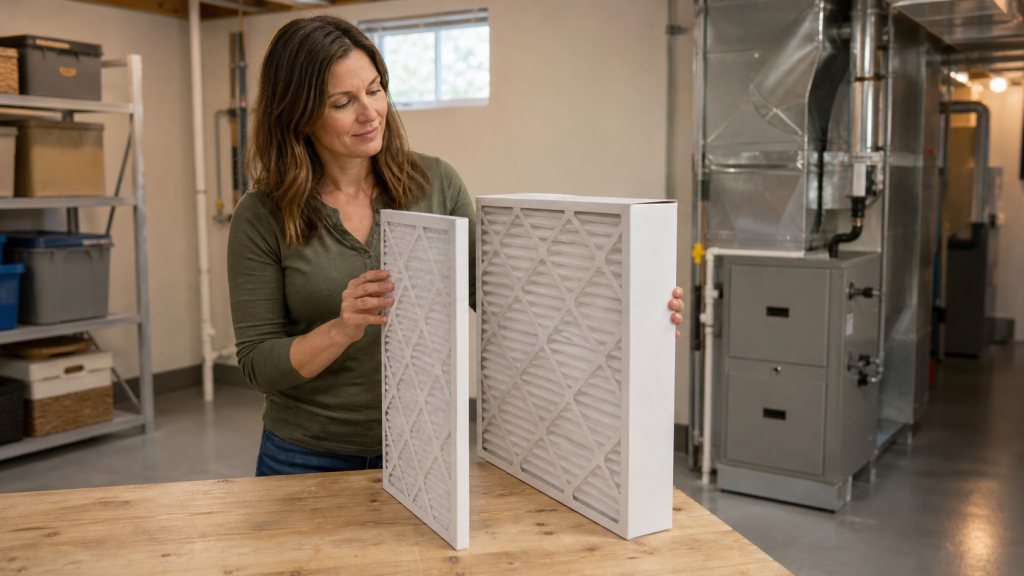
1 Inch vs 4 Inch Air Filter: Quick Answer
Choose a 1-inch filter when:
- Your furnace or air handler has a standard 1-inch filter slot.
- No compatible deeper media cabinet is installed.
- You prefer a lower upfront filter cost.
- The selected filter meets the equipment’s filtration and airflow requirements.
Choose a 4-inch filter when:
- Your system already has a compatible 4-inch media cabinet.
- You want greater dust-holding capacity.
- You prefer less frequent filter replacement.
- The selected filter provides suitable filtration efficiency and pressure drop for the system.
In a general 1-inch vs 4-inch furnace filter comparison, the 4-inch setup is usually better when it is properly designed for the HVAC system. The correct filter, however, is always one that fits the existing cabinet and allows the system to operate within its airflow requirements.
1-Inch vs 4-Inch Air Filter Comparison Table
| Feature | 1-Inch Filter | 4-Inch Filter | Practical Winner |
|---|---|---|---|
| Required cabinet | Standard shallow slot | Dedicated deep media cabinet | Depends on existing system |
| Media surface area | Usually less | Usually more | 4-inch |
| Dust-holding capacity | Usually lower | Usually higher | 4-inch |
| Typical replacement frequency | Generally more frequent | Generally less frequent | 4-inch |
| Pressure-drop potential | Depends on design and loading | Can be favorable because of greater media area | Product-specific |
| Upfront filter cost | Usually lower | Usually higher | 1-inch |
| Annual convenience | More frequent attention | Fewer changes in many homes | 4-inch |
| Availability | Widely available | Widely available but more cabinet-specific | 1-inch |
| Higher-MERV options | Available | Available | Depends on system |
| Best use case | Standard 1-inch slot | Compatible media cabinet | Depends on cabinet |
| Professional modification required | No, if already installed | Yes, when converting from 1-inch | 1-inch for existing setup |
These are general differences between 4 inch vs 1 inch furnace filters. Actual airflow resistance, filtration efficiency, and useful service life depend on the specific filter and HVAC system.
What “1-Inch” and “4-Inch” Actually Mean
Filter thickness refers to the filter’s nominal depth, not necessarily its exact physical measurement.
A filter sold as 1 inch thick may measure somewhat less than a full inch. Likewise, a filter commonly described as a 4-inch air filter may have an actual depth that differs from its nominal label.
That makes the full filter dimensions important. Do not buy a replacement based on thickness alone.
A typical 1-inch furnace filter slides into a narrow filter rack at the furnace, air handler, or return. A 4-inch furnace filter is usually an extended-surface pleated filter installed in a dedicated deep media cabinet.
Thickness also does not tell you the filter’s MERV rating. A 1-inch and 4-inch filter can have the same MERV rating while differing significantly in pleat design, media area, dust capacity, and pressure drop.
Why 4-Inch Filters Often Perform Better
The main technical advantage of a deep media filter is additional surface area.
A deeper filter can use longer pleats and more filter media within the same general face dimensions. That gives the air more media through which to pass.
More media can help control pressure drop
Air does not have to pass through every square inch of filter material at the same velocity. With greater media area, the air velocity through each portion of the media can be lower.
When comparing properly designed, compatible products, this can help a deeper filter maintain strong filtration without creating as much resistance as a densely constructed shallow filter might produce.
That does not mean every 4-inch filter has lower pressure drop than every 1-inch filter. Filter material, pleat geometry, MERV rating, airflow rate, and product design all affect resistance.
Greater media area also holds more dust
A larger amount of media gives captured particles more surface on which to accumulate.
That generally gives a 4-inch filter greater dust-holding capacity than a comparable 1-inch design. Greater capacity often allows the filter to remain usable longer before loading increases resistance enough to require replacement.
This combination of media area, capacity, and maintenance convenience is why a compatible 4-inch filter is often the stronger overall setup.
When a 1-Inch Filter Is the Right Choice
A 1-inch air filter is not inherently outdated or inadequate.
If your HVAC system was designed around a 1-inch slot, a properly selected 1-inch pleated filter may be exactly what the equipment requires.
A good 1-inch filter should:
- Match the specified dimensions.
- Meet the equipment’s filtration requirements.
- Have appropriate pressure-drop characteristics.
- Be inspected regularly.
- Be installed in the correct airflow direction.
- Fit without being bent, crushed, or surrounded by large gaps.
A 1-inch furnace filter may require more frequent attention because it generally has less media area and dust capacity. That maintenance difference does not make the filter unsuitable.
The important point is to match the filter to the system rather than assuming a thicker option is automatically a safe upgrade.
Can You Replace a 1-Inch Filter With a 4-Inch Filter?
Not without a compatible filter cabinet.
A 4-inch filter cannot simply be pushed into a 1-inch slot, and stacking several 1-inch filters does not create the equivalent of a deep media filter.
If you want to convert from a 1-inch filter to a 4-inch filter, an HVAC professional may need to evaluate:
- The existing return-air arrangement
- Available physical space
- Furnace or air-handler configuration
- Filter cabinet compatibility
- System airflow requirements
- Total external static pressure
- Ductwork limitations
A properly designed 4-inch media cabinet may be a useful upgrade, but it is not practical or appropriate for every installation.
Do not cut ductwork, modify sheet metal, or improvise a filter rack to make a deeper filter fit.
Airflow and Pressure Drop
Every HVAC filter creates resistance as air moves through it. That resistance is commonly described as pressure drop.
Air filter pressure drop depends on several factors:
- Filter-media construction
- Pleat design
- Total media area
- Airflow rate
- MERV rating
- Filter thickness
- Dust loading
- Overall product design
Neither thickness nor MERV rating tells the full story by itself.
A deeper filter can sometimes provide lower pressure drop than a shallow filter with similar filtration efficiency because the deep filter offers more media area. But that is not guaranteed across different products.
When available, compare product-specific initial pressure-drop information at an airflow relevant to the system.
Resistance can also change as a filter loads with dust. A filter that has reached the end of its useful service life may restrict HVAC filter airflow more than it did when new.
If there is uncertainty about filter compatibility, an HVAC technician can measure total external static pressure and evaluate the system. Homeowners do not need to perform that testing themselves.
MERV Rating vs Filter Thickness
Furnace filter thickness and MERV rating describe different things.
MERV measures particle-capture efficiency. Filter thickness describes physical depth.
Both 1-inch and 4-inch filters are available at multiple MERV ratings. Therefore:
- A 4-inch filter is not automatically MERV 13.
- A 1-inch filter is not automatically lower efficiency.
- A 1-inch MERV 13 filter may work properly in some HVAC systems.
- A 1-inch MERV 13 filter may create too much resistance for other systems.
- A 4-inch MERV 13 filter can sometimes achieve strong filtration with favorable pressure drop because of its larger media area.
A 4-inch MERV 13 filter should still be evaluated using its product specifications and the HVAC system’s requirements.
The practical goal is to use the highest filtration efficiency the system can accommodate without creating unacceptable airflow resistance.
If you’re comparing filtration levels as well as filter thickness, our MERV 8 vs MERV 11 vs MERV 13 comparison explains particle capture, airflow considerations, and how to choose a filter compatible with your HVAC system.
Dust-Holding Capacity and Filter Life
One of the clearest differences in a thick vs thin furnace filter comparison is dust-holding capacity.
Because deeper filters generally contain more media, they can often hold more captured material before replacement becomes necessary.
That is why a 4-inch filter often remains in service longer than a 1-inch filter. It is not appropriate, however, to assign one replacement schedule to every filter.
Actual service life varies with:
- Filter construction
- Manufacturer instructions
- HVAC runtime
- Household dust levels
- Number of occupants
- Pets
- Remodeling or construction dust
- Smoke or outdoor air conditions
- Filtration efficiency
A dirty, damaged, or heavily loaded filter should be replaced regardless of how long it has been installed.
For both filter depths, regular inspection and the filter and equipment manufacturer’s guidance are more reliable than a universal calendar rule.
For a practical schedule of filter inspections, replacements, and seasonal HVAC upkeep, follow our preventive HVAC maintenance guide to help keep your heating and cooling system operating reliably.
Cost Comparison
A 1-inch filter generally costs less each time you buy one. A 4-inch filter usually carries a higher individual purchase price.
That does not necessarily tell you which setup costs less over time.
A 1-inch filter may require more replacements, while a 4-inch filter’s greater dust capacity can reduce replacement frequency. Annual cost therefore depends on the specific products, household conditions, and how often each filter actually needs replacement.
There is also an important difference in setup cost. If you already have a 4-inch media cabinet, no conversion is needed. If your system only has a 1-inch slot, adding a 4-inch media cabinet requires professional installation and creates an additional upfront expense.
The lowest filter price at the store is not necessarily the lowest long-term cost, but convenience and compatibility are often more important than small differences in filter spending.
Which Is Better for Pets, Dust, and Smoke?
A deeper filter’s greater dust-holding capacity can be useful in homes that load filters quickly.
Homes with pets, ongoing renovation dust, or periods of wildfire smoke may need more frequent filter inspection regardless of thickness.
For particle capture, MERV rating matters more than depth alone. A low-MERV 4-inch filter is not automatically more efficient at capturing small particles than a higher-MERV 1-inch filter.
Pet owners should also remember that much of the large hair and settled debris in a home never reaches the HVAC filter. Regular cleaning remains important.
A central HVAC filter is one part of an indoor-air-quality strategy, not a complete solution by itself.
How to Identify the Filter Your System Uses
Use the existing filter and normal filter location before ordering replacements.
- Find the normal filter location. It may be at the furnace, air handler, dedicated media cabinet, or return grille.
- Read the dimensions printed on the existing filter.
- Check the filter rack or cabinet label.
- Record all dimensions. Include nominal and actual dimensions if both are provided.
- Check the furnace, air-handler, or filter-cabinet documentation.
- Confirm any required replacement model. Some media cabinets use specific filter sizes or designs.
- Do not assume a close measurement means a filter will fit.
- Ask an HVAC professional if the filter setup is damaged, improvised, poorly sealed, or difficult to identify.
Do not open blower, electrical, or combustion compartments to look for filter information.
How to Install the Correct Replacement Filter
Filter replacement is usually straightforward when the filter is located in its normal accessible slot or cabinet.
- Turn the HVAC system off using the normal control specified for the equipment.
- Remove the old filter from its accessible location.
- Compare the replacement dimensions with the old filter and cabinet requirements.
- Follow the airflow-direction arrow on the filter.
- Slide the replacement into place without bending or crushing it.
- Do not stack filters.
- Make sure the filter is seated properly without obvious gaps.
- Close the normal filter access cover.
- Restore normal HVAC operation.
Stop if the filter requires force, does not fit normally, or prevents the access cover from closing correctly.
Common Filter-Thickness Mistakes
Avoid these common errors:
- Buying filters before checking the cabinet
- Confusing nominal and actual dimensions
- Forcing a 4-inch filter into a 1-inch slot
- Stacking multiple filters
- Assuming thicker always means higher MERV
- Assuming higher MERV always means higher pressure drop
- Choosing a filter only by purchase price
- Ignoring product-specific pressure-drop information
- Using a filter that leaves large bypass gaps
- Installing the airflow arrow backward
- Relying on one universal replacement schedule
- Buying filters in bulk before confirming exact fit
The filter should match the equipment first. Filtration preferences come after compatibility.
Frequently Asked Questions
Is a 4-inch air filter better than a 1-inch filter?
In a compatible system, a 4-inch filter is generally the better overall setup because its greater media area can provide higher dust capacity, favorable pressure-drop characteristics, and less frequent replacement.
Can I put a 4-inch filter in a 1-inch slot?
No. A 4-inch filter requires a compatible deep media cabinet. Do not force it into a shallow slot.
Can I stack four 1-inch filters?
No. Stacking filters increases resistance and does not reproduce the design of a 4-inch extended-surface filter.
Does a 4-inch filter restrict airflow less?
It can. Greater media area may help reduce pressure drop compared with some shallow filters of similar efficiency. Actual resistance depends on the specific products and airflow conditions.
Does a 4-inch filter last longer?
Often, because it generally has greater media area and dust-holding capacity. Actual filter life depends on the product, system runtime, household conditions, and manufacturer guidance.
How often should I change a 1-inch air filter?
There is no universal interval. Inspect it regularly and replace it according to its condition and the filter and HVAC equipment instructions.
How often should I change a 4-inch air filter?
Use the manufacturer’s guidance and inspect the filter periodically. Greater media capacity often allows longer service than a 1-inch filter, but household conditions vary.
Is a 4-inch filter always a higher MERV rating?
No. Thickness and MERV are separate specifications. Both shallow and deep filters are available at different filtration efficiencies.
Is a 1-inch MERV 13 filter too restrictive?
Not necessarily. Some systems can accommodate one and others cannot. Product pressure drop and HVAC airflow requirements determine compatibility.
Are 4-inch filters better for pets?
Their greater dust-holding capacity can be useful in pet households, but MERV rating determines filtration efficiency. Pet homes should also inspect filters more frequently when shedding is heavy.
Is upgrading to a 4-inch media cabinet worth it?
It can be worthwhile if you want greater media capacity, fewer filter changes, or improved filtration options and your HVAC system can support the cabinet. An HVAC professional should evaluate the installation.
Why does my filter say a different actual size?
Filter labels often use nominal dimensions for convenience. Actual manufactured dimensions can be slightly different so the filter fits its intended cabinet correctly.
Final Recommendation
In a general 1 inch vs 4 inch air filter comparison, a compatible 4-inch system is usually the better overall setup for media area, dust-holding capacity, and maintenance convenience. A properly selected 1-inch filter remains the correct choice when your HVAC system uses a standard 1-inch slot.
Never force a deeper filter into a shallow rack or stack filters to imitate greater thickness. Converting to a 4-inch media cabinet requires professional evaluation and installation because the filter cabinet, duct arrangement, available space, pressure drop, and HVAC filter airflow all need to work together.