thermostat not working: common causes and fixes
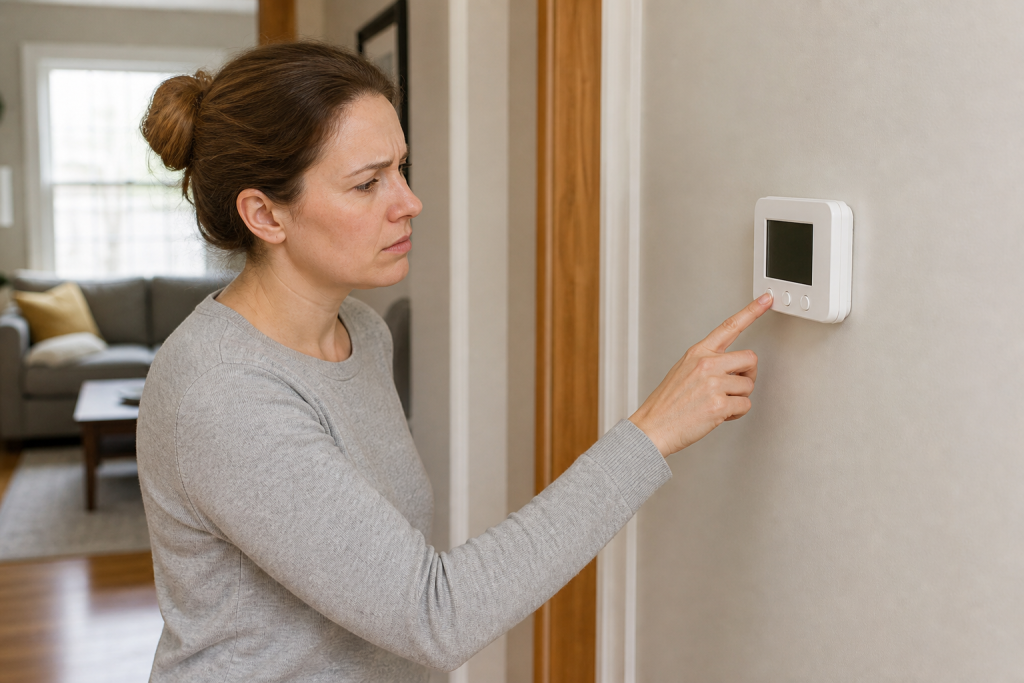
Thermostat not working problems can come from incorrect settings, dead batteries, lost power, schedules or lockouts, poor thermostat placement, communication faults, damaged wiring, or a failure elsewhere in the HVAC system. Start with simple settings and power checks, but remember: a thermostat displaying “Heat On” or “Cool On” does not prove the furnace, air conditioner, or heat pump is operating correctly.
Quick Answer
Check the thermostat mode, temperature setpoint, fan setting, schedule, batteries, and any visible messages first. Then inspect the HVAC filter and confirm the electrical breaker and equipment service switch appear normal.
Some thermostats intentionally delay compressor operation for several minutes after a power or setting change. Follow the instructions for your exact thermostat rather than repeatedly changing settings or cycling HVAC power.
If basic checks do not restore normal operation, the problem may be in the thermostat wiring, control circuit, safety system, or HVAC equipment itself.
What a Thermostat Actually Controls
A thermostat senses temperature and tells compatible HVAC equipment when heating, cooling, or fan operation is needed. More advanced thermostats may also manage schedules, heat-pump functions, multiple equipment stages, humidity, or other features.
That means there are two sides to thermostat troubleshooting:
- Is the thermostat correctly requesting heating or cooling?
- Is the HVAC system able to respond to that request?
A thermostat can look completely normal while a furnace, air conditioner, heat pump, control board, condensate safety, or other component prevents the equipment from operating.
Different symptoms also point in different directions:
- Blank screen: Possible battery or power problem.
- Screen on, controls unresponsive: Possible lock, software issue, thermostat failure, or power problem.
- “Heat On” but no furnace operation: The thermostat may be calling correctly while the heating equipment cannot respond.
- “Cool On” but no AC operation: A normal compressor delay or an HVAC fault may be involved.
- Wrong room-temperature reading: Placement or sensing problems are possible.
- Settings change unexpectedly: A schedule, hold, vacation, eco, or automation setting may be active.
- HVAC runs continuously: The thermostat setting may be wrong, or the equipment may have another fault.
- Rapid starts and stops: Short cycling can come from airflow, controls, equipment faults, or thermostat problems.
- Smart thermostat works at the wall but is offline in the app: The HVAC controls may still work even though internet connectivity does not.
- Smart thermostat has Wi-Fi but does not operate the HVAC equipment: The problem may be on the control or equipment side rather than the internet side.
Messages such as Delay, Waiting, Recovery, Auxiliary Heat, or an error code should be interpreted using the manual for the exact thermostat model.
Thermostat Not Working: Quick-Diagnosis Table
| Observed symptom | Possible cause | Safe homeowner check | When to call a professional |
|---|---|---|---|
| Screen is blank | Dead batteries or lost power | Replace batteries if applicable; check visible power status | Screen remains blank |
| Screen works but system does not start | Wrong mode or satisfied setpoint | Check Heat/Cool mode and temperature | Thermostat clearly calls but equipment stays off |
| Settings change unexpectedly | Schedule, hold, vacation, eco setting | Review thermostat menus | Settings change without explanation |
| Controls do not respond | Screen lock or thermostat fault | Check lock status and manual | Unit remains frozen or unresponsive |
| Thermostat loses power | Breaker, switch, safety circuit, C-wire issue | Check breaker and visible service switch | Power loss continues |
| Heat or Cool appears but nothing runs | HVAC equipment or control fault | Wait through required delay; check filter | Equipment still does not respond |
| System stops during operation | Dirty filter or condensate safety | Inspect filter; note visible alerts | Safety shutdown repeats |
| Temperature seems inaccurate | Poor placement or blocked sensor openings | Check sunlight, drafts, heat sources | Large error persists |
| Smart thermostat is offline | Wi-Fi, router, app, or server issue | Check whether local control still works | Local HVAC control also fails |
| Breaker is tripped | Electrical or equipment fault | Follow equipment manual if no warning signs | Breaker trips again |
| Furnace/air-handler panel appears loose | Door safety switch may be open | Confirm accessible panel is fully seated without removing it | Panel cannot be secured normally |
| Intermittent or erratic behavior | Wiring, C-wire, fuse, control board, thermostat | No wiring work | Professional diagnosis needed |
Stop Immediately for Gas, CO, or Electrical Warning Signs
Do not continue thermostat troubleshooting if you smell gas or a carbon-monoxide alarm sounds.
Leave the home immediately. Do not operate switches, thermostats, lights, phones, appliances, garage-door controls, or other electrical devices inside. Move everyone to fresh air and contact emergency services and the gas utility from outside.
Also stop and call a qualified professional for:
- Burning or melting-plastic odors
- Smoke, sparks, or scorching
- Persistent electrical buzzing
- A thermostat or wall plate that feels unusually hot
- Exposed, damaged, or frayed wiring
- Water near HVAC electrical equipment
- A breaker that trips again
- Persistent thermostat or equipment error codes
- Suspected gas, combustion, refrigerant, or high-voltage problems
Do not investigate the furnace or HVAC cabinet first when a gas odor or CO alarm is present.
Why Is the Thermostat Screen Blank?
A blank thermostat generally means the display has lost its power source or the thermostat itself has failed.
Possible causes include:
- Dead thermostat batteries
- Lost low-voltage HVAC power
- A tripped breaker
- An HVAC service switch that has been turned off
- An open furnace or air-handler door safety switch
- A condensate float-switch or drain-related safety shutdown
- A C-wire or control-power problem
- A blown low-voltage fuse
- A failed thermostat
Replace accessible thermostat batteries if your model uses them. If the thermostat is powered by the HVAC system and remains blank, internal electrical diagnosis belongs with a professional.
Do not remove HVAC access panels, test live voltage, replace fuses, or pull thermostat wires.
Thermostat Is On but the HVAC System Does Not Start
A working display only proves that the thermostat has enough power to operate its screen and controls.
If “Heat On” appears but the furnace does not run, possible causes include a furnace safety shutdown, ignition fault, blower problem, control-board issue, or loss of equipment power.
If “Cool On” appears but the AC does not run, the thermostat may be in a compressor protection delay. If the model’s required delay has passed, the problem could involve the air conditioner, heat pump, control circuit, condensate safety, or electrical supply.
Do not repeatedly raise and lower the temperature trying to force the equipment to start.
Check Thermostat Settings and Schedules
Incorrect settings can make a correctly functioning thermostat look broken.
Check these items before moving deeper into troubleshooting:
- Confirm the system is set to Heat when you want heating or Cool when you want cooling.
- Make sure the setpoint actually requires operation. For heating, it must be above room temperature; for cooling, below room temperature.
- Set the fan to Auto for normal testing.
- Check for an active schedule, temporary hold, permanent hold, vacation mode, eco mode, or energy-saving setting.
- Look for a child lock or screen lock.
- Review any displayed status message.
On programmable and smart thermostats, an unexpected temperature change may simply be a scheduled event rather than a failure.
Replace Thermostat Batteries
Weak batteries can cause a blank screen, unreliable controls, warnings, or intermittent operation on thermostats that depend on replaceable batteries.
Use the battery type specified for the thermostat and follow the model’s battery-replacement directions.
Some thermostats use batteries only as backup power, while others depend on them for normal operation. A battery change will not solve a lost HVAC power supply, control-wiring problem, or equipment failure.
If fresh batteries do not restore the display or normal control, move on to the other safe checks rather than repeatedly removing the thermostat.
Check for an Equipment Protection Delay
Many thermostats intentionally prevent an air conditioner or heat pump compressor from restarting immediately after shutdown or a power interruption.
The thermostat may display:
- Waiting
- Delay
- Cool On flashing
- Equipment protection
- A similar model-specific message
This can be normal.
Do not repeatedly change the setpoint or switch power off and on. Doing so may restart the protection period and make troubleshooting more confusing.
Allow the delay specified in the thermostat manual to finish. If the equipment still does not start afterward, continue with the safe checks or arrange professional service.
Thermostat Temperature Does Not Match the Room
An inaccurate reading does not automatically mean the thermostat has failed.
Placement can affect what the thermostat senses. Check whether it is influenced by:
- Direct sunlight
- A nearby supply register
- A draft
- An exterior door
- A fireplace
- Cooking heat
- Lamps, televisions, or appliances
- Another localized heat source
Also make sure exterior thermostat openings are not visibly blocked by dust. Clean only the exterior as permitted by the thermostat instructions; do not open the device to reach internal sensors.
If the reading remains substantially inconsistent with room conditions, the thermostat sensor, calibration, placement, or HVAC setup may need professional evaluation.
Can a Dirty Filter Make the Thermostat Seem Broken?
Yes. A dirty HVAC filter can restrict airflow enough to contribute to equipment protection or safety shutdowns.
For example, a furnace may overheat and stop heating even though the thermostat continues calling for heat. An air-conditioning system can also develop airflow problems that prevent normal cooling operation.
Inspect the filter and replace it if dirty using the correct size and an approved filter type.
Do not assume the filter is the only cause if the system continues shutting down after replacement.
Power, Breaker, and HVAC Service-Switch Checks
A thermostat and HVAC system may depend on the same indoor equipment power circuit.
Visually check the electrical panel for a tripped HVAC breaker and verify that a clearly identified furnace or air-handler service switch has not accidentally been turned off.
If a breaker is tripped and there is no burning odor, visible damage, water near equipment, heat, smoke, or other warning sign, follow the equipment manufacturer’s instructions. Do not repeatedly reset the breaker.
If it trips again, leave it off and call an HVAC professional.
Some furnaces and air handlers also have a safety switch that prevents operation when an access panel is not seated properly. If an already-accessible panel is visibly out of position, you may confirm it is fully closed without removing it or touching anything inside.
Never remove an HVAC panel to operate or bypass that safety switch.
Smart Thermostat and Wi-Fi Problems
A smart thermostat can have two separate communication paths:
- Its connection to the HVAC equipment
- Its connection to Wi-Fi, an app, or a remote service
If the thermostat appears offline in the app, first check the thermostat at the wall.
If local controls still operate the heating and cooling equipment, the HVAC control connection may be fine and the problem may involve the router, internet service, app, account, or remote server.
Follow the thermostat manufacturer’s Wi-Fi troubleshooting instructions for your exact model.
If the thermostat is connected to Wi-Fi but the HVAC equipment does not respond locally, treat that as a thermostat-to-equipment or HVAC problem rather than an internet problem.
How to Tell Whether the Problem Is the Thermostat or HVAC System
You usually cannot prove the cause from the thermostat screen alone, but the behavior can narrow the possibilities.
A thermostat problem becomes more likely when:
- The screen is blank despite known good power and batteries
- Controls freeze or do not respond
- Temperature readings remain inaccurate after placement influences are ruled out
- Settings change without a schedule or automation explaining them
- The thermostat repeatedly loses power or restarts
An HVAC equipment problem becomes more likely when:
- The thermostat clearly indicates a call for heating or cooling
- The required protection delay has ended
- The furnace, AC, or heat pump still does not operate
- The equipment starts and then shuts down
- A breaker or safety device repeatedly interrupts operation
- Heating or cooling performance remains poor despite normal thermostat behavior
The next diagnostic steps often require electrical measurements, equipment access, or interpretation of HVAC fault codes. Those belong with a qualified technician.
When a C-Wire or Wiring Problem Is Possible
Many powered thermostats use a C-wire as part of the low-voltage power circuit. Our guide to whether you need a C-wire for a smart thermostat explains its purpose and the compatibility issues homeowners should understand. A missing, loose, damaged, or unreliable control-power connection can contribute to blank screens, reboots, or inconsistent operation on some systems.
Other thermostat wiring faults can also prevent the HVAC equipment from responding correctly.
Do not pull thermostat wires, jumper terminals, test voltage, modify connections, or replace a low-voltage fuse as a troubleshooting experiment.
A blown control fuse can be a symptom of another electrical problem. Replacing it without finding the cause may simply result in another failure.
Signs the Thermostat May Need Replacement
A thermostat may be failing when basic causes have been ruled out and it continues to show symptoms such as:
- Blank or intermittently blank display
- Frozen or unresponsive controls
- Persistent inaccurate temperature readings
- Random restarts
- Unexplained setting changes
- Failure to send reliable heating or cooling commands
- Repeated internal error messages
Replacement is not simply a matter of choosing any thermostat that fits the wall.
Compatibility matters with heat pumps, multi-stage systems, communicating equipment, proprietary controls, millivolt systems, and other specialized HVAC configurations. Have the system identified before replacing an uncertain thermostat.
Before buying a replacement, determine whether a smart thermostat will work with your older HVAC system and its existing controls.
When to Call an HVAC Professional
Arrange professional service when:
- Basic thermostat settings and battery checks do not solve the problem
- The display remains blank
- The thermostat calls for heating or cooling but the equipment does not respond
- A breaker trips again
- A condensate or equipment safety repeatedly stops operation
- Error codes persist
- The thermostat repeatedly loses power
- Wiring appears damaged
- A C-wire or low-voltage power problem is suspected
- The furnace, air conditioner, or heat pump starts and stops abnormally
- HVAC equipment diagnosis requires opening a cabinet
- You are unsure whether the thermostat is compatible or correctly configured
Homeowners should not touch exposed wiring, jumper terminals, bypass safety switches, open control boards, replace control fuses, or work around wet electrical equipment.
Final Recommendation
If your thermostat is not working, begin with the controls you can safely verify: the screen message, Heat or Cool mode, setpoint, fan setting, schedules, locks, batteries, thermostat surroundings, filter, breaker status, and visible HVAC service switch.
Wait through any manufacturer-required equipment delay and consult the manual for the exact thermostat model. If the thermostat displays a heating or cooling call but the HVAC equipment still does not respond, stop treating the thermostat as the only possible cause.
Frequently Asked Questions
Why is my thermostat screen blank?
Dead batteries, lost HVAC power, a tripped breaker, an open equipment safety circuit, a C-wire problem, a control-power fault, or a failed thermostat can cause a blank screen.
Why is my thermostat on but the furnace is not running?
The thermostat may be calling for heat while the furnace has lost power, entered a safety shutdown, or developed an ignition, airflow, control, or other equipment problem.
Why does the thermostat say Cool On when the AC is not running?
The thermostat may be waiting through a normal compressor-protection delay. If the required delay ends and the AC still does not run, an equipment, power, safety, or control problem may be present.
How do I know whether my thermostat is broken?
A failed thermostat becomes more likely if it remains blank, unresponsive, inaccurate, or unreliable after batteries, settings, power, schedules, and other basic causes have been checked. Professional diagnosis may still be needed to separate thermostat failure from an HVAC fault.
Can dead batteries stop a thermostat from working?
Yes. On models that rely on replaceable batteries, weak or dead batteries can cause blank screens, warnings, or unreliable control.
Can a dirty filter make a thermostat stop working?
The thermostat itself may still work, but a dirty filter can restrict airflow and contribute to an HVAC safety shutdown that makes the system appear unresponsive.
Why does my thermostat temperature not match the room?
Sunlight, drafts, supply air, fireplaces, cooking heat, nearby appliances, poor placement, or a thermostat sensor problem can affect the displayed temperature.
Why does my thermostat keep changing its setting?
A programmed schedule, temporary hold expiration, vacation setting, eco mode, energy-saving feature, automation, or another authorized user may be changing it.
Why is my smart thermostat offline?
The thermostat may have lost Wi-Fi or internet connectivity, or the app or remote service may be unavailable. Check whether the thermostat still operates the HVAC equipment locally.
Will a smart thermostat still work without Wi-Fi?
Many smart thermostats can continue basic local HVAC control when internet service is unavailable, although remote-app and cloud features may stop. Check the manual for your exact model.
What does a thermostat delay or waiting message mean?
It often indicates an intentional equipment-protection period that prevents a compressor from restarting too quickly. Follow the thermostat’s model-specific instructions and wait for the stated delay to finish.
Can a tripped breaker make the thermostat go blank?
Yes. A thermostat powered through the HVAC equipment may lose power when the indoor equipment circuit is interrupted. A breaker that trips again requires professional diagnosis.
Can a C-wire problem cause a blank thermostat?
Yes, on thermostats that depend on continuous low-voltage power. C-wire and control-power problems should be diagnosed rather than guessed at or rewired experimentally.
Should I reset my thermostat?
Use a reset or reboot only when the exact thermostat manual recommends it for your symptom. There is no universal thermostat-reset procedure, and repeated power cycling can complicate troubleshooting.
When should I call an HVAC professional?
Call when thermostat not working symptoms continue after basic settings, battery, filter, and visible power checks; when the HVAC equipment does not respond to a clear call; or whenever wiring, safety circuits, electrical faults, refrigerant, combustion, or internal equipment access is involved.