Best hVAC tools for homeowners: complete tool kit
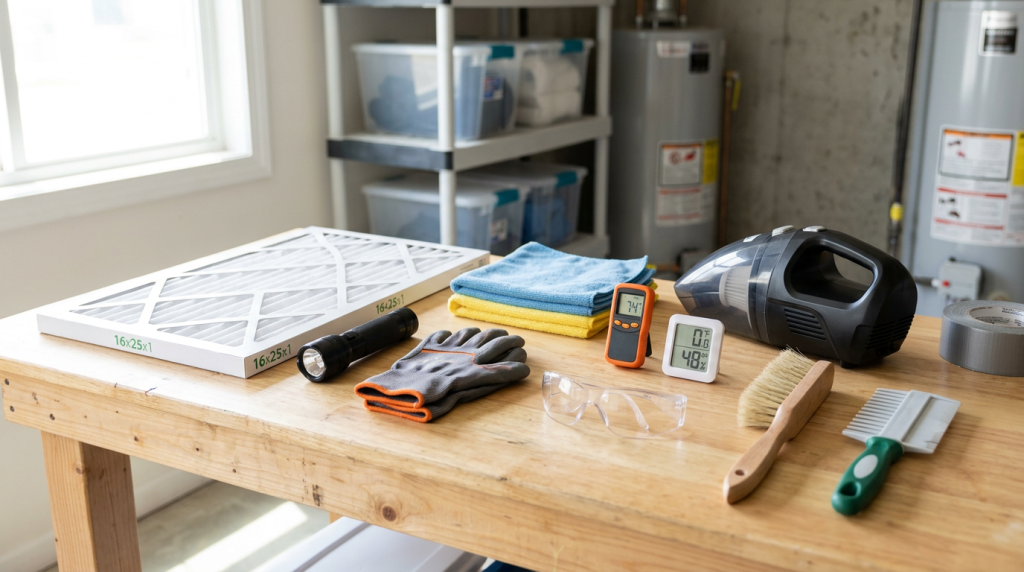
Best HVAC tools for homeowners include replacement filters, a headlamp, work gloves, safety glasses, a wet/dry vacuum, a digital thermometer, and gentle cleaning supplies. These tools support safe routine maintenance without encouraging homeowners to handle refrigerant, gas, combustion equipment, or live electrical components.
A useful HVAC tool kit should make recurring maintenance easier without turning into a collection of technician equipment. Start with tools you will use for filters, inspections, cleaning, and basic comfort checks, then add specialized maintenance items only when your system and routine justify them.
Best HVAC Tools: Quick Comparison
The most useful HVAC tools for homeowners are simple, reusable, and matched to maintenance tasks that do not require opening sealed or energized equipment.
| Tool | Best use | Buying priority | Typical homeowner task | Main limitation |
|---|---|---|---|---|
| Correct-size replacement air filters | Airflow maintenance | Essential | Replacing a dirty filter | Must match system requirements |
| Rechargeable headlamp | Hands-free inspection | High | Checking filters and visible equipment | Does not make internal inspection safe |
| Compact wet/dry vacuum | Accessible debris and water | High | Cleaning grilles or accessible drains | Not for internal electrical parts |
| Digital thermometer | Basic temperature checks | Medium | Comparing room or vent temperatures | Cannot diagnose equipment faults |
| Thermometer and humidity-gauge combination | Comfort monitoring | Medium | Tracking room conditions | Readings provide context, not diagnosis |
| Work gloves | Hand protection | Essential | Handling filters and debris | Do not protect against electrical hazards |
| Safety glasses | Eye protection | Essential | Overhead filter and grille work | Do not expand safe DIY scope |
| Soft coil-cleaning brush | Loose surface debris | Medium | Light exterior coil cleaning | Not for deep coil cleaning |
| Fin comb | Minor accessible fin straightening | Optional | Correcting a few lightly bent fins | Easy to damage fins if misused |
| Condensate-drain cleaning supplies | Drain maintenance | Medium | Clearing an accessible drain | Recurring leaks need diagnosis |
| Microfiber cloths and soft cleaning brushes | General surface cleaning | Essential | Cleaning vents and panels | Surface use only |
| Storage tote and maintenance log | Organization | High | Keeping supplies and records together | Requires regular updating |
For most homes, the first purchases should be filters, basic safety gear, lighting, and gentle cleaning supplies. A wet/dry vacuum and thermometer are useful additions when they support tasks you actually perform.
The Best Starter HVAC Tool Kit for Most Homeowners
A starter HVAC maintenance kit does not need specialty diagnostic equipment. A practical setup includes:
- Correct replacement filters
- Rechargeable headlamp
- Work gloves
- Safety glasses
- Microfiber cloths
- Soft cleaning brush
- Thermostat batteries when applicable
- Maintenance log
- Small storage tote
This kit covers the routine tasks most homeowners should be handling: filter changes, visible inspections, surface cleaning, thermostat upkeep, and maintenance tracking.
Build from there instead of buying a large technician-style HVAC tool kit. Many specialized tools are designed for electrical, refrigerant, combustion, or internal mechanical work that falls outside a homeowner’s safe maintenance scope.
Best HVAC Tools for Filter Maintenance
Replacement air filters
Replacement filters are among the most important homeowner HVAC maintenance tools because they are used repeatedly and directly affect airflow.
Before buying, confirm several details.
Dimensions: Match the length, width, and thickness required by your filter slot. Do not assume two filters with similar-looking dimensions are interchangeable.
MERV rating: Use a filtration level appropriate for your equipment. A higher rating is not automatically better if it creates more airflow resistance than the system is designed to handle. Comparing MERV 8 vs MERV 11 vs MERV 13 can help clarify the tradeoffs.
Filter thickness: A 1-inch filter and a 4-inch filter may have very different designs, capacities, and replacement schedules. Use the size your system is designed to accept rather than modifying the filter cabinet.
Airflow direction: Filters normally have an airflow-direction arrow. Install the replacement in the orientation specified for your system.
Compatibility: Follow the HVAC manufacturer’s filter requirements when available, especially if there are restrictions on filter type or resistance.
Multi-packs can be convenient when you already know the exact filter that fits your system. Avoid stocking a large quantity until you have confirmed the dimensions and suitability.
Filter puller or gripper
A filter puller is optional rather than essential.
It can be helpful when a filter is located in a ceiling return, recessed cabinet, or tight slot where getting a secure grip is difficult. Choose a simple design that lets you remove the filter without damaging the filter frame or nearby components.
If filters are already easy to reach, this tool adds little value.
Best HVAC Tools for Inspection and Comfort Checks
Rechargeable headlamp
A headlamp is often more useful than a handheld flashlight because it keeps both hands available while changing filters, inspecting accessible ductwork, or looking around indoor equipment.
Look for:
- Adjustable brightness
- A wide beam for close work
- Comfortable head straps
- Rechargeable battery
- A magnetic or other hands-free mounting option if useful
Extra brightness is less important than comfortable, even illumination at short distances.
A headlamp improves visibility. It does not make it appropriate to remove service panels or inspect energized components.
Digital thermometer
A basic digital thermometer can help homeowners compare temperatures in different rooms or observe whether air from a supply vent is warmer or cooler than the surrounding room.
It can be useful for spotting patterns. For example, a room that consistently differs from the rest of the house may deserve further investigation.
Do not treat a thermometer reading as a complete HVAC diagnosis. Temperature differences can be affected by system operation, airflow, weather, duct conditions, thermostat settings, and measurement location.
A household thermometer cannot determine refrigerant charge or establish that a compressor, blower, or other internal component is operating correctly.
Humidity gauge
A small thermometer and humidity-gauge combination can add useful context when a home feels unusually damp or dry.
Useful features include:
- Clear temperature and humidity display
- Easy-to-read numbers
- Stable tabletop or wall placement
- Optional historical readings through an app
Place the gauge in a representative living area rather than directly beside a supply vent, exterior door, humidifier, shower, or cooking area.
Humidity readings help describe indoor conditions. They do not identify the cause of a moisture or HVAC problem by themselves.
Best HVAC Cleaning Tools
Compact wet/dry vacuum
A compact wet/dry vacuum is one of the more versatile additions to a homeowner HVAC maintenance kit.
Appropriate uses can include:
- Cleaning loose debris around HVAC equipment
- Vacuuming accessible return grilles
- Removing loose exterior debris
- Assisting with an accessible condensate drain when the cleaning method is appropriate for the system
Keep the vacuum outside closed HVAC cabinets. Do not reach vacuum attachments into energized equipment or attempt to clean electrical components.
Water around HVAC equipment also needs context. A small amount associated with an accessible drain issue may be manageable, but repeated or significant leakage is not something to continually vacuum up without finding the cause.
Soft coil brush
A soft coil-cleaning brush can remove loose debris from accessible exterior coil surfaces without the aggressive force of a stiff brush.
Use light pressure. Coil fins are thin and easily bent.
A homeowner surface cleaning should not become deep coil servicing. Heavy contamination, inaccessible dirt, damaged coils, or cleaning that requires equipment disassembly belongs with professional service.
If a cleaner is being considered as well, confirm that the product and method are suitable for the equipment. AC coil cleaner foam vs spray products can differ in application and intended use.
Fin comb
A fin comb is an optional tool for small areas of lightly bent, readily accessible fins.
It is not a general-purpose coil repair tool. The comb spacing needs to match the fins, and excessive force can create more damage.
If a large section of the coil is crushed, heavily damaged, or difficult to access, leave it alone and have the equipment evaluated professionally.
Microfiber cloths and soft brushes
Microfiber cloths and soft brushes handle many ordinary cleaning jobs without requiring specialty HVAC products.
Use them for:
- Accessible vent covers
- Return grilles
- Thermostat exteriors
- Closed equipment panels
- Dust on surrounding surfaces
Avoid pushing brushes or cloths through openings into internal equipment. Surface cleaning should remain surface cleaning.
Condensate Drain Cleaning Supplies
An accessible condensate drain may require occasional maintenance during cooling season.
A simple drain kit can include:
- Wet/dry-vac drain attachment
- Funnel when appropriate
- Soft cleaning brush
- Work gloves
- Towels
- Manufacturer-approved drain treatment
The exact cleaning method depends on the drain layout and equipment instructions. A guide on how to clean an AC drain line safely can provide the procedure for an accessible system.
Stop treating the problem as routine maintenance if water continues to return, the drain repeatedly clogs, the drain pan overflows, water enters the equipment cabinet, or moisture reaches electrical components. Recurring leakage needs diagnosis, not repeated cleanup.
HVAC Safety Gear for Homeowners
Basic protective equipment belongs in the kit even though routine HVAC maintenance is relatively limited.
Work gloves help with dirty filters, sharp grille edges, and outdoor debris.
Safety glasses are particularly useful when removing overhead filters, brushing dusty grilles, or working where loose debris may fall.
A dust mask can be useful for dusty surface-cleaning tasks when appropriate.
Protective equipment does not expand the homeowner’s safe work scope. Gloves do not make electrical work safe, and safety glasses do not make refrigerant, combustion, or internal mechanical work appropriate for DIY servicing.
Optional Tools Worth Adding Later
Once the basic kit is established, a few additional tools may be worthwhile:
- Filter puller: Helpful for awkward filter locations.
- Fin comb: Useful for small, accessible areas of lightly bent fins.
- Infrared thermometer: Convenient for quick surface-temperature comparisons.
- Small inspection mirror: Helps view accessible areas without reaching into equipment.
- Garden-hose nozzle with a gentle setting: May assist with manufacturer-approved exterior cleaning when power is off; avoid electrical components and excessive pressure.
- Condensate-drain supplies: Useful for systems with an accessible homeowner-serviceable drain.
- Additional filter storage: Keeps correct filters clean and ready.
- Tool tote: Separates HVAC supplies from general household tools.
Add these tools because a recurring maintenance task requires them, not because they appear in a professional HVAC tool kit.
HVAC Tools Homeowners Should Not Buy for DIY Repairs
Some HVAC tools are designed specifically for work involving hazardous energy, refrigerants, gas, combustion, or internal electrical components.
| Professional-only tool | Why it is outside normal homeowner maintenance |
| Refrigerant manifold gauges | Connect directly to the refrigerant system and require technical knowledge |
| Refrigerant recharge kits | Encourage refrigerant handling without proper diagnosis |
| Vacuum pumps | Used during refrigerant-system service |
| Refrigerant recovery machines | Specialized equipment for refrigerant handling |
| Combustion analyzers | Require interpretation of combustion and venting conditions |
| Gas-pressure manometers | Used for gas-system measurement and adjustment |
| Brazing torches | Introduce fire risk and are used on sealed-system repairs |
| Capacitor testers | Often involve access to electrical components that can retain dangerous energy |
| Live-circuit diagnostic meters | Can expose the user to hazardous voltage during HVAC diagnosis |
| Safety-switch bypass tools | Defeat protections designed to shut equipment down under unsafe conditions |
Buying a tool does not make the underlying task safe.
Refrigerant work can involve regulated servicing practices. Gas and combustion adjustments can create fire or carbon-monoxide hazards. HVAC electrical systems may contain high voltage and components capable of retaining electrical energy even after operation stops.
When diagnosis reaches those systems, the correct tool for the homeowner is the phone used to schedule qualified service.
How Much Should a Homeowner HVAC Tool Kit Cost?
The right budget depends more on what you already own than on reaching a particular price point. Exact product prices also change too frequently to make a fixed total useful.
Think about the kit in three levels.
Basic kit
Start with:
- Correct filters
- Headlamp
- Gloves
- Safety glasses
- Microfiber cloths
- Maintenance log or tracking supplies
This level handles routine inspections and filter maintenance.
Expanded kit
Add:
- Compact wet/dry vacuum
- Digital thermometer
- Humidity gauge
- Soft cleaning brushes
The expanded kit is useful for homeowners who perform seasonal HVAC maintenance regularly.
Seasonal kit
Add only when the system and maintenance routine justify them:
- Fin comb
- Condensate-drain supplies
- Gentle hose nozzle
- Organized storage
- Extra correctly sized filters
Most homeowners are better served by building the kit gradually. A smaller collection of regularly used tools provides more value than a large box filled with specialty equipment.
How to Choose HVAC Tools Without Overbuying
Before adding any tool, ask:
- Will I use it for recurring maintenance?
- Can I use it without opening sealed or energized equipment?
- Does it fit my specific HVAC system?
- Can I store it properly?
- Are replacement supplies readily available?
- Does the manufacturer provide clear instructions?
- Would this task be safer for a professional?
The second question is especially important. If the tool is useful mainly after an electrical panel, refrigerant circuit, burner compartment, or other professional-service area has been opened, it probably does not belong in a homeowner HVAC maintenance kit.
When Your HVAC Tool Kit Is Not Enough
Maintenance tools are useful for prevention and observation. They are not substitutes for diagnosis when the system develops a significant fault.
Stop DIY maintenance and arrange qualified service for:
- Repeated breaker trips
- Gas odor
- Electrical burning smell
- Smoke or sparking
- Refrigerant-line icing
- Persistent water leakage
- Grinding or banging noises
- Failure to heat or cool
- Short cycling
- A thermostat that repeatedly loses power
If there is a gas odor, smoke, sparking, or a suspected carbon-monoxide problem, treat it as a safety issue rather than a tool problem.
For ordinary performance problems, symptom-specific guidance can help determine the next step. An AC running but not cooling, an AC making a grinding noise, furnace short cycling, a burning smell from a furnace, and a thermostat not working each require different checks and professional boundaries.
For routine care rather than troubleshooting, follow a preventive HVAC maintenance schedule so filters, accessible drains, outdoor equipment, and seasonal inspections are addressed before problems develop.
Frequently Asked Questions
What tools should homeowners have for HVAC maintenance?
Start with correct replacement filters, a headlamp, gloves, safety glasses, microfiber cloths, a soft brush, and a maintenance log. A compact wet/dry vacuum, thermometer, and humidity gauge are useful additions.
Do homeowners need refrigerant gauges?
No. Refrigerant gauges are professional service tools that connect to the refrigerant system. Homeowner preventive maintenance does not require measuring or adjusting refrigerant pressure.
Is a multimeter safe for DIY HVAC work?
A multimeter is not recommended for homeowner HVAC diagnosis when the task involves live voltage, internal electrical components, or stored electrical energy. Those tests should be performed by someone qualified to work safely on the equipment.
Can a wet/dry vacuum clean an AC drain line?
It can assist with some accessible condensate-drain cleaning methods when appropriate for the system. Persistent clogs, overflowing pans, or repeated leakage should be professionally diagnosed.
Is a fin comb safe for homeowners?
A fin comb can be reasonable for a small, easily accessible area of lightly bent fins. Stop if the fins are extensively damaged or the work requires reaching into or disassembling equipment.
What is the best starter HVAC tool kit?
For most homeowners, start with filters, a headlamp, gloves, safety glasses, microfiber cloths, a soft brush, thermostat batteries when applicable, a maintenance log, and a small tote.
Are HVAC tool kits made for technicians suitable for homeowners?
Usually not. Technician kits often contain electrical, refrigerant, and diagnostic tools intended for work outside normal homeowner maintenance. Build a smaller kit around the tasks you can safely perform.
How should HVAC maintenance tools be stored?
Keep tools clean and dry in a labeled tote or cabinet. Store replacement filters flat and protected from moisture and damage, and keep drain treatments or cleaning products in their original containers.
Final Recommendation
The best HVAC tools are the ones that support recurring, homeowner-safe maintenance. Begin with correct filters, a rechargeable headlamp, work gloves, safety glasses, a compact wet/dry vacuum, a digital thermometer, gentle cleaning supplies, and a maintenance log.
Add items such as a humidity gauge, fin comb, inspection mirror, or condensate-drain supplies only when they fit your equipment and maintenance routine. Skip professional repair tools that require access to refrigerant, gas, combustion, or live electrical systems.
Final Thoughts
A well-planned homeowner HVAC tool kit should make maintenance simpler without encouraging repairs beyond your safe scope. Build it gradually, choose tools for tasks you will actually perform, and keep the collection organized.
Use the Preventive HVAC Maintenance guide for the monthly and seasonal schedule that tells you when those tools should come out of the tote.