Communicating Thermostat vs Smart Thermostat
Communicating thermostat vs smart thermostat describes two different qualities of HVAC control. “Smart” generally refers to homeowner features such as Wi-Fi, app control, scheduling, alerts, and smart-home integration. “Communicating” describes how a control exchanges operating information with compatible HVAC equipment. Some thermostats are both, and choosing correctly depends on what your HVAC system requires.
Quick Answer
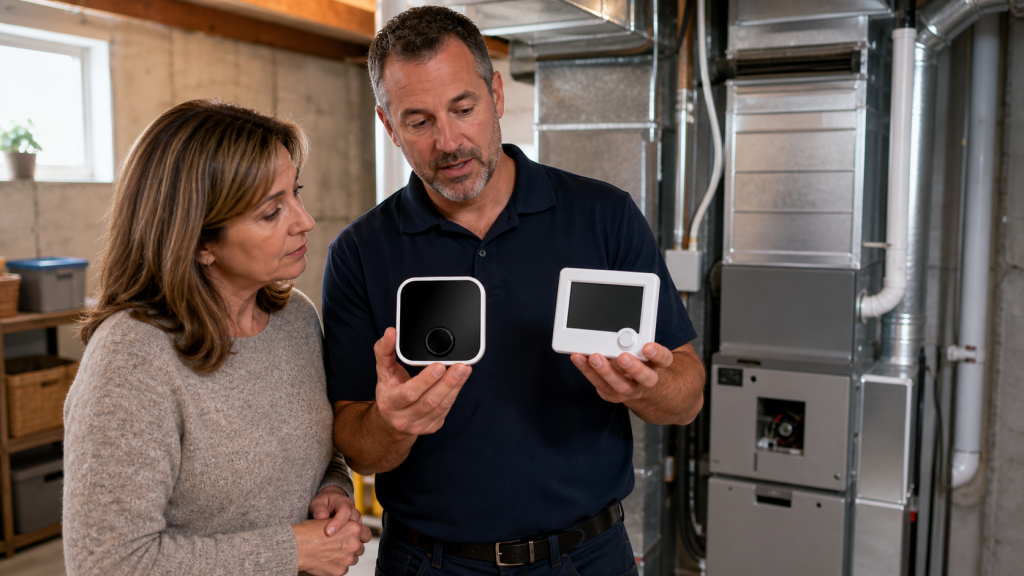
A conventional smart thermostat is often a practical choice for an HVAC system that uses supported standard low-voltage controls. A communicating HVAC system may instead depend on a matched wall control that coordinates equipment functions beyond basic heating and cooling calls.
The important distinction is:
- Smart: Homeowner connectivity and convenience.
- Communicating: Equipment integration and data exchange.
- Both: A communicating control can also offer Wi-Fi, apps, scheduling, and other smart features.
Compatibility matters more than the number of features on the thermostat.
| Comparison factor | Communicating thermostat | Conventional smart thermostat |
|---|
| Primary purpose | Coordinate compatible HVAC components | Control supported HVAC equipment with connected features |
| Communication with HVAC equipment | May exchange two-way digital information | Usually sends separate control calls |
| Typical compatibility | Often matched to a brand or equipment family | Often supports many conventional low-voltage systems |
| App and Wi-Fi features | Available on many models | Common |
| Variable-capacity control | May support full matched-system operation | Depends on equipment and thermostat |
| Staging and modulation | May coordinate automatically | Limited to supported stages and controls |
| Humidity and airflow control | May be integrated | Model- and system-dependent |
| Equipment diagnostics | May provide detailed system information | Usually more limited |
| Zoning | May integrate with matched zoning | Depends on zone equipment |
| Wiring | May use specialized communication connections | Commonly uses standard thermostat terminals |
| Replacement flexibility | Often more restricted | Generally broader |
| DIY suitability | Usually warrants professional verification | May be reasonable on simple compatible systems |
| Best fit | Matched communicating equipment | Supported conventional HVAC systems |
Communicating Thermostat vs Smart Thermostat: Comparison Table
Exact capabilities vary by thermostat and HVAC equipment.
A thermostat that powers on is not necessarily fully compatible or correctly configured.
What a Communicating Thermostat Is
A communicating thermostat exchanges operating information with compatible HVAC components instead of relying only on separate calls for heat, cooling, fan operation, and individual stages.
In a matched system, two-way HVAC communication can allow the wall control, indoor equipment, outdoor equipment, and supported accessories to coordinate operation. Depending on the system, that may include variable-capacity output, staging, blower airflow, humidity, ventilation, zoning, equipment status, or diagnostics.
Many communicating controls are manufacturer- or product-family-specific. However, “communicating” does not mean every system uses the same proprietary protocol or offers the same features.
What a Smart Thermostat Is
A smart thermostat is generally defined by its connected and automated homeowner features.
Common features include:
- Wi-Fi connectivity
- Thermostat app control
- Remote temperature adjustments
- Scheduling and automatic setbacks
- Alerts and reminders
- Occupancy or room sensors
- Smart-home or voice integration
- Equipment-use information
Those features do not prove that the thermostat provides advanced communication with the furnace, air handler, heat pump, or air conditioner.
Many retail smart thermostats are conventional controls that use standard low-voltage terminals. They can be highly capable without being communicating HVAC controls.
A Communicating Thermostat Is Not Automatically the Same Thing as a Smart Thermostat
There are four useful categories:
- Basic conventional thermostat: Uses standard control calls without extensive connected features.
- Conventional smart thermostat: Uses conventional HVAC controls but adds features such as Wi-Fi, apps, schedules, and alerts.
- Communicating control without extensive smart features: Exchanges system information but may have limited homeowner connectivity.
- Communicating control with smart features: Combines deeper HVAC system control with Wi-Fi, remote access, scheduling, or other connected functions.
That last category is important. Keeping a communicating wall control does not necessarily mean giving up modern app or remote-control features.
Communicating Thermostat vs Smart Thermostat: The Real Difference
A conventional thermostat commonly operates HVAC equipment through discrete low-voltage control calls. Separate terminals may request heating, cooling, fan operation, compressor stages, auxiliary heat, or other supported functions.
A communicating control can instead exchange more detailed information with compatible equipment. The equipment and control may coordinate operating capacity, airflow, humidity, system status, or other functions without treating every action as a separate simple call.
This is the central difference in communicating vs non-communicating HVAC control.
A universal smart thermostat may offer broader compatibility and excellent homeowner convenience. A matched communicating control may offer deeper equipment integration. Neither approach is automatically better for every home.
How Communicating Systems Work With Brand-Specific or Proprietary HVAC Equipment
Some HVAC manufacturers design indoor equipment, outdoor equipment, accessories, and the communicating wall control to operate as one matched platform.
Depending on the equipment, a proprietary HVAC control may coordinate:
- Variable-speed or variable-capacity operation
- Modulating heat
- Heating and cooling stages
- Blower airflow
- Humidity control
- Ventilation
- Thermostat zoning control
- Accessories
- Thermostat diagnostics
- Fault information
- Equipment status
A variable-speed HVAC system or modulating furnace may therefore rely on its matched control for functions that go beyond maintaining room temperature.
The exact capabilities vary considerably. Manufacturer documentation for the specific HVAC models and control should take priority over general thermostat advice.
Can a Communicating Thermostat Also Be Smart?
Yes. Many communicating controls also provide the features homeowners associate with smart thermostats, including Wi-Fi, scheduling, applications, remote adjustments, alerts, and smart-home functions.
“Communicating” describes how the control works with HVAC equipment. “Smart” describes its connected and automated features for the homeowner.
A manufacturer-specific thermostat can therefore serve as both the HVAC system control and a connected smart-home device. If app access is your main reason for considering replacement, first determine whether your existing communicating platform already provides it.
When a Smart Thermostat Is a Practical Fit
A conventional smart thermostat is often appropriate when:
- The HVAC equipment uses supported standard low-voltage controls.
- The thermostat supports the exact number of heating and cooling stages.
- Required heat-pump and auxiliary-heat functions are supported.
- C-wire or approved thermostat power requirements are satisfied.
- The exact thermostat’s compatibility checker approves the configuration.
- Replacing the current control will not remove required communicating functions.
A conventional multi-stage thermostat can control some multi-stage equipment correctly when its specifications match the system. That does not mean it can reproduce every capability of a communicating variable-capacity system.
When a Manufacturer-Specific Communicating Control May Be the Better Choice
Keeping or replacing the matched control is often the safer choice when:
- The HVAC equipment is designed as a communicating platform.
- The existing wall control is part of the matched system.
- The equipment is variable capacity or modulating.
- The control manages airflow, humidity, ventilation, accessories, or zoning.
- Integrated equipment diagnostics are important.
- The manufacturer requires or recommends the matched control.
- A conventional replacement would reduce system functionality.
Do not assume a more expensive universal thermostat is an upgrade. The correct thermostat is the one that properly supports the equipment.
Features You Could Lose by Replacing a Communicating Control
If you replace a communicating thermostat with a conventional control, possible losses can include:
- Variable-capacity control
- Modulation
- Precise staging
- Blower-speed coordination
- Humidity management
- Ventilation or accessory control
- Integrated zoning
- Equipment diagnostics
- Fault history
- Dealer-service information
- System-specific efficiency functions
Not every communicating system provides all of these features, and not every replacement removes them all. The question is what the existing control manages on your specific equipment.
A system may still produce heating and cooling after a control change while operating with fewer features than before.
Safe Ways to Identify Which Type You Have
Homeowners can gather useful information without rewiring or opening HVAC equipment.
- Turn HVAC power off at the breaker or equipment disconnect according to manufacturer instructions.
- Confirm the system does not respond to a temperature change.
- Remove only a thermostat faceplate designed to detach without disturbing wiring.
- Photograph the existing terminals and all readable labels.
- Record the thermostat model and HVAC model information already safely visible.
Possible clues of a communicating system include a wall control matching the HVAC manufacturer, unusual terminal labels, relatively few conductors serving many system functions, documentation that says “communicating,” or equipment described as variable capacity or modulating.
Integrated humidity, zoning, equipment-status, or diagnostic displays can also be clues.
Numbers, data or bus markings, or manufacturer-specific letters may indicate specialized controls, but they are not proof by themselves. Do not disconnect wires or guess what unfamiliar terminals mean.
If wiring is damaged, brittle, proprietary, unfamiliar, or unclear, replace the cover and contact a qualified HVAC professional. Do not open equipment panels, access control boards, test voltage, splice wiring, install interfaces, or attempt to convert the system to conventional control.
Decision Guide for Homeowners
Use this sequence before purchasing a replacement:
- Identify the HVAC equipment and current thermostat or wall control.
- Determine whether the existing control is conventional or communicating.
- List important functions it currently manages, such as staging, humidity, zoning, or diagnostics.
- Decide which homeowner features you want, such as scheduling or remote access.
- Check smart thermostat compatibility for the exact replacement model.
- Confirm which existing HVAC functions would remain available.
- Use a qualified HVAC professional if the system is communicating, proprietary, variable capacity, zoned, dual fuel, or unclear.
The goal is not simply to find a thermostat that can turn the equipment on. It is to preserve the functions your system needs.
Common Comparison Mistakes
Common mistakes include:
- Assuming smart and communicating mean the same thing
- Assuming Wi-Fi means communicating HVAC control
- Treating every retail smart thermostat as universal
- Shopping for app features before checking HVAC compatibility
- Assuming a thermostat that powers on is configured correctly
- Ignoring variable-speed, humidity, zoning, or diagnostic functions
- Replacing a branded control without checking manufacturer requirements
- Assuming higher price means better compatibility
- Buying before documenting the existing HVAC system
Compatibility should come before appearance, touchscreen features, or app preferences.
Cost and Replacement Considerations
Communicating controls and professional replacement can cost more than a straightforward conventional thermostat swap because the hardware, compatibility requirements, and configuration may be more specialized.
That does not make a universal replacement automatically more economical. Converting or replacing the wrong control can lead to additional installation work, lost functionality, comfort problems, or the need to restore the original control strategy.
Do not choose between communicating and conventional controls based on an assumption that one will always save more energy. Equipment design, control strategy, installation, settings, climate, and homeowner behavior all affect performance.
Final Recommendation
For a conventional low-voltage HVAC system, choose a smart thermostat that supports the complete equipment configuration and the homeowner features you want.
For a communicating HVAC system, preserving the matched communicating or manufacturer-specific control is generally the safer approach unless the HVAC manufacturer or a qualified professional confirms an approved alternative.
If you are unsure which type you have, identify the equipment and existing control before buying anything. Do not replace a communicating thermostat based only on wire count, appearance, price, or Wi-Fi features.
Frequently Asked Questions
What is the difference between a communicating thermostat and a smart thermostat?
A smart thermostat is defined mainly by connected features such as Wi-Fi, apps, scheduling, and automation. A communicating thermostat exchanges operating information with compatible HVAC equipment.
Can a communicating thermostat also be a smart thermostat?
Yes. A communicating control can also offer Wi-Fi, app access, scheduling, alerts, and smart-home features.
Is a Wi-Fi thermostat a communicating thermostat?
Not necessarily. Wi-Fi describes network connectivity. It does not prove that the thermostat provides two-way communication with HVAC equipment.
Can I replace a communicating thermostat with a smart thermostat?
Sometimes, but doing so may require an approved control method and can reduce system functionality. Verify the exact HVAC manufacturer requirements before replacement.
How can I tell if my HVAC system is communicating?
Manufacturer documentation is the best confirmation. A matched branded wall control, unusual terminals, variable-capacity equipment, or advanced diagnostic displays can be clues but are not proof.
Are communicating thermostats brand-specific?
Many are tied to a manufacturer or particular product family, but communicating HVAC controls should not be defined as universally proprietary.
Can a regular smart thermostat control variable-speed HVAC equipment?
Sometimes it can provide basic or staged control, depending on the equipment. It may not reproduce the full variable-capacity control available through the matched communicating system.
What features could be lost with a universal thermostat?
Possible losses include modulation, variable-capacity operation, airflow coordination, humidity control, zoning, accessory management, and system diagnostics.
Do communicating thermostats require special wiring?
Some use communication connections that differ from conventional thermostat terminals. Wiring methods vary by manufacturer and system.
Are communicating thermostats better?
Not universally. They can be the best fit for equipment designed around communicating control, while a conventional smart thermostat may be the better choice for a standard HVAC system.
Does a communicating thermostat need a C-wire?
Power requirements vary by control system. Do not assume conventional C-wire rules apply; follow the requirements for the exact communicating control and HVAC equipment.
When should an HVAC professional replace the thermostat?
Professional replacement is appropriate for communicating or proprietary controls, variable-capacity equipment, zoning, dual-fuel systems, unclear wiring, or any situation requiring equipment access or control reconfiguration.
Final Thoughts
The communicating thermostat vs smart thermostat decision should begin with the HVAC equipment, not the app or touchscreen. Conventional systems often pair well with a compatible smart thermostat, while communicating equipment may depend on a matched control to preserve advanced system functions.
Identify the equipment and current control, document the thermostat terminals without disturbing the wiring, and verify the exact replacement requirements. When a system is communicating, proprietary, variable capacity, zoned, or unclear, have a qualified HVAC professional confirm the replacement before changing the control.