Spray vs granular weed killer for spot treating lawns
Choosing spray vs granular weed killer for spot treating lawns gets much easier once you know that spot treatment is all about precision.
If you are only dealing with a few dandelions, clover patches, or other scattered weeds, a spray is usually the better choice. It is easier to aim at individual weeds and easier to keep off the rest of the lawn.
Granular weed killer still has a place, but it usually makes more sense for broader applications instead of small, targeted lawn touch-ups.
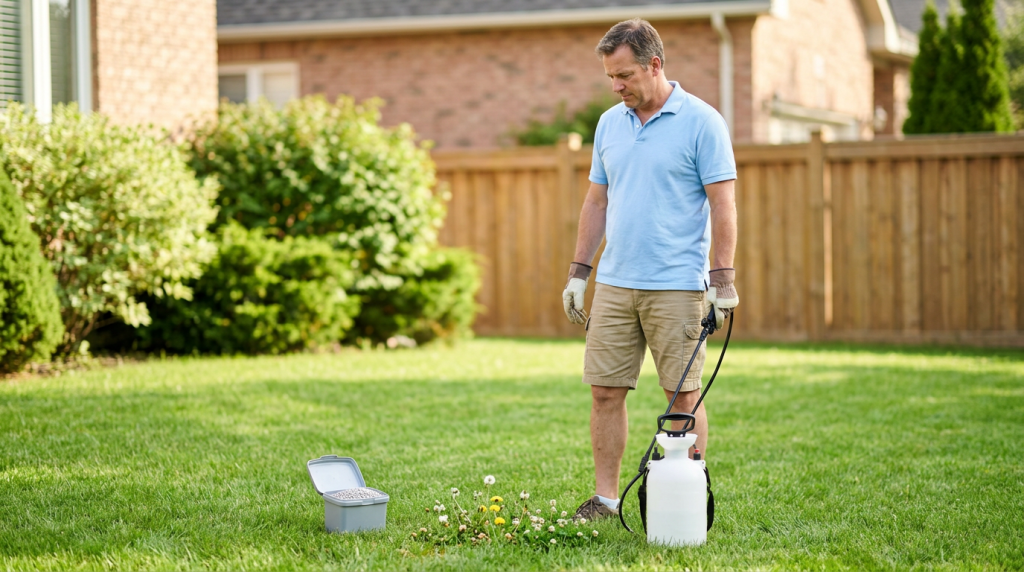
What spot treating means in plain English
Spot treating means applying weed killer only where weeds are growing instead of spreading product across the whole yard.
That matters because many lawns do not need blanket treatment. If you only have a few problem weeds, treating the entire lawn usually means using more product than necessary.
For most homeowners, spot treating is the more practical approach when:
- weeds are scattered instead of everywhere
- the lawn is mostly healthy
- you want to avoid unnecessary chemical use
- you are trying to protect nearby desirable plants
Spray vs granular weed killer for spot treating lawns
For most beginner homeowners, spray weed killer is the better option for spot treating lawns.
That is because spray lets you hit the weed directly. You can aim it at individual plants or small patches and stop once the leaves are coated lightly.
Granular weed killer is usually less precise for this job. It can work in some situations, but it is harder to target exactly where you want it, especially when you are only treating a few weeds.
So the simplest answer is this:
- choose spray for isolated weeds and small patches
- choose granular more often for broader lawn coverage, not precise spot treatment
Why spray usually works better for spot treatment
Most lawn weeds you can see are treated with post-emergent herbicides. That just means the product is meant to kill weeds after they have already come up.
Many of those products work best through the weed’s leaves. A spray makes it easier to coat those leaves directly.
That gives spray a few clear advantages for spot treatment.
Spray usually works better because it is
- easier to aim at the weed itself
- easier to use on scattered weeds
- less wasteful for small problem areas
- better for avoiding full-yard treatment
- simpler for beginners when using a ready-to-use bottle
For a lawn with a handful of visible weeds, this is usually the most practical route.
Why granular is usually less ideal for small spot treatment
Granular products are spread as small particles instead of being sprayed as a liquid.
That can work for some lawn weed control situations, but it is usually not the easiest way to treat a few individual weeds. Granules are harder to place exactly where you want them, and some need the weed leaves to be damp so the particles stick properly.
That makes granular weed killer less convenient for isolated spot treatment.
Granular products are usually less ideal when
- you only have a few weeds
- you want very targeted control
- the lawn is dry and the granules will not stick well
- nearby flowers or ornamentals need careful protection
- you are trying to avoid treating more lawn than necessary
This is why many beginners get better results with a lawn weed spray than with a granular product for small infestations.
When granular weed killer does make sense
Granular weed killer is not useless. It is just usually better suited to a different job.
Some granular products make more sense when you are treating a larger portion of the lawn, especially when the product is designed to be spread with a spreader rather than aimed at one weed at a time.
Granular weed control may make more sense when:
- weeds are spread across much of the yard
- you are already doing a broader lawn treatment
- the product label clearly fits your grass type and weed problem
- the lawn conditions match the label directions, including moisture requirements
This is more common with weed-and-feed style products or broader broadcast applications than true spot treatment.
If you are comparing spot treatment with broader spring lawn products, our guide on weed and feed vs pre-emergent for spring lawns explains where each approach fits better.
Spray is usually the easiest option for beginners
For most first-time homeowners, a ready-to-use spray bottle is the easiest starting point.
You do not have to mix it. You do not have to calibrate a spreader. You do not have to cover more of the lawn than needed.
That makes it easier to slow down and treat only the weeds you actually see.
A ready-to-use spray is often best for beginners because it
- removes guesswork about mixing
- helps limit overapplication
- works well on small infestations
- makes it easier to stop once the weed is lightly coated
- is simpler to store and use for occasional lawn touch-ups
For a lot of homeowners, this is the most realistic and least intimidating way to begin.
The type of weed matters too
Not every lawn weed responds to the same herbicide.
A broadleaf weed like dandelion or clover is different from a grassy weed like crabgrass. A sedge is different again. That means the first step is not choosing spray or granular. The first step is knowing what the weed actually is.
Common lawn weed groups include
- broadleaf weeds like dandelion, clover, plantain, and chickweed
- grassy weeds like crabgrass
- sedges like yellow nutsedge
If you use the wrong product, the form of the product will not matter much because the active ingredient may not work on that weed.
If the main broadleaf weed you are trying to spot treat is dandelion, read our guide on how to get rid of dandelions in a cool-season lawn for the full control plan.
Timing matters more than many homeowners expect
Visible lawn weeds are usually easier to control when they are still young and actively growing.
Older, tougher weeds often take more effort and sometimes repeat treatments. Many perennial broadleaf weeds are also easier to control in fall, even though spring is when many homeowners first notice them.
That means the best treatment is not always the first warm weekend you feel like doing yard work.
Weed killer usually works better when
- weeds are small and actively growing
- the lawn is not drought-stressed
- temperatures are moderate
- wind is low
- rain is not expected right away if the label warns against it
Good timing often matters as much as the product choice.
When spray can go wrong
Spray is usually the better spot-treatment tool, but it still has risks.
The biggest one is drift. Drift means the spray moves off target through wind or fine mist and lands on plants you did not mean to treat.
That is why a calm day matters.
Spray can cause problems when
- wind carries it onto flowers, shrubs, or vegetables
- you apply too much and soak the weed
- you use it on a stressed lawn
- you spray in hot conditions that raise turf injury risk
- you treat the wrong weed with the wrong product
The goal is not to drench the weed. It is usually enough to wet the foliage lightly.
When granular can go wrong
Granular products have their own common mistakes.
A lot of beginners assume they work like fertilizer, but many granular weed killers need very specific conditions to work well. Some need damp weed leaves so the particles can stick long enough to be absorbed.
Granular products often disappoint when
- the grass and weeds are too dry
- the product is watered or rained off too soon
- you are only trying to hit a few isolated weeds
- the spread pattern is uneven
- you use a yard-wide product when you only needed spot treatment
This is one reason many homeowners use too much product for too little actual weed pressure.
Spray vs granular: the best practical rule
If you want the simplest rule, use this:
Use spray when you can point to the weeds you want gone.
Use granular when the weed problem is broad enough that you are treating a larger section of lawn and the label directions fit that approach.
For true spot treatment, spray usually wins because it is more precise and usually easier for beginners to control.
Safe DIY checks before treating lawn weeds
Most homeowners can handle small lawn weed problems safely if they slow down and check a few basics first.
Safe DIY checks include
- identifying the weed before buying a product
- confirming the product is labeled for lawns
- making sure your grass type is listed as safe
- choosing a calm day with little wind
- avoiding treatment on drought-stressed grass
- reading the label for watering and mowing directions
- keeping spray or granules away from flowers, shrubs, and vegetable beds
These checks help prevent accidental lawn damage and wasted product.
When spot treatment may be better than any full-yard product
A lot of lawns do not need weed-and-feed or full broadcast weed control at all.
If the yard is mostly healthy and the weeds are limited, spot treatment is often the better long-term habit. It keeps chemical use lower and makes you look more closely at the actual lawn problem.
That also helps you notice when weeds are really a symptom of something else, like thin turf, compacted soil, or mowing too short.
When to call a professional
Sometimes a lawn weed problem is too large, too confusing, or too risky for guesswork.
It may be time for a pro when
- the lawn is more weeds than grass
- you are not sure what the weed actually is
- the problem involves sedges or hard-to-control perennial weeds
- nearby trees, shrubs, or garden beds could be damaged easily
- repeat treatments have failed
- the lawn is thin because of drainage, shade, or soil problems instead of simple weed pressure
A professional can help if the real issue is not just weed control, but lawn health and diagnosis.
Final takeaway
The best answer to spray vs granular weed killer for spot treating lawns is that spray is usually the better tool for the job.
It is more precise, easier to aim at individual weeds, and usually a better fit for scattered lawn weeds in an otherwise healthy yard. Granular weed killer can still be useful, but it usually makes more sense for broader applications than for a few isolated weeds.
For most beginner homeowners, a ready-to-use lawn weed spray is the simplest and most practical starting point for spot treatment.