
How to Get Rid of Dandelions
Knowing how to get rid of dandelions starts with deciding whether you have a few scattered weeds or a broader lawn problem.
For a small number of dandelions, hand removal or targeted spot treatment may be enough. If they keep returning, the better long-term fix is to combine weed control with lawn care that helps grass grow thicker and leaves less open space for new weeds.
The best approach depends on how many dandelions you have, whether they are actively growing, and how healthy the surrounding lawn is.
Why dandelions show up in cool-season lawns
Dandelions are tough broadleaf weeds with deep taproots.
A taproot is one thick main root that grows down into the soil. That root helps the plant survive mowing, dry weather, and rough treatment better than many homeowners expect.
Dandelions also take advantage of lawns that are:
- thin
- cut too short
- underfed
- compacted
- patchy from wear or winter damage
If the lawn has open space and sunlight hitting the soil, dandelions get a much easier place to start.
How to get rid of dandelions
For most homeowners, the best approach is a combination of:
- hand removal for a small number of weeds
- spot treatment for scattered active weeds
- better mowing and lawn care to thicken the turf
That is the simplest answer to how to get rid of dandelions in a cool season lawn. Kill or remove what is there, then make the lawn a harder place for new dandelions to establish.
Start by deciding how bad the problem is
Before you buy anything, look at the lawn honestly.
A few dandelions in an otherwise healthy lawn should be handled differently than a yard with dozens of them in every direction.
A small problem looks like this
- a few scattered dandelions
- mostly healthy grass around them
- no major bare spots
- no large thin sections of turf
A bigger problem looks like this
- clusters of dandelions across the yard
- thin grass between weeds
- poor lawn density
- many flowering weeds at once
That first check helps you choose between simple spot control and a bigger lawn-improvement plan.
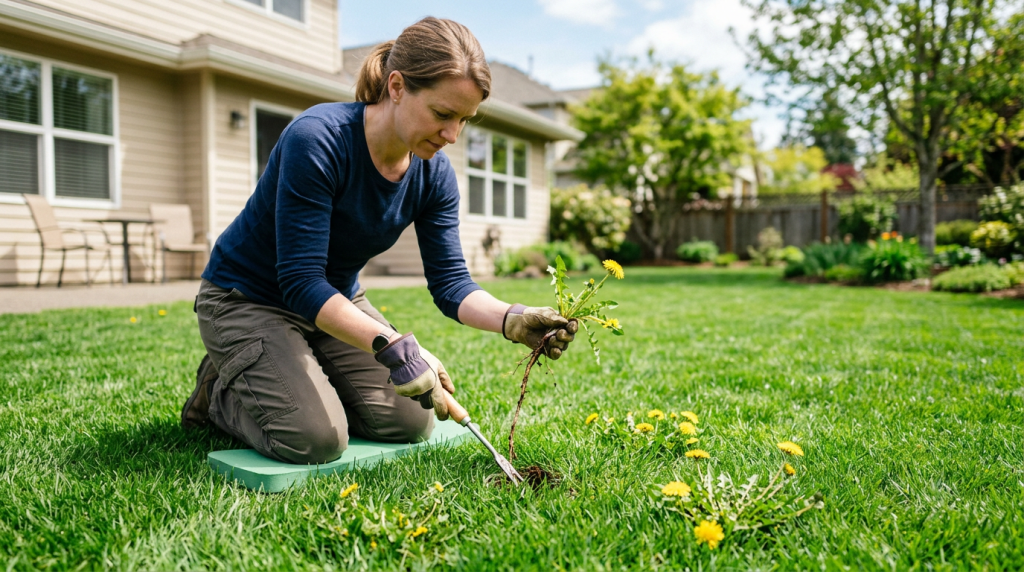
Hand-pulling works best for small numbers
If you only have a few dandelions, pulling them by hand is often the easiest place to start.
The trick is removing as much of the taproot as possible. If too much root stays in the ground, the plant can regrow.
Hand-pulling works best when
- the soil is slightly moist
- the plants are still fairly young
- you use a weeding knife or dandelion puller
- you loosen the soil enough to get deeper root removal
Do not just snap off the top growth and expect the problem to be solved. The leaves may disappear for a while, but the root can still send up new growth.
Spot-spraying is usually the best chemical option
For most beginner homeowners, a lawn-safe broadleaf weed spray is the easiest chemical option for scattered dandelions.
Dandelions are broadleaf weeds, which means they are different from grass. A selective lawn weed killer is designed to target broadleaf weeds while leaving labeled lawn grasses alone when used correctly.
Spray is usually better than granular weed killer for spot treatment because it is easier to aim directly at individual plants.
Spot-spraying makes the most sense when
- the dandelions are scattered
- the lawn is mostly healthy
- you want to avoid treating the whole yard
- the weeds are actively growing
- you can spray on a calm day
A ready-to-use spray bottle is often the easiest option for a beginner.
If you are still deciding which kind of product is better for scattered weeds, our guide on spray vs granular weed killer for spot treating lawns explains which option is easier to control.
Fall is usually the best time for the strongest control
This is one of the most important things homeowners miss.
Spring is when dandelions are most noticeable because they flower and stand out. But in many cool-season lawns, fall is often the best time to get longer-lasting herbicide control.
That is because dandelions move energy down into their roots as cooler weather returns. When a properly chosen lawn herbicide is applied at that time, the plant is more likely to move the treatment down toward the root system.
Spring spot treatment can still work, especially on small active plants. But fall is usually the stronger long-term window.
Spring control still has a place
Even though fall is often better, you do not have to ignore dandelions all spring.
If the weeds are active and bothering you now, spring spot treatment can still help reduce the visible problem. Just keep your expectations realistic. A spring treatment may clean things up, but a fall follow-up often does the heavier long-term work.
This is why some homeowners feel like dandelions “always come back.” They knock down the spring top growth, but never really improve the lawn or time the control plan well.
Granular weed-and-feed is not always the best answer
A lot of homeowners reach for weed-and-feed because it sounds convenient.
Sometimes it can help. But for scattered dandelions, it is often more product than you actually need. It also ties together two separate jobs:
- feeding the lawn
- killing visible weeds
That is not always ideal timing.
For a few dandelions, spot spraying is usually more precise and less wasteful than spreading weed killer across the whole lawn.
Mowing higher helps more than many beginners expect
Cool-season lawns usually do better when they are not cut too short.
A slightly taller lawn shades the soil better and gives grass more leaf area to stay healthy. That makes it harder for new weeds to get established.
Better mowing habits include
- mowing high enough for your grass type
- following the one-third rule
- keeping the mower blade sharp
- avoiding scalping the lawn
The one-third rule means you should not remove more than one-third of the grass blade in a single mowing.
A lawn that is scalped regularly often ends up looking weaker and weedier over time.
Feeding the lawn helps crowd out future dandelions
A thick lawn is one of the best defenses against dandelions.
Cool-season grasses respond well when fertilizer timing is used carefully, especially in fall. A stronger lawn fills space better and gives weed seedlings less room to get established.
That does not mean dumping on extra fertilizer. It means using a sensible lawn-feeding plan and avoiding the idea that weed control alone will solve everything.
If you are not sure when that feeding should happen, read our guide on spring lawn fertilizer.
Watering matters too
Dandelions tolerate stress better than weak turf.
When a lawn is watered badly, especially with frequent shallow watering, the grass may stay weaker than it should. Stronger turf usually does better with proper mowing, sensible feeding, and watering that supports root growth.
Good lawn-watering habits usually mean
- watering deeply instead of lightly every day
- avoiding constant shallow sprinkling
- watching for runoff in compacted areas
- adjusting based on weather and soil conditions
The goal is not to pamper the dandelions along with the lawn.
Bare spots and thin areas need attention
A lawn with open patches is basically an invitation for weeds.
If dandelions keep showing up in the same thin sections, the problem may not be the dandelions themselves. The problem may be the weak turf.
Common reasons a cool-season lawn stays thin
- traffic wear
- pet damage
- shade
- compacted soil
- poor mowing habits
- skipped fall lawn care
- summer stress that never got repaired
If those issues are not addressed, the lawn often stays easy for weeds to invade.
What not to do
A lot of dandelion frustration comes from avoidable mistakes.
Avoid these common mistakes
- pulling only the top of the weed and leaving most of the root
- spraying on windy days
- using the wrong product for a lawn
- treating a dry, heat-stressed lawn
- mowing too short
- assuming one treatment fixes a weak lawn forever
- spreading a whole-yard weed product for only a few scattered weeds
A simple, targeted plan is usually better than a rushed one.
Safe DIY checks before treating dandelions
Most homeowners can handle small to moderate dandelion control safely with a few basic checks.
Safe DIY checks include
- confirming the weed is actually dandelion
- reading the label to make sure the product is lawn-safe
- checking that your grass type is listed on the label
- spraying only on calm days
- keeping product away from flowers, shrubs, and garden plants
- avoiding treatment when the lawn is under drought or heat stress
- using hand removal when the problem is small
These steps go a long way toward preventing accidental lawn damage.
When it makes sense to call a professional
Sometimes the dandelion problem is really a lawn-health problem.
It may be time for a professional when
- the lawn is more weeds than grass
- the same weed problem returns year after year
- the yard has major compaction or drainage issues
- you are not sure what products are safe for your grass type
- the lawn needs broader repair, overseeding, or renovation
- nearby beds, trees, or ornamentals make treatment riskier
A pro can help when the issue is larger than simple spot control.
A simple plan most homeowners can follow
If you want the calmest and easiest path, follow this order.
Start here
- pull or spot-spray the dandelions you see now
- mow the lawn a little higher
- keep the grass thick with sensible care
- repair thin areas when the timing is right
- plan for stronger broadleaf weed control in fall if dandelions keep returning
This approach usually works better than chasing every yellow flower one by one without improving the lawn itself.
Final Thoughts
The best way to get rid of dandelions is to match the control method to the size of the problem. Hand-pull a few weeds, use targeted lawn-safe treatment where appropriate, and avoid treating the entire yard when only scattered plants need attention.
For longer-term control, focus on keeping the lawn dense and healthy through proper mowing, watering, feeding, and repair of thin areas. Dandelions are much easier to manage when healthy grass leaves them less room to establish.