
How to clean an AC drain line and unclog it safely
Clean AC drain line buildup before it causes an overflow, water damage, or an unexpected cooling shutdown. For homeowner-level maintenance, the safest approach is to turn off the HVAC system, identify the actual condensate-drain layout, inspect only accessible areas, and use a wet/dry vacuum at a clearly identified exterior outlet when appropriate. Use vinegar only for manufacturer-approved preventive maintenance in a line that is already draining.
If water is near electrical components, leaking through a ceiling, filling an overflow pan, or returning after cleaning, leave the system off and call an HVAC professional.
Quick Answer
Before you clean an AC drain line:
- Set the thermostat to Off.
- Shut off power to the indoor HVAC equipment using a clearly identified service switch, disconnect, or breaker according to manufacturer instructions.
- Stop if you cannot confidently identify the correct shutoff.
- Keep water, vacuum hoses, and cleaning liquids away from electrical components.
- Wear gloves and eye protection.
- Place towels and a bucket around the accessible work area.
Then identify where the AC condensate drain line actually runs. Some systems drain outdoors, while others use plumbing connections, floor drains, utility sinks, or condensate pumps.
Do not assume a particular pipe is the condensate drain. Do not open HVAC panels, reach inside equipment, bypass a float switch, or force pressure, tools, or chemicals through a clogged line.
What an AC Condensate Drain Line Does
An air conditioner removes heat and moisture from indoor air. Moisture condenses at the evaporator section, collects in the system’s condensate-management components, and must drain away safely.
Many systems use PVC drain piping, but the complete arrangement varies.
You may see some combination of:
- Primary drain: Carries normal condensate away from the system.
- Secondary or overflow drain: Provides another drainage path or visible warning if the primary system backs up.
- Accessible drain pan: Catches water beneath some installations.
- AC float switch: May shut the cooling system down if water rises to an unsafe level.
- Condensate pump: Collects and pumps water when gravity drainage is not practical.
- Trap, vent, or cleanout: May be included depending on the equipment and piping design.
Not every installation has every component, and not every AC drain line ends outside.
Signs the AC Drain Line May Be Clogged
A clogged AC drain line can cause water to back up instead of leaving the system normally.
Possible signs include:
- Water around the air handler or furnace
- Water in an accessible overflow pan
- Water dripping from a secondary drain
- Cooling that shuts down unexpectedly
- An activated float switch
- Musty odors near the equipment
- Gurgling from accessible drain piping
- Slow or absent drainage
- Ceiling or wall staining
- Visible algae or sludge at an accessible opening
These symptoms do not prove where the restriction is. Water around air handler equipment can also result from other drainage, coil, piping, or equipment problems.
If water is reaching electrical components or finished ceilings, stop troubleshooting and leave the system off.
Clean AC Drain Line or Call a Professional?
| Situation | Reasonable homeowner action | Stop-and-call-professional condition |
|---|---|---|
| Light preventive maintenance | Inspect accessible drainage and follow approved maintenance | Layout or cleanout is unclear |
| Accessible exterior termination | Remove surface debris; use a wet/dry vacuum if appropriate | Pipe is loose, cracked, or unidentified |
| No exterior outlet | Identify the documented drain destination | Do not vacuum an unknown connection |
| Full drain pan | Turn system off | Arrange HVAC service |
| Attic air handler | Inspect only from a safe, stable location | Ladder, ceiling, or walking-surface risk |
| Condensate pump | Observe for overflow or obvious failure | Pump is noisy, overflowing, or not operating |
| Shared plumbing connection | Follow system documentation | Do not vacuum or pour cleaner into an uncertain drain |
| Repeated clogs | Note symptoms and maintenance history | Have piping and drainage configuration evaluated |
| Water near electricity | Keep system off | Obtain professional service |
| Ceiling leak | Protect the area below if safe | Treat as an urgent drainage problem |
| Cracked or loose PVC | Stop handling the pipe | Have the damaged drain repaired |
Tools and Supplies
For appropriate homeowner-level AC drain line maintenance, you may need:
- Wet/dry vacuum
- Towels
- Bucket
- Gloves
- Eye protection
- Flashlight
- Funnel or measuring cup
- Distilled white vinegar, only when permitted
- Flexible drain-opening brush for accessible surface buildup only
- HVAC manufacturer documentation
Never use a standard household vacuum to remove water. Use only a wet/dry vacuum designed for liquid pickup and follow its operating instructions.
How to Clean an AC Drain Line Safely
Step 1: Turn the Thermostat and Indoor Equipment Off
Set the thermostat to Off, then shut off power to the indoor HVAC equipment using a clearly identified switch, disconnect, or breaker as directed by the manufacturer.
If you cannot positively identify how to shut the equipment off, stop.
Do not open a furnace, air-handler, evaporator-coil, electrical, or control panel to continue the job.
Step 2: Identify the Drain Layout
Look only at components and piping that are already visible and safely accessible.
You may see PVC piping, a removable cleanout cap, an exterior termination, a secondary drain, a float switch, or a condensate pump.
Do not assume every white PVC pipe is an AC drain line. A condensate line can terminate outdoors, enter an approved plumbing connection, discharge into a floor drain or utility sink, or feed a pump.
Before vacuuming or adding liquid, identify the actual drain and its destination.
Step 3: Check for Standing or Overflowing Water
Inspect safely visible areas around the HVAC equipment and any accessible overflow pan.
Stop if you find:
- A full or rapidly filling pan
- Water close to wiring or electrical equipment
- Water leaking through a ceiling
- Water spreading across a floor
- A float switch that repeatedly stops the system
Do not access a concealed primary drain pan or remove equipment panels to find one.
Step 4: Inspect the Exterior Drain Termination
If you have positively identified an AC drain line outside, inspect its opening.
Remove only loose leaves, insects, dirt, or other surface debris that comes away easily. Do not push a stiff brush, snake, or tool into hidden fittings.
Remember that some condensate systems have no exterior termination, so absence of one does not necessarily indicate a problem.
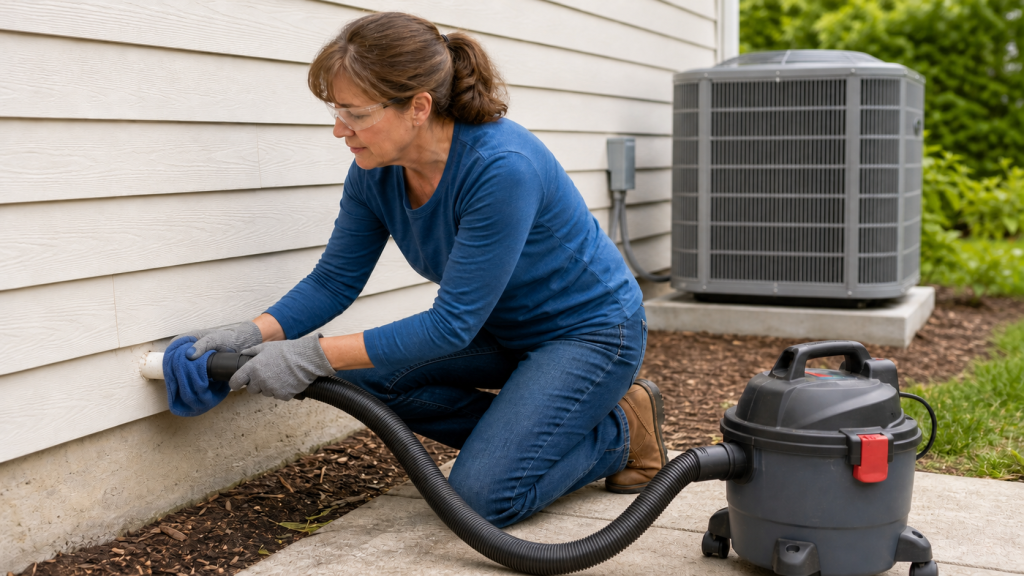
Step 5: Use a Wet/Dry Vacuum to Clean AC Drain Line Buildup When Appropriate
A wet/dry vacuum can pull soft algae, sludge, and water from an accessible exterior termination.
Use only a wet/dry vacuum approved for liquid pickup. Connect its hose to the clearly identified drain outlet and create a temporary seal with a towel or another easily removable material.
Follow the vacuum manufacturer’s liquid-use instructions. Afterward, check the canister for water, algae, or sludge.
Do not use this wet/dry vacuum AC drain line method when the drain enters plumbing, connects to a condensate pump, terminates somewhere you cannot identify, or has fragile, loose, or damaged piping.
Avoid excessive suction on questionable PVC. Do not substitute high-pressure air, compressed gas, or a pressure washer.
Step 6: Inspect the Accessible Cleanout
An AC drain line cleanout may look like a capped vertical section of PVC near the visible drainage piping.
Remove a cap only when you have positively identified it as a removable cleanout and it comes off without force.
Do not force a glued, brittle, cracked, or unidentified fitting. Do not remove a vent fitting simply because it looks similar to a cleanout.
A flexible brush may be used only to wipe away light buildup right at an accessible opening. Do not force it through traps, bends, or concealed pipe.
Step 7: Use Vinegar Only for Appropriate Preventive Maintenance
Vinegar in an AC drain line is a maintenance option only when the equipment manufacturer permits it, the correct cleanout is positively identified, and the line is already draining.
Use distilled white vinegar and pour it slowly. Follow the HVAC manufacturer’s instructions for quantity and waiting time rather than assuming one amount applies to every system.
Do not pour vinegar into:
- A fully blocked line
- An overflowing system
- A condensate pump
- An unidentified pipe
- A drain that may already contain bleach or another cleaner
Never mix cleaning products.
Step 8: Rinse Only When Manufacturer Instructions Allow
If manufacturer instructions call for rinsing and the line is flowing freely, use only a modest amount of clean water.
Pour slowly and watch the accessible cleanout.
Stop immediately if the water rises, backs up, or spills. Do not try to overcome a blockage by increasing the volume or pressure.
Step 9: Restore Power and Verify Drainage
Replace any removable cleanout cap in its normal position. Dry the work area and confirm no tools or liquids remain near electrical equipment.
Restore HVAC power and run the cooling system.
Condensate may not appear immediately because the amount of water produced depends on indoor humidity, operating conditions, and runtime. Inspect visible fittings and any accessible pan for leaks or returning water.
If water returns, the system shuts down, or you are not confident that it is draining correctly, switch the equipment off and arrange professional service.
How to Unclog an AC Drain Line Versus Maintain It
Preventive AC drain line maintenance is different from dealing with an active backup.
Preventive maintenance is more appropriate when:
- The line is draining
- No pan is overflowing
- Buildup is light and accessible
- Manufacturer-approved vinegar maintenance is allowed
- A clearly identified exterior termination is suitable for wet/dry vacuum use
An active clog is more likely when:
- Water backs up at a cleanout
- An overflow pan fills
- A float switch shuts the equipment down
- Water leaks through a ceiling
- Expected drainage stops
- Water repeatedly returns after basic cleaning
A fully clogged line may require professional vacuuming, controlled flushing, trap cleaning, disassembly, or correction of the drain piping. Those procedures are beyond a beginner maintenance task.
What Not to Pour Into an AC Drain Line
An AC condensate line should not be treated like a clogged sink drain.
Do not use:
- Chemical drain opener
- Strong acids
- Solvents
- Foaming household cleaners
- Mixed cleaning products
- Casually measured or undiluted bleach
- Vinegar when another chemical may already be present
Never mix bleach with vinegar, ammonia, drain cleaner, disinfectants, or other cleaning products. Hazardous vapors can result.
Do not attempt to clear a clog with high-pressure air, unregulated compressed gas, or a pressure washer. Excessive force can separate fittings or push water and debris toward HVAC equipment.
Condensate Pumps Require Different Handling
A condensate pump typically includes a reservoir, float mechanism, electrical power source, discharge tubing, and a check-valve arrangement.
That makes it different from a simple gravity drain.
Do not dismantle a condensate pump, vacuum through it, or pour vinegar, AC drain line cleaner, or other chemicals into it without model-specific instructions.
If the pump is overflowing, not operating, making unusual noises, or repeatedly cycling without clearing the water, leave the HVAC system off and arrange service.
Attic and Ceiling-Mounted Air Handlers
An attic installation raises both water-damage and access risks.
Do not work from an unsafe ladder, step onto unfinished ceiling surfaces, or cross an attic without a secure walking platform. If reaching the drain requires unsafe positioning, professional service is the appropriate choice.
Water in an attic overflow pan or discharge from a secondary drain should be treated as an urgent warning that the primary condensate-management system needs attention.
If water is already staining or leaking through a ceiling, leave the cooling system off.
Should You Use Condensate-Pan Tablets?
Condensate-pan tablets may help with maintenance on some systems, but only when both the HVAC manufacturer and tablet instructions permit their use.
Follow the exact product label and place a tablet only in a safely accessible location approved for that system.
Do not remove HVAC panels merely to reach a hidden pan.
Tablets cannot repair an active clog, failed condensate pump, cracked pan, damaged drain, or improperly sloped piping.
How Often Should the AC Drain Line Be Checked?
There is no single flushing schedule that fits every HVAC installation.
A practical approach is to:
- Inspect safely visible drainage areas during cooling season
- Look for water when changing the HVAC filter
- Include condensate drainage in annual HVAC maintenance
- Follow the equipment manufacturer’s maintenance schedule
- Ask your HVAC technician about local needs if algae in the AC drain line is a recurring problem
Homes in humid climates or systems with a history of buildup may warrant more frequent checks.
Why an AC Drain Line Keeps Clogging
Repeated clogs can indicate more than routine algae buildup.
Possible causes include:
- Persistent algae or biofilm
- Dust and filtration problems
- An improperly functioning trap
- Poor pipe slope
- A sagging drain line
- Cracked or damaged piping
- Condensate-pump problems
- Blockage at the drain termination
- Poor drain configuration
- Contamination in a pan or evaporator area that requires professional access
If the AC drain line is not draining again soon after cleaning, repeated flushing is unlikely to correct an underlying installation problem.
When to Call an HVAC Professional
Leave the system off and arrange professional service when:
- Water is near electrical components
- Water has damaged a ceiling, wall, or floor
- An accessible pan is full or repeatedly fills
- The float switch repeatedly stops the HVAC system
- You cannot identify the correct cleanout or drain outlet
- A condensate pump is involved and malfunctioning
- Safe attic access is not available
- The drain clogs repeatedly
- PVC is cracked, sagging, loose, or disconnected
- Concealed mold growth is suspected
- The line remains blocked after reasonable exterior wet/dry vacuum use
- You cannot positively identify the pipe you are working on
Do not bypass an AC float switch or repeatedly reset a safety device to keep the system running. A shutdown may be protecting the home from additional water damage.
Frequently Asked Questions
How do I clean an AC drain line?
Turn the thermostat and indoor equipment power off, identify the actual condensate-drain layout, inspect safely accessible areas, and use a wet/dry vacuum at a confirmed exterior termination when appropriate. Use vinegar only when the manufacturer permits it and the line is already draining.
Can I use a wet/dry vacuum on an AC drain line?
Yes, when you have a clearly identified exterior drain termination and intact piping. Do not use a regular household vacuum for liquids.
Can I pour vinegar into an AC drain line?
Sometimes. Distilled white vinegar may be suitable for preventive maintenance when permitted by the HVAC manufacturer, used at the correct cleanout, and added to a freely draining line.
How much vinegar should I use?
Follow the HVAC manufacturer’s guidance. Recommended quantities and procedures vary, so there is no universal amount appropriate for every system.
Can I use bleach in an AC condensate drain?
This guide does not recommend bleach flushing. Follow the HVAC manufacturer’s maintenance instructions instead, and never mix cleaning products.
Can I mix vinegar and bleach in a drain line?
No. Never mix bleach with vinegar or other household cleaners. Dangerous vapors can be released.
Why does my AC drain line keep clogging?
Recurring problems may involve algae or biofilm, dust, poor slope, a sagging line, trap problems, pump issues, damaged piping, or the original drain configuration.
Where does an AC condensate drain line end?
It varies. A line may terminate outside or drain to an approved plumbing connection, floor drain, utility sink, or condensate pump.
Why did my AC stop running when the drain clogged?
A float switch or other condensate safety device may have stopped operation after water backed up. Do not bypass or repeatedly reset the safety device.
What does an AC float switch do?
A float switch detects rising condensate at a protected location and can interrupt HVAC operation to reduce the risk of overflow.
Can I clean a condensate pump myself?
Limit homeowner work to observations permitted by the pump’s instructions. Do not dismantle, chemically flush, or vacuum through a pump without model-specific guidance.
How often should an AC drain line be checked?
Inspect accessible drainage during cooling season and include condensate drainage in regular HVAC maintenance. Follow the equipment manufacturer’s schedule rather than a rigid universal interval.
What should I do if the drain pan is full?
Turn the HVAC system off. A full or repeatedly filling pan indicates a drainage problem that warrants professional attention, especially when the location is above finished space.
When should I call an HVAC technician?
Call when water threatens electrical components or finishes, the system repeatedly shuts down, a pump or attic installation is involved, the piping is damaged, the drain cannot be identified, or reasonable exterior vacuuming does not restore drainage.
Final Thoughts
To clean AC drain line buildup safely, use gentle maintenance methods and stay within the parts of the drainage system you can positively identify without opening HVAC equipment. An appropriate wet/dry vacuum at an accessible exterior outlet and manufacturer-approved preventive vinegar maintenance can help in the right installation.
Stop before forcing tools, water, chemicals, or pressure into a blocked or uncertain drain. If water is overflowing, reaching electrical components, damaging the home, or repeatedly returning, leave the system off and have a qualified HVAC professional diagnose the cause.