Home AC Running but Not Cooling? Causes and safe checks
AC running but not cooling can happen when the thermostat fan is circulating room air without an active cooling cycle, the thermostat is set incorrectly, airflow is restricted, the outdoor unit is not operating properly, or the indoor coil has frozen. Refrigerant, compressor, electrical, duct, and internal component problems can cause the same symptom. Start with the safe homeowner checks below and leave internal HVAC diagnosis and repair to a qualified technician.
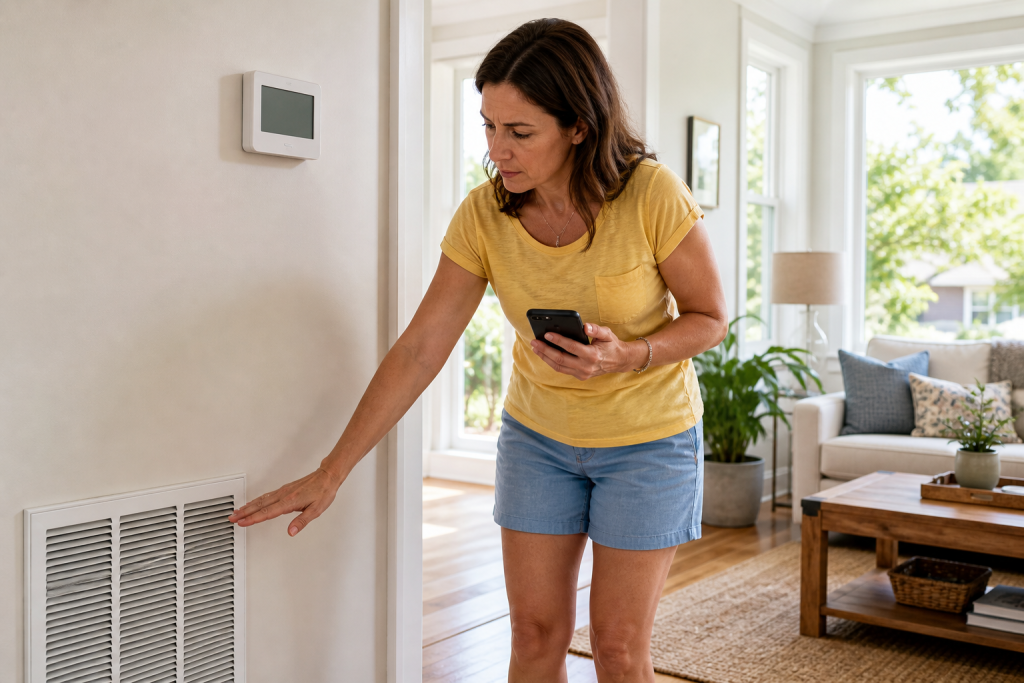
AC Running but Not Cooling? Start With These Checks
Work through these checks before assuming the air conditioner needs a major repair:
- Confirm the thermostat is set to Cool.
- Set the thermostat fan to Auto.
- Set the temperature below the current indoor temperature.
- Allow the system several minutes to respond.
- Check the homeowner-serviceable air filter.
- Make sure supply registers and return grilles are open and unobstructed.
- Determine whether the outdoor unit appears to be operating.
- Look for visible ice or water around accessible equipment.
- Remove loose debris around the outdoor condenser without reaching inside it.
- Stop for burning or electrical odors, smoke, repeated breaker trips, severe mechanical noises, or water contacting electrical parts.
If these checks do not restore cooling, avoid taking equipment apart. Many remaining causes require electrical testing, refrigerant work, or internal diagnosis.
Determine What Is Actually Running
Hearing the system run does not always mean the entire cooling system is operating.
The indoor blower moves air through the ducts. It can run even when the outdoor cooling equipment is off, particularly if the thermostat fan is set to On.
The outdoor condenser fan moves air through the outdoor coil. Seeing that fan spin confirms part of the outside unit is operating, but it does not prove the compressor is operating correctly.
The compressor circulates refrigerant through the cooling system. Homeowners should not attempt to test it directly.
If the system appears to run continuously, note whether the air from the registers is actually cool and whether the indoor temperature is falling.
| Observed Pattern | Possible Explanation | Safe Next Step |
|---|---|---|
| Indoor blower runs but outdoor unit is silent | Fan setting, outdoor power, control, or component problem | Check thermostat settings and call for service if outdoor operation does not start |
| Indoor and outdoor fans run but air is warm | Compressor, refrigerant, control, or coil problem | Turn cooling off if the problem persists and arrange diagnosis |
| Air is cool but airflow is weak | Dirty filter, airflow restriction, blower, or duct problem | Check filter and accessible vents |
| Air is cool but house temperature does not drop | High heat load, duct loss, sizing, or reduced system capacity | Check obvious heat sources and monitor performance |
| Ice is visible | Frozen evaporator coil or refrigerant-line icing | Turn cooling off and arrange service |
| Outdoor unit hums or buzzes | Electrical, motor, capacitor, or compressor problem | Turn cooling off and call a technician |
| System starts and stops repeatedly | Control, airflow, electrical, pressure, or equipment problem | Stop repeated restarting and arrange service |
| Only certain rooms stay warm | Register, return-air, balancing, or duct problem | Check accessible vents and obstructions |
These patterns help describe the problem, but they cannot identify a failed component by themselves.
Check the Thermostat
A thermostat setting can make an otherwise functional system appear to be cooling when it is only circulating air.
Confirm that the thermostat is set to Cool and that the set temperature is below the current room temperature.
Set the fan to Auto, not On. When the fan is set to On, the indoor blower may run continuously between cooling cycles. That can create an indoor fan running but no cold air condition even though the compressor is not supposed to be running at that moment.
Also check for:
- Weak or dead thermostat batteries.
- A blank or unresponsive screen.
- A programmed schedule that raised the set temperature.
- Away or energy-saving modes.
- Recent thermostat replacement or wiring changes.
If cooling problems began after thermostat replacement or wiring work, stop with the basic settings and battery checks. Wiring and control-signal diagnosis should be handled professionally.
Allow the system time to respond after changing settings. Many air conditioners use an intentional delay before restarting the compressor.
Check the Air Filter
A heavily clogged filter restricts airflow through the indoor equipment.
Reduced airflow can make cooling less effective and may contribute to freezing of the indoor evaporator coil. Once a coil freezes, airflow and cooling performance can become much worse.
Turn cooling off at the thermostat before removing a normal homeowner-serviceable filter. If the filter is heavily coated with dust and debris, replace it with the correct size and a type suitable for the equipment.
Most disposable filters have an airflow arrow on the frame. Install the replacement with the arrow pointing in the direction specified for the filter slot or shown by the previous filter’s correct orientation.
Do not assume that one filter rating is appropriate for every HVAC system. A filter must be compatible with the airflow requirements of the equipment.
If airflow remains weak after replacing a dirty filter, another restriction or equipment problem may be present.
If you’re replacing a dirty filter and aren’t sure which filtration level to choose, our MERV 8 vs MERV 11 vs MERV 13 comparison explains filtration differences, airflow considerations, and how to select a filter compatible with your HVAC system.
Check Supply and Return Airflow
Your air conditioner can produce cool air and still struggle to cool the house if that air cannot circulate properly.
Walk through accessible rooms and check for:
- Closed supply registers.
- Furniture covering vents.
- Rugs, boxes, or other objects blocking floor registers.
- Curtains or furniture obstructing return grilles.
- Noticeably weak airflow throughout the home.
If airflow is weak at nearly every register, the problem may involve the filter, blower, indoor coil, duct system, or another system-wide restriction.
If one room or one area remains warm while other rooms cool normally, the issue may be more localized. A closed register, poor return-air path, leaking duct, disconnected duct, or airflow-balancing problem may be involved.
Limit your checks to accessible registers, grilles, and visible obstructions. Do not enter an unsafe attic, crawlspace, or other difficult area to trace ductwork.
Check the Outdoor Unit From a Safe Distance
The outdoor condenser must release heat removed from the house. A problem there can leave you with an outside AC unit running but not cooling effectively.
From outside the cabinet, observe:
- Whether the outdoor fan is spinning.
- Whether the unit is completely silent.
- Whether you hear humming, buzzing, grinding, or repeated clicking.
- Whether leaves, grass, weeds, or stored objects are blocking airflow.
- Whether ice is visible on accessible refrigerant tubing or the cabinet.
- Whether the cabinet has obvious physical damage.
You can remove loose leaves and other ground-level debris around the unit and trim vegetation that is crowding it. Keep your hands and tools outside the cabinet.
Do not remove panels, reach through the fan guard, open the disconnect, or push-start a stationary fan.
If the outdoor unit hums while the fan does not spin, turn cooling off and call an HVAC technician.
If the indoor blower is running but the outdoor condenser remains silent, our guide to an outside AC unit not turning on explains the safe homeowner checks for thermostat settings, visible power conditions, airflow, and possible safety shutdowns.
Look for a Frozen Evaporator Coil
The evaporator coil is the indoor coil that absorbs heat from household air. It can freeze when operating conditions are wrong.
Possible causes include restricted airflow, a badly clogged filter, blower problems, low refrigerant, or other refrigeration-system faults.
You may not be able to see the coil without opening equipment, which you should not do. Instead, look for external clues such as:
- Ice on accessible refrigerant tubing.
- Very weak airflow from multiple registers.
- Water appearing as accumulated ice begins to melt.
- An air conditioner running for long periods without cooling effectively.
If you see ice, turn cooling off.
Do not chip, scrape, heat, or otherwise try to remove the ice manually. Do not open the air handler or furnace cabinet to inspect the coil.
A filter change may correct one possible airflow restriction, but recurring freezing needs professional diagnosis. Running the system while it remains frozen can worsen the problem.
Consider Outdoor Heat and Household Heat Gain
An air conditioner may run for longer periods during unusually hot weather without necessarily having failed.
Cooling demand can increase because of:
- Strong afternoon sun.
- Doors or windows left open.
- Significant air leakage.
- Heavy cooking or appliance use.
- Poor insulation.
- An undersized cooling system.
A system that has always struggled to cool certain rooms or maintain comfort during the hottest periods may have a sizing, insulation, duct, or heat-gain issue.
A sudden change is different. If the same air conditioner previously cooled the home well under similar conditions and now cannot keep up, a developing HVAC problem is more likely.
Avoid relying on a universal indoor-versus-outdoor temperature rule or expecting every house to cool at the same rate. Equipment capacity, building construction, humidity, duct design, solar exposure, and outdoor conditions all affect performance.
Check for Visible Condensate Problems
Air conditioners remove moisture from indoor air as they cool. That moisture normally drains away through a condensate system.
If the drain backs up, water can collect around the indoor equipment. Some installations use a float or overflow safety switch that can interrupt operation when the water level rises.
Look for:
- Standing water near the air handler or furnace.
- A visibly full auxiliary drain pan.
- Unexpected dripping or overflow.
- Recurring water where the area is normally dry.
Do not bypass, tape down, hold, or otherwise defeat a condensate safety switch.
A drain problem can contribute to an air conditioner running but not cooling normally, depending on how the system is controlled. If water is present or repeatedly returns, have the drainage problem corrected rather than repeatedly restarting the system.
Possible Ductwork Problems
Sometimes the air conditioner is making cold air, but too little of it reaches the rooms that need it.
Leaking or disconnected ducts can lose conditioned air before it reaches a register. Poorly insulated ducts in hot spaces can also reduce performance, while an imbalanced system may deliver too much airflow to some areas and too little to others.
The pattern can provide clues:
- Weak cooling everywhere: Look first at the filter and overall airflow. Equipment or major duct problems may be involved.
- One warm room: A local register, return-air, balancing, or branch-duct problem is more likely.
- One warm floor: Duct layout, return airflow, heat gain, zoning, or system capacity may contribute.
- Airflow gets weaker farther from the air handler: Duct restrictions, leakage, design, or balancing problems may be involved.
Have inaccessible ducts inspected professionally rather than entering hazardous attic or crawlspace areas.
Professional-Only Causes
If the basic checks do not explain why the central air is running but not cooling, the remaining causes commonly require HVAC instruments, electrical work, refrigerant handling, or equipment disassembly.
Refrigerant Leak or Low Refrigerant
Refrigerant carries heat through the cooling system. A leak or incorrect refrigerant charge can reduce cooling and contribute to coil freezing or long run times.
Do not attach gauges, add refrigerant, or attempt leak detection yourself.
Dirty or Damaged Evaporator Coil
The indoor coil can lose heat-transfer performance when it becomes contaminated or damaged. Because accessing it usually requires opening HVAC equipment, inspection and deeper cleaning are professional work.
Dirty or Damaged Condenser Coil
Heavy contamination or physical damage to the outdoor coil can reduce the unit’s ability to release heat. Loose exterior debris is reasonable for a homeowner to remove, but service requiring panel removal or work around internal electrical components should be left to a technician.
Failed Capacitor
Capacitors help certain motors and compressors start and run. Failure may cause humming, unsuccessful starts, or a fan or compressor that does not operate correctly.
Capacitors can retain electrical energy. Do not touch, test, discharge, or replace one.
Failed Contactor
The contactor is an electrical switching component in the outdoor unit. A fault can prevent the compressor or fan from receiving power correctly.
Testing or replacement requires access to energized equipment.
Compressor Problem
A compressor can run poorly, fail to start, or experience an internal mechanical or electrical fault. The outdoor fan may sometimes operate even though effective refrigeration is not taking place.
Compressor diagnosis requires professional testing.
Condenser Fan Motor Problem
A failing outdoor fan motor can interfere with heat rejection. Grinding, intermittent operation, or a stationary fan while the unit hums are reasons to shut cooling off.
Indoor Blower Problem
A blower that cannot move enough air across the evaporator coil can reduce cooling and contribute to icing.
Persistent weak airflow after filter and vent checks requires professional evaluation.
Metering-Device or Expansion-Valve Problem
The refrigeration system uses a metering device to control refrigerant flow into the evaporator. A malfunction can interfere with normal cooling and requires refrigeration-system diagnosis.
Thermostat Wiring or Control-Board Problem
A thermostat may display a cooling request even when a control or wiring problem prevents the equipment from operating correctly.
Do not test wiring or live electrical circuits yourself.
Electrical or Disconnect Problem
Damaged wiring, failing electrical components, or problems at the outdoor disconnect can interrupt part of the cooling system.
Do not open the disconnect or equipment access panels.
Incorrect System Sizing
An air conditioner that is too small for the home’s cooling load may run extensively and still struggle during demanding conditions. Proper sizing considers more than floor area, so replacement sizing should be evaluated professionally rather than based only on the size of the old unit.
When to Turn the AC Off
Stop cooling operation when you notice:
- Visible ice.
- A burning or electrical odor.
- Smoke or sparking.
- Repeated breaker trips.
- Loud grinding or metal-on-metal noise.
- An outdoor unit humming while its fan does not spin.
- Water reaching electrical components.
- Damaged or melted wiring.
- Severe repeated starting and stopping.
Do not keep restarting the thermostat or resetting breakers to see whether the problem clears.
For smoke, sparking, overheating electrical equipment, or other immediate electrical hazards, keep clear of the equipment and get qualified help.
When to Call an HVAC Technician
Arrange professional service when:
- The safe homeowner checks do not restore cooling.
- Ice returns after the system has been shut down.
- The outdoor equipment does not run normally.
- The air remains warm during a cooling call.
- Airflow stays weak after filter and vent checks.
- The system runs continuously without lowering the indoor temperature.
- Cooling performance suddenly declines.
- Condensate water repeatedly returns.
- Electrical or mechanical warning signs appear.
When you call, provide observations rather than trying to diagnose the component yourself.
Useful information includes:
- Thermostat mode and temperature setting.
- Current indoor temperature.
- Whether the indoor blower runs.
- Whether the outdoor fan runs.
- Whether register air feels warm, slightly cool, or cold.
- Whether airflow seems strong or weak.
- Any visible ice or water.
- Unusual sounds or odors.
- Approximate equipment age.
- Recent filter changes, storms, power outages, or HVAC maintenance.
This information can help the technician understand the operating pattern before examining the system.
How to Help Prevent Cooling Problems
Routine care cannot prevent every breakdown, but it can reduce avoidable airflow and maintenance problems.
- Check and replace filters at intervals appropriate for your equipment and household conditions.
- Keep supply registers and return grilles unobstructed.
- Keep leaves, vegetation, and stored objects away from the outdoor unit.
- Pay attention to declining airflow or longer-than-usual run times.
- Address recurring condensate water promptly.
- Schedule appropriate professional HVAC maintenance.
- Avoid repeatedly operating a system that is frozen or clearly malfunctioning.
Changes in noise, airflow, cycle length, and cooling performance are often worth addressing before the system stops cooling entirely.
Frequently Asked Questions
Why Is My AC Running but Not Cooling?
Possible causes include incorrect thermostat settings, a fan set to On, a dirty filter, restricted airflow, a frozen evaporator coil, outdoor-unit problems, refrigerant trouble, duct losses, or inadequate system capacity.
Why Is the Indoor Fan Running but the Air Is Not Cold?
The thermostat fan may be set to On, allowing the blower to circulate room-temperature air without an active cooling cycle. If the thermostat is set correctly, the outdoor equipment, controls, compressor, or refrigeration system may not be operating properly.
Why Is My Outside AC Unit Running but the House Is Warm?
Seeing the outdoor fan run does not prove that the entire refrigeration system is working correctly. Compressor, refrigerant, coil, airflow, duct, or capacity problems may still prevent effective cooling.
Should I Turn Off My AC if It Is Not Cooling?
Turn it off if you see ice or notice electrical odors, smoke, severe noises, repeated breaker trips, water contacting electrical parts, or a humming outdoor unit with a stationary fan. Persistent warm-air operation also deserves professional evaluation.
Can a Dirty Filter Stop an AC From Cooling?
Yes. A severely dirty filter can reduce airflow, hurt cooling performance, and contribute to freezing of the evaporator coil.
Can a Frozen Coil Make an AC Blow Warm Air?
Yes. A frozen evaporator coil cannot transfer heat normally, and airflow may also become very weak. Turn cooling off if you see ice and have recurring freezing diagnosed.
Why Is My AC Running Continuously?
Continuous operation can occur during high cooling demand, but it can also result from restricted airflow, a dirty coil, refrigerant problems, duct losses, incorrect sizing, or other system faults. If the temperature is not dropping, service is appropriate.
Can Low Refrigerant Cause an AC to Run Without Cooling?
Yes. Low refrigerant can reduce cooling performance and may contribute to coil freezing. Refrigerant problems require professional leak diagnosis and service.
Why Are Some Rooms Warm While Others Are Cool?
Possible causes include blocked registers, poor return airflow, duct leakage, disconnected ducts, airflow imbalance, high heat gain, or limitations in the original duct design.
When Should I Call an HVAC Technician?
Call when thermostat, filter, vent, visible condensate, and outdoor-obstruction checks do not solve the problem, or immediately when you find ice, electrical trouble, abnormal mechanical noise, recurring water, or outdoor equipment that is not operating normally.
Final Thoughts
If you have an AC running but not cooling, start by checking the thermostat, air filter, supply and return vents, and whether the outdoor unit appears to be operating. Look for visible ice or water, clear loose debris around the condenser, and note whether the problem affects the entire home or only certain rooms.
Those are reasonable homeowner checks. Refrigerant, compressor, capacitor, motor, internal coil, electrical, and control problems require qualified HVAC service. If the system remains unable to lower the indoor temperature after the safe checks—or shows ice, electrical warning signs, severe noises, or repeated shutdowns—turn cooling off and have the system professionally diagnosed.