outside AC Unit Not Turning On? What to Check First
AC unit not turning on when the thermostat is calling for cooling? The cause may be as simple as a thermostat setting, interrupted power, an indoor safety shutdown, or restricted airflow. It can also indicate a failed electrical or mechanical component. Start with the safe homeowner checks below, and stop before opening panels, handling wiring, testing electrical parts, or working on the refrigerant system.
AC Unit Not Turning On? Start With These Checks
When an air conditioner won’t turn on, work from the simplest checks toward the equipment. Before calling for service:
- Confirm the thermostat is set to Cool, with the temperature below the current room temperature.
- Set the thermostat fan to Auto.
- Check for a blank thermostat display or dead batteries.
- Confirm the indoor furnace or air-handler service switch has not been turned off.
- Look at the HVAC breakers without opening or touching anything inside the electrical panel.
- Check the air filter for severe dirt buildup.
- Look for visible water around the indoor equipment or condensate drain pan.
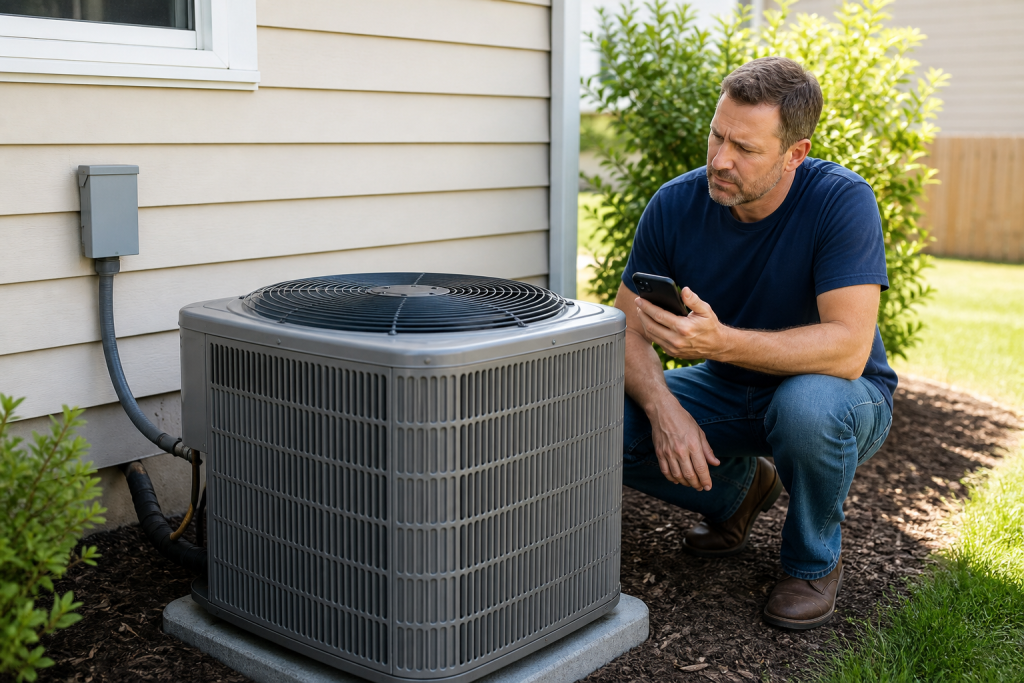
- Check the outdoor unit for leaves, weeds, or other obvious airflow obstructions.
- Note whether the indoor blower runs and whether the outdoor unit is silent, humming, clicking, or starting and stopping.
If you smell burning, see smoke or sparking, find damaged wiring, hear severe mechanical noises, or see water reaching electrical components, turn the system off if you can do so safely and call a qualified professional.
Determine Which Part of the System Is Not Running
A central air conditioner has indoor and outdoor components that must work together. The indoor equipment circulates air through the house and contains the evaporator coil. The outside condenser contains the compressor and condenser fan.
Knowing which part is running helps narrow the possibilities without taking anything apart.
| Symptom | Possible Cause | Safe Next Step |
|---|---|---|
| No indoor airflow and no outdoor operation | Thermostat or indoor power problem, safety shutdown | Check thermostat, indoor service switch, and visible breaker status |
| Indoor blower runs but outside unit is silent | Outdoor power interruption, control problem, failed component | Check thermostat and visually inspect breaker/disconnect status |
| Outdoor unit hums, clicks, or buzzes | Electrical or motor-start problem | Turn cooling off and call an HVAC technician |
| Outdoor fan is not spinning | Fan motor, capacitor, control, or compressor-related problem | Keep hands and tools out; call for service |
| System starts and stops quickly | Airflow, control, freezing, pressure, or equipment problem | Check filter and vents; call if cycling continues |
If the indoor fan is running but the outside unit is not working, setting the thermostat fan to Auto can provide another clue. A fan set to On may run continuously even when the cooling cycle has not started.
An outside AC unit not turning on can also be the result of a problem indoors. A condensate safety switch, loss of power to the furnace or air handler, or failed control can prevent the outdoor equipment from receiving the signal to run.
Check the Thermostat
Begin at the thermostat because several normal settings can make a working system appear dead.
Confirm that:
- The operating mode is set to Cool.
- The fan setting is Auto rather than On.
- The set temperature is below the current indoor temperature.
- The screen is readable and displaying normally.
- Battery-powered models have working batteries.
- A programmed schedule is not raising the cooling setpoint unexpectedly.
If the thermostat screen is blank, replace homeowner-serviceable batteries if your model uses them. A blank hardwired thermostat can also indicate that the indoor HVAC equipment has lost power or a control circuit has shut down.
Smart and programmable thermostats may also be following an away setting, energy-saving schedule, or other programmed change. Temporarily select a normal cooling temperature according to the thermostat instructions.
After changing the setting, allow several minutes for the system to respond. Many systems intentionally delay compressor startup after a shutdown or thermostat adjustment to protect the equipment.
If the thermostat is set to Cool but the AC is not running after that delay, continue with the power and airflow checks below.
If your thermostat remains blank, displays an error, or fails to respond after these basic checks, our thermostat not working guide explains common causes, safe troubleshooting steps, and when professional service is necessary.
Check Whether the Indoor HVAC Equipment Has Power
The outside condenser depends on controls associated with the indoor furnace or air handler. If the indoor equipment loses power, the outdoor unit may not receive the signal to start.
Some furnaces have an ordinary wall-style service switch mounted on or near the equipment. It can look similar to a light switch and may be accidentally turned off while someone is working or storing items nearby.
You can visually confirm that an obvious, labeled service switch is in its normal operating position.
Do not remove furnace or air-handler panels to search for switches, fuses, wiring, or controls. If the indoor equipment appears to have no power and there is no simple external explanation, an HVAC technician should diagnose the problem.
Check the Circuit Breaker Safely
Central air-conditioning systems often have separate electrical circuits for the indoor and outdoor equipment.
At the electrical panel, look only at the breaker handles. A tripped breaker may sit between the On and Off positions or may indicate a trip differently depending on the panel design.
Do not remove the electrical panel cover or touch anything except normal exterior controls.
If an HVAC or air-conditioner breaker appears tripped, stop troubleshooting and have the cause evaluated by a qualified HVAC or electrical professional. A breaker is a safety device, and a trip may indicate an electrical or mechanical fault.
Do not repeatedly reset a breaker. Also stop immediately if a breaker or panel is:
- Hot.
- Buzzing or crackling.
- Visibly damaged.
- Discolored or scorched.
- Associated with a burning odor.
If a breaker has already been reset and trips again, leave it off and call for service.
Visually Check the Outdoor Disconnect
Most central air conditioners have an outdoor disconnect mounted on a wall near the condenser. It allows power to the outside equipment to be shut off for service.
From the outside, check whether the enclosure appears securely mounted and undamaged. If your disconnect has a clearly visible external operating handle, you can note its position.
Do not open the disconnect enclosure, pull out internal components, remove covers, test voltage, replace fuses, rewire anything, or bypass the disconnect.
Damage, heat discoloration, buzzing, loose parts, or signs of burning require professional attention. If you are uncertain about the disconnect’s normal position or design, leave it alone.
Check the Air Filter and Indoor Airflow
A severely clogged filter restricts the air moving through the indoor equipment. Reduced airflow can contribute to coil freezing and protective shutdowns, and it can make the system operate poorly even when it does start.
Locate the normal homeowner-serviceable filter. Turn the system off at the thermostat before removing it.
If the filter is heavily loaded with dust and debris, replace it with the correct size and a filter type suitable for your HVAC system. Note the airflow-direction arrow and install the new filter in the same orientation specified for the equipment.
Also check accessible supply and return openings around the home. Avoid blocking return grilles with furniture, rugs, boxes, or curtains, and make sure normal supply vents have not all been closed.
If you see ice on refrigerant tubing or accessible portions of the indoor equipment, turn cooling off. Do not chip, scrape, or melt the ice with tools or heat. Persistent freezing needs professional diagnosis because airflow problems are only one possible cause.
Look for Condensate Drain or Safety-Switch Problems
Air conditioners remove moisture from indoor air. That water normally flows from the indoor equipment through a condensate drain.
Some installations include a float or overflow safety switch. If water backs up because the drain cannot carry it away, the switch can interrupt cooling to help prevent water damage.
Signs of a possible condensate problem include:
- Water around the furnace or air handler.
- A visibly full auxiliary drain pan.
- Dripping or overflow where you do not normally see water.
- A system that stopped while the thermostat still calls for cooling.
Do not bypass or hold down a float switch to force the system to run. The shutdown may be preventing an overflow.
A clogged condensate drain can shut down an AC system, but clearing the drain correctly depends on how the system is installed. If you find standing water or cannot identify the cause safely, leave the system off and arrange service.
If you suspect a clogged drain and your system has an accessible homeowner-serviceable cleanout, our guide on how to clean an AC drain line explains safe maintenance methods and when to leave the work to an HVAC technician.
Inspect the Area Around the Outdoor Unit
Restricted airflow around the condenser can interfere with heat removal and contribute to poor operation.
Walk around the outdoor unit and look for:
- Leaves piled against the cabinet.
- Tall grass or weeds crowding the sides.
- Grass clippings or loose debris.
- Stored objects blocking airflow.
- Shrubs growing directly against the unit.
Remove loose debris from the ground around the condenser and trim vegetation back without reaching into the unit.
Do not remove panels, reach through the fan guard, or insert tools into the cabinet. Do not spray water into electrical areas while troubleshooting an AC that will not start.
If the cabinet or coil has severe contamination that requires disassembly or deeper cleaning, leave that work to an appropriate service procedure or HVAC technician.
Common Professional-Only Causes
Once basic settings, visible power conditions, airflow, drainage, and outdoor obstructions have been checked, the remaining possibilities commonly require electrical testing or refrigeration-system diagnosis.
Failed Capacitor
A capacitor helps certain motors and compressors start and operate. A failed capacitor may be associated with an AC unit humming but not starting, a stationary outdoor fan, or unsuccessful startup attempts.
Capacitors can retain an electrical charge. Do not open the access panel, touch a capacitor, attempt to discharge it, or replace it yourself.
Failed Contactor
The contactor is an electrically controlled switch inside the outdoor unit that helps send power to major components when cooling is requested.
A failed contactor may prevent the condenser from starting or contribute to abnormal clicking. Testing and replacement involve energized electrical equipment and are technician work.
Condenser Fan Motor Failure
The outdoor fan moves air through the condenser coil. If the motor, its controls, or related electrical components fail, the outside AC fan may not spin even though the system is attempting to operate.
Never push-start an outdoor fan with a stick, screwdriver, or other object.
Compressor Problem
The compressor circulates refrigerant through the cooling system. Electrical, mechanical, or internal compressor failures can prevent the outdoor unit from starting or cause it to shut down after an attempted start.
Compressor diagnosis requires professional tools and training.
Damaged Wiring
Loose, burned, corroded, or otherwise damaged wiring can interrupt power or control signals.
Do not touch exposed wires or attempt temporary repairs. Burned or melted wiring is a reason to keep the system off until it has been inspected.
Control-Board or Thermostat-Signal Failure
The thermostat’s request for cooling passes through controls that coordinate indoor and outdoor operation. A control board, low-voltage circuit, thermostat connection, or other control failure can keep the condenser off even when the thermostat display looks normal.
Diagnosing the signal path requires electrical testing.
Refrigerant or Pressure-Related Safety Shutdown
Some systems use pressure controls or other protections that can stop operation when conditions fall outside acceptable limits. Refrigerant problems can also contribute to poor cooling, icing, or compressor protection events.
Do not attempt to diagnose leaks, attach gauges, add refrigerant, or open the sealed system.
Failed Safety Switch
HVAC systems may use several protective switches. A safety device that has opened may be reacting to a real problem rather than being the cause itself.
Never bypass a safety switch to make an air conditioner run.
What Different Sounds May Mean
The sound from an outdoor unit can provide useful information to the technician, but it cannot confirm which component has failed.
- Silence: The condenser may not be receiving power or a cooling signal, or a control or safety device may be preventing operation.
- Humming: A motor or compressor may be trying to start, or an electrical component may be having trouble supplying the required startup conditions.
- Clicking: A control may be attempting to engage, but clicking can have several causes.
- Buzzing: Electrical or motor-related problems are possible and deserve prompt professional attention.
- Repeated attempted starts: The system may be entering a protective shutdown or struggling with an electrical, motor, compressor, or control problem.
If the AC condenser is not turning on and is making unfamiliar electrical or mechanical sounds, turn cooling off and arrange service rather than repeatedly trying to start it.
When to Shut the System Off Immediately
Stop operating the air conditioner and get professional help if you notice:
- A burning smell.
- Smoke.
- Sparking.
- Melted, scorched, or damaged wiring.
- Hot or buzzing electrical equipment.
- Repeated breaker trips.
- Loud grinding or metal-on-metal noises.
- Significant ice combined with poor airflow.
- Water contacting electrical components.
Do not keep cycling the thermostat to see whether the problem clears. Continuing to operate equipment with an electrical, mechanical, or water-related fault can create additional hazards or damage.
When to Call an HVAC Technician
Call an HVAC technician when the safe checks do not restore normal operation, or sooner when you find a stop condition.
Before calling, gather a few observations that can help describe the problem:
- What the thermostat displays and how it is set.
- Whether the indoor blower runs.
- Whether the outdoor unit is silent or making a particular sound.
- Whether the outdoor fan spins.
- Whether a breaker appears tripped.
- Whether you can see water or ice.
- The approximate age of the system.
- Whether a storm or power outage occurred recently.
- Any recent HVAC maintenance or repairs.
These details do not replace diagnosis, but they give the technician a clearer starting point.
Frequently Asked Questions
Why Is My Thermostat Set to Cool but My AC Is Not Turning On?
The thermostat may be working while another part of the system is not. Possible causes include loss of indoor or outdoor power, a condensate safety shutdown, control failure, restricted airflow, or a failed outdoor component. Confirm the set temperature is below room temperature and allow for the normal startup delay before continuing with safe checks.
Why Is the Indoor Fan Running but the Outside AC Unit Is Not?
If the thermostat fan is set to On, the indoor blower can run without active cooling. If it is set to Auto and the blower runs while the outdoor unit remains off, possible causes include an outdoor power problem, control failure, safety shutdown, or failed condenser component.
Why Is My Outside AC Unit Humming but Not Starting?
Humming can indicate that electrical or mechanical components are trying unsuccessfully to start. Capacitor, motor, compressor, and other problems can produce similar symptoms. Turn cooling off and have the system professionally diagnosed rather than opening the condenser.
Should I Reset the AC Breaker?
Do not repeatedly reset an HVAC breaker. If the breaker appears tripped, treat that as a potential fault and arrange professional evaluation. If a breaker has already been reset and trips again, leave it off.
Can a Clogged Air Filter Stop an AC From Turning On?
A severely restricted filter can reduce airflow enough to contribute to freezing or a protective shutdown. Replacing a dirty homeowner-serviceable filter is a reasonable first check, but continued problems need further diagnosis.
Can a Clogged Condensate Drain Shut Down an AC System?
Yes. On systems equipped with an overflow or float safety switch, backed-up condensate can trigger a shutdown to help prevent water damage. Visible standing water or overflow near the indoor equipment is a clue.
Why Is the Outside AC Fan Not Spinning?
An outside AC fan not spinning can result from a fan-motor problem, failed electrical component, control issue, or another outdoor-unit fault. Do not reach into the fan or try to push-start it.
How Long Should I Wait After Changing the Thermostat Setting?
Allow several minutes after requesting cooling. Many systems intentionally delay compressor operation after a thermostat change or recent shutdown. If nothing happens after the delay, proceed with the safe checks rather than repeatedly changing settings.
When Should I Stop Troubleshooting and Call a Professional?
Stop when basic thermostat, filter, visible power, condensate, and outdoor-obstruction checks do not identify a simple cause. Call immediately for repeated breaker trips, buzzing electrical equipment, smoke, sparking, burning odors, damaged wiring, water near electrical parts, severe noises, persistent icing, or any problem requiring access to equipment panels.
Final Thoughts
When you find your AC unit not turning on, start with the thermostat, confirm the indoor equipment appears to have power, visually check breaker and disconnect conditions, inspect the filter, look for condensate overflow, and clear obvious debris from around the outdoor condenser.
Then stop. An outdoor AC unit not turning on because of a capacitor, contactor, fan motor, compressor, wiring, control, refrigerant, or safety-device problem requires professional diagnosis. Knowing what the indoor blower and outdoor unit are doing helps you rule out simple causes without taking unnecessary electrical or mechanical risks.