Best Air Purifier for HVAC Dust: What Homeowners Should Know
Best air purifier for hvac dust is a phrase homeowners often search when dust keeps coming back around vents, furniture, return grilles, and living spaces. A good air purifier can help reduce airborne dust, but it does not replace HVAC filter changes, duct repairs, cleaning, vacuuming, or fixing airflow problems.
The right air purifier depends on where the dust shows up, how large the room is, what type of filter the unit uses, and whether the dust problem is really coming from the HVAC system or from normal household activity.
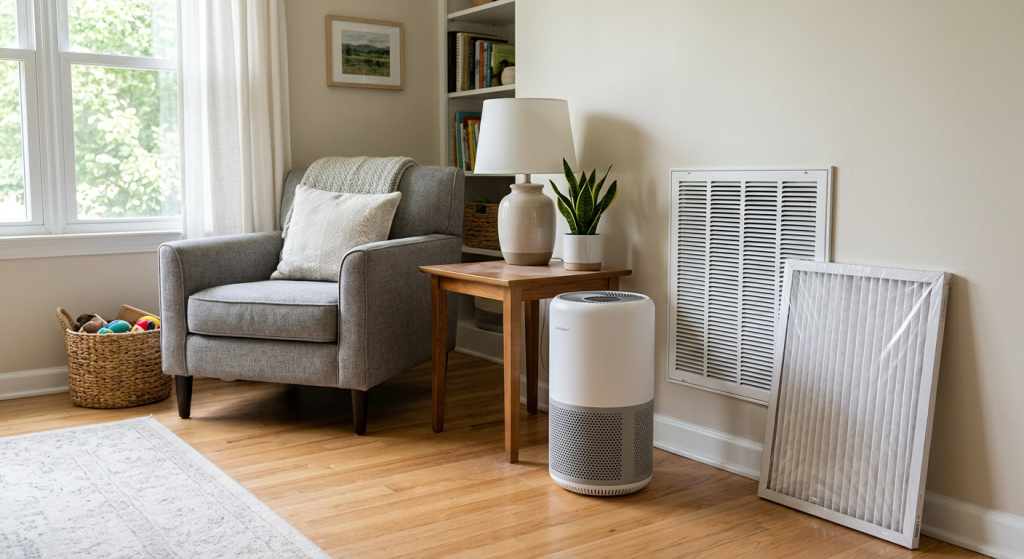
Best Air Purifier for HVAC Dust: Quick Comparison
| Air Purifier Type | Best For | Main Strength | Watch Out For |
|---|---|---|---|
| Small room HEPA air purifier | Bedrooms, offices, and small rooms near dusty vents | Helps reduce airborne dust in one room | May be too small for large living areas |
| Larger living-room air purifier | Family rooms, open areas, and high-traffic spaces | Moves more air through a larger filter | Can cost more and run louder on high speed |
| Air purifier with pre-filter | Homes with visible dust, lint, and pet hair | Catches larger particles before the main filter | Pre-filters need regular cleaning or replacement |
| Air purifier with carbon filter | Rooms with dust plus mild odors | Helps with some odors while filtering particles | Carbon filters wear out and need replacement |
| Room purifier plus HVAC filter support | Homes with central heating and cooling | Helps reduce particles in rooms and in system airflow | HVAC filters must match what the system can handle |
What Homeowners Mean by “HVAC Dust”
HVAC dust usually means dust that seems connected to the heating and cooling system. You may notice it around supply vents, return grilles, ceiling registers, baseboards, or nearby furniture.
Sometimes the HVAC system is spreading normal household dust. Other times, the problem is a dirty filter, leaky ductwork, poor airflow, construction dust, attic dust, or a return-air leak pulling dirty air into the system.
An air purifier can help reduce dust floating in a room. It cannot repair ducts, seal gaps, clean the HVAC system, or fix a filter that is missing, clogged, or installed incorrectly.
What an Air Purifier Can and Cannot Do
A room air purifier pulls air through one or more filters and sends cleaner air back into the room. For dust, the most useful models usually include a particle filter, a pre-filter, or both.
A HEPA air purifier can help capture small airborne particles. A pre-filter can help catch larger dust, lint, and pet hair before they reach the main filter. Activated carbon can help with some odors, but it is not the main dust-control feature.
An air purifier can help reduce:
- Airborne dust in a room.
- Fine particles that float before settling.
- Dust stirred up by foot traffic.
- Some pet dander and lint.
- Some pollen and outdoor particles that enter the home.
- Mild odors when the unit includes activated carbon.
An air purifier cannot replace:
- Changing HVAC filters.
- Vacuuming carpets and furniture.
- Dusting surfaces.
- Cleaning return grilles and vent covers.
- Repairing leaky ducts.
- Fixing poor airflow.
- Solving moisture or ventilation problems.
- Professional HVAC service when the system has a real issue.
Think of an air purifier as room-level support. It helps filter the air that passes through it, but it does not fix the source of every dust problem.
Product Features That Matter Most
The best product features depend on the room and the dust problem. Do not choose only by brand name or a “best overall” claim.
Start with room size, filter type, replacement filter cost, and how easy the unit is to keep running.
The most important features to compare are:
- Room size rating.
- HEPA filtration or strong particle filtration.
- A pre-filter for larger dust and lint.
- Replacement filter cost.
- Replacement filter availability.
- Noise level on low and medium settings.
- Filter change indicator.
- Easy access to the filter compartment.
- Multiple fan speeds.
- Activated carbon if odors are also a concern.
For everyday use, noise matters more than many homeowners expect. A purifier that is too loud may stay turned off, which means it will not help much.
Room Size Matters
A small air purifier can work well in a bedroom or office. It may not do much in a large living room or open floor plan.
Room-size air purifiers are designed for specific spaces. A unit that is undersized will move too little air to make a noticeable difference. A larger living-room air purifier usually has a stronger fan and larger filter, but it may also cost more and use more expensive replacement filters.
Match the unit to the space:
- Use a small room purifier for bedrooms, offices, and nurseries.
- Use a medium purifier for dens, guest rooms, and smaller living rooms.
- Use a larger living-room air purifier for family rooms and open spaces.
- Consider more than one purifier if dust is a problem in separate rooms.
- Place the purifier in the room where dust is most noticeable.
One air purifier in a hallway usually will not clean the entire house. It works best in the room where it is running.
Filter Type: HEPA, Pre-Filters, and Carbon
Filter type is one of the biggest buying decisions.
For dust, a HEPA air purifier is often a strong choice because it is designed to capture small airborne particles. A pre-filter is also useful because it catches larger particles before they clog the main filter.
Activated carbon filters are different. They are mainly used for odors and gases, not ordinary household dust. They can be useful if the room has stale smells, pet odors, or mild cooking odors, but they should not be the only reason you choose a dust-focused purifier.
Common filter layers include:
- Pre-filters for larger dust, lint, and hair.
- HEPA filters for smaller airborne particles.
- Activated carbon filters for some odors.
- Combination filter cartridges.
- Washable pre-filters on some models.
- Replacement filters that need scheduled changes.
In dusty homes, filter access matters. If cleaning or replacing the filter is annoying, it is easy to fall behind.
Why Pre-Filters Help With HVAC Dust
A pre-filter is the first filter layer the air passes through. It helps catch larger dust, lint, hair, and debris before those particles reach the main filter.
This can be especially useful when dust is visible around vents or when the room collects lint and pet hair quickly.
A pre-filter does not make the purifier maintenance-free. It may need to be vacuumed, rinsed, or replaced depending on the model. Always follow the manufacturer’s instructions.
Replacement Filter Cost
The price of the air purifier is only the first cost. Replacement filters can become the bigger long-term expense.
Some units use one all-in-one filter. Others use separate HEPA, carbon, and pre-filter pieces. Pet hair, heavy dust, and frequent use can make filters load up faster.
Before buying, check:
- The price of replacement filters.
- How often the filters need replacement.
- Whether the pre-filter is washable or replaceable.
- Whether the carbon filter is separate.
- Whether filters are easy to find.
- Whether the unit has a filter reminder.
- Whether the filter cost makes sense for regular use.
A cheaper air purifier is not always cheaper over time if the replacement filters are expensive or hard to find.
When a Better HVAC Filter May Help Too
A room air purifier filters the air in one room. Your HVAC filter filters air that moves through the heating and cooling system.
A better HVAC filter may help reduce some dust moving through the ductwork, but only if the system can handle that filter. Some high-efficiency filters are more restrictive. If the filter is too restrictive for the system, airflow can suffer.
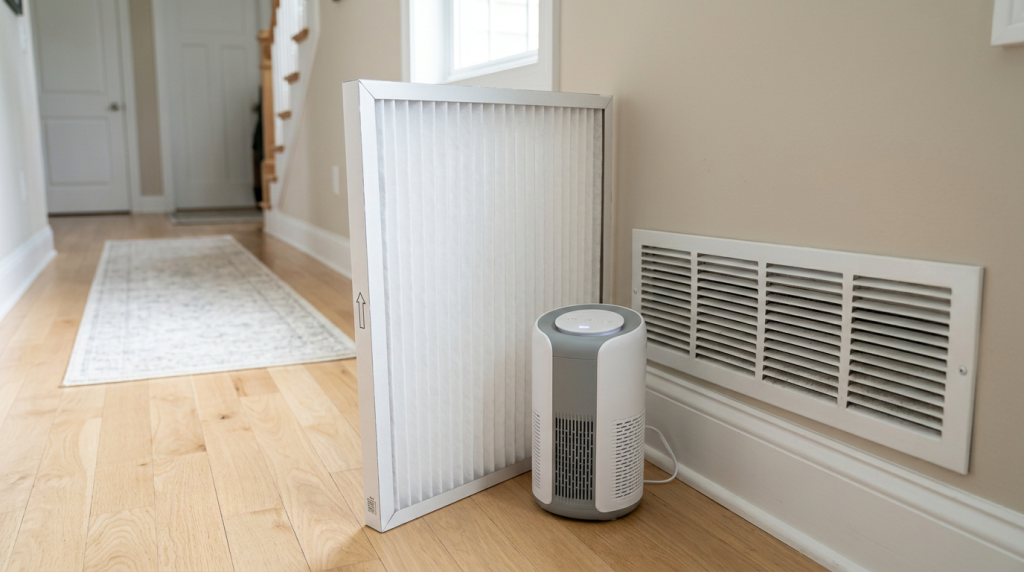
HVAC filter support may help when:
- Dust collects near supply vents.
- Return grilles look dirty quickly.
- The home has central heating and cooling.
- You already change filters on schedule.
- The system manual allows a higher-efficiency filter.
- An HVAC professional confirms the system can handle the filter.
Do not force a thicker or more restrictive filter into your system. Do not modify ductwork, bypass safety switches, open sealed HVAC components, or work on live electrical parts.
For help choosing a filter that fits your system, see our guide to the best furnace filters for homeowners before switching to a higher-efficiency option.
Where to Place an Air Purifier
Placement affects how well the purifier works.
The unit needs open space around the intake and outlet. If it is tucked behind furniture, blocked by curtains, or placed under a table, it may not move air properly.
For HVAC dust, place the purifier in the room where dust is most noticeable. That may be a bedroom, living room, home office, or room near a return grille.
Good placement habits include:
- Keep the intake clear.
- Keep the outlet clear.
- Avoid placing it behind furniture.
- Keep it away from water.
- Keep cords out of walkways.
- Close windows during dusty outdoor conditions.
- Run the unit consistently in the problem room.
The purifier does not need to sit directly in front of a vent. It just needs good airflow in the room.
Dust Around Vents
Dust around vents can be normal, especially if air is constantly moving across the grille. But heavy dust, dark streaks, or dust that returns quickly may need closer attention.
Sometimes the issue is as simple as a dirty filter or dusty vent cover. Other times, it may point to air leaks, dirty return paths, poor filtration, or duct problems.
Simple homeowner checks include:
- Make sure the HVAC filter is installed correctly.
- Replace a dirty filter.
- Vacuum supply and return grilles.
- Dust around vents with a damp cloth.
- Check that vents are not blocked by furniture.
- Look for gaps around return grilles.
- Notice whether dust appears worse after the system runs.
Stay with safe, basic maintenance. Do not open sealed HVAC equipment or take apart ductwork.
When Dust May Point to an HVAC Issue
Sometimes dust is not just a room air problem. It may point to something wrong with the HVAC system, ductwork, or airflow.
An air purifier may help the room feel cleaner, but it should not be used to ignore a bigger issue.
Dust may point to an HVAC issue when:
- Dust blows out of vents when the system starts.
- The HVAC filter gets dirty very quickly.
- Dust appears around several vents.
- Some rooms have weak airflow.
- Return grilles are pulling dust from attics, basements, or wall cavities.
- Ducts appear damaged, disconnected, or poorly sealed.
- Dust increased after renovation work.
- The system runs often but comfort is uneven.
- There are musty smells along with dust.
- You see signs of moisture near HVAC equipment.
If the dust problem seems connected to duct leaks, airflow, moisture, or HVAC performance, call a qualified professional. A purifier can reduce some airborne dust, but it cannot diagnose or repair the system.
Do Not Use Ozone Generators for Everyday Dust Control
Ozone generators are not a good choice for normal homeowner dust control.
For occupied living spaces, choose safer filter-based options such as HEPA air purifiers, pre-filters, and proper HVAC filter support. Avoid products that rely on ozone as the cleaning method.
A dust problem should be handled with filtration, cleaning, source control, and HVAC maintenance, not unsafe air-cleaning shortcuts.
Humidity and Dust
Humidity does not create ordinary dust by itself, but indoor moisture can affect comfort, odors, and air quality.
If the home feels dusty and musty, a humidity gauge can help you understand whether moisture is also part of the problem. High humidity can make rooms feel stale and may support mold or mildew problems. Very dry air can make dust feel more noticeable and irritating.
A humidity gauge is a simple product that helps you stop guessing. It will not clean the air, but it can help you decide whether the home also needs moisture control.
Product Choices That Make Sense
Choosing the right air purifier starts with the actual problem.
If dust is light and limited to one room, a smaller room-size air purifier may be enough. If dust is heavy in a family room, a larger living-room air purifier may be a better fit. If visible lint and hair are part of the problem, compare units with good pre-filters.
Compare these product types first:
- HEPA air purifiers for airborne dust and fine particles.
- Air purifiers with pre-filters for larger dust, lint, and pet hair.
- Activated carbon filter models if odors are also present.
- Small room-size air purifiers for bedrooms and offices.
- Larger living-room air purifiers for family rooms and open spaces.
- Replacement filters before choosing a model.
- HVAC filter options that are approved for your system.
- Humidity gauges if the home feels dusty, dry, damp, or musty.
For most homeowners, the best starting point is a room-size HEPA air purifier with a washable or replaceable pre-filter, because that combination helps with both fine airborne dust and larger visible dust before it reaches the main filter.
The right choice is the one that matches your room size, dust level, HVAC setup, maintenance habits, and budget. Avoid unsupported “best overall” claims because homes and systems are different.
If your main concern is pet hair along with dust, see our guide to the best air purifier for pet hair and dust before choosing a room air purifier.
Simple Buying Checklist
A short checklist can help you avoid buying the wrong unit.
Before you buy, confirm:
- The purifier is rated for the room size.
- The filter type fits your dust problem.
- The unit has a pre-filter if larger dust is common.
- Replacement filters are affordable.
- Replacement filters are easy to find.
- The noise level works for the room.
- The controls are simple.
- The unit has clear maintenance instructions.
- The air intake and outlet are easy to keep clean.
- The return policy makes sense.
A good air purifier should be easy to use every day. Consistent use matters more than extra features you will never use.
Common Buying Mistakes
Many homeowners buy an air purifier because dust is frustrating, but the wrong unit can lead to disappointment.
The goal is to reduce airborne dust in a specific room, not magically remove all dust from the whole house.
Avoid these common mistakes:
- Buying a unit that is too small.
- Ignoring replacement filter cost.
- Choosing odor features instead of dust filtration.
- Expecting one purifier to clean the whole house.
- Blocking the intake with furniture.
- Running the purifier only once in a while.
- Forgetting to clean the pre-filter.
- Using an air purifier instead of changing HVAC filters.
- Ignoring duct leaks or airflow problems.
- Buying ozone-generating products for normal dust control.
An air purifier works best as part of a larger dust-control routine.
A Practical Dust-Control Routine
A purifier can help, but it should work alongside basic home maintenance.
A simple routine includes:
- Change HVAC filters on schedule.
- Use an HVAC filter your system can handle.
- Vacuum carpets, rugs, and upholstery.
- Dust with a damp cloth.
- Keep return grilles clean.
- Wash bedding and soft items regularly.
- Keep windows closed during dusty outdoor conditions.
- Use a room air purifier in the dustiest room.
- Check humidity if the home feels dry, damp, or musty.
- Call a professional if dust seems tied to duct or airflow problems.
This approach gives the air purifier a fair chance to help because you are also reducing the dust sources around it.
Final Thoughts
The best air purifier for hvac dust is not one specific model for every home. It is the right type of air purifier for the room, the dust level, and the HVAC situation.
For most homeowners, a HEPA air purifier with a good pre-filter is a practical place to start. Larger rooms may need a larger living-room air purifier. Homes with odors may benefit from activated carbon. Homes with central heating and cooling may also benefit from the right HVAC filter support.
An air purifier can reduce airborne dust, but it cannot replace filter changes, cleaning, vacuuming, duct repairs, or airflow fixes. If dust keeps coming from vents, filters clog quickly, airflow is weak, or musty smells appear with the dust, the better next step may be an HVAC inspection instead of another room air purifier.