Why Touch Up Paint Looks Shiny?
Touch up paint looks shiny when the touched-up area reflects light differently than the surrounding wall, even if the paint color seems correct. This usually happens because of a sheen mismatch, old paint aging, different application tools, too much paint, wall texture differences, skipped primer, poor mixing, or the way light hits the wall.
A touch-up can match the color but still look wrong. That is because paint has two parts that matter: color and sheen. Color is the shade. Sheen is how much light the dried paint reflects.
If the sheen is different, the touch-up may look glossy, wet, raised, or brighter than the rest of the wall. This is especially common on satin, semi-gloss, and darker paint colors.
Color Match vs. Sheen Match
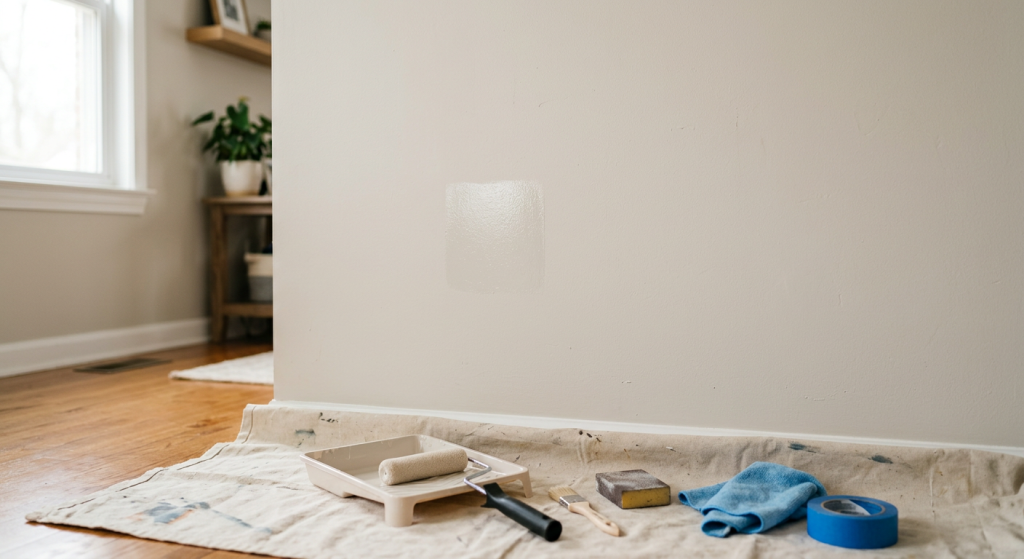
A paint color can be correct while the finish still looks different. That is why a touch-up may look shiny even when you used leftover paint from the original can.
Color match means the shade is close. Sheen match means the surface reflects light the same way. A good touch-up needs both.
| Problem | What You See | Common Cause | Basic Fix |
|---|---|---|---|
| Color matches but spot shines | Glossy-looking patch | Sheen or texture difference | Blend with roller or repaint section |
| Spot looks raised | Thick paint edge | Too much paint applied | Sand lightly, repaint thinly |
| Spot looks different in daylight | Light catches it | Wall angle or old paint aging | Repaint larger area |
| Patch looks dull or shiny | Uneven absorption | No primer over repair | Prime, then repaint |
Why Touch Up Paint Looks Shiny
Touch up paint looks shiny because the repaired area is not behaving like the rest of the wall. It may have a different texture, a different thickness of paint, a different sheen, or a different level of absorption underneath.
This does not always mean you used the wrong color. Many shiny touch-up spots happen when the surface under the paint or the tool used to apply it is different.
A wall originally painted with a roller has a light roller texture. If you touch it up with a brush, the brush marks can reflect light differently. That small texture change can make the spot look shiny.
Cause 1: The Paint Sheen Does Not Match
Sheen mismatch is one of the most common reasons touch-up paint looks shiny. Paint comes in finishes such as flat, matte, eggshell, satin, semi-gloss, and gloss. Each one reflects light differently.
If the wall is eggshell and the touch-up paint is satin, the spot may look shinier. If the wall is satin but the touch-up area absorbed paint differently, the sheen can still look off.
Even a small sheen difference can be obvious on a wall with side lighting from a window or lamp.
Sheen mismatch is more noticeable on:
- Satin paint
- Semi-gloss paint
- Gloss paint
- Dark paint colors
- Bright rooms
- Hallways with angled light
- Smooth walls
- Large touch-up areas
Flat and matte paints are usually more forgiving. They reflect less light, so small touch-ups are less likely to stand out.
Cause 2: The Old Paint Has Aged
Paint changes after it has been on a wall for a while. Sunlight, dust, cleaning, moisture, cooking residue, and normal wear can all affect the surface.
Fresh paint from the original can may not look exactly like the paint that has been on the wall for months or years. The color might still be close, but the sheen may look cleaner, brighter, or shinier.
This is why touch-ups are harder on older walls. The new paint has not aged the same way as the surrounding wall.
Old paint may look different because of:
- Sun fading
- Household dust
- Cleaning marks
- Hand oils near switches and doors
- Kitchen grease
- Moisture in bathrooms
- General wear over time
If the wall paint is old, a small touch-up may never blend perfectly. Repainting the full wall may give a cleaner result.
Cause 3: You Used a Brush on a Rolled Wall
A brush touch-up can look different on a wall originally painted with a roller because the texture is different. Rollers leave a light, even stipple pattern. Brushes leave strokes.
Even if both areas use the same paint, they may reflect light differently after drying. The brushed area can look smoother, shinier, or more noticeable from an angle.
For small marks, a touch-up brush can work. For larger spots, a mini roller usually blends better with the surrounding wall.
If the surrounding wall was rolled, choosing the best paint roller for smooth walls can help the repaired area match the existing texture better.
Use the tool that matches the wall:
- Use a touch-up brush for tiny chips, corners, and tight spots.
- Use a mini roller for small wall patches.
- Use a roller cover similar to the one used on the original wall.
- Use light pressure instead of pressing hard.
- Feather the paint slightly beyond the repair.
- Avoid leaving a thick edge around the touch-up.
A small paint tray and mini roller are useful for these repairs because they help you apply a thinner, more even coat.
Cause 4: Too Much Paint Was Applied
More paint does not always hide a touch-up better. In many cases, too much paint makes the spot more visible.
A heavy touch-up can create a raised edge, thicker texture, or glossier finish. When light hits the wall, that thicker area can stand out.
This is especially common when homeowners dab paint over a mark with a loaded brush. The spot may look fine while wet, then dry into a shiny patch.
Signs you used too much paint include:
- The spot looks raised
- The edge of the touch-up is visible
- The area looks glossier than the wall
- Brush marks are easy to see
- The paint feels thicker to the touch
- The patch still shows after drying
Thin coats are better than heavy coats. If a second coat is needed, let the first coat dry before adding more.
Cause 5: The Wall Texture Is Different
Touch-up paint can look shiny when the repaired spot has a different texture than the rest of the wall. This often happens after sanding, patching, or cleaning one small area.
A smooth patch on a lightly textured wall can catch light differently. A rough patch on a smooth wall can do the same.
Primer and paint cannot fully hide a texture problem. The surface needs to be prepared before painting.
Texture differences can come from:
- Sanding one area too smooth
- Leaving patch edges raised
- Applying paint with the wrong tool
- Using a brush instead of a roller
- Scrubbing one spot before painting
- Applying thick paint over a small area
- Skipping primer over spackle or joint compound
A sanding sponge can help smooth raised edges, but use light pressure. The goal is to blend the repair, not create a polished spot that is smoother than the rest of the wall.
Cause 6: Primer Was Skipped Over a Patch
If the touch-up was done over spackle, joint compound, or a drywall patch, skipped primer may be the problem. Bare patching material absorbs paint differently than a painted wall.
Sometimes this makes the patch look dull. Other times it can create an uneven surface that catches light and looks shiny around the edges.
Primer helps seal the patch before paint goes on. For ordinary wall repairs, a basic drywall primer or interior primer is usually enough.
Primer is usually needed when:
- You painted over spackle
- You painted over joint compound
- The patch was sanded
- The repair is larger than a tiny nail hole
- The wall has satin or semi-gloss paint
- The patch looks chalky or dull before painting
- The touch-up keeps showing after paint dries
Do not use heavy primer buildup. A thin, even coat is usually the right approach.
For patched spots that keep showing through paint, this guide on paint flashing over a drywall patch explains why primer and surface prep matter.
Cause 7: The Paint Was Not Mixed Well
Paint can separate while it sits. Pigments, binders, and sheen-related ingredients may not stay evenly mixed in the can.
If you dip into old paint without stirring it well, the touch-up may dry with a different sheen. It may also look slightly different in color.
This is common with leftover paint that has been stored for a long time. Before touching up, stir the paint thoroughly from the bottom of the can.
Before using leftover paint:
- Check that the paint has not spoiled
- Stir it well from the bottom
- Make sure there are no lumps
- Test a small hidden spot first
- Let the test spot dry fully before judging it
- Confirm the sheen as well as the color
Paint can look different wet than dry, so do not judge the touch-up immediately.
Cause 8: Lighting Makes the Spot Stand Out
Lighting can make a shiny touch-up look worse. Side lighting from windows, lamps, hallway lights, or ceiling fixtures can reveal small differences in sheen and texture.
A spot that looks fine in soft light may stand out in bright afternoon sun. This is common on long hallway walls, stairway walls, and rooms with large windows.
This does not mean the wall is ruined. It means the surface is reflecting light unevenly.
Check the touch-up in different conditions:
- Straight on
- From the side
- In daylight
- At night with room lights on
- From normal walking distance
- After the paint has fully dried
If the touch-up only shows from one sharp angle, you may be seeing a texture or sheen issue rather than a color problem.
When a Small Touch-Up May Work
A small touch-up may work when the damaged area is tiny, the wall paint is flat or matte, and the original paint is still in good condition.
Tiny chips, pinholes, and small marks are the best candidates. The smaller the area, the easier it is to blend.
Use a light hand. A touch-up should not look like a separate layer sitting on top of the wall.
A small touch-up is more likely to work when:
- The spot is very small
- The paint is flat or matte
- The wall was painted recently
- The original paint is available
- The paint has been mixed well
- The wall is lightly textured
- The spot is not in strong side lighting
For tiny spots, use a small touch-up brush. For larger spots, use a mini roller to better match the wall texture.
When Repainting the Full Wall Is Better
Repainting the full wall is better when the touch-up keeps showing, the paint is older, the wall has a noticeable sheen, or the repaired area is larger than a small mark.
This is not always what homeowners want to hear, but it is often the cleanest solution. A full wall repaint gives your eye natural stopping points at corners, trim, and ceiling lines.
It also avoids the problem of trying to blend fresh paint into an aged wall surface.
Repaint the full wall when:
- The touch-up looks shiny after drying
- The wall paint is old or faded
- The paint sheen is satin, semi-gloss, or gloss
- The wall color is dark or bold
- There are several touch-up spots
- The repaired area is larger than a few inches
- The wall gets strong natural light
- The texture difference is easy to see
Use painter’s tape to protect trim, a quality roller cover for the wall texture, and a paint tray that gives you room to load the roller evenly.
Step-by-Step Fix for Shiny Touch-Up Paint
The best fix is to correct the surface first, then repaint lightly. Do not keep adding thick paint over the shiny spot. That can make the area more raised and more noticeable.
Let the paint dry fully before deciding what to do. Fresh paint can look shinier while it is still drying.
Fix shiny touch-up paint this way:
- Let the touch-up paint dry completely.
- Look at the spot from different angles.
- Lightly sand any raised edge or thick paint with a fine sanding sponge.
- Wipe away dust with a microfiber cloth.
- Prime the area if the touch-up is over spackle, joint compound, or bare drywall.
- Let the primer dry fully.
- Stir the paint well before using it again.
- Apply a thin coat with a mini roller if the wall was originally rolled.
- Feather the paint slightly beyond the repair.
- Let it dry before deciding whether another coat is needed.
If the spot still looks shiny after this, repainting the full wall may be the better fix.
How to Prevent Shiny Touch-Up Spots
The best way to prevent shiny touch-up spots is to match the paint, sheen, surface texture, and application method as closely as possible.
Do a small test before painting a noticeable area. Let the test dry fully because paint changes as it dries.
To prevent shiny touch-ups:
- Save the paint label or color information
- Store leftover paint properly
- Stir paint thoroughly before use
- Use the same sheen as the original wall
- Use a mini roller on rolled walls
- Use thin coats instead of heavy dabs
- Prime spackle or drywall patches before painting
- Wipe dust off repaired areas
- Test the touch-up in a hidden spot
- Repaint the full wall when blending is unlikely
Paint sheen samples can be helpful when you are not sure whether the wall is flat, eggshell, satin, or semi-gloss. Matching sheen matters just as much as matching color.
Common Mistakes When Fixing Shiny Touch-Up Paint
Shiny touch-up paint is frustrating, so it is easy to overcorrect. The most common mistake is adding more and more paint without fixing the cause.
If the problem is sheen, texture, or skipped primer, more paint alone usually will not solve it.
Avoid these mistakes:
- Applying thick paint over the shiny spot
- Using a brush on a large rolled-wall area
- Skipping primer over spackle or joint compound
- Forgetting to stir old paint
- Using the wrong sheen
- Judging the paint before it dries
- Sanding too aggressively
- Leaving dust on the wall after sanding
- Touching up only one spot on an old faded wall
- Using a different roller texture than the surrounding wall
A calm, step-by-step fix usually works better than trying to hide the spot with more paint.
Helpful Tools for Better Touch-Ups
Small paint repairs are easier with the right tools. You do not need a large setup, but the basics can make the finished wall look cleaner.
Useful touch-up supplies include:
- Touch-up brushes for tiny chips and corners
- Mini rollers for blending small wall areas
- Roller covers that match the wall texture
- Small paint trays for controlled paint loading
- Painter’s tape for trim and edges
- Fine sanding sponges for raised paint or patch edges
- Microfiber cloths for removing dust
- Primer for spackle, joint compound, or bare drywall
- Paint sheen samples when the original finish is unknown
A mini roller is often the most helpful tool for shiny touch-up problems because it can make the touched-up area look more like the surrounding rolled wall.
Final Thoughts
Touch up paint looks shiny when the touched-up spot reflects light differently than the rest of the wall. The color may be right, but the sheen, texture, thickness, primer, tool marks, or lighting can still make the spot stand out.
For tiny marks, a careful touch-up with well-mixed paint may work. For larger spots, use the right primer when needed, apply thin coats, and try a mini roller instead of a brush on rolled walls.
If the wall is older, shiny, dark, or strongly lit, repainting the full wall may be the cleanest fix. Do not try to bury the shiny spot under heavy paint. A smooth surface, proper primer, matching sheen, and light even coats give you the best chance of making the repair blend in.
Touch up paint looks shiny when the touched-up area reflects light differently than the surrounding wall, even if the paint color seems correct. This usually happens because of a sheen mismatch, old paint aging, different application tools, too much paint, wall texture differences, skipped primer, poor mixing, or the way light hits the wall.
A touch-up can match the color but still look wrong. That is because paint has two parts that matter: color and sheen. Color is the shade. Sheen is how much light the dried paint reflects.
If the sheen is different, the touch-up may look glossy, wet, raised, or brighter than the rest of the wall. This is especially common on satin, semi-gloss, and darker paint colors.
Color Match vs. Sheen Match
A paint color can be correct while the finish still looks different. That is why a touch-up may look shiny even when you used leftover paint from the original can.
Color match means the shade is close. Sheen match means the surface reflects light the same way. A good touch-up needs both.
| Problem | What You See | Common Cause | Basic Fix |
|---|---|---|---|
| Color matches but spot shines | Glossy-looking patch | Sheen or texture difference | Blend with roller or repaint section |
| Spot looks raised | Thick paint edge | Too much paint applied | Sand lightly, repaint thinly |
| Spot looks different in daylight | Light catches it | Wall angle or old paint aging | Repaint larger area |
| Patch looks dull or shiny | Uneven absorption | No primer over repair | Prime, then repaint |
Why Touch Up Paint Looks Shiny
Touch up paint looks shiny because the repaired area is not behaving like the rest of the wall. It may have a different texture, a different thickness of paint, a different sheen, or a different level of absorption underneath.
This does not always mean you used the wrong color. Many shiny touch-up spots happen when the surface under the paint or the tool used to apply it is different.
A wall originally painted with a roller has a light roller texture. If you touch it up with a brush, the brush marks can reflect light differently. That small texture change can make the spot look shiny.
Cause 1: The Paint Sheen Does Not Match
Sheen mismatch is one of the most common reasons touch-up paint looks shiny. Paint comes in finishes such as flat, matte, eggshell, satin, semi-gloss, and gloss. Each one reflects light differently.
If the wall is eggshell and the touch-up paint is satin, the spot may look shinier. If the wall is satin but the touch-up area absorbed paint differently, the sheen can still look off.
Even a small sheen difference can be obvious on a wall with side lighting from a window or lamp.
Sheen mismatch is more noticeable on:
- Satin paint
- Semi-gloss paint
- Gloss paint
- Dark paint colors
- Bright rooms
- Hallways with angled light
- Smooth walls
- Large touch-up areas
Flat and matte paints are usually more forgiving. They reflect less light, so small touch-ups are less likely to stand out.
Cause 2: The Old Paint Has Aged
Paint changes after it has been on a wall for a while. Sunlight, dust, cleaning, moisture, cooking residue, and normal wear can all affect the surface.
Fresh paint from the original can may not look exactly like the paint that has been on the wall for months or years. The color might still be close, but the sheen may look cleaner, brighter, or shinier.
This is why touch-ups are harder on older walls. The new paint has not aged the same way as the surrounding wall.
Old paint may look different because of:
- Sun fading
- Household dust
- Cleaning marks
- Hand oils near switches and doors
- Kitchen grease
- Moisture in bathrooms
- General wear over time
If the wall paint is old, a small touch-up may never blend perfectly. Repainting the full wall may give a cleaner result.
Cause 3: You Used a Brush on a Rolled Wall
A brush touch-up can look different on a wall originally painted with a roller because the texture is different. Rollers leave a light, even stipple pattern. Brushes leave strokes.
Even if both areas use the same paint, they may reflect light differently after drying. The brushed area can look smoother, shinier, or more noticeable from an angle.
For small marks, a touch-up brush can work. For larger spots, a mini roller usually blends better with the surrounding wall.
Use the tool that matches the wall:
- Use a touch-up brush for tiny chips, corners, and tight spots.
- Use a mini roller for small wall patches.
- Use a roller cover similar to the one used on the original wall.
- Use light pressure instead of pressing hard.
- Feather the paint slightly beyond the repair.
- Avoid leaving a thick edge around the touch-up.
A small paint tray and mini roller are useful for these repairs because they help you apply a thinner, more even coat.
Cause 4: Too Much Paint Was Applied
More paint does not always hide a touch-up better. In many cases, too much paint makes the spot more visible.
A heavy touch-up can create a raised edge, thicker texture, or glossier finish. When light hits the wall, that thicker area can stand out.
This is especially common when homeowners dab paint over a mark with a loaded brush. The spot may look fine while wet, then dry into a shiny patch.
Signs you used too much paint include:
- The spot looks raised
- The edge of the touch-up is visible
- The area looks glossier than the wall
- Brush marks are easy to see
- The paint feels thicker to the touch
- The patch still shows after drying
Thin coats are better than heavy coats. If a second coat is needed, let the first coat dry before adding more.
Cause 5: The Wall Texture Is Different
Touch-up paint can look shiny when the repaired spot has a different texture than the rest of the wall. This often happens after sanding, patching, or cleaning one small area.
A smooth patch on a lightly textured wall can catch light differently. A rough patch on a smooth wall can do the same.
Primer and paint cannot fully hide a texture problem. The surface needs to be prepared before painting.
Texture differences can come from:
- Sanding one area too smooth
- Leaving patch edges raised
- Applying paint with the wrong tool
- Using a brush instead of a roller
- Scrubbing one spot before painting
- Applying thick paint over a small area
- Skipping primer over spackle or joint compound
A sanding sponge can help smooth raised edges, but use light pressure. The goal is to blend the repair, not create a polished spot that is smoother than the rest of the wall.
Cause 6: Primer Was Skipped Over a Patch
If the touch-up was done over spackle, joint compound, or a drywall patch, skipped primer may be the problem. Bare patching material absorbs paint differently than a painted wall.
Sometimes this makes the patch look dull. Other times it can create an uneven surface that catches light and looks shiny around the edges.
Primer helps seal the patch before paint goes on. For ordinary wall repairs, a basic drywall primer or interior primer is usually enough.
Primer is usually needed when:
- You painted over spackle
- You painted over joint compound
- The patch was sanded
- The repair is larger than a tiny nail hole
- The wall has satin or semi-gloss paint
- The patch looks chalky or dull before painting
- The touch-up keeps showing after paint dries
Do not use heavy primer buildup. A thin, even coat is usually the right approach.
Cause 7: The Paint Was Not Mixed Well
Paint can separate while it sits. Pigments, binders, and sheen-related ingredients may not stay evenly mixed in the can.
If you dip into old paint without stirring it well, the touch-up may dry with a different sheen. It may also look slightly different in color.
This is common with leftover paint that has been stored for a long time. Before touching up, stir the paint thoroughly from the bottom of the can.
Before using leftover paint:
- Check that the paint has not spoiled
- Stir it well from the bottom
- Make sure there are no lumps
- Test a small hidden spot first
- Let the test spot dry fully before judging it
- Confirm the sheen as well as the color
Paint can look different wet than dry, so do not judge the touch-up immediately.
Cause 8: Lighting Makes the Spot Stand Out
Lighting can make a shiny touch-up look worse. Side lighting from windows, lamps, hallway lights, or ceiling fixtures can reveal small differences in sheen and texture.
A spot that looks fine in soft light may stand out in bright afternoon sun. This is common on long hallway walls, stairway walls, and rooms with large windows.
This does not mean the wall is ruined. It means the surface is reflecting light unevenly.
Check the touch-up in different conditions:
- Straight on
- From the side
- In daylight
- At night with room lights on
- From normal walking distance
- After the paint has fully dried
If the touch-up only shows from one sharp angle, you may be seeing a texture or sheen issue rather than a color problem.
When a Small Touch-Up May Work
A small touch-up may work when the damaged area is tiny, the wall paint is flat or matte, and the original paint is still in good condition.
Tiny chips, pinholes, and small marks are the best candidates. The smaller the area, the easier it is to blend.
Use a light hand. A touch-up should not look like a separate layer sitting on top of the wall.
A small touch-up is more likely to work when:
- The spot is very small
- The paint is flat or matte
- The wall was painted recently
- The original paint is available
- The paint has been mixed well
- The wall is lightly textured
- The spot is not in strong side lighting
For tiny spots, use a small touch-up brush. For larger spots, use a mini roller to better match the wall texture.
When Repainting the Full Wall Is Better
Repainting the full wall is better when the touch-up keeps showing, the paint is older, the wall has a noticeable sheen, or the repaired area is larger than a small mark.
This is not always what homeowners want to hear, but it is often the cleanest solution. A full wall repaint gives your eye natural stopping points at corners, trim, and ceiling lines.
It also avoids the problem of trying to blend fresh paint into an aged wall surface.
Repaint the full wall when:
- The touch-up looks shiny after drying
- The wall paint is old or faded
- The paint sheen is satin, semi-gloss, or gloss
- The wall color is dark or bold
- There are several touch-up spots
- The repaired area is larger than a few inches
- The wall gets strong natural light
- The texture difference is easy to see
Use painter’s tape to protect trim, a quality roller cover for the wall texture, and a paint tray that gives you room to load the roller evenly.
Step-by-Step Fix for Shiny Touch-Up Paint
The best fix is to correct the surface first, then repaint lightly. Do not keep adding thick paint over the shiny spot. That can make the area more raised and more noticeable.
Let the paint dry fully before deciding what to do. Fresh paint can look shinier while it is still drying.
Fix shiny touch-up paint this way:
- Let the touch-up paint dry completely.
- Look at the spot from different angles.
- Lightly sand any raised edge or thick paint with a fine sanding sponge.
- Wipe away dust with a microfiber cloth.
- Prime the area if the touch-up is over spackle, joint compound, or bare drywall.
- Let the primer dry fully.
- Stir the paint well before using it again.
- Apply a thin coat with a mini roller if the wall was originally rolled.
- Feather the paint slightly beyond the repair.
- Let it dry before deciding whether another coat is needed.
If the spot still looks shiny after this, repainting the full wall may be the better fix.
How to Prevent Shiny Touch-Up Spots
The best way to prevent shiny touch-up spots is to match the paint, sheen, surface texture, and application method as closely as possible.
Do a small test before painting a noticeable area. Let the test dry fully because paint changes as it dries.
To prevent shiny touch-ups:
- Save the paint label or color information
- Store leftover paint properly
- Stir paint thoroughly before use
- Use the same sheen as the original wall
- Use a mini roller on rolled walls
- Use thin coats instead of heavy dabs
- Prime spackle or drywall patches before painting
- Wipe dust off repaired areas
- Test the touch-up in a hidden spot
- Repaint the full wall when blending is unlikely
Paint sheen samples can be helpful when you are not sure whether the wall is flat, eggshell, satin, or semi-gloss. Matching sheen matters just as much as matching color.
Common Mistakes When Fixing Shiny Touch-Up Paint
Shiny touch-up paint is frustrating, so it is easy to overcorrect. The most common mistake is adding more and more paint without fixing the cause.
If the problem is sheen, texture, or skipped primer, more paint alone usually will not solve it.
Avoid these mistakes:
- Applying thick paint over the shiny spot
- Using a brush on a large rolled-wall area
- Skipping primer over spackle or joint compound
- Forgetting to stir old paint
- Using the wrong sheen
- Judging the paint before it dries
- Sanding too aggressively
- Leaving dust on the wall after sanding
- Touching up only one spot on an old faded wall
- Using a different roller texture than the surrounding wall
A calm, step-by-step fix usually works better than trying to hide the spot with more paint.
Helpful Tools for Better Touch-Ups
Small paint repairs are easier with the right tools. You do not need a large setup, but the basics can make the finished wall look cleaner.
Useful touch-up supplies include:
- Touch-up brushes for tiny chips and corners
- Mini rollers for blending small wall areas
- Roller covers that match the wall texture
- Small paint trays for controlled paint loading
- Painter’s tape for trim and edges
- Fine sanding sponges for raised paint or patch edges
- Microfiber cloths for removing dust
- Primer for spackle, joint compound, or bare drywall
- Paint sheen samples when the original finish is unknown
A mini roller is often the most helpful tool for shiny touch-up problems because it can make the touched-up area look more like the surrounding rolled wall.
Final Thoughts
Touch up paint looks shiny when the touched-up spot reflects light differently than the rest of the wall. The color may be right, but the sheen, texture, thickness, primer, tool marks, or lighting can still make the spot stand out.
For tiny marks, a careful touch-up with well-mixed paint may work. For larger spots, use the right primer when needed, apply thin coats, and try a mini roller instead of a brush on rolled walls.
If the wall is older, shiny, dark, or strongly lit, repainting the full wall may be the cleanest fix. Do not try to bury the shiny spot under heavy paint. A smooth surface, proper primer, matching sheen, and light even coats give you the best chance of making the repair blend in.
