
How Long Does Caulk Take to Dry Before Painting?
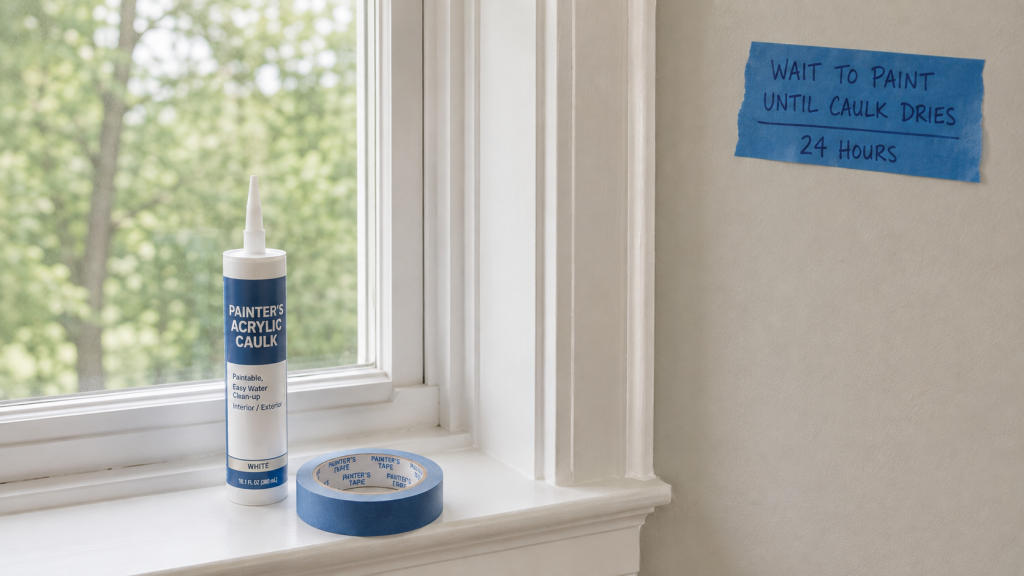
How long does caulk take to dry before painting? There is no universal wait time. Some paintable caulks are labeled ready for paint relatively quickly, while others need several hours or longer. The product label controls. A bead that feels dry on the surface may still be soft underneath, especially when it is thick or applied in cool or humid conditions.
| Caulk type | General paint-ready behavior | Common use | Main caution |
|---|---|---|---|
| Paintable acrylic latex caulk | Often designed for painting after a specified drying period | Trim, baseboards, molding, interior gaps | Paint-ready time varies by formula and conditions |
| Fast-dry paintable caulk | Some products are specifically labeled for painting after a short wait | Painting projects where turnaround matters | Do not assume every acrylic caulk is fast-dry |
| Hybrid or specialty paintable caulk | Paint timing varies considerably by formulation | Trim, windows, doors, moisture-prone areas | Follow the exact product’s paint-ready instructions |
| Silicone or non-paintable caulk | Many silicone sealants are not intended to accept paint | Kitchens, baths, exterior sealing, wet areas | Do not use a non-paintable product where the finished bead must be painted |
The distinction that matters most is paint-ready time, not simply whether the caulk has formed a skin. Temperature, humidity, airflow, bead thickness, the surface underneath, and the caulk formulation can all change how quickly a bead becomes ready for its next coat.
How Long Does Caulk Take to Dry Before You Paint It?
Start with the manufacturer’s stated paint-ready time. Depending on the product, that may be a relatively short period or several hours or longer.
Avoid applying a universal rule such as “wait 30 minutes” or “always wait 24 hours.” Caulks use different formulations, and manufacturers specify different conditions and waiting periods.
Four timing terms can appear on caulk packaging or technical information:
- Skin-over time is when a thin film develops on the exposed surface.
- Dry-to-touch time describes when the surface no longer feels obviously wet or tacky.
- Paint-ready time is when the manufacturer says the caulk can be painted under the stated conditions.
- Full cure is when the bead has developed its intended cured properties throughout.
These stages are not interchangeable. A caulk can skin over while material deeper in the bead remains soft. Likewise, a product may be paint-ready well before it reaches full cure.
If your goal is painting, use the manufacturer’s paint-ready guidance rather than waiting for full cure unless the instructions specifically require it.
Why Caulk Drying Time Matters Before Painting
Paint adds a film over the caulk. Applying that film before the caulk is ready can interfere with the finish as the material underneath continues drying or curing.
Painting too soon can contribute to:
- Wrinkling or distortion in the paint film
- Smearing the bead during brushing or rolling
- Soft spots beneath the painted surface
- Cracking as the caulk continues to change
- A rough or uneven finished appearance
- Slower drying beneath the paint film
Timing is not the only possible cause of these problems. Caulk compatibility, surface contamination, excessive movement, application technique, and the paint itself can also affect the finished result.
When the label gives a paint-ready time, treat that as the minimum under the manufacturer’s stated conditions rather than assuming that a surface skin means the bead is ready.
What Changes How Fast Caulk Dries?
The time printed on the tube is the starting point, but application conditions matter. A bead applied under less favorable conditions may behave differently from one applied under the conditions used for the manufacturer’s guidance.
Caulk formulation
Acrylic latex, fast-dry acrylic, hybrid sealants, and silicone-based products do not all dry or cure in the same way.
Even two products that look similar on the shelf can have different paint-ready instructions. Some fast-dry paintable caulks are formulated for a short turnaround, while other paintable products require considerably more time.
This is why the exact label matters more than a general rule based only on the words “acrylic,” “latex,” or “silicone.”
For more help with choosing a caulk intended for a painted finish, see Best Caulk for Trim Before Painting.
Bead thickness
A thin, properly sized bead generally has less material that must dry or cure than an excessively thick application.
The exposed surface can become firm first while material farther inside remains soft. This makes a thick bead particularly easy to misjudge by touch alone.
Do not compensate for a large gap by piling on caulk beyond the product’s intended joint dimensions. Follow the manufacturer’s application limits and joint-preparation instructions.
Temperature
Temperature affects how caulks behave during application and drying. Cool conditions can extend the process for some formulations, while temperatures outside the manufacturer’s application range can create additional problems.
Check the label for the permitted application temperature and any conditions attached to the stated paint-ready time.
Humidity
Humidity can also change drying or curing behavior, but its effect depends on the formulation.
For that reason, “more humidity always means slower drying” is not a reliable rule for every sealant. When conditions differ substantially from those specified by the manufacturer, allow for the possibility that the stated timing may change.
Airflow
Reasonable ventilation can help maintain suitable drying conditions, particularly indoors. Avoid trying to force the process with excessive heat or other methods that conflict with the product instructions.
Follow label directions for ventilation as well as drying and curing conditions.
Substrate and surface condition
Caulk should be applied to surfaces that meet the manufacturer’s requirements for cleanliness, dryness, preparation, and compatibility.
Porous and nonporous materials can interact differently with particular formulations. Residual moisture, dust, old loose caulk, oils, or other contamination can also affect the application and finished bead.
Drying time cannot compensate for poor surface preparation.
How to Tell Whether Caulk Is Ready for Paint
The safest practical check begins with the tube or cartridge. Find the manufacturer’s stated paint-ready time and any qualifying temperature, humidity, bead-size, or application conditions.
Then consider what actually happened during your project.
If you applied a heavier-than-normal bead, worked in cooler conditions, or encountered conditions outside those assumed by the instructions, the surface appearance alone should not persuade you to paint early.
A bead that still feels unusually soft, tacky, easily deformed, or prone to smearing should not be painted merely because the minimum time has passed. Recheck the label and give the material additional time if appropriate.
Avoid aggressive testing. Repeatedly pressing, rubbing, or digging into a fresh bead can damage an otherwise good application.
When in doubt, waiting longer is generally less disruptive than painting a bead that is visibly or noticeably still too soft, provided the longer wait is consistent with the manufacturer’s instructions.
Paintable Caulk vs. Non-Paintable Caulk
Drying longer does not make a non-paintable caulk paintable.
Traditional 100% silicone sealants, for example, are commonly sold in formulations that are not intended to accept ordinary paint. Other silicone-containing or hybrid products are specifically formulated and labeled as paintable.
That distinction is more important than the ingredient name alone. Read the actual package rather than assuming that every product containing silicone behaves the same way.
If the caulk line will be part of a painted trim, baseboard, molding, or similar finish, use a product specifically labeled as paintable and suitable for that application.
For the broader question of where caulking belongs in a painting project, see Caulk Before or After Painting? The Correct Order.
Common Mistakes That Can Delay or Spoil the Finish
One of the most common mistakes is treating “dry to the touch” as proof that caulk is ready for paint. The surface may have skinned over even though the bead remains soft below it.
Other avoidable mistakes include:
- Assuming all caulks with a similar name have the same drying time
- Applying an unnecessarily heavy bead and expecting fast-dry performance
- Ignoring cool, humid, or otherwise unsuitable application conditions
- Painting immediately because the surface no longer looks wet
- Using a non-paintable caulk and expecting extra drying time to solve the problem
- Applying caulk over dirty, damp, loose, or incompatible surfaces
- Ignoring the manufacturer’s specified application and paint-ready conditions
Another mistake is confusing paint-ready with fully cured. A manufacturer may permit painting before the caulk has completely cured. If so, follow that product-specific instruction rather than waiting for an arbitrary universal cure period.
Safe Handling While Caulk Dries
Caulking is generally a routine home-repair task, but the specific product still determines the appropriate precautions.
Follow the label for ventilation, skin contact precautions, cleanup method, application temperature, storage, and cure conditions. Cleanup instructions are especially product-dependent: a method appropriate for an uncured water-cleanup acrylic caulk may not be appropriate for another sealant formulation.
Keep the area reasonably protected while the bead is fresh. Avoid touching, washing, soaking, or disturbing it until the product instructions allow those conditions.
If the caulk produces noticeable fumes, use the ventilation specified by the manufacturer and do not substitute improvised solvents or cleanup chemicals for those listed on the package.
Final Thoughts
There is no single answer to how long caulk must dry before painting. Some paintable products are formulated for a short turnaround, while others require several hours or longer. Bead thickness, temperature, humidity, airflow, substrate, and formulation can all affect the practical wait.
Use the product’s stated paint-ready time as your primary guide, not simply whether the bead feels dry on top. If the caulk remains soft, tacky, or easily disturbed, do not rush the paint. Giving the correct product enough time to become paint-ready is a small delay that can help produce a cleaner, more durable finish.