
leak under kitchen sink: what to check first
A leak under kitchen sink plumbing can come from supply lines, shutoff valves, faucet connections, drain pipes, the P-trap, sink strainer, garbage disposal, dishwasher hose, or water tracking down from above. Remove stored items, dry everything thoroughly, then determine when the leak appears before tightening or disconnecting anything.
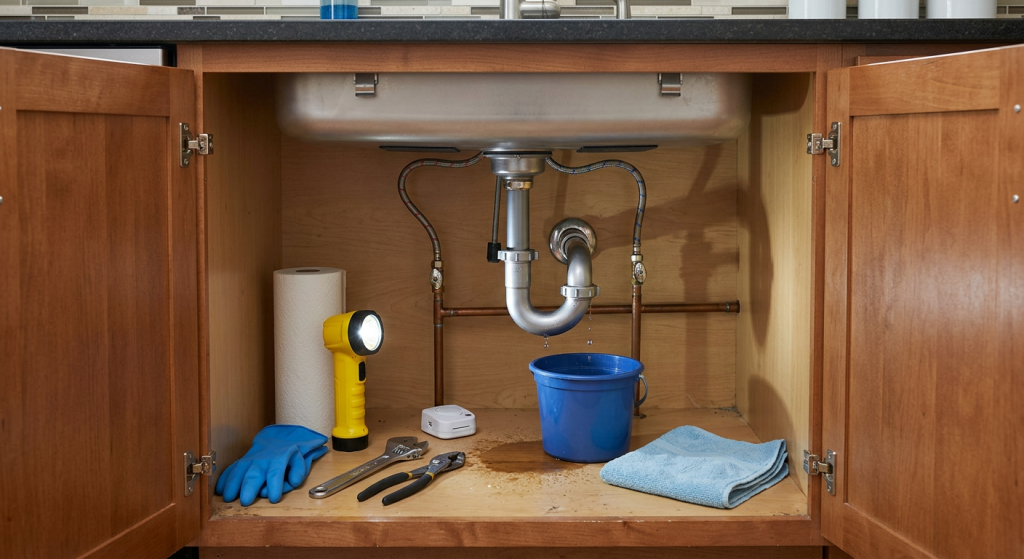
A leak under kitchen sink cabinets can come from the faucet supply lines, shutoff valves, faucet connections, drain pipes, P-trap, sink strainer, garbage disposal, dishwasher hose, or water tracking down from above. Remove stored items, dry everything thoroughly, then determine when the leak appears before tightening or disconnecting anything.
| When water appears | Likely places to check | First move |
|---|---|---|
| Faucet is running | Supply lines, faucet connections, sprayer hose | Watch for the first new drop |
| Sink is draining | P-trap, drain joints, strainer | Run water briefly and observe |
| Dishwasher is running | Drain hose or disposal connection | Inspect accessible hose connections |
| Nothing is being used | Supply lines, shutoff valves | Look for a slow pressurized leak |
| After splashing around sink | Faucet base, sink rim, countertop | Trace water from above |
Start by Drying Everything Under the Sink
An already-wet cabinet makes a kitchen sink leak difficult to trace. Water can spread across the cabinet floor, run along pipes, and drip several inches away from its actual source.
Remove cleaners, trash bins, and other stored items. Dry the cabinet floor and accessible plumbing surfaces with towels. Place a small container or fresh towel beneath an obvious drip if necessary, and use a flashlight to inspect the plumbing.
Once the area is dry, watch for the first place new moisture appears. Run the faucet only briefly while observing. If the leak is active or spreading quickly, stop using the sink rather than continuing the test.
Avoid tightening fittings simply because they look like possible sources. First determine whether the water appears while the faucet runs, while the sink drains, during dishwasher operation, or even when nothing is being used.
That timing is one of the fastest ways to narrow down the source.
Leak Under Kitchen Sink When the Faucet Is Running
If water appears as soon as you turn on the faucet, inspect the pressurized water-supply components and faucet connections first.
Use a flashlight to look at the hot and cold supply lines running between the shutoff valves and faucet. Check for visible moisture around the lines, valve connections, and the point where the lines connect to the faucet.
Also inspect the faucet shank and accessible connections beneath the faucet. If the faucet has a pull-out or side sprayer, check the visible sprayer hose and its connections.
Remember that the location of the drip may not be the location of the leak. Water can follow a supply tube or hose before falling onto the cabinet floor.
If moisture appears around a shutoff valve, do not automatically tighten or operate it. A corroded or deteriorated valve can begin leaking more severely when disturbed.
If you need to shut off the fixture but a valve is stuck, leaking, or badly corroded, do not force it. See Water Shut-Off Valve Won’t Turn: What Homeowners Should Know for the appropriate next steps.
A leak that continues when the faucet is off can also point toward a pressurized supply connection rather than a drain problem.
If the Leak Appears While the Sink Is Draining
When the cabinet stays dry while the faucet runs, but water appears as the sink drains, concentrate on the drain assembly.
Common places to inspect include:
- P-trap joints
- Slip-joint connections
- Drain tailpiece connections
- Sink strainer
- Garbage disposal connections, if present
Dry these areas first. Then run a modest amount of water and watch closely for the first sign of moisture.
Drain leaks often appear only when water is moving through the piping. A joint can therefore look completely dry when the sink is not being used.
The P-trap is the curved section of drain piping beneath the sink. Look around its connections for drops or a thin line of water traveling along the pipe.
Do not automatically tighten every slip-joint nut. Plastic fittings can be damaged by overtightening, and tightening the wrong connection does nothing to address the actual leak. If a joint is visibly damaged, badly misaligned, or continues leaking after basic inspection, it may need proper service rather than additional force.
Check the Sink Strainer
The sink strainer is another possible source when a kitchen sink is leaking underneath during draining.
The strainer passes through the sink and connects to the drain piping below. If water escapes around the strainer assembly, it may run down the drain components before dripping into the cabinet.
A strainer leak may become noticeable when the sink contains water or when a larger amount of water drains through it.
Watch the underside of the strainer while water is flowing. If the first moisture appears around the strainer body rather than a lower drain joint, the leak may originate there.
Do not start disassembling the strainer simply because the cabinet is wet. Confirming the source first avoids unnecessary plumbing work.
Water Around a Garbage Disposal
Water near a garbage disposal does not automatically mean the disposal itself has failed.
Several potential leak points are concentrated in that area, including:
- The sink flange above the disposal
- The dishwasher hose connection
- The drain connection
- The disposal body itself
Dry the exterior surfaces that you can safely reach, then observe where fresh water first appears.
If water begins at the sink flange and travels down the disposal, the leak may originate above the unit. If it appears at a drain or dishwasher connection, that connection may be the source. Water emerging from the disposal body itself is a different problem and may indicate that the unit needs professional evaluation or replacement.
Treat electricity as the priority. If water is near disposal wiring, an electrical outlet, plug, cord, or other electrical equipment, do not reach into or work in the wet area. Stop using the sink and disposal and obtain qualified help.
Do not remove electrical covers or attempt wiring work as part of leak diagnosis.
If Water Appears When the Dishwasher Runs
A dishwasher can send water into the sink cabinet even when the faucet and sink drain appear normal during ordinary use.
If the cabinet becomes wet during or shortly after a dishwasher cycle, inspect the accessible dishwasher drain hose and its connection under the sink. Depending on the installation, the hose may connect to a garbage disposal or another drain fitting.
Look for moisture around the hose and connection without disconnecting them.
Timing is especially useful here. A cabinet that remains completely dry during normal sink use but becomes wet during dishwasher operation gives you a strong reason to investigate the dishwasher-related plumbing.
Keep the diagnosis limited to accessible observations. Problems originating inside the dishwasher or requiring appliance disassembly belong outside a basic under-sink leak check.
If Water Appears When Nothing Is Being Used
Water under kitchen sink cabinets when no fixture is operating deserves prompt attention.
Drain components generally need water moving through them before they leak. Supply lines and their connections, however, remain under water pressure even when the faucet is off.
After drying everything, leave the faucet and dishwasher off and watch the supply lines, shutoff valves, and faucet connections. A slowly forming drop can reveal a pressurized leak that was difficult to spot while everything was already wet.
If a supply line shows cracking, corrosion, bulging, or other visible damage, stop using the fixture and arrange appropriate repair. Do not disconnect a damaged line unless you can reliably control the water supply.
If water is accumulating rapidly, stop using the sink. Close the fixture shutoff valves only if they operate normally and can be used safely. If necessary and safe, use the home’s main water shutoff to control an active leak.
Check Whether Water Is Actually Coming From Above
Sometimes the plumbing under the sink is not leaking at all.
Water can enter the cabinet from the faucet base, sink rim, countertop seam, or splashing around the sink. It may then track down the outside of the sink or faucet components and appear beneath the cabinet as though a pipe is leaking.
After drying the cabinet, inspect above the sink as well as below it. Think about what happened immediately before the water appeared.
Did someone wash dishes and splash water around the faucet? Does moisture appear after using a sprayer? Is water collecting around the faucet base or sink rim?
Tracing the wet path upward can prevent unnecessary work on perfectly sound drain and supply connections.
Follow the Water to Its Highest Wet Point
When the source remains unclear, follow moisture in the opposite direction from gravity.
Start at the drip and trace the wet surface upward. A drop falling from the bottom of a P-trap, for example, could have originated at a higher connection and traveled along the pipe.
Use a flashlight and a dry paper towel to help identify small amounts of fresh moisture. Briefly operating the suspected fixture can help, but stop once you have enough information to identify the source.
Do not keep running water simply to make a small leak easier to see. Prolonged testing can damage the cabinet and flooring.
Once the leak is addressed, monitoring can provide additional early warning in vulnerable locations. Water Leak Detector Placement: Where to Put Sensors explains where a sensor should sit so escaping water is likely to reach it.
Avoid Random Tightening and Unnecessary Disassembly
Finding water under the sink does not mean every fitting needs tightening.
Blindly tightening connections can damage plastic slip-joint nuts, disturb seals that were not leaking, or worsen problems with corroded components. The same caution applies to supply connections and shutoff valves.
Instead, identify the first place fresh water appears and determine whether it is associated with supply pressure, sink drainage, dishwasher operation, or water coming from above.
Do not force a stuck shutoff valve. Do not disconnect supply lines when you cannot reliably shut off the water. Avoid improvising repairs on visibly corroded or damaged plumbing components.
A few minutes spent tracing the source can prevent unnecessary work and make the next repair decision much clearer.
When to Call a Plumber
Call a qualified plumber if the leak is active and cannot be safely controlled, a shutoff valve will not operate normally, a supply line is damaged, or the source remains unclear after basic observation.
Professional help is also appropriate for badly corroded plumbing, repeated leaks, damaged drain components, or a problem that requires disassembly beyond ordinary homeowner troubleshooting.
If water is spreading toward disposal wiring, outlets, cords, powered appliances, or other electrical equipment, stay out of the wet area and obtain qualified help. Do not enter standing water near electrical equipment or attempt to work on energized components.
Final Thoughts
A leak under kitchen sink cabinets is easiest to diagnose when you dry the area first and identify exactly when fresh water appears. Faucet use points you toward supply and faucet connections, draining points toward the P-trap, strainer, and drain joints, and dishwasher operation can reveal a separate hose or connection problem.
Remember that water can travel along pipes, tubing, cabinets, and fixture surfaces before it drips. Trace the source before tightening or disconnecting anything, stop using the sink if the leak is spreading, and get qualified help when the water cannot be safely controlled or the source cannot be identified.