
Water Leak Detector Placement: Where to Put Sensors
Good water leak detector placement puts sensors near high-risk water sources and where leaking water is likely to collect first. Prioritize water heaters, washing machines, dishwashers, sinks, toilets, sump pump areas, refrigerators with water lines, and HVAC condensate equipment. Within each area, place the sensor in the likely water path rather than wherever it is easiest to hide.
| Priority location | Where to place the detector | Main leak risk |
|---|---|---|
| Water heater | Floor near the tank or drain pan | Tank, valve, or connection leak |
| Washing machine | Behind or beside machine near hoses and valves | Supply hose or connection |
| Dishwasher | At floor level where water escaping underneath will reach | Supply, drain, or appliance leak |
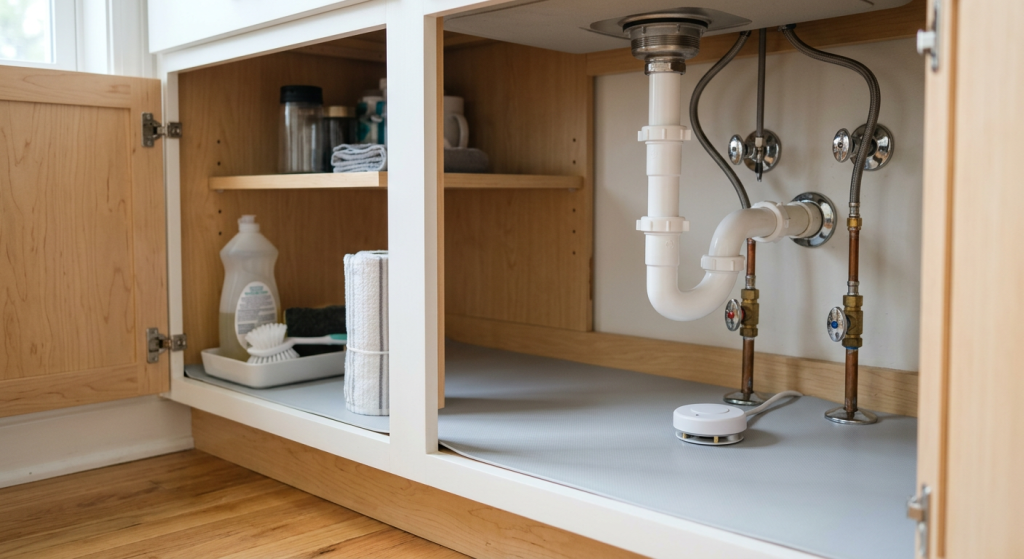
| Under sinks | Cabinet floor beneath supply and drain connections | Supply, faucet, or drain leak |
| Toilet | Behind or beside toilet near supply line and base | Supply or toilet leak |
| Sump area | Near the pit at a likely collection point | Overflow or pump problem |
| Refrigerator | Near water-line connection or likely water path | Supply-line leak |
| HVAC equipment | Near condensate drainage or collection area | Condensate overflow |
Where to Place Water Leak Detectors First
You do not necessarily need a detector beside every plumbing fixture. Start with locations where a leak could develop unnoticed or cause substantial damage before someone discovers it.
A water heater is usually a strong first priority because it stores a significant amount of water and often sits in a basement, utility room, garage, or closet where a leak may not be noticed immediately.
Washing machines and dishwashers also deserve early attention. Both combine water connections with appliances that can conceal leaks until water reaches the surrounding floor.
From there, consider sinks, toilets, sump pump areas, refrigerators with water lines, and HVAC condensate equipment. Your home’s layout should influence the final order. A rarely visited basement utility room, for example, may deserve more monitoring than a bathroom someone uses throughout the day.
The important question is not simply where to put water leak detectors, but where a small amount of escaping water will actually reach the sensing contacts.
Water Heater Placement
Place a detector on the floor near the water heater where leaking water would travel or collect. If the heater has a drain pan, position the sensing point according to the detector design so it can detect water associated with the pan or nearby floor without interfering with the equipment.
Look at the surrounding floor before choosing the exact spot. A slight slope may carry water away from the side of the heater you expected. Nearby walls, curbs, seams, or other barriers can also redirect it.
Keep the detector accessible enough to test, inspect, and replace its battery if applicable. Avoid wedging it somewhere that makes routine maintenance difficult.
If water is already present around a water heater, treat that as a leak to investigate rather than simply installing a detector and waiting for another alarm.
Washing Machine Placement
A washing machine detector should generally sit behind or beside the machine near the water-supply hoses and shutoff valves, provided the sensor can remain in the likely water path.
Consider where water would move if a hose, valve, or connection began leaking. Depending on the floor and appliance position, the best sensing point may be slightly beside the machine rather than directly behind it.
Do not position the detector where moving the washer, cleaning the floor, or storing laundry supplies will easily knock it away.
Accessibility matters here as well. A detector hidden so deeply behind the appliance that it cannot be tested is less useful, especially if it relies on a local audible alarm.
Dishwasher Placement
Dishwasher leaks can be difficult to spot because much of the appliance and its plumbing are concealed.
Place the detector at floor level where water escaping from beneath or around the dishwasher is likely to reach it. The exact position depends on the cabinet layout, flooring, and accessible openings around the appliance.
Do not dismantle cabinetry or the dishwasher simply to create a detector location. The goal is early detection from an accessible sensing point, not appliance disassembly.
Pay attention to barriers. Cabinet edges or flooring transitions may prevent a sensor several feet away from detecting a small leak until considerable water has accumulated.
Under-Sink Placement
Under kitchen and bathroom sinks, place the detector on the cabinet floor beneath or near the supply and drain connections. Look for the lowest practical point where water from a dripping connection, faucet supply, or drain assembly would collect.
Do not bury the detector behind cleaning products, trash bins, or stored items. Besides making the sensor difficult to inspect, stored objects can redirect water away from it.
If the cabinet floor is warped or slopes toward one corner, that low area may provide better warning than a visually centered position.
If you discover moisture rather than merely planning sensor placement, the next step is identifying the source. See Water Leaking Under Kitchen Sink: What to Check First for a focused troubleshooting guide.
Toilet Placement
Place a leak detector behind or beside the toilet where water from the supply connection or toilet area is likely to reach it.
The detector should remain out of normal foot traffic while still being accessible for testing. Avoid positioning it so far behind the toilet that you cannot inspect it or tell whether an alarm corresponds to an actual leak.
Also consider the floor. Water may follow grout lines, seams, or a slight slope instead of collecting immediately beside the toilet.
Water at the toilet base deserves investigation rather than repeated alarm resets. If you find moisture there, see Water Around Base of Toilet: What to Check Before Calling a Plumber for the appropriate checks.
Sump Pump and Basement Utility Areas
A basement can contain several potential water sources while receiving relatively little daily attention, making early detection especially useful.
Near a sump pump, position the detector where unexpected water escaping the pit or surrounding equipment would collect. Keep it far enough from normal incidental moisture that routine conditions do not repeatedly trigger false alarms.
Other basement plumbing may justify additional coverage depending on the home. Rather than scattering sensors evenly around the room, identify plumbing connections, equipment, floor low points, and likely water paths.
Do not place a detector in standing water or in a location where it interferes with the sump pump or other equipment.
Refrigerator Water-Line Placement
If your refrigerator has an ice maker or water dispenser, its supply line creates another potential leak point.
Place the sensor near an accessible supply-line connection or where water leaking behind the refrigerator is likely to emerge or collect. A probe-style detector can sometimes make it easier to put the sensing point in a confined area while leaving the main alarm unit accessible.
Avoid positioning a loose detector where moving the refrigerator could crush it, drag it out of position, or damage its cord or probe.
For audible-only detectors, consider whether you could actually hear an alarm from behind the refrigerator.
HVAC Condensate Placement
Air-conditioning and other HVAC equipment can produce condensate that must drain properly. Where appropriate, a water detector can provide warning if water appears where it normally should not.
Position the sensing point near a condensate drainage or collection area where unexpected water would become detectable, without blocking drains, interfering with equipment, or placing the detector inside equipment.
Normal configurations vary, so distinguish between water where it is designed to be contained and water escaping onto a surrounding floor.
If water is spreading toward electrical equipment, outlets, cords, or other energized components, do not enter the wet area to retrieve or reposition a detector. Keep away and obtain qualified help.
Follow the Water Path, Not Just the Plumbing
Good placement requires thinking about how water behaves after it escapes.
Gravity usually moves water toward the lowest available point, but floors and cabinets are rarely perfectly level. Even a subtle slope can send a leak in an unexpected direction.
Before settling on a sensor location, look for:
- Low points in floors or cabinets
- Flooring seams and transitions
- Drain pans
- Cabinet edges and walls that can redirect water
- Obstacles that could keep water from reaching the sensor
A detector sitting close to a pipe can still miss an early leak if the floor slopes away from it. Conversely, a sensor positioned slightly farther away at a natural collection point may sound sooner.
This is especially important in cabinets and utility areas. Do not choose a position merely because the detector is hidden there.
Basic and Smart Detectors Have Different Placement Needs
Basic water leak detectors typically sound an audible alarm when their sensing contacts encounter water. They need to be located where water will reach them, but the alarm also needs to be loud enough to alert someone.
Smart detectors may send notifications remotely, which can be useful in basements, utility rooms, vacation properties, or other locations where an audible alarm could go unnoticed.
Some detectors use remote probes or sensing cables. These can allow the actual sensing point to reach a low, narrow, or awkward location while the main unit remains accessible.
Whatever style you use, practical placement should account for battery replacement, testing, signal connectivity when required, and the manufacturer’s placement limitations. Do not sacrifice the likely water path merely to improve appearance.
Common Water Leak Detector Placement Mistakes
Even a working detector provides limited protection if water cannot reach it or no one responds to its alarm.
Common placement problems include:
- Putting the detector too far from the likely leak path
- Ignoring a floor or cabinet’s lowest point
- Burying the sensor beneath stored items
- Leaving it where feet, cleaning tools, or appliances can move it
- Positioning an audible alarm where it cannot reasonably be heard
- Forgetting routine testing or battery maintenance
- Resetting an alarm without finding out why it sounded
Occasional splashes or normal moisture can also cause nuisance alarms in some locations. If false alarms repeatedly occur, determine whether the detector can be moved slightly while remaining in the likely path of a genuine leak. Do not solve nuisance alarms by moving the sensor so far away that it loses its early-warning value.
Test detectors as directed for their design and replace batteries as needed. Periodically confirm that sensors have not been shifted by cleaning, storage, pets, or appliance movement.
What to Do When a Water Leak Detector Alarms
Treat an alarm as a reason to investigate, not simply a device that needs to be silenced.
Locate the detector and use a flashlight to inspect the surrounding area. If you can safely identify the source, check whether water is coming from a fixture, supply connection, drain, appliance, or nearby equipment.
If a fixture is leaking and its shutoff valve is readily accessible, functioning normally, and can be operated safely, shut off that fixture’s water supply. Do not force a valve that is stuck, corroded, or leaking.
Never step into standing water near outlets, power strips, electrical cords, appliances, or energized equipment. If water is spreading into an electrical area, stay out of the wet area and obtain qualified help.
After the situation is safe, investigate why the alarm occurred before drying and resetting the detector. A wet sensor is evidence to follow, not the problem itself.
If you cannot identify or safely control the leak, or water is spreading rapidly, get qualified plumbing or other appropriate professional help.
Final Thoughts
Effective water leak detector placement starts with high-risk water sources, but the final few inches matter. Put each sensing point where leaking water is most likely to travel or collect, accounting for slopes, low spots, seams, drain pans, cabinets, and other barriers.
Prioritize the locations that present the greatest risk in your particular home, keep detectors accessible for testing, and investigate every alarm. A well-placed sensor cannot prevent every leak, but it can provide valuable early warning before a hidden water problem becomes much larger.