
toilet Leaking at Base: what to check before calling a plumber
A toilet leaking at base does not automatically mean the wax ring or toilet-to-floor seal has failed. Water may come from the supply line, shutoff valve, tank, tank bolts, condensation, an overflow, or spilled water. Dry the toilet and floor completely first, then identify where fresh water appears before attempting any repair.
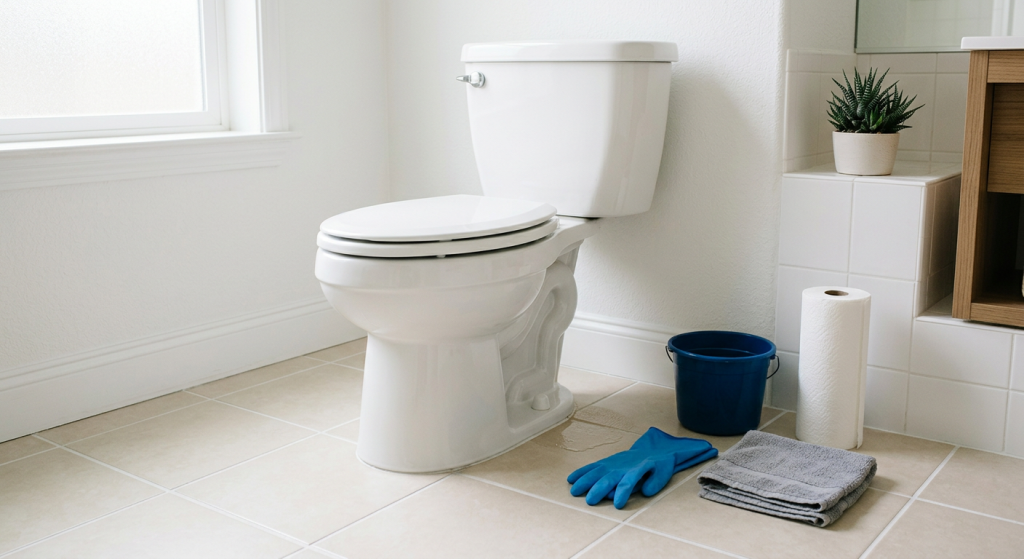
| Where water first appears | Possible source | What to check |
|---|---|---|
| Behind the toilet | Supply line or shutoff valve | Connections, valve, visible leaks |
| Higher on the toilet | Tank, bolts, or tank-to-bowl area | Trace moisture downward |
| Beneath toilet after flushing | Toilet-to-floor seal area | Stop use and assess other clues |
| Across tank or bowl exterior | Condensation | Look for broad surface moisture |
| Only after cleaning or overflow | Spilled water | Dry completely and monitor |
Dry the Toilet and Floor Before Diagnosing the Leak
Water can travel along porcelain, supply lines, and flooring before collecting around the bottom of the toilet. The wettest spot is not necessarily where the leak started.
Use towels to dry the floor around the toilet. Also dry the tank, underside of the tank, tank-to-bowl area, supply line, shutoff valve, and accessible exterior surfaces of the bowl.
If there is already substantial water on the floor, clean it up before troubleshooting. Keep children and pets away until you know whether the water is clean or potentially contaminated.
Once everything is dry, use a flashlight to look for the first new moisture.
Do not repeatedly flush an actively leaking toilet just to reproduce the problem. If you have already established that water emerges from beneath the toilet after flushing, additional testing can send more water into the flooring or the area below.
Check the Supply Line and Shutoff Valve
If moisture is concentrated behind the toilet, start with the water-supply components rather than assuming the base seal has failed.
Inspect the visible supply line between the shutoff valve and toilet tank. Look for:
- Drops forming on the supply line
- Moisture around either connection
- Visible cracking, corrosion, or damage
- Water around the shutoff valve
- Moisture at the tank supply connection
Water from these locations can run down the line, follow the toilet exterior, or spread across the floor until it collects around the base.
Trace moisture upward whenever possible. A puddle beside the toilet may have started several inches or even a few feet away.
Do not randomly tighten supply connections. If a connection is damaged or corroded, additional force can make the problem worse.
If the shutoff valve operates normally and an active leak needs to be controlled, it can be used to stop water to the toilet. Do not force a valve that is stuck, badly corroded, or leaking.
If the valve will not operate safely, see Water Shut-Off Valve Won’t Turn: What Homeowners Should Know before attempting further work.
Check Whether the Water Is Coming From the Tank
Water around base of toilet fixtures frequently appears to be a floor-level problem even when the leak begins higher up.
Dry the tank and surrounding surfaces, then inspect the underside of the tank and the seam where the tank meets the bowl.
Possible tank-area sources include:
- Tank bolt seals
- The tank-to-bowl gasket
- The water-supply connection
- Condensation on the tank exterior
- A crack in the tank
Follow any moisture to its highest wet point. Water can travel down the back or side of the toilet before reaching the floor.
If fresh water clearly starts around a tank bolt or tank seam, treat that as a tank-area problem rather than a toilet-to-floor seal problem. For that troubleshooting path, see Toilet Tank Leaking From Bolts: What Homeowners Should Know.
A visible crack in the tank is a stop condition. Stop using the toilet, shut off its water supply if the valve can be operated safely, and arrange qualified plumbing help rather than attempting to patch or manipulate cracked porcelain.
If Water Appears Only After Flushing
Timing provides an important clue when diagnosing a toilet base leak.
If the toilet and surrounding floor remain dry while the fixture sits unused, but fresh water repeatedly emerges from beneath the toilet after flushing, the toilet-to-floor seal becomes a stronger suspect.
That seal is commonly made with a wax ring or another toilet sealing system. Its job is to seal the connection between the toilet outlet and the drain opening below.
A compromised seal can allow water to escape beneath the fixture during a flush.
However, water appearing after a flush does not prove that the wax ring has failed. A tank-to-bowl leak, tank bolt leak, or other source higher on the fixture may also become active during flushing and then run downward.
That is why drying and tracing the water first matters.
If you have already confirmed that water is emerging from beneath the toilet, stop using the fixture rather than repeatedly flushing it to gather more evidence.
Check Whether the Toilet Rocks or Moves
A toilet should feel stable on the floor.
If it rocks, shifts, or moves when used, stop using it until the cause can be evaluated. Movement can interfere with the toilet-to-floor seal and may indicate a mounting, flange, flooring, or installation problem.
Do not try to diagnose a loose toilet by repeatedly rocking it.
Also avoid attempting to solve movement simply by aggressively tightening accessible hardware. Excessive force can damage porcelain, and movement may have a cause that tightening alone cannot correct.
A toilet that moves and also has recurring moisture at the base deserves prompt attention because continued use may allow additional water to reach the flooring.
Confirming the condition of the seal, flange, or mounting often requires removing the toilet. For most beginner homeowners, that is an appropriate point for professional service rather than a basic diagnostic step.
Signs the Toilet-to-Floor Seal May Be Involved
No single symptom confirms a failed wax ring or other toilet seal without further evaluation, but several clues together can make the seal area more suspicious.
These include:
- Water emerging from beneath the toilet after flushing
- Moisture returning after the toilet and floor have been dried
- A toilet that rocks or shifts
- Sewage odor around the toilet
- Staining or deterioration near the base
- Flooring that feels soft, swollen, or damaged
A toilet leaking from the bottom areas with these symptoms should not remain in normal use while you wait for the problem to become more obvious.
Replacing or confirming the condition of the toilet-to-floor seal generally requires removing the toilet. That work can also reveal problems with the flange or flooring that were hidden beneath the fixture.
This article is focused on identifying the likely leak source rather than providing a toilet-removal or wax-ring replacement procedure.
Consider Condensation Before Assuming There Is a Leak
A cold toilet tank can develop condensation when surrounding air is warm and humid. Moisture may form across the tank exterior, run downward, and eventually drip onto the floor.
The bowl exterior can sometimes collect moisture as well.
Condensation generally produces a broader pattern of dampness than a plumbing leak from one specific connection. If much of the tank exterior is covered with small droplets, trace that moisture downward before assuming water is escaping from beneath the toilet.
Dry the exterior and observe how the moisture returns.
Water that repeatedly emerges from beneath the toilet specifically after flushing is different from widespread moisture forming on exposed porcelain surfaces.
Rule Out Overflow, Cleaning Water, and Spills
Not every puddle beside a toilet comes from plumbing.
Think about what happened immediately before the water appeared. Recent causes can include:
- A toilet overflow
- Mopping the bathroom floor
- Cleaning the toilet
- Splashing or spilled water
- Condensation dripping from the fixture
Drying the toilet and floor completely is the easiest way to separate a one-time spill from recurring water leaking around the base of toilet fixtures.
If the floor remains dry after a spill has been cleaned up and the toilet otherwise operates normally, you may simply need to monitor the area.
If moisture returns without another spill, continue tracing the source.
An overflow deserves more caution, especially if water came from the toilet bowl. Do not assume that water is clean simply because the floor has been wiped up.
Treat Water From Beneath the Toilet Carefully
If water appears to be emerging from beneath the toilet after flushing, particularly if there is a sewage odor, treat it as potentially contaminated.
Stop using the toilet. Avoid bare-skin contact with the water, and wear suitable gloves for basic cleanup. Keep children and pets away from the affected area.
Do not continue flushing to see whether the leak happens again once the pattern is already clear.
Extensive contamination, water spreading into concealed areas, or sewage entering the room requires more than routine homeowner cleanup. Obtain appropriate professional help.
Also check the surrounding flooring from a safe, dry area. Softness, swelling, staining, or other deterioration may indicate that moisture has been present longer than the visible puddle suggests.
If water has reached a ceiling below the bathroom, stop using the toilet and arrange prompt professional evaluation.
Do Not Caulk Over an Active Toilet Base Leak
Caulk is not a repair for an unidentified leak beneath a toilet.
If water is emerging from under the fixture, sealing the visible edge does not correct a failed toilet seal, loose fixture, damaged flange, or another plumbing problem.
Caulking over an active leak may also make the escaping water less visible while moisture continues reaching the flooring.
Identify and repair the source first.
The same principle applies elsewhere on the toilet: do not use sealant, aggressive tightening, or improvised patches as substitutes for determining where the water originates.
When to Call a Plumber
Call a qualified plumber if water repeatedly emerges from beneath the toilet, the toilet rocks or shifts, or there is a sewage odor around the fixture.
Professional help is also appropriate when the flooring feels soft or damaged, water has reached the ceiling below, the tank or bowl is cracked, or the toilet’s shutoff valve cannot be operated safely.
If you cannot determine whether the moisture comes from the supply plumbing, tank, or toilet-to-floor connection, stop using the fixture when necessary and have the source identified before damage spreads.
A suspected toilet-to-floor seal problem commonly requires toilet removal for confirmation and repair. That is a reasonable professional handoff for a beginner homeowner.
Final Thoughts
When you find a toilet leaking at base level, do not assume the wax ring has failed. Dry the entire toilet and floor, then trace fresh moisture from the supply line, shutoff valve, tank, and tank-to-bowl area before deciding that water is actually emerging from beneath the fixture.
Water that repeatedly appears from under the toilet after flushing, sewage odor, toilet movement, or damaged flooring deserves prompt attention. Stop using the fixture when those warning signs appear, and do not hide an active leak with caulk or continue flushing a toilet that may be sending water beneath the floor.