
garbage disposal leaking from bottom: what it usually means
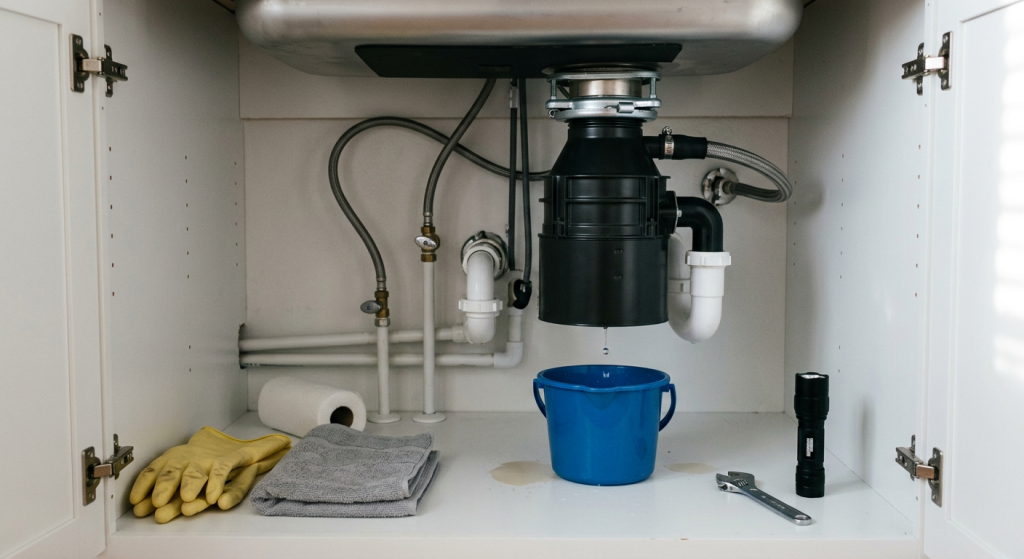
A garbage disposal leaking from bottom areas may have an internal seal or housing failure if water truly originates from the sealed lower body. Replacement is often more practical than opening or rebuilding that assembly. First, however, confirm the source. Water from the sink flange, mounting area, dishwasher connection, or discharge pipe can run down the disposal and make a higher leak look like a bottom leak.
Because a disposal combines water and electricity, stop using it and turn the wall switch off before inspecting the leak. Disconnect power before putting hands or tools beneath or near the unit. Never energize a disposal while it is wet or leaking.
| What Happens | What It May Suggest | Safe First Check | When to Stop |
|---|---|---|---|
| Completely silent | Power loss, reset, GFCI, breaker, or unit failure | Check safe power sources | Burning smell, damage, or repeated trips |
| Hums but does not spin | Jam or stalled motor | Turn it off immediately | Do not keep cycling the switch |
| Runs briefly, then stops | Overheating or overload | Let unit cool | Stop if problem repeats |
| Reset button will not stay in | Unresolved overload or internal problem | Do not force it | Stop repeated reset attempts |
| GFCI or breaker trips again | Electrical or appliance fault | Reset only once | Stop after another trip |
| Water is under sink | Leak and electrical risk | Do not operate disposal | Stop if water is near electrical parts |
| Switch sparks or feels hot | Electrical problem | Leave switch off | Do not open the switch box |
Start With Safety When a Garbage Disposal Is Not Turning On
A garbage disposal combines an electric motor with plumbing, so a no-power problem needs a cautious approach.
Turn the wall switch off before inspecting the disposal. Look beneath the sink for leaks, standing water, or moisture around the appliance and electrical components.
Keep your hands out of the disposal opening. Turning off the wall switch does not make reaching into the grinding chamber a safe troubleshooting method.
Do not touch a wet plug, outlet, cord, reset control, or wiring. Do not remove wiring covers or work on a hardwired connection.
If water is near electrical parts, stop. Do not press the reset button or turn the disposal on to see whether it still works.
First Determine Whether the Disposal Is Silent or Humming
The sound the disposal makes is one of the most useful clues.
A completely silent disposal may point toward:
- No electrical power
- A tripped disposal reset
- A tripped GFCI
- A tripped circuit breaker
- A switch problem
- An overheated motor
- A failed motor or other internal component
A disposal that hums is different. Humming generally indicates that power is reaching the unit but the motor is unable to turn normally.
If the disposal hums, switch it off immediately. Do not repeatedly cycle the switch, keep pressing the reset button, or reach into the disposal.
That symptom belongs on a separate troubleshooting path. Garbage Disposal Hums but Does Not Spin covers what to check next without treating the problem as a simple loss of power.
If the disposal is completely silent, continue with the safe power checks below.
Check the Wall Switch Without Opening It
Make sure the disposal’s wall switch is in its normal off position before inspecting anything beneath the sink.
Then consider whether the switch itself has shown unusual behavior.
Stop if the switch:
- Sparks
- Buzzes abnormally
- Smells burnt
- Feels unusually hot
- Feels physically loose or damaged
Do not remove the switch plate or open the electrical box to investigate.
This article does not require live voltage testing or access to household wiring. If the switch appears damaged or abnormal, leave it off and have the electrical problem evaluated.
If the switch appears normal, continue checking the accessible power sources.
Check the Plug if the Disposal Uses One
Some garbage disposals plug into an outlet beneath the sink. Others are hardwired.
Only inspect a cord-connected disposal when the cabinet, plug, outlet, and surrounding area are dry.
If safely accessible, confirm that the plug is seated normally in the outlet. Do not unplug and reconnect it repeatedly as a troubleshooting technique.
Never reach through standing water or around wet plumbing to touch a plug or receptacle.
If your disposal is hardwired, do not open the wiring compartment to check its connections. Hardwired electrical troubleshooting is outside the scope of beginner no-power checks.
Check for a Tripped GFCI
A disposal circuit may receive power through GFCI protection.
The relevant GFCI device is not necessarily directly beside the disposal. Depending on the home’s electrical arrangement, protection may be provided elsewhere on the circuit.
If you can identify an accessible GFCI that is associated with the disposal and the area is completely dry, check whether it has tripped.
Reset it once.
If power returns and the disposal operates normally, continue watching for abnormal behavior.
If the GFCI trips again, stop.
Repeatedly resetting a protective device does not solve the condition causing it to trip. Do not keep pressing the reset button in an attempt to make the disposal run.
Check the Circuit Breaker Once
If the garbage disposal still has no power and you can safely identify the correct circuit breaker, check whether it has tripped.
A tripped breaker may not always look dramatically different from the other breakers.
Reset the correctly identified breaker once if appropriate.
Do not remove the electrical panel cover or access wiring inside the panel.
If the breaker trips again when the disposal is used, stop troubleshooting. Repeated trips can indicate a problem with the appliance or electrical circuit that requires further diagnosis.
Do not repeatedly cycle the breaker to force a garbage disposal to operate.
Check the Garbage Disposal Reset Button
Many garbage disposals have an overload reset button on the unit.
Before checking it, make sure the wall switch is off, and the area beneath the sink is dry.
If the disposal recently stopped after heavy use or appears unusually warm, give it time to cool before attempting a reset. Thermal overload protection may have stopped the motor.
Once the unit has cooled, press the reset button once without forcing it.
Do not repeatedly press the button if the disposal still will not start or if the button will not remain set.
If the reset trips again, stop rather than continuing the reset-and-test cycle.
If the Disposal Stopped During Use
A garbage disposal that was operating normally and suddenly stopped may have overheated or encountered an overload.
Useful clues include:
- It stopped during heavy use
- The disposal feels unusually warm
- The reset button has tripped
- It works normally after cooling and one reset
A jam can also overload the motor and trigger its protection.
If the disposal begins humming rather than running normally, turn it off. Do not keep testing it.
Likewise, if the unit runs briefly and repeatedly stops, do not continue resetting it. A protective device that keeps activating is telling you the underlying condition has not been resolved.
A Jam Can Look Like a Power Problem
A jam does not always present the same way.
It may cause the disposal to hum, stop during operation, trip its overload protection, or appear dead after the protection has activated.
The important distinction is what happens after safe power and reset checks.
If the disposal hums when power is restored, treat it as a stalled or jammed-disposal symptom rather than continuing through no-power troubleshooting.
Do not reach into the disposal to search for an obstruction.
Also avoid repeatedly switching the motor on and off. A motor that cannot rotate normally can overheat or trip its protection again.
Jam-clearing procedures are separate from diagnosing why a completely silent disposal has no apparent power.
Water Under the Sink Changes the Troubleshooting
Before every electrical check beneath the sink, pay attention to moisture.
If water is leaking around the disposal or collecting near electrical equipment, do not press the reset button or test the appliance.
Do not touch a wet:
- Plug
- Outlet
- Cord
- Reset button
- Wiring connection
- Electrical cover
If power can be isolated safely without contacting wet equipment, leave the disposal de-energized.
A leaking disposal or plumbing connection needs to be addressed before routine electrical troubleshooting resumes.
If water is spreading toward other electrical equipment, stop using the sink and disposal until the situation can be made safe.
If the disposal itself is not clearly the source, Leak Under Kitchen Sink: What to Check First covers other common under-sink leak sources such as supply lines, shutoff valves, the P-trap, sink drain connections, and faucet plumbing.
Repeated Trips Mean Stop Resetting
A reset button, GFCI, or circuit breaker is a protective device, not a control that should need repeated resetting during normal operation.
Stop troubleshooting if:
- The disposal reset pops again
- The GFCI trips again
- The breaker trips again
Do not rotate through these devices repeatedly to see whether one eventually stays on.
Repeated trips may indicate an unresolved jam, overload, appliance fault, electrical problem, or another condition requiring diagnosis.
The same applies if the disposal repeatedly starts and then stops.
When the Garbage Disposal May Have Failed
A disposal that remains completely silent after reasonable, safe power checks may have an internal failure.
Possible warning signs include:
- No operation after power and reset checks
- Repeated protective-device trips
- Burning or overheated odor
- Visible damage
- Significant corrosion combined with other failure symptoms
- Abnormal behavior immediately before the disposal stopped working
These signs do not identify a specific failed internal component by themselves.
Do not open the motor housing or electrical compartment to determine which internal part failed.
Likewise, do not perform live voltage tests, disconnect hardwired leads, replace switches, or open receptacle boxes as an extension of these beginner checks.
At that point, the remaining diagnosis may require appliance or electrical testing beyond the scope of safe homeowner troubleshooting.
When to Call a Professional
Stop and get qualified help if the switch sparks, buzzes, smells burnt, or becomes unusually hot.
Professional diagnosis is also appropriate when a GFCI or breaker trips repeatedly, the disposal remains completely silent after safe basic checks, or the unit shows signs of internal failure.
If the disposal is hardwired and the problem appears electrical, do not open the connection yourself.
Water near electrical components, wet wiring, burning smells, visible electrical damage, or repeated protective-device trips are also reasons to leave the disposal off rather than continuing to test it.
Final Thoughts
A garbage disposal not turning on does not automatically mean the unit needs replacement. A tripped reset, lost power, GFCI trip, breaker trip, or temporary overheating can all leave a disposal completely silent.
Start by keeping the switch off, confirming the area is dry, and distinguishing a silent disposal from one that hums. Check only safely accessible power and reset points, and reset protective devices no more than once. If water is near electrical parts, the disposal hums, a protective device trips again, or you notice sparking, heat, burning odor, or damage, stop troubleshooting and leave the unit de-energized.