
Can You Plug an Air Conditioner Into an Extension Cord?
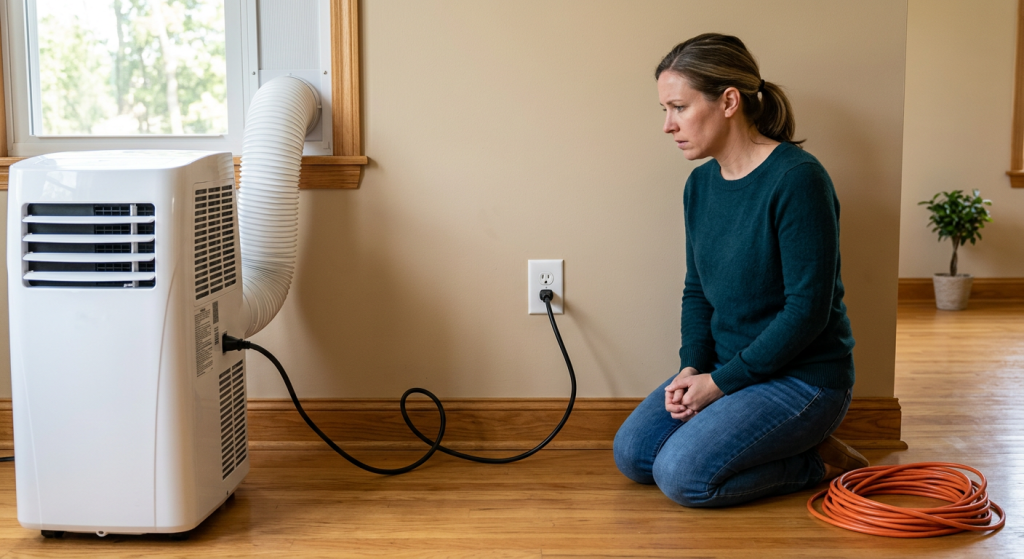
If you are asking, “can you plug an air conditioner into an extension cord,” the preferred setup is to plug the unit directly into a properly grounded wall receptacle that meets the manufacturer’s requirements. Air conditioners can draw substantial current, and an undersized, damaged, or overly long extension cord can overheat or cause voltage drop. If the manufacturer prohibits extension cords, do not use one.
| Situation | Recommended approach | Why |
|---|---|---|
| AC reaches a suitable grounded wall outlet | Plug it directly into the wall | Avoids extra cord and connection points |
| Manufacturer says no extension cord | Do not use one | Follow the appliance requirements |
| Manufacturer specifically permits one | Follow its exact cord requirements | Cord rating, grounding, and length matter |
| Ordinary household extension cord | Do not assume it is suitable | It may be undersized for the load |
| Power strip or surge protector | Do not use as a substitute for a proper outlet | It does not increase circuit capacity |
| Cord or plug becomes warm or hot | Stop using the setup | Overheating may indicate an unsafe condition |
| Plug or outlet discolors or melts | Stop using it | Electrical damage may be occurring |
| Breaker repeatedly trips | Stop resetting it | The circuit or appliance needs evaluation |
Safety First: Stop if the Cord, Plug, or Outlet Shows Warning Signs
Stop using the air conditioner setup if you notice a burning smell, smoke, sparks, buzzing, crackling, a hot plug, hot cord, hot receptacle, melted plastic, discoloration, damaged insulation, a loose plug connection, or repeated breaker or GFCI trips.
Do not remove or alter the air-conditioner plug, remove the grounding pin, use a three-to-two-prong adapter, bypass grounding or GFCI protection, splice a damaged extension cord, modify a receptacle, replace a breaker, install a larger breaker, open the electrical panel, test live voltage, or modify appliance wiring.
Do not repeatedly reset a breaker to keep the air conditioner running.
1. Why Direct-to-Wall Connection Is Usually Preferred
Room air conditioners use considerably more electrical power than many common household devices such as lamps, phone chargers, and small electronics.
Many units also contain a compressor, which can create additional electrical demand when it starts.
A direct wall connection eliminates several potential trouble points associated with an extension cord, including:
- An extra plug-and-receptacle connection
- Added electrical resistance
- Voltage drop through a long or undersized cord
- Damage to a temporary cord
- Accidental use of a cord not suitable for the appliance
Fewer connections also mean fewer places where a loose fit, damaged plug, or overheated contact can develop.
That is why plugging the air conditioner directly into a suitable grounded receptacle is generally the preferred arrangement.
2. Follow the Air Conditioner Manufacturer’s Instructions
The appliance manual and labeling should control the final decision.
Some room air-conditioner manufacturers specifically instruct users not to use extension cords. If your unit includes that restriction, follow it.
Do not assume that choosing a cord marketed as “heavy duty” overrides the appliance instructions.
If the manufacturer specifically allows an extension cord, follow its requirements for that particular unit. Those requirements may address:
- Electrical current or amperage rating
- Conductor size
- Grounding
- Cord type
- Maximum permitted length
There is no single extension-cord specification that can safely be applied to every air conditioner.
A small room AC and a larger unit may have very different electrical requirements. Portable and window units can also vary substantially from one model to another.
Check the appliance information rather than relying on a generic internet rule.
3. Why Ordinary Household Extension Cords Can Overheat
Extension cords have electrical limits.
A lightweight cord that works adequately for a lamp or small electronic device may not be suitable for the sustained load of an air conditioner.
Overheating risk can increase with:
- Thin conductors
- Excessive cord length
- Damaged insulation
- Loose plug connections
- A cord left tightly coiled during use
- Cords placed beneath rugs or furniture
- Multiple devices connected to the same cord
- A worn wall receptacle
Longer and smaller-conductor cords can also create greater voltage drop between the wall receptacle and the appliance.
That can affect appliance operation and add unnecessary stress to the electrical setup.
Do not assume that a particular cord gauge is universally acceptable for all air conditioners. If extension-cord use is permitted at all, the cord needs to satisfy the requirements for the specific appliance.
4. Do Not Use a Power Strip as a Substitute
A power strip does not increase the amount of electrical capacity available from the branch circuit.
Likewise, surge protection does not make an undersized or overloaded connection suitable for an air conditioner.
Do not plug a room air conditioner into a generic power strip simply because the strip has a convenient cord or additional outlets.
Adding more receptacles does not create more circuit capacity.
If you are comparing these devices for lower-load household electronics, the guide to surge protector vs power strip explains their different purposes.
For the air conditioner itself, follow the appliance manufacturer’s connection requirements.
5. Watch for Heat at the Plug, Cord, or Outlet
Heat is an important warning sign in an air-conditioner power connection.
Watch for:
- A plug becoming noticeably hot
- An extension cord becoming unusually warm or hot
- Heat at the wall receptacle
- Brown or black discoloration
- Melted or softened plastic
- A burning odor
- A plug that fits loosely
- Buzzing or crackling
Do not repeatedly touch electrical equipment to judge whether it is getting hotter.
If you notice obvious abnormal heat or another warning sign, stop using the setup rather than continuing to operate the AC to see whether the condition worsens.
A loose plug deserves particular attention. Poor contact can create additional resistance and heat at the connection.
Do not bend plug blades or attempt to adjust receptacle contacts to make the plug fit tighter.
6. What if the Air Conditioner Cannot Reach the Wall Outlet?
If the AC cord does not reach an appropriate receptacle, do not automatically solve the problem with whatever extension cord happens to be available.
Better options include:
- Choosing another appropriate installation location
- Having a properly located receptacle installed by a qualified electrician
- Checking whether the manufacturer specifically permits an extension cord and, if so, following its requirements exactly
Avoid improvised arrangements such as:
- Daisy-chaining extension cords
- Connecting multiple extension cords together
- Running the AC through a generic power strip
- Using grounding adapters
- Routing cords beneath rugs
- Running cords through walls
- Routing cords through doorways where they can be pinched
- Treating temporary wiring as a permanent substitute for a properly located outlet
If the appliance manufacturer requires a direct wall connection, the long-term solution is an appropriate receptacle location rather than a permanent extension cord.
7. Window AC vs. Portable AC
Do not assume the extension-cord decision can be made solely from the style of air conditioner.
Window units can draw substantial current, but portable units can as well. Many portable air conditioners also use compressors and have significant electrical requirements.
Through-wall units and other room-air-conditioning equipment can differ again.
The important information is the electrical requirement of the specific appliance, not whether it sits in a window or rolls across the floor.
A portable AC is not automatically safer to use with an extension cord simply because it can be moved around the room.
Check its labeling and manufacturer instructions the same way you would for a window unit.
8. What if the Breaker Keeps Tripping?
Repeated breaker trips are not a reason to try a larger power strip, different extension-cord arrangement, or larger breaker.
A breaker may trip because of:
- Circuit overload
- An appliance problem
- A cord or connection problem
- Another electrical fault on the circuit
Do not repeatedly reset the breaker to keep the air conditioner operating.
If the breaker keeps tripping, reduce the load and follow the appropriate beginner-safe troubleshooting steps for that symptom.
Do not increase the breaker size as a solution. Breaker sizing is part of the electrical system’s protection and should not be altered to accommodate an appliance.
9. When to Stop and Get Professional Help
Professional help is appropriate when the air-conditioner manufacturer requires a direct wall connection, but no suitable receptacle is available.
Have the setup evaluated when:
- The plug or receptacle becomes unusually hot.
- An extension cord becomes hot.
- A burning smell appears.
- Plastic becomes discolored or melted.
- Sparks, buzzing, or crackling occur.
- The plug fits loosely.
- A breaker or GFCI repeatedly trips.
- The receptacle appears damaged.
- Installing the AC properly would require adding or modifying electrical wiring.
A qualified electrician can determine whether the existing circuit and receptacle are appropriate and can install a properly located outlet when necessary.
Final Thoughts
If you are deciding whether to plug an air conditioner into an extension cord, start with the manufacturer’s instructions. Direct connection to a suitable grounded wall receptacle is generally the preferred setup, and an extension cord should not be used simply for convenience.
If the manufacturer specifically permits extension-cord use, follow its requirements for that appliance rather than relying on a generic “heavy-duty” cord. Stop using any setup that develops heat, burning odors, loose connections, electrical noise, visible damage, or repeated breaker trips.