polymeric sand vs regular sand for pavers
Choosing polymeric sand vs regular sand for pavers depends on the patio’s condition, joint design, drainage, and how much installation and maintenance work you want to manage. Polymeric sand generally creates firmer, more washout-resistant joints, while regular joint sand is easier to install, remove, and replenish.
Before changing materials, confirm that the pavers are stable and the sand is compatible with the paver type and joint dimensions. Joint sand should not be treated as a repair for rocking pavers, failed edges, major settlement, or recurring drainage problems.
| Paver situation | Better starting choice | Main caution |
|---|---|---|
| New interlocking paver patio | Polymeric sand, if approved | Installation must follow product requirements |
| Existing patio with stable regular sand | Regular joint sand | Periodic replenishment may be needed |
| Joints that wash out during rain | Polymeric sand | Correct concentrated runoff first |
| Wide or unusually narrow joints | Product-specific choice | Check the approved joint-width range |
| Permeable paver system | Approved open-graded joint material | Polymeric sand may interfere with drainage |
| Uneven or rocking pavers | Neither | Correct the underlying movement first |
| Patio with recurring drainage problems | Neither | Evaluate the water problem before changing sand |
Polymeric Sand vs Regular Sand for Pavers: The Quick Answer
Polymeric sand contains fine sand and binding additives that are activated with water according to the product label. Regular joint sand contains no binding polymer and remains loose.
When properly matched and installed, polymeric sand may offer better joint stability and resistance to washout, weed establishment, and insect excavation. Regular sand is simpler to install, refresh, and remove during repairs. The paver and sand manufacturers’ requirements take priority because neither material is suitable for every installation.
What Is Polymeric Sand?
Polymeric sand is swept into the joints and activated with water. Its additives bind the particles together, creating joints that remain flexible to varying degrees depending on the formula.
Products are made for specific joint widths, paver materials, and applications. Some are intended for standard concrete pavers, while others are designed for wider joints or compatible natural stone.
Polymeric sand is not concrete, mortar, or permanent glue. Incorrect installation can cause weak bonding, crusting, cloudy haze, or hardened residue on the paver faces.
What Is Regular Paver Sand?
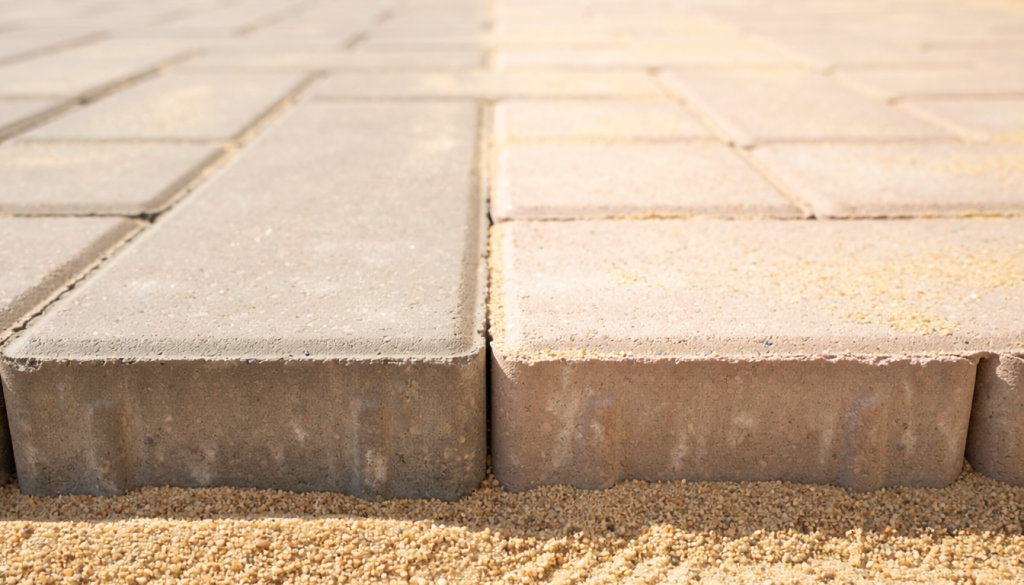
Regular joint sand fills the spaces between pavers without chemical binders. It supports the paver edges but may gradually be washed, blown, or carried out of the joints.
Because it stays loose, regular sand is easier to replenish and remove during repairs. It may be a practical choice for traditional installations and stable patios that have already performed well with it.
Bedding sand beneath the pavers is not automatically suitable as joint sand. Do not use play sand, masonry sand, or leftover material unless it is approved for the paver and joint system.
Polymeric Sand: Advantages and Disadvantages
Polymeric sand’s main benefit is improved joint stability. Properly bonded joints are generally less likely to wash out during normal rain, migrate onto the paver surface, or be excavated by insects.
It may also reduce spaces where weed seeds become established and can provide a cleaner finished appearance. In a suitable installation, less frequent replenishment may be needed.
The tradeoff is a more demanding installation. Pavers and joints must meet the product’s moisture, weather, and cleanliness requirements. Too much or too little activation water can cause poor bonding, erosion, or surface residue.
Moisture can activate material during installation or inside an opened bag. Repairs are also more difficult because hardened material may have to be removed before joints can be refilled. Polymeric sand is not weed-proof, ant-proof, waterproof, or maintenance-free.
Regular Sand: Advantages and Disadvantages
Regular joint sand is easier to work with because it does not require chemical activation. It can be swept into the joints, compacted or allowed to settle, and topped up as needed. It is also easier to remove when individual pavers require repair.
This simplicity makes regular sand a reasonable option for an existing, stable patio that already uses it successfully. Homeowners who expect future adjustments may also prefer a material that is easy to disturb and replace.
The main drawbacks are washout and maintenance. Loose sand can be displaced by runoff, wind, cleaning equipment, and insects. As joints lose material, sand may collect on the paver surface and the paver edges receive less support.
Joint Width and Paver Compatibility
Polymeric products have minimum and maximum joint-width requirements. Very narrow joints may not accept enough material, while unusually wide or deep joints may require a specialized formula.
Paver material, edge shape, and surface texture also affect suitability. Rough or porous surfaces can hold residue more easily.
Permeable paver systems often require an approved open-graded joint material that allows water to pass through. Do not substitute polymeric sand unless the system and product manufacturers specifically permit it.
Drainage and Moisture Considerations
Polymeric sand does not correct poor patio drainage. Standing water and frequently saturated joints can weaken some products, while regular sand may wash out where runoff is concentrated.
Water should drain away instead of repeatedly crossing the joints or moving toward the house. Recurring puddles, erosion, or base material appearing between the pavers should be evaluated before new joint material is installed.
Neither sand should be expected to stop all water infiltration.
Recurring puddles, concentrated runoff, erosion, or water moving toward the house may indicate broader patio drainage problems.
Weeds, Insects, and Ongoing Maintenance
Polymeric sand may reduce the loose spaces where weed seeds germinate and insects excavate, but it cannot permanently prevent either problem. Organic debris can collect on top of bonded joints and support new growth, while ants may enter through cracked, weak, or incompletely filled areas.
Regular sand is easier for insects to disturb and usually requires more frequent replenishment. Weed growth is often supported by soil, dust, and decaying material deposited in the joints rather than by plants growing upward from beneath the patio.
Regular sweeping and debris removal help with either material. Avoid aggressive cleaning methods that strip sand from the joints.
Installation Difficulty
Polymeric sand
Polymeric sand generally requires dry pavers and joints, suitable weather, and careful surface cleaning. The material must be placed below the paver surface as directed, and all residue must be removed before activation.
Watering and curing must follow the label. Wear eye protection, control dust, and prevent loose sand or activation runoff from entering storm drains, planting beds, or nearby surfaces.
Regular sand
Regular sand is usually swept into the joints and compacted or allowed to settle. Several passes may be needed to fill the joints evenly.
It does not require activation, but joints that remain shallow or uneven may provide inadequate support.
Risk of Polymeric Sand Haze
Polymeric residue left on paver faces can activate and form a cloudy film or hardened coating. Textured and porous pavers require extra care because fine particles can remain in surface depressions.
Clear the paver faces before watering without blowing or sweeping so aggressively that the joints are emptied.
Once haze has cured, follow the sand or paver manufacturer’s guidance. Extensive residue may require professional help. Do not experiment with strong cleaning chemicals that could stain or damage the surface.
Can Polymeric Sand Be Used Over Existing Regular Sand?
Applying a thin polymeric layer over shallow or contaminated regular sand may not create a stable joint. Loose material underneath can prevent proper bonding.
The patio should be stable and dry, and the joints must provide enough usable depth for the selected product. Existing sand may need to be removed according to the polymeric-sand manufacturer’s retrofit requirements.
Can Regular Sand Replace Polymeric Sand?
Regular sand may replace polymeric sand during a repair or complete joint replacement when the paver system permits it. Hardened polymeric material may need to be removed first.
Mixing loose regular sand with cracked or partially bonded residue can create uneven joints. Widespread failure or large amounts of hardened material are better handled by a paver professional.
Polymeric Sand vs Regular Sand Comparison
| Factor | Polymeric sand | Regular joint sand |
|---|---|---|
| Joint stability | Higher when properly installed | Lower; remains loose |
| Washout resistance | Generally better | More likely to wash out |
| Weed resistance | Reduces establishment | Debris can support growth |
| Insect disturbance | Harder to excavate | Easier to disturb |
| Installation difficulty | More demanding | Simpler |
| Repair ease | Harder to remove | Easier to remove |
| Weather sensitivity | High during installation | Lower |
| Maintenance | Usually less replenishment | More frequent topping up |
| Permeable-system suitability | Only when approved | Open-graded material may be required |
Choose Polymeric Sand When
Polymeric sand may be the better choice when:
- The paver and joint system permits it.
- Joint widths match the product.
- The patio is stable and drains properly.
- Washout or insect disturbance keeps returning.
- Activation and curing instructions can be followed closely.
- The surface can be cleaned thoroughly before watering.
Choose Regular Sand When
Regular joint sand may be the better choice when:
- The existing patio is stable and performs well with it.
- Easy future repairs are important.
- The system does not permit polymeric sand.
- A permeable installation requires open-graded joint material.
- Periodic replenishment is acceptable.
- Installation simplicity is a priority.
When Neither Sand Is the Right First Step
Have the patio evaluated before replacing joint material when you see:
- Loose, rocking, sinking, or heaving pavers.
- Failed edges or widespread movement.
- Recurring standing water or severe joint erosion.
- Base material rising through the joints.
- Water draining toward the house.
- Uncertain permeable-system requirements.
When only one or two units have settled or lifted, address the uneven patio pavers before replacing the joint material.
Common Joint-Sand Mistakes
Avoid these common errors:
- Using bedding, play, or leftover sand without approval.
- Installing polymeric sand in damp joints.
- Leaving polymeric residue on paver faces.
- Using incorrect activation water.
- Ignoring joint-width limits.
- Adding a thin polymeric layer over unstable sand.
- Using polymeric sand in an incompatible permeable system.
- Skipping required weather or curing conditions.
When to Contact a Professional
Contact a qualified paver contractor for large areas of loose or sunken pavers, failed patio edges, recurring drainage problems, severe erosion, or water moving toward the house.
Professional help is also appropriate for extensive polymeric haze, hardened failed material requiring widespread removal, base material pumping through joints, uncertain permeable-system requirements, or a large joint-replacement project.
Final Thoughts
Polymeric sand offers better joint stability and washout resistance when it is correctly matched to stable pavers and installed under suitable conditions. Regular sand is simpler to use, replenish, and remove during repairs.
Joint width, paver type, drainage, existing conditions, repair needs, and maintenance priorities determine the better choice. Address widespread movement, failed edges, or recurring drainage problems before selecting new joint material.