How Far Should Downspouts Extend From the House?
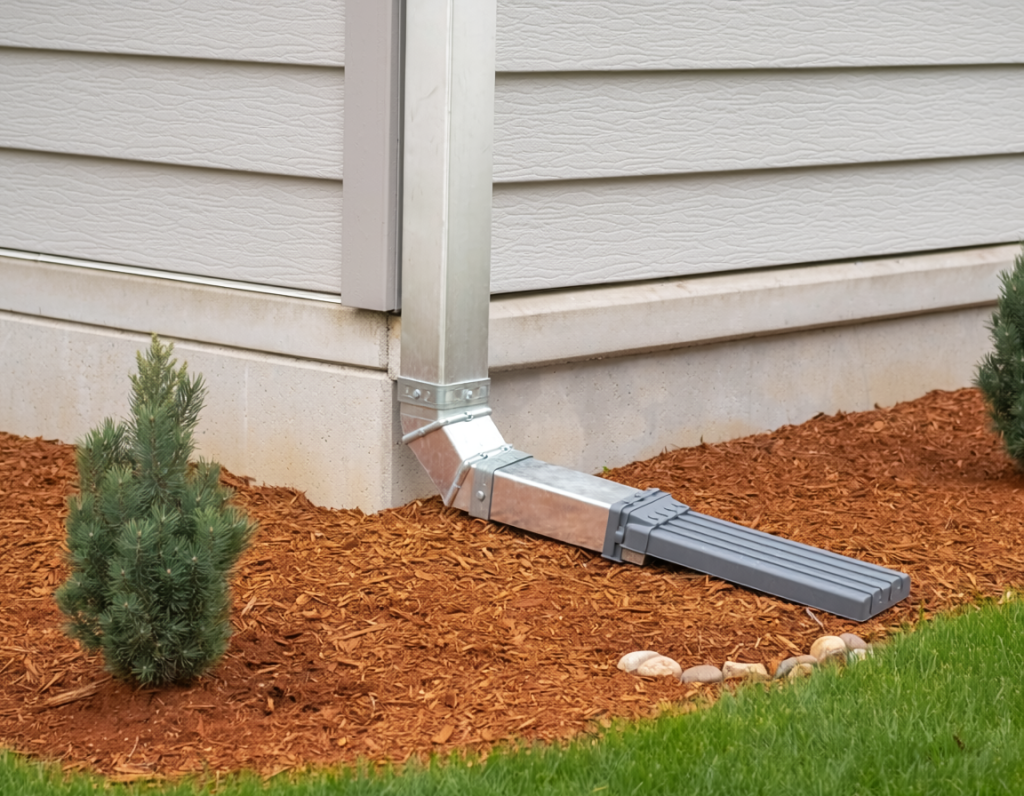
A practical answer to how far should downspouts extend from house foundations is usually about 4 to 6 feet as a starting point. That is not a universal code or guaranteed distance. The real goal is to release roof runoff where it will continue moving safely away from the foundation without pooling, flowing back toward the house, causing erosion, or creating problems elsewhere.
| Site Condition | Practical Starting Approach | Why |
|---|---|---|
| Yard slopes away | Several feet may be enough | Gravity continues moving runoff away |
| Flat yard | A longer extension may be needed | Water can stop and pool near the outlet |
| Ground slopes toward house | Extension alone may not solve the problem | Runoff can travel back toward the foundation |
| Clay-heavy or slow-draining soil | More distance may be helpful | Water may remain near the surface longer |
| Well-drained soil | A moderate extension may work | Water can infiltrate more readily |
| Large roof drainage area | Give runoff more room to disperse | One downspout may handle substantial water |
| Walkway or driveway near outlet | Redirect to a safer discharge area | Runoff can create puddles, erosion, or ice |
A Practical Starting Distance
For many homes, extending a downspout roughly 4 to 6 feet from the foundation is a reasonable place to begin. The number is useful as a starting point, but it should not be treated as a universal requirement.
The better question is whether the extension reaches ground where runoff continues moving away from the house. A four-foot extension that empties onto a steady downhill slope may work better than an eight-foot extension that ends in a depression where water collects.
When weather conditions are safe, observe the outlet during moderate rainfall. Water should leave the extension and continue away instead of turning back toward the wall, forming a persistent puddle, or saturating the same small area.
Avoid inspecting drainage during lightning, heavy runoff, flooding, or when walking surfaces are slippery.
Why Downspout Distance Matters
A gutter collects rain from a relatively large section of roof and concentrates that water into one or more downspouts. That means a surprisingly large amount of runoff may leave through a small discharge point.
If that water is released immediately beside the house, the nearby soil may become repeatedly saturated. Depending on the property, this can contribute to damp soil along the foundation, erosion, muddy planting beds, standing water, or moisture problems around a basement or crawl space.
Moving the discharge farther away reduces the amount of concentrated roof runoff released directly beside the foundation. However, downspout distance alone does not cause or solve every basement or crawl-space moisture problem. Grading, soil, drainage systems, construction details, groundwater, and other conditions may also matter.
The discharge location must work as part of the entire drainage path.
How Grading Changes the Answer
Ground slope is one of the most important factors in deciding whether a downspout extension is long enough.
When the yard slopes steadily away from the foundation, runoff has a natural path after it leaves the extension. Once water reaches that outward slope, gravity continues carrying it farther from the house. A relatively modest extension may therefore work well.
Flat ground behaves differently. Water may leave the extension successfully and then stop near the outlet because there is little slope to move it farther away. Inward-sloping ground can be more troublesome because runoff may travel back toward the house.
This is why simply adding more extension does not always solve a drainage problem. Adding several feet of pipe may only move the puddle several feet farther from the wall.
Look beyond the end of the extension. The receiving ground should provide a continuing path away rather than a basin that collects water and allows it to migrate back toward the foundation.
Major grading changes are outside the scope of a simple downspout-extension adjustment and may need professional evaluation.
How Soil Type Changes the Answer
Soil affects how quickly discharged water can move into the ground.
Clay-heavy soil often drains slowly, especially after prolonged rainfall. Water may remain near the surface, spread laterally, or form puddles. On a flat property with slow-draining soil, a longer discharge route may be useful because releasing large amounts of roof runoff close to the house can repeatedly saturate the same area.
Sandy or otherwise well-drained soil generally allows water to infiltrate more readily. When that soil is combined with good outward grading, a moderate extension may perform adequately.
Do not rely only on how the soil looks when it is dry. Conditions can change significantly after repeated or heavy rain. The most useful test is what actually happens at the outlet and surrounding ground during and after storms.
If the area remains soggy long after nearby sections of the yard have drained, the discharge location may need improvement even if the extension already reaches several feet from the house.
How Roof Size and Runoff Volume Matter
Not every downspout handles the same amount of water.
One downspout may serve a relatively small roof area, while another receives runoff from several roof sections. Roof geometry, gutter layout, storm intensity, and the amount of roof feeding a particular gutter run can all change how much water reaches one discharge point.
A large volume of runoff can overwhelm a poorly drained patch of soil even when the extension is four, six, or more feet long. Watch whether the outlet creates a fast-moving stream, washes mulch or soil away, forms a large puddle, or sends water across nearby pavement.
If the gutter itself is filling or overflowing before the water reaches the downspout, that is a separate gutter-system issue. This article is focused on where water goes after it successfully reaches the downspout.
Splash Blocks Versus Extensions
Splash blocks and downspout extensions both help manage discharge, but they do different jobs.
A splash block sits beneath the downspout outlet. It helps prevent concentrated water from eroding the soil immediately below the opening and can direct runoff slightly farther away. A splash block works best where the surrounding ground already slopes away effectively.
On a flat yard, slow-draining soil, or a location with recurring moisture beside the foundation, a short splash block may not provide enough separation. Water can simply flow off its end and collect nearby.
A downspout extension physically carries water farther before releasing it. That makes an extension more useful when the area immediately beside the house is not a suitable discharge location.
For more detail on when a shorter surface option makes sense, see splash blocks for downspouts.
Whichever method is used, the outlet should direct water away rather than allowing it to return toward the wall.
Above-Ground Extensions Versus Buried Drainage
Above-ground downspout extensions are usually easy to evaluate because the entire drainage path remains visible. You can see where the water exits, whether the extension has moved, and whether it has been crushed or disconnected.
They also have practical drawbacks. Long surface extensions may interfere with mowing, landscaping, foot traffic, or access around the home. Flexible sections can move during yard work or storms, and poorly placed extensions can become trip hazards.
Buried drainage can carry water farther without leaving a pipe across the lawn, but it requires more planning. Proper slope, outlet location, drainage capacity, soil conditions, and underground utilities all matter. Buried systems can also develop hidden blockages or damaged sections that are more difficult to diagnose.
This is not a trenching or buried-pipe installation guide. Do not begin excavation or underground drainage work without following required utility-location procedures and understanding where the system can safely discharge.
If the problem is that water backs up instead of moving through the downspout or connected drain, see the separate guide on a downspout not draining.
Signs the Current Extension Is Too Short or Poorly Located
An existing extension may need attention when you notice:
- Water pooling beside the foundation
- Runoff moving back toward the house
- Persistent soggy soil near the wall
- Soil or mulch erosion near the outlet
- A puddle repeatedly forming at the end of the extension
- Basement or crawl-space moisture that worsens after rainfall
- Runoff crossing a walkway
- Water flowing across a driveway
- Ice forming in walking or driving areas during freezing weather
- The extension ending in a visible depression or low spot
A puddle several feet from the house can still indicate an inadequate drainage path. Moving water away from the foundation helps, but collecting it in a new low spot does not fully solve the problem.
How to Evaluate the Extension During Rain
The best way to judge downspout performance is to observe where the runoff actually goes.
From a safe location during ordinary rainfall, look at the point where water exits the extension. Does it continue away from the house, or does it stop immediately and form a puddle?
Watch whether water begins flowing back toward the foundation as the soil becomes saturated. Look for soil or mulch being washed away, especially below a high-volume downspout.
Also check whether runoff crosses sidewalks, driveways, steps, gates, or other traffic areas. A drainage route that keeps water away from the foundation but creates a slipping or winter icing hazard needs improvement.
Consider the combined effect of nearby downspouts as well. Several outlets may individually appear reasonable but still discharge enough water into one part of the yard to overwhelm the area.
You do not need to stand in heavy runoff or inspect the system during dangerous weather. The goal is simply to understand whether the current discharge location continues carrying water away after it leaves the extension.
Common Mistakes
A common mistake is treating four feet, six feet, or any other distance as a universal rule. The number matters less than where the water goes after reaching that point.
Other mistakes include:
- Ending the extension in a depression
- Discharging onto ground that slopes toward the house
- Assuming a splash block will solve significant pooling
- Directing runoff across a frequently used walkway
- Allowing water to create driveway icing
- Sending runoff toward neighboring property
- Continually adding pipe without addressing poor grading or drainage
- Ignoring a crushed or disconnected extension
- Creating an unnecessary trip hazard
- Assuming that moving a puddle farther from the house means the drainage problem is solved
Check removable and flexible extensions periodically because they can shift during mowing, landscaping, storms, or routine yard work.
When to Call a Drainage Professional
Professional evaluation is worthwhile when water continues pooling even with a reasonably long extension, the yard slopes toward the house, several downspouts overwhelm the same area, or erosion is significant.
Help may also be appropriate when basement or crawl-space moisture persists, there is no obvious safe discharge point, drainage changes could affect neighboring property, buried drainage appears necessary, or major grading work may be required.
An existing underground system that backs up or fails to discharge properly also deserves further evaluation rather than repeatedly adding surface extensions.
A drainage professional can look at the property as a complete system and consider roof runoff, grading, soil conditions, outlets, property boundaries, and existing drainage together.
Final Thoughts
For many homes, about 4 to 6 feet is a practical starting point when deciding how far a downspout should extend, but it is not an absolute rule.
The discharge location matters more than the number alone. Water should leave the extension and continue moving safely away without pooling, flowing back toward the foundation, causing erosion, or creating hazards elsewhere.
Watch the system during safe rainfall conditions. If water simply collects at the new outlet, the drainage path still needs improvement rather than more distance alone.