
do gutter guards cause ice dams?
Do gutter guards cause ice dams? Usually, no. A true ice dam normally starts when heat escaping from the home warms part of the roof, melts snow, and sends water toward a colder roof edge where it refreezes. Gutter guards generally do not create that uneven roof temperature.
However, a gutter guard can contribute to winter icing if it traps snow, slush, or debris or restricts meltwater from reaching the gutter and downspout. That can make ice around the eaves more noticeable and, in some cases, worsen drainage behind an existing ice dam.
Do not climb onto an icy roof or use an unstable ladder to investigate. Avoid standing beneath heavy icicles or hanging ice, and never chip roof ice with hammers or sharp tools, use an open flame, or pour corrosive chemicals onto shingles or gutters.
| What you see | More likely explanation | Role of gutter guard |
|---|---|---|
| Ice only inside gutter | Trapped water or frozen outlet | May contribute to restricted drainage |
| Thick ice ridge along roof edge | Snowmelt refreezing at a colder eave | Usually secondary, not the root cause |
| Icicles hanging from guard | Meltwater freezing at the edge | May affect where water drips and freezes |
| Water backing up behind frozen debris | Blocked drainage path | Guard or debris may be contributing |
| Ice concentrated at one downspout | Blocked or frozen outlet | Drainage problem is more likely |
| Repeated ice dams after snowstorms | Uneven roof temperature and recurring snowmelt | Guard may worsen symptoms but is unlikely to be the main cause |
Do Gutter Guards Actually Cause Ice Dams?
Most gutter guards do not cause the condition that starts a classic roof ice dam.
The more important issue is what is happening higher on the roof. If heat from the house warms the roof deck while the outdoor temperature is below freezing, snow can melt on the warmer section. That water runs downward until it reaches a colder eave or roof overhang, where it freezes. Repeated melting and freezing can build a ridge of ice that blocks later meltwater.
A gutter guard sits near the end of that drainage path. Depending on its design and condition, it can change how snow, slush, debris, and meltwater behave at the gutter edge. It may therefore make an icing problem worse without being the original cause.
What Creates a True Ice Dam
A true ice dam is a ridge of ice near the lower edge of a roof that prevents water from draining normally. Meltwater can collect behind the ridge and potentially work beneath roofing materials, leading to leaks or moisture damage.
The usual sequence is:
- Heat from the home reaches the attic or roof assembly.
- Part of the snow-covered roof becomes warm enough for snow to melt.
- Meltwater travels toward the eave.
- The colder roof overhang causes that water to refreeze.
- Repeated cycles build an ice ridge that can hold back additional water.
Poor attic air sealing and inadequate insulation can allow too much heat to reach the roof deck. Improving those conditions can reduce the heat loss associated with ice-dam formation.
That is why replacing a gutter guard may change the icing you see at the gutter but still leave the underlying ice-dam problem intact.
For a broader prevention guide focused on attic heat loss, air leakage, insulation, and roof-edge refreezing, see how to prevent ice dams.
Gutter Icing Versus Roof Ice Dams
Not every frozen gutter is an ice dam.
A gutter can fill with ice because water reached it and could not drain before temperatures dropped. A clogged downspout, frozen outlet, debris buildup, poor gutter pitch, or a localized drainage restriction can leave water sitting in the gutter. That water may freeze into a solid mass without a large ridge of ice forming on the roof itself. Keeping gutters and downspouts clear helps meltwater drain instead of remaining trapped.
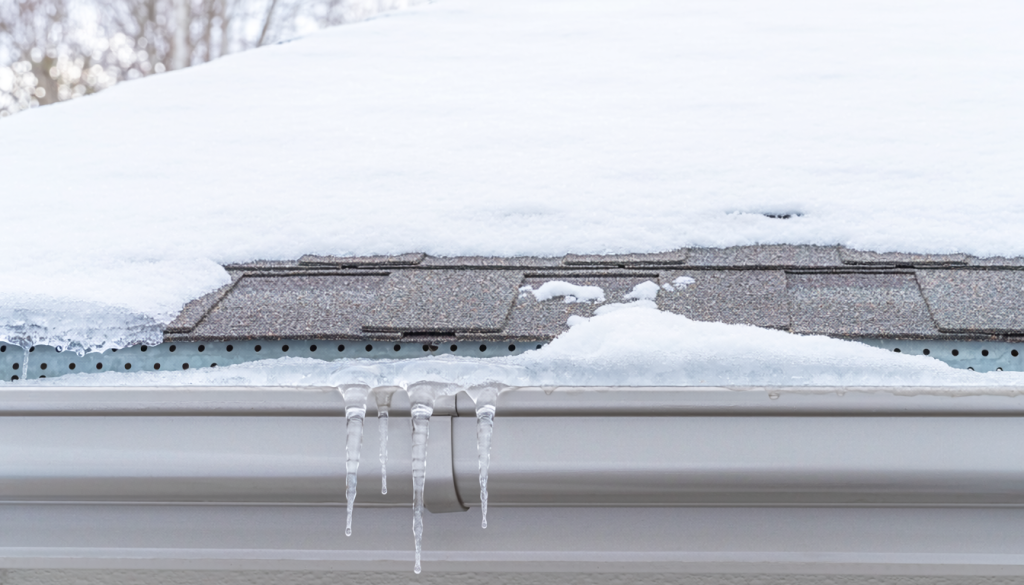
Icicles are also not proof of a true ice dam. They show that liquid water reached a cold edge and froze as it dripped. That may accompany an ice dam, but it can also occur around a gutter or guard that is simply icing over.
A thick ridge extending onto the roof edge, especially when snow remains higher on the roof and water appears to collect behind the ridge, is more consistent with classic ice damming.
How Gutter Guards Can Contribute Indirectly
Gutter guards become more relevant when they interfere with winter drainage.
Snow can collect on top of some guards instead of falling into the gutter. During a thaw, that snow may turn to slush and water. If the guard openings are frozen, covered with debris, or blocked by compacted snow, meltwater may move slowly, run over the gutter edge, or refreeze across the guard.
Debris can cause a similar problem. Leaves, needles, seed material, and fine organic debris may accumulate on or within a guard. Once wet and frozen, that material can restrict the route into the gutter.
A guard can therefore contribute when it creates a bottleneck at an already cold part of the roof. It still does not explain why large amounts of snow are repeatedly melting on an otherwise freezing roof.
How Different Guard Types Behave in Winter
Guard design affects where snow and ice can collect, but no type is automatically responsible for an ice dam.
- Reverse-curve guards: Water follows a solid curved surface into the gutter. Snow or ice can cover the exposed surface, and freezing at the edge may temporarily affect drainage.
- Mesh guards: Openings allow water through while excluding larger debris. Snow, frozen debris, or surface ice can cover those openings during winter weather.
- Micro-mesh guards: Very small openings block finer material, but a layer of slush, frost, or debris on the surface may reduce how quickly meltwater enters the gutter.
- Brush guards: Bristles occupy the gutter while leaving spaces for water. Snow and debris can collect among the bristles, so winter performance depends partly on whether a usable drainage path remains.
- Foam guards: Porous foam fills much of the gutter channel and is intended to let water pass through. Debris or frozen material on or within the exposed surface can still affect drainage under some conditions.
The useful question is not simply which guard type you own. Look at whether water appears able to reach an open gutter outlet when temperatures rise.
For a broader comparison of the main designs, see our guide to gutter guard types for homeowners.
Why Blocked Drainage Makes Icing Worse
Even a properly functioning roof drainage system has limited value if meltwater cannot exit.
A downspout packed with debris or frozen near its inlet can cause water to remain in the gutter. Incorrect gutter pitch can also leave low spots where water collects instead of moving toward the outlet.
If a guard is covered with frozen debris at the same time, the restriction can occur both above and below the gutter opening. The result may be a large amount of visible gutter ice even when the roof does not have a classic ice dam.
This is especially worth suspecting when the worst ice consistently appears around one downspout rather than across a long section of the eave.
Signs the Guard System May Be Part of the Problem
The guard deserves closer attention when you can see a clear connection between its condition and the icing pattern.
Possible signs include:
- Ice forming mainly across the guard surface rather than farther up the roof.
- Leaves or other debris visibly covering guard openings.
- Meltwater flowing over the front edge while nearby sections drain normally.
- Heavy icing limited to a particular guarded section.
- Water backing up immediately behind frozen debris on the guard.
- A recurring problem that began after a guard was installed or changed, especially if drainage was previously better.
These signs do not prove the guard is the only cause. If thick roof-edge dams recur after substantial snow, attic heat loss and roof temperature differences still deserve evaluation.
Removing or replacing the guards may be reasonable if a roofing or gutter professional confirms that their design, condition, or installation is restricting drainage. Changing guards alone should not be expected to correct attic air leakage or inadequate insulation.
What Homeowners Can Safely Observe From the Ground
For a beginner homeowner, keep winter diagnosis at ground level. A clear view from a safe location can provide useful information without exposing you to an icy roof or ladder.
Look for:
- Whether the ice is confined to the gutter or extends onto the roof.
- Whether icicles occur everywhere or mainly near one outlet.
- Visible leaves, needles, or snow covering the guard surface.
- Water spilling over one section during a daytime thaw.
- Sections of gutter that appear unusually low or sagging.
- Uneven snow patterns, such as snow repeatedly disappearing from an upper roof area while remaining near colder edges.
Use binoculars or a camera zoom if necessary, but remain well away from areas where ice could fall. Do not stand beneath large icicles to inspect them.
Common Mistakes
One common mistake is assuming that any ice touching a gutter guard proves the guard caused the problem. Winter icing can reveal several different drainage and roof-temperature conditions.
Other mistakes include:
- Treating icicles alone as proof of an ice dam.
- Replacing gutter guards without investigating repeated roof snowmelt.
- Ignoring a clogged or frozen downspout because the gutter itself looks clear.
- Trying to break ice loose with hammers, axes, screwdrivers, or other sharp tools.
- Climbing a ladder or walking on the roof to inspect a frozen guard.
- Assuming that removing guards will correct poor attic air sealing or insulation.
Focus first on identifying whether you are seeing gutter icing, restricted drainage, or a genuine roof-edge ice dam.
When to Call a Professional
Call a roofing professional if ice extends onto the roof, water is leaking indoors, shingles or gutters appear damaged, or substantial ice dams repeatedly develop after snowstorms. A roofer can evaluate the roof edge, drainage system, and how the guards interact with the gutter without requiring you to access an icy roof.
If the pattern suggests excessive heat reaching the roof, an insulation or home-energy professional can evaluate attic air sealing and insulation. These conditions generally matter more to recurring true ice dams than the presence of a gutter guard itself.
A gutter professional may be appropriate when icing is concentrated around blocked outlets, improperly pitched gutters, damaged sections, or a guard system that appears to obstruct drainage.
Final Thoughts
Gutter guards can sometimes worsen winter icing by trapping snow, slush, debris, or restricting drainage, but they usually do not create the heat-loss condition behind a true ice dam. Recurring roof-edge dams point more strongly toward uneven roof temperatures, snowmelt, and refreezing at the colder eaves.
If the ice is limited to the gutter or one downspout, investigate drainage as the likely issue. If thick ice repeatedly builds along the roof edge, have the roof and attic conditions evaluated before assuming that changing the gutter guards will solve the problem.