best lawn sprinkler
The best lawn sprinkler is the one that matches your lawn’s size and shape while working well with the water pressure available at your outdoor faucet. A small rectangular lawn may be easy to cover with an oscillating sprinkler, while a large open yard may be better suited to an impact or rotary design.
Do not choose by advertised coverage alone. Real-world performance changes with water pressure, hose length and diameter, elevation, wind, and sprinkler design, so a smaller adjustable sprinkler that covers the lawn accurately can be more useful than an oversized one that constantly waters pavement.
| Yard situation | Best sprinkler type | Why |
|---|---|---|
| Small rectangular lawn | Oscillating | Rectangular pattern is easy to match to the lawn |
| Large rectangular lawn | Large oscillating or repositioned sprinkler | Provides controllable coverage without excessive overspray |
| Irregular lawn | Adjustable rotary or multiple placements | Pattern can be matched more closely to separate areas |
| Narrow strip | Adjustable or stationary sprinkler | Limits water outside the turf |
| Low water pressure | Low-pressure-friendly sprinkler | Reduced pressure can limit range and pattern quality |
| Large open area | Impact or rotary | Circular coverage suits broad open spaces |
| Small patch or targeted area | Stationary sprinkler | Simple, localized watering |
What Makes a Lawn Sprinkler a Good Fit?
Start with the lawn rather than the sprinkler.
Measure or estimate the areas that actually need water and pay attention to their shape. A 2,000-square-foot rectangle and a 2,000-square-foot lawn wrapped around a patio may need very different sprinkler setups.
Consider:
- Lawn size
- Lawn shape
- Available water pressure
- Hose length
- Obstacles such as trees and play equipment
- Nearby sidewalks and driveways
- How often you expect to move the sprinkler
- Storage space
- How much adjustment you actually need
Coverage numbers on packaging are useful for comparison, but they should not be treated as guarantees. Water pressure and flow affect sprinkler performance, and excessive pressure can also contribute to misting or inefficient spray patterns in some sprinkler systems.
The goal is not maximum reach. It is reasonably even coverage of the grass with as little wasted spray as practical.
Best Sprinkler for Small Lawns
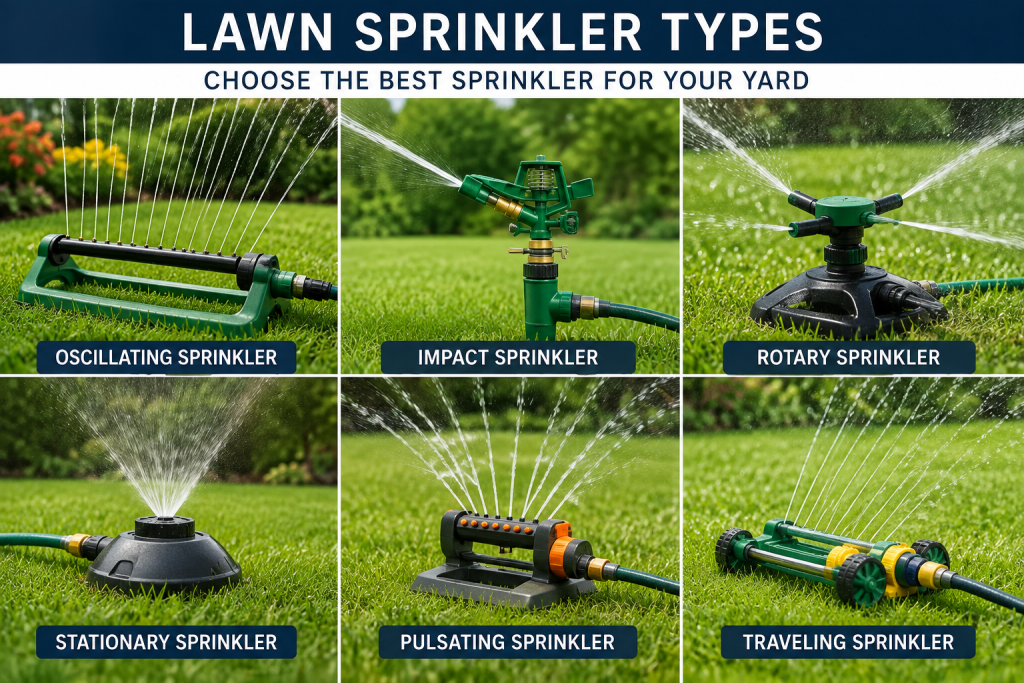
For a small rectangular lawn, an oscillating sprinkler is often one of the simplest choices.
An oscillating sprinkler sends multiple streams of water back and forth across a rectangular or roughly rectangular area. That shape works particularly well for many front and back lawns bordered by sidewalks, fences, patios, or planting beds.
Look for adjustment controls that let you shorten or narrow the pattern. Useful adjustments can reduce the amount of water landing outside the lawn.
For very small areas, a stationary sprinkler may be even simpler. These sprinklers have no moving mechanism and distribute water through a fixed spray pattern.
A stationary sprinkler can work well for:
- A small patch of grass
- A compact side yard
- Newly repaired lawn areas
- Locations where you can match the spray pattern closely to the turf
Its limitation is flexibility. If the pattern does not match the space, you may spend more time repositioning it or watering areas that do not need water.
Best Sprinkler for Large Lawns
Large open lawns generally benefit from sprinklers designed to throw water over a wider circular or sweeping area.
Impact sprinklers
Impact sprinklers produce a rotating stream with the familiar clicking action associated with many outdoor sprinklers. They can be useful for broad, open turf areas where a circular or adjustable arc makes sense.
They are less convenient when a large circular pattern would regularly spray a house, driveway, flower bed, or neighboring property.
Rotary sprinklers
Rotary sprinklers distribute water through moving streams or rotating patterns. They can be a practical choice when you want to cover a larger open section of lawn without relying on a rectangular oscillating pattern.
Rotating sprinkler designs are commonly used for broad lawn coverage, while actual range still depends on available pressure, flow, and the particular sprinkler.
For a very large yard, do not assume you need one sprinkler capable of reaching everything from a single location. Moving a well-matched sprinkler between zones can provide more controlled coverage and reduce unwanted watering.
Best Sprinkler for Irregular or Narrow Areas
Irregular lawns are usually where maximum coverage becomes less important than pattern control.
A lawn that bends around a patio, narrows beside a driveway, or contains several separated turf areas can be difficult to water efficiently with one broad spray pattern.
Consider an adjustable sprinkler that lets you control:
- Spray width
- Spray distance
- Direction
- Arc or rotation where applicable
For a narrow strip, a small stationary or carefully adjustable sprinkler may be a better choice than a large impact model.
Sometimes the simplest solution is to divide an awkward lawn into two or three watering areas. Repositioning a smaller sprinkler can be more practical than trying to force one large pattern onto a space it does not fit.
That also helps limit overspray onto pavement, siding, fences, and neighboring property.
Best Sprinkler for Low Water Pressure
Low water pressure can make a sprinkler that looks suitable on paper perform poorly in the yard.
Possible symptoms include:
- Shorter-than-expected range
- Incomplete oscillation
- Weak rotation
- Uneven patterns
- Poor coverage at the far edges
Sprinkler output changes with the available pressure and flow, so connecting a sprinkler to a water supply that cannot support its design may reduce both reach and coverage quality.
If low pressure is a known issue, prioritize simpler sprinklers or designs intended to perform with limited flow rather than buying solely on maximum advertised range.
Also consider the hose. An unnecessarily long run, restrictive fittings, or other demands on the same water supply can affect what reaches the sprinkler.
For a more focused comparison, see the HRA guide to choosing the best sprinkler for low water pressure.
Oscillating vs Impact vs Rotary Sprinklers
The three common types solve slightly different coverage problems.
Choose an oscillating sprinkler when:
- The lawn is rectangular.
- You want straightforward width and distance adjustment.
- You need a portable sprinkler that is easy to position along straight boundaries.
Choose an impact sprinkler when:
- You have a relatively large open lawn.
- Circular or partial-circle coverage fits the space.
- You want a sprinkler that can cover broad areas from one position.
Choose a rotary sprinkler when:
- A rotating pattern better matches the yard.
- You want broad coverage without a back-and-forth rectangular pattern.
- You have enough water pressure and flow for the sprinkler to operate properly.
A pulsating sprinkler is generally part of the same broad family as impact-style sprinklers. The important buying decision is not the terminology on the box but whether the pattern, adjustments, and water requirements fit your lawn.
For small targeted areas, a stationary sprinkler can remain the better option even though it is mechanically simpler.
What Features Matter Most?
Extra controls only add value if they help you match the sprinkler to your yard.
Useful adjustment
The best adjustment system is one you will actually use.
For rectangular lawns, width and distance control can help keep spray within the grass. For circular-pattern sprinklers, arc control can help prevent watering a full circle when only part of it is needed.
A stable base
Portable sprinklers should remain where you place them.
A wide or suitably weighted base can help reduce shifting on the grass. Spike-mounted designs may also provide stability where the soil and sprinkler design make them appropriate.
Whatever the design, position the sprinkler on stable ground and follow the manufacturer’s instructions.
Hose connection quality
A connection that leaks wastes water and creates a muddy area around the sprinkler.
Look for a fitting that feels secure and is compatible with your normal garden hose. Metal components can provide durability in some designs, but material alone does not determine overall quality. A poorly designed metal fitting is not automatically better than a well-made alternative.
Your hose can also affect how convenient the system is to use. If you are replacing one, see the guide to choosing a garden hose for homeowners.
Ease of moving and storage
If you will move the sprinkler frequently, size and weight matter.
A sprinkler that is cumbersome to carry around the house may discourage you from repositioning it properly. Compact storage also matters when garage or shed space is limited.
If hose storage is the bigger frustration, a wall-mounted hose reel may improve the overall watering setup more than buying a more complicated sprinkler.
How Water Pressure Affects Sprinkler Performance
Pressure helps determine how a sprinkler distributes water. Too little can reduce range or interfere with moving mechanisms, while excessive pressure can create misting and overspray in some sprinkler applications.
That is why two homeowners can connect the same sprinkler and get different results.
Other factors can also change performance:
- Hose diameter
- Hose length
- Elevation changes
- Other fixtures using water at the same time
- Wind
- Sprinkler design
Rather than chasing a particular pressure number without reference to a product, follow the sprinkler manufacturer’s operating requirements.
If your sprinkler performs poorly, do not immediately assume that a larger model will solve the problem. First consider whether the water supply is limiting the existing one.
When One Sprinkler Is Not Enough
One sprinkler does not need to cover the entire lawn from one position to be a good purchase.
For an L-shaped yard, narrow side lawn, or property divided by landscaping, moving the sprinkler can provide better control than buying a model with an enormous spray radius.
Multiple small watering zones can help you:
- Match different lawn shapes
- Reduce pavement overspray
- Keep water away from buildings
- Adapt to obstacles
- Avoid watering areas that are already wet
Using several sprinklers simultaneously is another option, but only if the water supply can support them. Adding sprinklers divides the available flow, and performance can decline when the supply is inadequate.
For many homeowners, moving one sprinkler is the simpler solution.
When a Sprinkler Is Not the Best Watering Tool
Portable lawn sprinklers are intended primarily for turf and other areas where overhead coverage makes sense.
They may be a poor fit for narrow planting beds, vegetable gardens, individual shrubs, or locations where you want water delivered close to the soil without wetting a broad surrounding area.
For those situations, targeted watering methods such as soaker hoses or drip irrigation may make more sense. Low-volume irrigation can reduce runoff and overspray in planted areas compared with broad spray watering.
If that is the problem you are trying to solve, see soaker hose versus drip irrigation.
Whatever sprinkler you choose, aim the water at the lawn rather than sidewalks, driveways, siding, foundations, or neighboring property. Reposition the sprinkler if necessary instead of accepting large amounts of overspray.
Avoid leaving walkways unnecessarily wet where they can become slippery, and keep sprinkler spray and hose connections away from outdoor electrical equipment. Follow the hose and sprinkler manufacturer’s instructions.
For broader seasonal decisions about whether the lawn needs additional water at all, see the Spring Lawn Care Guide for Homeowners.
Final Thoughts
For a small rectangular lawn, an adjustable oscillating sprinkler is often the easiest place to start. Larger open lawns may be better suited to impact or rotary designs, while stationary sprinklers make sense for small targeted areas. Low pressure, narrow spaces, and irregular shapes should push the decision toward controlled coverage rather than maximum range.
Choose the sprinkler that fits the lawn you actually have. Accurate coverage, useful adjustment, stability, and easy handling matter more than chasing the largest coverage claim or the longest feature list.