
How to Repair a Cracked Concrete Driveway
To repair cracked concrete driveway damage safely, first determine whether the crack is stable. A crack is a better DIY candidate when both sides remain reasonably level, the surrounding concrete is sound, and there is no evidence of active settlement or heaving. The first step is not buying filler. It is deciding whether the slab is still stable enough for a surface repair.
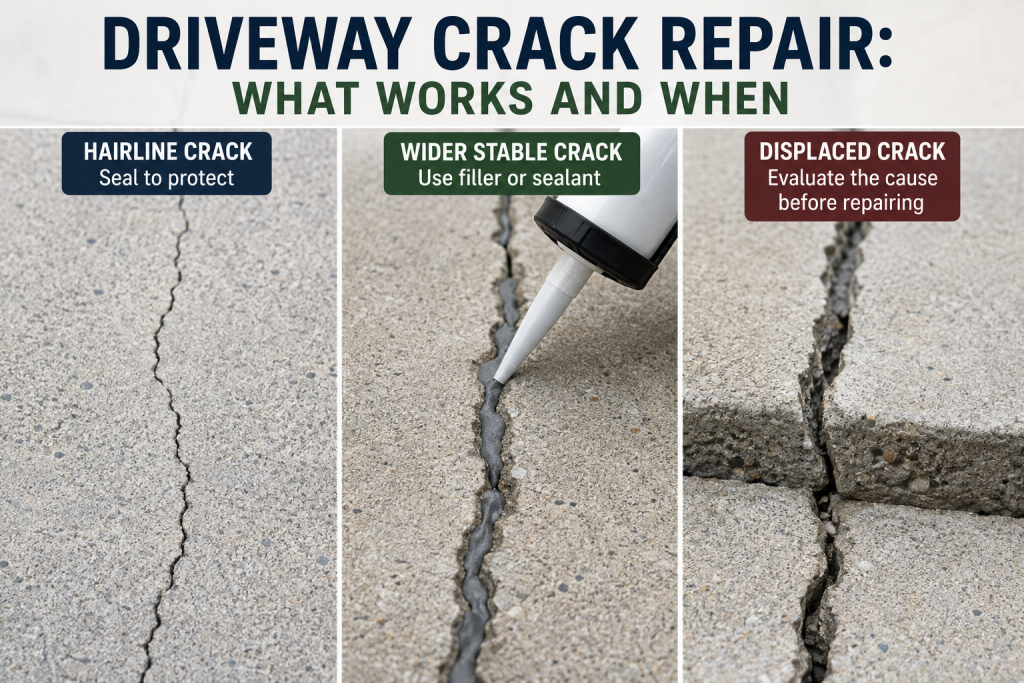
| Crack Condition | Likely Repair Direction | Main Concern |
|---|---|---|
| Hairline flat crack | Monitor or use compatible filler if appropriate | Water or debris entering the crack |
| Narrow stable crack | Crack filler or flexible sealant may work | Product compatibility |
| Wider but flat crack | Evaluate and select material for the crack size | Greater repair depth or missing material |
| Crack with missing or broken edges | Patching material may be needed | Damaged surrounding concrete |
| Crack with vertical displacement | Professional evaluation | Slab movement |
| Crack that repeatedly reopens | Investigate the cause | Continuing movement |
| Crack beside a sunken slab | Evaluate settlement | Loss of support |
| Multiple interconnected cracks | Broader driveway evaluation | Widespread deterioration or movement |
This table is a starting point, not an absolute diagnosis. Movement matters more than crack width alone.
Start by Deciding Whether the Crack Is Repairable
Look closely at the crack before choosing a repair material. Check whether both sides remain level, whether the opening is widening, and whether a previous repair has reopened. The surrounding concrete should also be examined for crumbling, broken edges, settlement, or heaving.
Notice whether the crack is isolated or part of a larger pattern. Several interconnected cracks, nearby sinking, or visible movement can indicate a problem that a surface filler will not correct.
Drainage also matters. Ponding water, runoff, or saturated slab edges can contribute to deterioration and recurring damage.
A wider crack that has remained flat and stable may be a better repair candidate than a narrow crack that continues to move.
Hairline and Narrow Cracks
Hairline cracks do not always require immediate repair. Some can simply be monitored when they remain stable and do not collect water or debris.
Repair may make sense when water enters the crack, debris collects inside it, or the opening is large enough for a compatible repair product. Both sides should remain level and the surrounding concrete should be sound.
Depending on the crack and product requirements, a pourable crack filler or compatible flexible sealant may be appropriate. No single product works for every crack, so check the manufacturer's limits for crack size, surface condition, moisture, temperature, and curing.
Wider or Deeper Cracks
Wider cracks deserve closer inspection because they may require a different repair material or indicate a more significant problem.
Some stable wider cracks can be repaired with products designed for larger openings. Flexible sealant may be useful where limited movement is expected, while repair mortar or patching material may be appropriate when concrete has broken away from the crack edges.
Missing concrete is different from a simple narrow opening. A damaged edge may need rebuilding rather than merely filling the center of the crack.
Rigid patching material should not automatically be used in a crack that is still moving. The repair material must match the condition of the concrete and the expected movement.
When Vertical Displacement Changes the Decision
If one side of a crack sits higher than the other, the problem may involve settlement, loss of support, frost-related heaving, soil movement, or movement of the slab itself.
Filling the visible opening does not correct these conditions.
Homeowners should not attempt to jack, lift, structurally stabilize, or inject material beneath slabs as a routine crack repair. Structural leveling and slab movement require different equipment and expertise than filling a stable surface crack.
Professional evaluation is appropriate when vertical displacement is visible or increasing.
Why Cracks Sometimes Reopen
A repaired crack may reopen when the condition that created it remains active. Continuing settlement, seasonal soil movement, freeze-thaw cycles, water beneath the slab, poor drainage, or movement at joints can all contribute.
Weak concrete, inadequate preparation, or a repair material that was not suited to the crack can also lead to failure.
Repeatedly placing more filler into the same opening does not solve active movement. When a crack keeps returning, the cause deserves attention before another repair is attempted.
Crack Filler vs Flexible Sealant vs Patching Material
Crack filler may suit certain stable cracks when the product is compatible with the opening's width, depth, slope, and concrete condition.
Flexible sealant may better tolerate limited movement because it can accommodate some change without behaving like a rigid patch.
Patching mortar is more appropriate when concrete is missing, edges have broken away, or shallow spalling exists beside the crack.
Before selecting a product, verify the manufacturer's requirements for crack width and depth, horizontal use, moisture conditions, temperature, preparation, and curing. No single repair material is best for every driveway crack.
How to Prepare a Stable Crack for Repair
Good preparation helps the repair material bond to sound concrete.
Remove loose debris, dirt, and contaminants from the crack. Inspect the edges and remove loose material only as necessary for the selected repair system. The concrete should meet the moisture and surface-condition requirements specified by the manufacturer.
Do not aggressively grind or saw a crack simply to change its shape unless the repair product specifically requires that preparation and the work can be performed safely.
Concrete cutting, grinding, and drilling can generate respirable crystalline silica dust. Use appropriate eye protection, gloves, dust controls, respiratory protection when required, and hearing protection for powered work. Extensive powered preparation may be better handled professionally.
Basic Steps to Repair a Cracked Concrete Driveway
For a stable crack that is appropriate for homeowner repair, the basic process is:
- Confirm that the crack is stable enough for a surface repair.
- Remove loose debris, dirt, and contamination.
- Check the repair product's requirements for crack width, depth, surface condition, and moisture.
- Prepare the crack only as directed by the manufacturer.
- Apply the compatible repair material.
- Tool or finish the repair if the product requires it.
- Protect the area while the material cures.
- Keep vehicles and foot traffic off the repair until permitted.
- Reinspect the repair over time for movement or reopening.
Do not assume universal crack widths, mixing ratios, application temperatures, backer-rod sizes, or curing times. Manufacturer instructions control these details.
How Water and Freeze-Thaw Affect Driveway Cracks
Water entering a crack can contribute to deterioration along the edges and may worsen existing damage. In climates with freezing conditions, repeated freeze-thaw cycles can increase stress around vulnerable concrete.
Look for ponding, runoff, downspout discharge, or consistently saturated soil along driveway edges.
Repairing a crack can help protect the opening, but it does not correct the water source. If drainage repeatedly directs water toward the same damaged area, address that condition as part of the broader repair plan.
Weather and Curing Matter
Concrete repair materials have specific requirements for temperature, surface moisture, rain exposure, cure time, and traffic restrictions.
Applying material outside the manufacturer's permitted conditions can reduce adhesion or shorten repair life. Rain can damage some uncured products, and putting a vehicle on the repair too soon can deform or weaken it.
Follow the selected manufacturer's instructions rather than relying on one universal curing period.
When Crack Repair Is Not Enough
Crack-by-crack repair becomes less practical when cracking is widespread, multiple slabs are moving, sections are sinking or heaving, deep deterioration is present, or previous repairs continue to fail.
Extensive shallow surface deterioration may sometimes be better suited to concrete driveway resurfacing than repeated individual repairs, provided the underlying slab remains suitable for resurfacing.
When damage extends beyond isolated cracks, review the broader concrete driveway repair decision to determine whether localized repair, resurfacing, or replacement is the more appropriate path.
When to Call a Concrete Professional
Professional evaluation is appropriate when cracks show vertical displacement, slabs are sunken or heaved, cracks change rapidly, or repaired cracks repeatedly reopen.
Widespread interconnected cracking, significant crumbling, suspected loss of support, substantial drainage or erosion problems, and extensive powered preparation are additional reasons to seek professional help.
A contractor can help determine whether the visible crack is primarily a surface defect or evidence of a larger slab or base problem.
Final Thoughts
Stable, flat cracks in otherwise sound concrete are the best homeowner repair candidates.
The correct repair material depends on the crack condition, width and depth, expected movement, surrounding concrete, and manufacturer requirements. Proper preparation and suitable weather also matter.
A surface repair can close a crack and help protect the damaged area. It cannot permanently correct active slab movement. When a crack shows vertical displacement, repeated reopening, settlement, or heaving, identify the underlying cause before relying on another surface repair.