
Garage Door Opener Not Working: What to Check
If your garage door opener not working problem appears suddenly, do not assume the motor has failed. Start with simple checks: power, the wall control, remote batteries, lock or vacation mode, obstructions, and the safety sensors. If the door is crooked, off track, unusually heavy, binding, or has a broken spring or damaged cable, stop operating it. Garage-door springs and lift cables store dangerous energy.
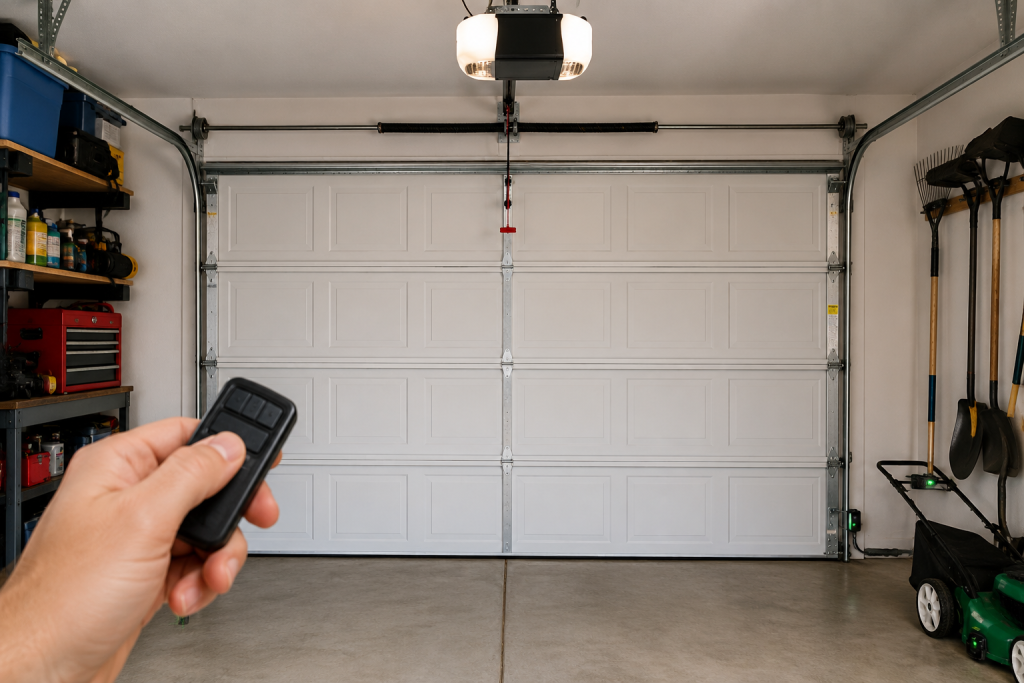
| What You Observe | Likely Cause | Safe First Check |
|---|---|---|
| Nothing happens | Power or control issue | Check plug, outlet, breaker, and wall control |
| Wall button works but remote does not | Remote or lock-mode issue | Replace batteries and check lock/vacation mode |
| Door starts down then reverses | Obstruction, sensor, or resistance issue | Clear doorway and inspect sensors |
| Opener runs but door does not move | Disconnected trolley or mechanical problem | Check emergency-release status from a safe position |
| Door moves only a few inches | Binding, resistance, or mechanical damage | Stop repeated cycling and inspect for obvious damage |
| Sensor lights are off or blinking | Obstruction, misalignment, or sensor issue | Clear beam and inspect indicator lights |
| Door moves unevenly or appears crooked | Track, cable, spring, or balance problem | Stop operating the door and arrange service |
These are starting points rather than absolute diagnoses. A garage-door problem can involve both the opener and the door mechanism.
Start With These Safe Checks
Begin with the simplest checks before assuming an internal opener fault:
- Confirm the opener is plugged in.
- Check whether the outlet has power.
- Check the circuit breaker or related GFCI when applicable.
- Try the wall control.
- Try another remote if available.
- Replace the remote batteries.
- Check lock or vacation mode.
- Look for obstructions beneath the door.
- Inspect the safety sensors from floor level.
- Stop if the door is crooked, heavy, jammed, off track, or mechanically damaged.
Do not repeatedly cycle an opener that is struggling. Repeated operation can worsen a mechanical problem.
If the Garage Door Opener Has No Power
If nothing responds, first confirm that the opener’s cord is plugged in and that the receptacle has power.
A tripped breaker or related GFCI can interrupt power. A normally tripped breaker or GFCI may be reset when it is safe to do so, but if it trips again, stop troubleshooting and arrange qualified service.
Do not remove electrical covers, open the opener housing, or troubleshoot live wiring. Repeated electrical tripping can indicate a fault that requires professional diagnosis.
If the Wall Button Works but the Remote Does Not
When the wall control operates the door but the remote does not, the problem is usually on the remote-control side rather than with the main opener motor.
Replace the remote battery first. If another remote is available, compare its operation. Also check whether lock or vacation mode has been activated at the wall control, since some systems disable handheld remotes in that mode.
Limited range or intermittent response may involve interference, the opener antenna, or programming.
Programming procedures vary by manufacturer and model. Follow the opener’s specific instructions rather than using a generic sequence.
If the Door Will Not Close
Before focusing on the opener, inspect the doorway.
Remove objects, debris, tools, toys, or anything else beneath the door. Even a small obstruction can prevent normal closing.
If the path is clear and the door begins closing but reverses, move on to the safety-sensor checks.
Do not force the door closed or repeatedly activate the opener in an attempt to overpower a problem.
Check the Safety Sensors
Photo-eye safety sensors are typically located near the lower portion of the garage-door tracks.
Safe homeowner checks include clearing anything blocking the beam, gently cleaning the sensor lenses, checking for obvious misalignment, observing indicator lights, and inspecting visible low-voltage wiring from floor level.
Some openers use blinking or colored indicators to identify sensor faults. Consult the model-specific documentation for those signals.
Never bypass, tape, disconnect, defeat, or intentionally misalign the safety sensors to make the door close.
If normal operation cannot be restored with basic approved checks, service is appropriate.
If the Door Starts Moving and Then Reverses
A door that begins moving and then reverses may be responding to an obstruction, sensor problem, binding, track trouble, roller resistance, or another mechanical condition.
Some opener systems also have model-specific travel or force settings, but those settings should not be increased simply to overpower a resistant door.
If the opener previously worked properly and the door suddenly requires more force, look for the reason the door has become harder to move.
New resistance can indicate a door problem rather than an opener-adjustment problem.
If the Opener Runs but the Door Does Not Move
If you hear or see the opener operating but the door remains stationary, check whether the trolley has been disconnected by the emergency release.
A disconnected trolley may leave the opener running without moving the door.
Other possibilities include an opener-drive problem or a mechanical door failure such as a broken spring, damaged lift cable, damaged hardware, or an off-track door.
Stop immediately if you see a broken spring, damaged cable, crooked door, damaged track, or unusually heavy door.
The opener should never be used to compensate for a door that is mechanically damaged or poorly balanced.
Check the Emergency Release and Door Lock
A manually locked garage door can prevent the opener from moving it. Check whether a manual lock has been engaged.
Also verify whether the trolley was intentionally disconnected from the opener using the emergency release.
Do not pull the emergency release while the door is raised when a broken spring, cable problem, balance issue, or other mechanical damage is suspected. A poorly supported door can move suddenly.
Reconnection procedures vary by manufacturer, so follow the opener’s instructions.
Test the Door Manually Only When Safe
Manual testing should be conservative.
Only consider disconnecting the opener when the door is fully closed, appears intact, has no visible broken spring or cable damage, is not off track, and the manufacturer’s emergency-release procedure can be followed safely.
If the door is safely disconnected, it should move in a controlled manner.
Stop immediately if it feels unusually heavy, jams, drops, rises unexpectedly, or cannot be controlled.
Do not use this test as an opportunity to adjust springs or balance hardware. Those components can store dangerous energy and are not appropriate trial-and-error DIY work.
When Routine Lubrication May Help
If the door otherwise moves correctly but approved moving points sound dry or noisy, routine lubrication may reduce friction and noise.
Use the correct lubricant only on components allowed by the manufacturer. For the full homeowner-safe procedure, see how to lubricate a garage door.
Do not treat the tracks as a universal lubrication point, and do not lubricate springs, cables, or high-tension hardware unless the manufacturer specifically instructs you to do so.
Lubrication cannot correct a bent track, broken spring, damaged cable, or poor door balance.
When the Problem May Be the Opener
The opener itself becomes more suspect when the door moves normally by hand, the sensors appear to function correctly, power is available, controls respond, and no obvious mechanical door problem is present.
Possible opener-side symptoms include humming, severe grinding, repeated stopping, motor operation without normal door movement, or no response despite confirmed external power and controls.
Do not open the unit to repair internal motors, gears, capacitors, circuit boards, or electrical components.
Burning smells, smoke, sparks, or overheating are immediate stop-use conditions.
Disconnect power if it can be done safely and arrange qualified service.
What Not to Adjust Yourself
Do not loosen, adjust, remove, or repair torsion springs, extension springs, lift cables, bottom brackets connected to high-tension hardware, or other high-tension components.
Do not attempt to straighten or reposition a severely damaged track while the door is under load.
Internal opener electrical components should also be left to qualified service.
Never increase opener force merely to overpower a binding or damaged door.
If the door does not move normally, identify the underlying cause instead of forcing the opener to work harder.
When Side Gaps Point to a Door Problem
If the opener operates but the closed door suddenly leaves a new or uneven gap along one side, the issue may involve alignment, track condition, rollers, framing, or seals rather than the opener motor.
Uneven closure can be another clue that the door is not traveling normally.
For a focused look at those causes, see garage door gaps on the sides.
Do not attempt spring or cable adjustments to correct an uneven gap.
When to Call a Garage Door Professional
Professional service is appropriate when you find a broken spring, damaged cable, off-track door, crooked or unstable door, unusually heavy door, or a door that drops unexpectedly.
Service is also warranted for repeated reversing with no safe obvious cause, repeated breaker or GFCI tripping, damaged tracks, severe grinding, or safety sensors that cannot be restored to normal operation.
Burning smells, smoke, sparks, overheating, or an apparent internal opener failure are also stop-use conditions.
Keep children and pets away from an unstable door and avoid repeated operation while waiting for service.
Final Thoughts
When a garage door opener stops working, start with power, controls, batteries, lock modes, obstructions, and safety sensors.
Then determine whether the problem is actually the opener or the garage door itself.
If the door is heavy, crooked, binding, off track, or has damaged springs or cables, stop troubleshooting and use professional service. Simple controls and sensor issues are reasonable homeowner checks, but high-tension door hardware and internal opener repairs are not.