furnace short cycling: causes and what to check
Furnace short cycling means the furnace starts and stops repeatedly without completing a normal heating cycle or satisfying the thermostat. Common causes range from a dirty air filter or blocked airflow to thermostat problems, overheating, ignition faults, venting restrictions, or internal furnace failures. Homeowners can safely check a few external items, but repeated shutdowns or safety-control trips require professional service.
Quick Answer
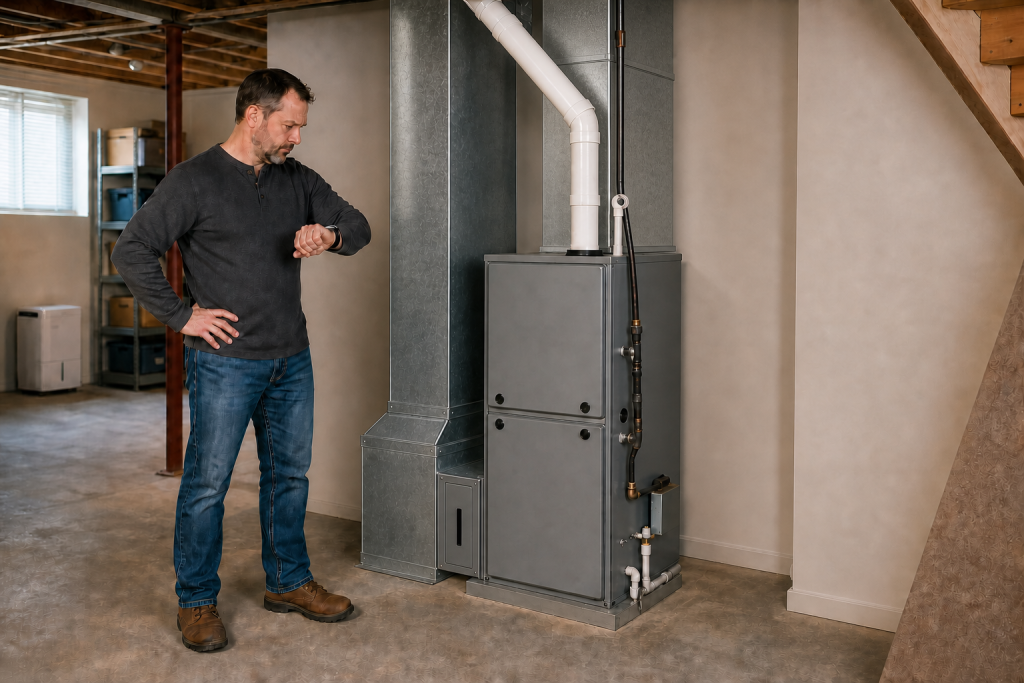
Start by watching the furnace without opening its cabinet. Check the thermostat settings and batteries, inspect the air filter, make sure supply registers and return grilles are unobstructed, and look at accessible outdoor intake and exhaust terminations for obvious blockage.
Do not keep resetting a short-cycling furnace to force it to run. If basic checks do not correct the problem, stop troubleshooting and arrange HVAC service.
What Is Furnace Short Cycling?
Short cycling occurs when a furnace begins a heating cycle but shuts down sooner than expected, then starts again repeatedly.
There is no universal number of minutes that defines a normal furnace cycle. Cycle length changes with outdoor temperature, heating demand, furnace type, thermostat settings, insulation, system sizing, and equipment design.
The more useful question is whether the furnace repeatedly shuts down before satisfying the thermostat or behaves noticeably differently from its normal pattern.
For example, a furnace that fires briefly, stops, cools, and then repeatedly tries again deserves attention. A furnace that runs longer during very cold weather may be operating normally.
Furnace Short Cycling vs Normal Furnace Operation
Several normal or different furnace behaviors can look like short cycling.
- Normal completed cycle: The furnace runs until the thermostat’s heating demand is satisfied, then shuts down until the temperature drops enough for another call for heat.
- Blower running after the burners stop: The blower may continue after combustion ends to move remaining heat through the ductwork. That alone is not short cycling.
- Multi-stage operation: A multi-stage furnace may change between lower and higher heating output rather than simply turning fully on and off.
- Variable-capacity operation: Some furnaces adjust output for longer, lower-capacity operation. Changes in sound or heat output do not necessarily indicate cycling.
- Very cold weather: Greater heating demand can cause more frequent or longer operation.
- Failed ignition attempts: A furnace may make several controlled ignition attempts and then enter a safety lockout. That is an ignition problem rather than a normal thermostat-controlled heating cycle.
If the furnace repeatedly fails to ignite or enters lockout, do not repeatedly reset it.
Quick-Diagnosis Table
| Observed pattern | Possible cause | Safe homeowner check | When to call a professional |
|---|---|---|---|
| Furnace runs briefly, then restarts | Dirty or restrictive filter | Inspect and replace if dirty | Cycling continues with correct filter |
| Furnace stops before house warms | Blocked return or closed supplies | Check visible grilles and registers | Airflow remains weak |
| Furnace responds inconsistently | Thermostat setting or batteries | Check Heat mode, setpoint, batteries | Problem continues |
| Cycling changes with nearby heat | Poor thermostat placement | Look for sunlight, vents, fireplace, cooking heat | Thermostat needs relocation or diagnosis |
| Thermostat appears normal but calls are erratic | Wiring or control problem | Note alerts only | Do not modify wiring |
| Burners stop while blower continues | Furnace overheating/high-limit opening | Check filter and room airflow | Repeated safety shutdowns |
| Flame starts, then quickly stops | Flame sensor or burner problem | Observe from outside cabinet only | Professional diagnosis required |
| Furnace makes repeated ignition attempts | Ignition problem | Note visible fault code | Stop resetting and call |
| Furnace stops during severe snow or debris buildup | Intake or exhaust blockage | Look at safely accessible exterior termination | Vent cannot be cleared without tools or climbing |
| Weak airflow accompanies cycling | Blower or duct restriction | Check filter, registers, returns | Internal airflow diagnosis needed |
| Furnace has always cycled unusually fast | Oversized furnace | Note history and room-temperature pattern | Have sizing evaluated |
| Cycling persists despite basic checks | Limit switch, control board, ductwork, or other fault | No internal DIY check | Arrange HVAC service |
| Soot, scorching, abnormal flame, or suspected heat-exchanger problem | Combustion or heat-exchanger defect | Do not investigate internally | Shut system down and obtain service |
Common Causes of Furnace Short Cycling
Furnace short cycling can begin on either the airflow side or the combustion-and-control side of the system.
Common causes include:
- Dirty or overly restrictive air filters
- Blocked return grilles
- Closed or obstructed supply registers
- Incorrect thermostat settings
- Weak thermostat batteries
- Poor thermostat placement
- Thermostat wiring or control faults
- Furnace overheating and high-limit shutdown
- Dirty or malfunctioning flame sensors
- Ignition or burner problems
- Blocked combustion-air intake or exhaust venting
- Blower motor or other airflow problems
- Oversized furnace capacity
- Restricted or poorly designed ductwork
- Faulty limit switches or control boards
- Cracked or damaged heat exchangers
Several of the more serious causes create similar symptoms. A homeowner cannot reliably determine from cycling behavior alone whether the problem is a flame sensor, safety switch, control board, blower, combustion system, or heat exchanger.
Safe Checks Homeowners Can Perform
Perform these checks in order and stop once the cause moves beyond an accessible homeowner task.
- Observe the furnace without opening its cabinet. Note how often it starts, whether warm air reaches the rooms, and whether the thermostat reaches its setting.
- Check the thermostat. Confirm it is set to Heat and the temperature setting is above the current room temperature.
- Replace weak thermostat batteries if applicable. Follow the thermostat manufacturer’s directions.
- Check thermostat surroundings. Look for direct sunlight, a nearby supply register, fireplace heat, cooking heat, or another source that could affect its temperature reading.
- Inspect the furnace filter. Replace a dirty filter with the correct size and an approved filter type for the system.
- Open supply registers. Make sure they are not closed or covered by furniture, rugs, or other objects.
- Clear return grilles. Move curtains, furniture, boxes, rugs, or other obstructions away from returns.
- Look at accessible exterior vent terminations. From a safe ground-level location, check for obvious snow, leaves, nests, or debris. Do not climb, dismantle venting, or insert tools.
- Record visible alerts or fault codes. If a code can be seen without removing a panel, consult the furnace manual for its meaning.
- Stop if the furnace still short cycles. Arrange professional service rather than continuing with internal troubleshooting.
Do not remove furnace panels, alter wiring, clean internal sensors, bypass switches, or repeatedly cycle furnace power.
How a Dirty Filter Can Cause Short Cycling
A furnace needs adequate airflow across its heat exchanger. A dirty filter can reduce that airflow enough for heat to build inside the furnace faster than the blower system can carry it away.
If furnace temperature becomes too high, the high-limit safety switch can shut the burners off. Once temperatures fall, the furnace may be able to start again, creating a repeating on-off pattern.
An overly restrictive filter can contribute to similar airflow problems even when it looks relatively clean. Our MERV 8 vs MERV 11 vs MERV 13 comparison explains how filtration level can affect airflow and HVAC system compatibility. Use the size and filter type approved for your furnace rather than assuming a higher-rated filter is always better.
If a correct new filter does not stop the cycling, do not assume the limit switch itself is the problem. Blower performance, duct restrictions, furnace setup, or other faults can produce the same symptom.
Thermostat Problems That Can Cause Rapid Cycling
A thermostat can contribute to rapid cycling if it senses room temperature incorrectly or sends unreliable heating calls.
Start with the simple checks:
- Heat mode is selected
- The setpoint is above room temperature
- Batteries are not weak
- The thermostat is not heated by direct sunlight
- A nearby supply register is not blowing directly toward it
- A fireplace, stove, or other heat source is not influencing it
Internal thermostat wiring, damaged conductors, control signals, calibration problems, or equipment-interface problems require professional diagnosis.
Do not move thermostat wires or experiment with terminals to troubleshoot a short-cycling furnace.
Why a Furnace May Overheat and Shut Down
A furnace high-limit switch is a safety device that responds when temperatures rise beyond the system’s intended operating range.
Restricted airflow is one possible reason. A dirty filter, blocked returns, excessive supply restrictions, duct problems, or blower faults can prevent enough air from moving across the furnace.
When a high-limit control opens, the burners may stop while the blower continues running to help cool the furnace. That pattern can repeat after the furnace cools.
Do not bypass, reset, replace, or test a limit switch yourself. Repeated high-limit operation means the reason for overheating needs to be found.
Ignition and Flame-Sensing Problems
Gas furnaces use ignition and flame-proving controls to ensure fuel burns when it is supposed to.
A furnace may ignite and then shut the burners off shortly afterward if the control does not reliably prove flame. A contaminated or failing flame sensor is one possible cause, but ignition components, burner problems, gas supply conditions, controls, and other faults can produce similar behavior.
Homeowners should not remove or sand a flame sensor, handle an igniter, touch burners, or work on the gas valve.
If the furnace repeatedly lights and immediately shuts off, or makes several failed ignition attempts, call an HVAC professional.
Venting and Combustion-Air Problems
Many furnaces depend on an unobstructed exhaust path, and high-efficiency furnaces may also draw combustion air through dedicated outdoor piping.
Snow, ice, leaves, nests, or other debris at an exterior termination can interfere with proper operation.
A homeowner can look for an obvious obstruction only when the termination is safely accessible from the ground. Do not insert a tool into the pipe, take fittings apart, climb onto a roof, or alter the vent.
If an obstruction cannot be removed without disturbing the system, leave the furnace off and arrange service.
Can an Oversized Furnace Short Cycle?
Yes. A furnace with substantially more heating capacity than the home needs may raise the temperature near the thermostat quickly, shut off, and then restart after a relatively short interval.
Oversizing is more likely to be suspected when rapid cycling has existed since the system was installed rather than appearing suddenly after years of normal operation.
Ductwork and airflow also matter. A properly sized furnace connected to restrictive ducts can behave poorly, while modern staged or variable-capacity equipment may intentionally operate differently from a basic single-stage furnace.
Determining whether a furnace is oversized requires a professional heating-load and system evaluation.
Is Furnace Short Cycling Dangerous?
Not every short-cycling problem represents an immediate emergency, but repeated furnace shutdowns should not be ignored. The furnace may be responding to overheating, failed ignition, improper combustion conditions, or another safety-related fault.
Leave the home immediately if you smell gas or a carbon-monoxide alarm sounds. Do not investigate the furnace first. Do not operate light switches, thermostats, phones, appliances, garage-door controls, or other electrical devices inside. Move everyone to fresh air and call emergency services and the gas utility from outside.
Also treat headache, dizziness, nausea, weakness, confusion, chest pain, or other possible carbon-monoxide symptoms seriously. Get everyone into fresh air and seek emergency medical help.
If you see smoke, scorching, soot, or flame where flame should not be visible, stop using the furnace. For active smoke or fire, leave the home and contact emergency services.
Do not open the furnace to look for a cracked heat exchanger. Heat-exchanger condition requires professional inspection and, when appropriate, specialized testing.
When to Shut the Furnace Off
Leave the furnace off and obtain professional help when:
- It repeatedly trips a safety control
- Ignition repeatedly starts and fails
- The furnace enters lockout
- Short cycling continues after basic thermostat and airflow checks
- You see soot or scorching
- You hear unusual booming or delayed-ignition sounds
- Venting appears damaged or obstructed
- Airflow becomes unusually weak
- A fault code indicates a service condition
- You suspect a combustion, electrical, blower, or heat-exchanger problem
If the shutdown is accompanied by a furnace banging noise, stop the system and investigate that symptom before operating it again.
Never keep resetting the furnace simply because it starts working again temporarily. A reset does not correct the condition that caused the shutdown.
When to Call an HVAC Professional
Call a qualified HVAC technician when furnace short cycling persists after the filter, thermostat settings, batteries, registers, returns, and safely accessible exterior vent terminations have been checked.
Professional diagnosis is also appropriate for suspected:
- Flame-sensing problems
- Ignition or burner faults
- High-limit trips
- Blower motor problems
- Duct restrictions
- Thermostat wiring faults
- Defective limit switches
- Control-board problems
- Oversized equipment
- Combustion or venting faults
- Heat-exchanger damage
These problems involve fuel-burning, electrical, control, or safety components that should not be diagnosed by reaching inside the furnace.
How to Help Prevent Furnace Short Cycling
Basic maintenance can reduce some common airflow-related causes and help problems get noticed earlier.
- Check the furnace filter regularly and replace it when needed.
- Use the correct filter size and an approved filter type.
- Keep return grilles unobstructed.
- Keep supply registers open unless your HVAC design specifically calls for something different.
- Keep safely accessible exterior intake and exhaust terminations clear of obvious seasonal debris.
- Keep furniture and heat-producing appliances from interfering with the thermostat.
- Pay attention to unusual changes in cycle behavior.
- Schedule furnace maintenance according to the equipment manufacturer’s recommendations.
Maintenance cannot prevent every control, motor, ignition, or equipment-sizing problem, but it can help keep routine airflow issues from becoming repeated shutdowns.
Final Recommendation
If your furnace starts and stops unusually often, begin with the safe external checks: thermostat settings and batteries, filter condition, open supply registers, clear return grilles, thermostat surroundings, and visible outdoor vent terminations.
If furnace short cycling continues, treat the repeated shutdown as a symptom rather than something to override. Do not open the furnace or keep resetting it. Have an HVAC professional identify whether the cause is airflow, overheating, ignition, venting, controls, equipment sizing, or another internal problem.
Frequently Asked Questions
What is considered short cycling for a furnace?
There is no universal cycle-time cutoff. Furnace short cycling generally means the furnace repeatedly shuts off before completing its normal heating cycle or satisfying the thermostat. Compare the behavior with your furnace’s normal operation rather than relying on one exact number of minutes.
Why does my furnace turn on and off every few minutes?
Possible causes include restricted airflow, thermostat problems, overheating, ignition or flame-sensing faults, vent restrictions, blower problems, equipment sizing, or failed controls. Start with the safe external checks and call a professional if the pattern continues.
Can a dirty furnace filter cause short cycling?
Yes. A clogged or overly restrictive filter can reduce airflow, allowing excessive heat to build inside the furnace and potentially trigger a high-limit shutdown.
Can a thermostat cause a furnace to short cycle?
Yes. Incorrect settings, weak batteries, poor placement, a faulty thermostat, or control problems can create unreliable heating calls.
Can closed vents cause furnace short cycling?
Closing or obstructing too many supply registers can reduce system airflow and may contribute to overheating. Keep registers open and unobstructed unless the HVAC system was specifically designed otherwise.
Why does my furnace light and then shut off?
A flame-sensing, ignition, burner, gas-control, or other combustion problem may cause the burners to shut down shortly after ignition. Do not open the furnace to investigate; arrange professional diagnosis.
Can a flame sensor cause short cycling?
Yes. If the furnace cannot reliably confirm that a flame is present, its safety controls can shut off the burners. Cleaning, testing, or replacing a flame sensor is outside the homeowner checks in this guide.
Is furnace short cycling dangerous?
It can indicate a safety-related problem such as overheating or an ignition or combustion fault. Gas odor, a CO alarm, smoke, soot, scorching, or abnormal flame requires immediate action rather than continued troubleshooting.
Will short cycling damage a furnace?
Repeated starts and stops can increase wear on furnace components and may accompany overheating or other conditions that need repair. Correct the underlying cause rather than allowing the furnace to continue cycling.
Can an oversized furnace short cycle?
Yes. An oversized furnace can heat the space rapidly and satisfy the thermostat sooner than intended, leading to frequent cycles. Proper sizing requires a professional evaluation.
Should I keep resetting a short-cycling furnace?
No. Repeatedly resetting a furnace can mask a fault without correcting it and may defeat the purpose of a protective shutdown. If the furnace repeatedly stops or locks out, arrange service.
When should I call an HVAC technician?
Call when short cycling continues after basic external checks, the furnace repeatedly trips a safety control, ignition fails, airflow is weak, venting is questionable, a fault code appears, or any internal furnace diagnosis would be required.