
dishwasher not draining: causes and what to check
Dishwasher not draining can point to anything from a clogged filter or blocked drain path to a sink-plumbing, garbage-disposal, hose, pump, or internal dishwasher problem. A small amount of water may be normal on some models, but persistent standing water across the tub floor is not. Start with the easiest accessible checks, and keep water-and-electricity safety in mind before reaching into lower areas of the appliance.
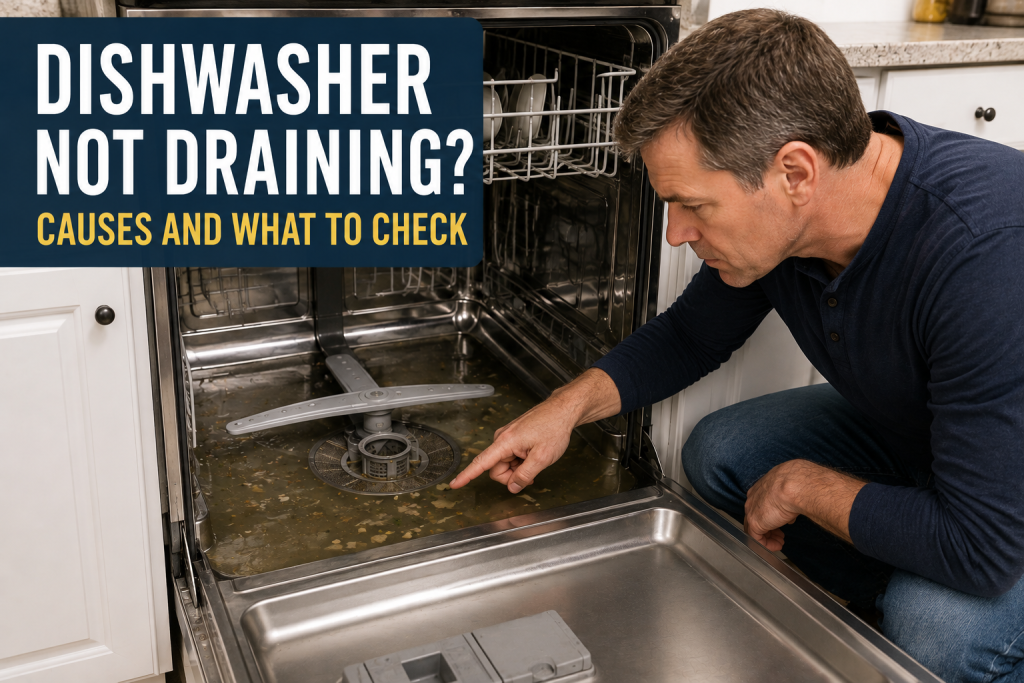
Dishwasher Not Draining? Start With These Checks
Before reaching into the lower dishwasher area, stop the appliance and allow hot water and components to cool. If a check requires access near moving or electrical components, disconnect power first. Unplug the dishwasher only if the plug and surrounding area are dry and safely accessible. For a hardwired appliance or uncertain shutoff, use the appropriate breaker or professional help.
| What to Check | What You May Notice | Safe First Step |
|---|---|---|
| Normal residual water | Small amount below the filter area | Check the owner’s manual |
| Dirty filter | Food or buildup on filter | Remove and clean as directed |
| Food debris | Visible particles near drain area | Inspect with good lighting |
| Blocked drain area | Water remains above filter | Remove only accessible debris |
| Drain hose | Visible kink or crushing | Inspect accessible hose routing |
| Garbage disposal | Sink/disposal drains poorly | Check sink-side symptoms |
| Air gap, if equipped | Debris under accessible cap | Inspect and clean accessible parts |
| Sink drain | Slow sink or backup | Address household drainage issue |
| Interrupted cycle | Water remains after cycle stops | Use normal cancel/drain function |
| Internal problem | No draining after basic checks | Call an appliance technician |
Do not blindly reach into standing water. Broken glass, bones, hard plastic, and other sharp debris may be hidden around the filter or drain area.
First, Decide Whether the Water Is Actually Abnormal
Some dishwashers retain a small amount of water in or below the filter or sump area by design. That water may help keep seals or components from drying out, depending on the model.
The more important question is where the water is and whether it remains after normal draining. Signs of a likely drainage problem include:
- Water covering part of the tub floor
- Water reaching or surrounding the filter
- Dirty or foul-smelling standing water
- Water remaining after repeated completed cycles
- More water than you normally see after washing
There is no universal normal water depth for every dishwasher. If you are unsure whether the visible water is expected, check the owner’s manual for your model before taking anything apart.
Try the Dishwasher’s Normal Cancel or Drain Function
An interrupted wash cycle can leave water in the bottom even when the drain system is working normally.
Close and latch the door as you normally would, then use the manufacturer’s cancel, reset, or drain control if your dishwasher provides one. Listen for the normal sound of water moving toward the sink plumbing.
If the dishwasher drains, the original problem may have been an interrupted cycle rather than a blockage.
If nothing happens or the water level does not drop, do not keep starting full wash cycles. Stop the appliance and continue with non-energized, accessible checks. Never bypass the door switch or interlock to make the dishwasher operate while open.
Check the Dishwasher Filter
A dirty filter is one of the most accessible causes of dishwasher standing water. Many modern dishwashers have homeowner-serviceable filters near the bottom of the tub, although the design varies by model.
Stop the appliance, let hot water cool, and remove the lower rack. Follow the manufacturer’s instructions for releasing and removing the filter.
Inspect it for:
- Food particles
- Greasy buildup
- Paper labels
- Small pieces of plastic
- Glass or other hard debris
Clean the filter using the method specified for your dishwasher and reinstall it correctly. A filter that is not seated properly can create additional washing or drainage problems.
Be especially careful around broken glass. Do not reach blindly beneath the filter or begin dismantling pump or motor components that are not identified as normal homeowner-service areas.
Look for Debris in the Accessible Drain Area
Even with a relatively clean filter, food or packaging debris may collect near an accessible drain opening.
Use good lighting and inspect only areas you can clearly see and safely reach according to the manufacturer’s instructions. Common debris can include seeds, food fragments, bits of plastic, labels, or glass.
Avoid putting your bare hand into cloudy standing water where sharp objects may be hidden. Cleaning gloves can provide some protection, but they do not make blind probing safe.
Do not remove pump covers, service panels, or internal components unless your dishwasher’s instructions specifically identify them as homeowner-serviceable. If the obstruction appears deeper inside the appliance, that is a reasonable stopping point for professional service.
Check the Dishwasher Drain Hose
The dishwasher normally sends wastewater through a drain hose connected to household plumbing, often at a garbage disposal or sink drain connection.
Where the hose is safely visible, look for:
- Kinks
- Crushing
- Sharp bends
- Obvious displacement
- Leakage
A restricted hose can slow or prevent drainage.
Do not pull the dishwasher out merely to inspect a hidden section of hose unless the manufacturer’s instructions support that access and you can do it safely. Moving the appliance can disturb the water supply, drain connection, electrical connection, flooring, and surrounding cabinetry.
If hose inspection or correction requires appliance removal, professional help may be the safer choice.
Check the Garbage Disposal Connection
Many dishwashers discharge through a garbage disposal, so a problem at the disposal can look like a dishwasher failure.
Check whether the sink and disposal side are draining normally. Standing water in the disposal, an obvious sink backup, or other drainage symptoms can indicate that the restriction is outside the dishwasher.
A newly installed garbage disposal deserves special attention. Disposal units commonly have a dishwasher inlet that must be prepared during installation. If the dishwasher inlet knockout plug was left in place, dishwasher water cannot flow through that connection properly.
Do not put your hand inside a garbage disposal chamber. If an inspection requires more than ordinary sink use, disconnect disposal power first. Unplug it only when the plug and surrounding area are dry and safely accessible; otherwise isolate power appropriately.
Do not run a disposal that is jammed, humming abnormally, leaking, or showing electrical symptoms.
If the garbage disposal itself only hums instead of running normally, address the garbage disposal humming problem before assuming the dishwasher drain system is at fault.
Check the Sink Drain
A dishwasher can have trouble draining when the household drain it connects to is already restricted.
Check for clues such as:
- A sink that drains slowly
- Water backing up into the sink
- A disposal that holds water
- Gurgling associated with poor drainage
- Recurring sink backups
If both the sink and dishwasher have drainage symptoms, the problem may belong to the household plumbing rather than the dishwasher itself.
That distinction matters when choosing professional help. A plumber is generally the better starting point for a backed-up sink or household drain. An appliance technician is better suited to an internal dishwasher failure.
Check the Dishwasher Air Gap if You Have One
Some dishwasher installations use a countertop air gap, usually located near the sink faucet. Not every home has one.
If your system has an air gap and its decorative cap is designed for homeowner removal, lift or remove the cap as directed and look for visible debris in the accessible area. Clean only the parts intended for routine homeowner access.
A clogged air gap can interfere with normal drainage or contribute to water appearing where it should not.
Avoid dismantling plumbing below the counter merely to investigate the air gap. If the blockage appears deeper in the drain connection, plumbing service may be appropriate.
Could the Drain Hose Be Installed Incorrectly?
Drain-hose routing helps control how water leaves the dishwasher and helps prevent unwanted water from returning.
Installation problems may include:
- A missing required high loop
- A hose routed too low
- A pinched hose behind cabinetry
- An improper drain connection
- An error after a new dishwasher or disposal installation
Do not rely on a universal hose height or measurement. Requirements vary with the dishwasher, installation method, and local plumbing rules.
Check the dishwasher’s installation instructions. If correcting the routing requires pulling out the appliance or changing plumbing connections, consider having an appliance installer or plumber handle it.
What If the Dishwasher Drains Slowly but Not Completely?
A dishwasher not draining completely often points to a partial restriction rather than a totally blocked path.
Possible causes include a partially clogged filter, restricted drain hose, disposal problem, blocked air gap, slow sink drain, or a developing internal pump problem.
Start with the accessible filter, visible drain area, sink, disposal connection, air gap if equipped, and visible hose routing.
If those areas are clear but water consistently remains after the drain function finishes, an internal component may require diagnosis. Do not move on to energized pump testing or internal motor disassembly.
What If the Dishwasher Hums or Grinds but Does Not Drain?
A humming or grinding sound during the drain portion of the cycle can indicate debris near an accessible drain area, but it can also point to a pump or motor problem.
Stop the dishwasher if the sound is abnormal or persistent. Disconnect power before inspecting homeowner-accessible filter or drain areas.
Remove only debris you can safely see and access. Do not repeatedly run the dishwasher to see whether a grinding noise clears itself.
If the filter and accessible drain area are clean but the unusual sound continues, stop troubleshooting and arrange appliance service. Testing or dismantling the drain pump is beyond a basic homeowner drainage check.
What If Water Comes Back Into the Dishwasher After Draining?
Water that drains successfully and then returns later can suggest that the dishwasher itself is capable of pumping water out.
Possible causes include:
- A slow or backed-up sink drain
- A garbage-disposal drainage problem
- Incorrect drain-hose routing
- An installation or backflow-related drain-path problem
Notice what happens at the sink when the dishwasher drains and whether the water returns immediately or after using the sink.
If correcting the issue would require plumbing modification or appliance removal, use a plumber or qualified appliance installer rather than reconstructing the drain arrangement through trial and error.
When a Dishwasher Not Draining Needs Professional Service
Accessible troubleshooting should end when the likely cause moves inside the dishwasher or into plumbing you cannot safely reach.
Call an appliance technician when:
- The filter and accessible drain areas are clear but cancel/drain does not work
- Humming or grinding continues
- The drain hose is inaccessible or appears damaged
- A pump, motor, sensor, wiring, or control problem is suspected
- Dishwasher removal is required
- The appliance leaks externally
- Electrical symptoms, burning odors, or repeated tripping occur
If water is leaking near electrical components, stop using the dishwasher. Avoid wet or potentially energized parts and isolate power safely if possible.
If the dishwasher is older and drainage trouble is part of a growing pattern of repairs, its age and overall condition can help you decide whether another repair is worthwhile.
A plumber is generally more appropriate when the sink drain, disposal connection, household drain, air-gap plumbing, or installation-related drain routing is causing the problem.
Common Dishwasher Drain Troubleshooting Mistakes
Avoid these common errors:
- Assuming any water in the bottom means the dishwasher has failed
- Repeatedly running wash cycles when water is not leaving
- Reaching blindly into standing water
- Ignoring the possibility of broken glass
- Skipping the filter because it looks clean from above
- Overlooking a slow sink drain
- Forgetting to check the garbage-disposal connection
- Assuming every dishwasher has an air gap
- Pulling the dishwasher out before checking accessible causes
- Testing a drain pump while the appliance is energized
- Disassembling internal parts before checking the normal drain path
The safest troubleshooting sequence starts with what the homeowner can see, clean, and verify without exposing internal electrical or mechanical components.
Dishwasher Not Draining FAQ
Why is there standing water in the bottom of my dishwasher?
A small amount of water beneath the filter area may be normal on some models. Water covering the tub floor, surrounding the filter, smelling foul, or remaining after repeated completed cycles is more likely to indicate a drainage problem. Check your owner’s manual if you are uncertain what is normal for your model.
Why won’t my dishwasher drain completely?
A dishwasher may drain partially when the filter, hose, air gap, disposal connection, or sink drain is restricted rather than completely blocked. If those accessible areas are clear, an internal pump or control problem may require appliance service.
Can a clogged filter stop a dishwasher from draining?
Yes. Depending on the dishwasher design, heavy food debris or buildup around a homeowner-serviceable filter can interfere with the drain path. Clean and reinstall the filter according to the manufacturer’s instructions before investigating less accessible causes.
Can a garbage disposal cause a dishwasher not to drain?
Yes. If the dishwasher drains through a disposal, a blockage or connection problem can interfere with drainage. A newly installed disposal can also prevent draining if its dishwasher inlet was not prepared correctly during installation. Never reach into the disposal chamber.
When should I call an appliance technician for a dishwasher drain problem?
If you still have a dishwasher not draining after checking the normal drain function, filter, accessible debris, visible hose condition, disposal, sink drainage, and air gap if equipped, the cause may be internal. Call for service rather than testing pumps, motors, wiring, or controls while energized.
Final Thoughts
Work through a dishwasher drainage problem from the outside in: confirm that the water is abnormal, try the normal cancel/drain function, clean the homeowner-serviceable filter, inspect visible debris and hose routing, then check the disposal, sink drain, and air gap if equipped.
If the dishwasher not draining problem continues after those checks, stop before internal pump, motor, electrical, sensor, or control diagnosis. An appliance technician can handle internal dishwasher faults, while a plumber is usually the better choice when the connected sink or household drainage system is the source of the problem.